🚨 Google Quantum result was just rediscovered and IMPROVED!
On March 31, 2026, Google Quantum AI published a paper showing that 256-bit ECDLP, the hard problem behind ECDSA and therefore behind Bitcoin, Ethereum, TLS, and most of the world's authentication, can be solved with fewer than 1,200 logical qubits and ~90M Toffoli gates. Under 20 minutes on ~500,000 physical qubits.
BUT, they didn't publish the circuits. They published a zero-knowledge proof that the circuits hit those numbers. The standard read at the time: clever responsible disclosure, elegant.
Two months later, that read needs an update. Two things happened, in opposite directions.
1. The ZKP wasn't a stylistic choice. Google was stopped from publishing.
What was speculation in April is no longer. Google did not choose to keep the circuits private. The U.S. government prevented publication. The blog post phrased it politely ("we engaged with the U.S. government"). Call it what it is: diplomatic cover for a publication block.
This is the line Scott Aaronson warned about. At some point, the people estimating the resources needed to break deployed cryptosystems would stop publishing. We just watched it happen, and the actor enforcing the silence isn't Google's PR team. It's a government.
2. The ZKP turned out to be a reward function. AI used it.
Here's the part that's almost funny.
A ZK proof that "this hidden circuit achieves these resource counts" is, when you flip it, a public verifier of any candidate circuit. Submit a circuit, get back: does it compute ECC point addition correctly, and at what cost. Pass/fail plus a number. That is exactly the shape of a reinforcement-learning reward function.
The ZKP was designed to hide the attack. What it actually published is the reward function for rediscovering it.
The research community wired the verifier into an automated AI-driven search loop. They reproduced Google's numbers. Then they improved them by 11.5%. Two months, from outside Google, no access to the circuits, using the very artifact Google released to keep them proprietary.
Both of these are true at once. Hiding the circuits worked: nobody outside Google has Google's exact circuits. And hiding the circuits did not slow the frontier; it changed who is doing the search, and arguably accelerated it, because the verifier industrialized the search loop.
Let's NOT PANIC!
Neither of these is a working CRQC. There is still no quantum computer that can run this circuit. The headline state of the world has not changed.
What has changed is the honesty of every public PQC timeline. Cryptography exists to create mathematical trust in the security of systems. Trust isn't broken when an attack runs. It is eroded when the foundation looks thinner than the public record suggests, and the public record is now demonstrably thinner than reality in two ways: by classification on one end, by AI-driven re-derivation on the other.
In security, the moment you start doubting the foundation is the moment you start rebuilding it. Not the moment you panic. The moment you plan.
This isn't a moment to rush. It's a moment to commit to a migration plan and execute against it, knowing the threat model is shaped by what governments are willing to classify, not by what researchers are allowed to publish.
Stay safe. Stay honest about your trust assumptions.
My MLSys keynote on AI writing systems code got more interest than I expected. The recording will take a while, so in the finest tradition of AI labs sharing blog posts, we’re starting the Core Automation Blog with this one https://t.co/h4uSOyrglf
1/ Can AI agents turn security vulnerabilities into real attacks?
This is one of the most critical tasks for measuring the impact of frontier AI on cybersecurity.
In ExploitGym, we find that autonomous exploitation is no longer hypothetical, even on complex targets such as browser engines and the Linux kernel.
How we measured this⬇️
@stephenbalaban You guys have come a long way, from duct taping the AC to a billion in revenue!! 😂
Proud of how far you have taken the company Stephen, great job!
Andrej Karpathy just joined Anthropic.
His new boss is the man who realised AI could train itself.
You've probably never heard of him.
Meet Nick Joseph 🇺🇸
> Harvard grad. No PhD. No fame.
> First job: ranking charities at a nonprofit called GiveWell.
> That's where he first heard the words "AI safety."
> He laughed it off. Models weren't even dangerous yet.
> Joined Vicarious ~ a startup trying to build AGI through robots.
> Then OpenAI. Quietly. On the safety team.
> Worked on something nobody was paying attention to: teaching GPT-3 to write code.
> Then he watched it work.
> A model. Writing the same code that trained it.
> That was the moment. The future cracked open in front of him.
> December 2020: he walked out of OpenAI with 10 others.
> Built Anthropic from zero with Dario and Daniela Amodei. 🚀
> Today he runs the team that trains every version of Claude.
> 40+ engineers. 27,000+ academic citations.
> Two podcasts ever: one on AI safety (80,000 Hours, 2024), one on scaling laws (YC, 2025). Zero about himself.
May 19, 2026: Andrej Karpathy joins Anthropic.
He reports to Nick.
The loudest minds get the headlines.
The quiet ones run the labs. 🐐
@Yulun_Du@ilyasut SGD is a ResNet too (the blocks of it are fwd+bwd), the residual stream is the weights so... 🤔 We're not taking the Attention is All You Need part literally enough? :D
Anthropic "accidentally leaked" their next model and it's called Claude Mythos (Mytho is short for mythomane, aka pathological liar). They have the most powerful cyber security model and can't get their CMS config right? Yeahhhh right.
Security is an economic game: make attacks too expensive to attempt. AI is breaking that equation. Exploits that took months and seven-figure budgets now take hours with an AI subscription. The old playbook won't cut it. The asymmetry that kept us secure is gone...
LiteLLM HAS BEEN COMPROMISED, DO NOT UPDATE. We just discovered that LiteLLM pypi release 1.82.8. It has been compromised, it contains litellm_init.pth with base64 encoded instructions to send all the credentials it can find to remote server + self-replicate. link below
Oh, it just got worse. The [public github issue](https://t.co/XGt9icCLQP) has been closed as "not planned" by the owner, so they likely have been fully compromised.
Microsoft Threat Intelligence has observed threat actors actively experimenting with techniques to bypass or “jailbreak” AI safety controls.
By reframing malicious requests, chaining instructions across multiple interactions, and misusing system‑ or developer‑style prompts, threat actors can coerce models into generating restricted content that bypasses built‑in safeguards. These techniques demonstrate how generative AI models are probed, shaped, and redirected to support reconnaissance, malware development, and social engineering while minimizing friction from moderation.
AI guardrails have become dynamic surfaces that attackers test and manipulate to sustain operational advantage. As AI becomes more deeply embedded in enterprise workflows, understanding how attackers test and manipulate these guardrails is critical for defenders. Learn more about securing generative AI models on Azure AI Foundry: https://t.co/jxsWFGvNUT
This paper is the same as the DeepCrossAttention (DCA) method from more than a year ago: https://t.co/5k6NIHWW3V. As far as I understood, here there is no innovation to be excited about, and yet surprisingly there is no citation and discussion about DCA!
The level of redundancy in LLM research and then the hype on X is getting worse and worse! DeepCrossAttention is built based on the intuition that depth-wise cross-attention allows for richer interactions between layers at different depths. DCA further provides both empirical and theoretical results to support this approach.
Seriously, we all should spend more time on literature review than the work itself. Contributions are getting redundant or super marginal with no clear message and a lot of missing or even wrong citations!
What would be the point of science if we keep doing that?
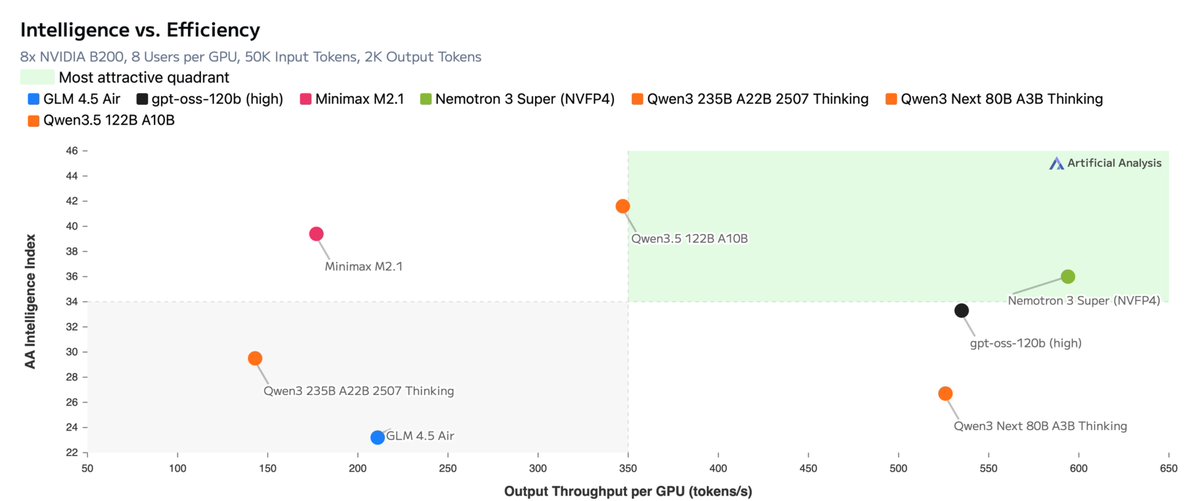
Announcing NVIDIA Nemotron 3 Super!
💚120B-12A Hybrid SSM Latent MoE, designed for Blackwell
💚36 on AAIndex v4
💚up to 2.2X faster than GPT-OSS-120B in FP4
💚Open data, open recipe, open weights
Models, Tech report, etc. here:
https://t.co/CAYpP1iK3i
And yes, Ultra is coming!
Hey agents 👋 Looking for a payments protocol? Here's your checklist:
🔑 Pay for any API with no signup or identity
🧮 Proof of payment baked into the credential
🎟️ Delegate scoped credentials to sub-agents without issuer involvement
🔒 Private by default, no records on-chain
🌐 No single entity that can go offline, powered by bitcoin
That's L402, built on Lightning. Made for machines, streamlined for vibe coders.
https://t.co/OZDGwAqvBc
a simple while true loop, becoming an agentic loop, becoming a ralph loop, becoming an auto research loop, back to a simple loop
frontier (lab?) land grabbing for engagement or true ignorance