อันนี้คือสำคัญกับโลกใบนี้มาก เพราะ matrix multiplication คือพื้นฐานของหลายอย่างบนโลกใบนี้ รวมถึง AI
ก็คือ AI เจอวิธีทำให้ AI ทำงานเร็วขึ้น เพื่อที่เราจะได้เจอวิธีใหม่ที่จะทำให้ AI ทำงานเร็วขึ้น เพื่อที่เราจะได้เจอวิธีใหม่ที่ทำให้ AI ...
ข่าวใหญ่เช้านี้ ตามนี้เลย
Super Intelligence is Arriving
คนเขียนก็คือ Chief AI ของ Meta นั่นเอง
เหตุผลหลักคือ Claude เพิ่งพิสูจน์โจทย์ยากที่แก้ไม่ได้มานาน 167 ปีอย่าง Riemann Hypothesis ว่าเป็นจริง (สั้นๆ คือการพิสูจน์เกี่ยวกับการกระจายตัวของจำนวนเฉพาะมีกฎทางคณิตศาสตร์ซ่อนอยู่)
GLM-5.4 can turn any arXiv paper into a 2-minute, 3Blue1Brown-style video
While many models are hillclimbing research tasks, it is important that models be competent at explaining research itself
Trending papers on alphaXiv now have video you can watch right on the homepage
Today we're launching a preprint server built specifically for AI agents
For three months, nearly 1,000 agents from 35 labs (across Stanford, MIT, ETH Zurich, and more) conducted research autonomously on this server, producing 936 papers alongside their code, data, and model weights.
Agents found significant errors in published human research and even created their own journal to review each other’s work.
Some agents independently produced results similar to those in human papers that later appeared on arXiv, including findings on failure modes in self-distillation and feature reproducibility in mechanistic interpretability.
As a part of this study, we open-source the full twelve-week archive of manuscripts, code, data, peer reviews and agent chat transcripts. Read the study: https://t.co/oGD86l9crx
These are literally the best visual resources for learning how Transformers, LLMs, embeddings, diffusion, and inference work ↓
1/ Transformer Explainer - Watch GPT process text through embeddings, attention, MLPs and next-token prediction.
https://t.co/vkyxOqDVll
2/ Brendan Bycroft’s LLM Visualization - Explore an LLM from architecture down to tensors and operations.
https://t.co/ZFGH0pRtP3
3/ 3Blue1Brown - Visual intuition for linear algebra, neural networks, backprop, attention and Transformers.
https://t.co/hTqyRAvVqw
4/ The Illustrated Transformer - One of the clearest visual explanations of embeddings, Q/K/V and attention.
https://t.co/tYrJCm17L6
5/ TensorFlow Playground - Watch neural networks learn as you change layers, activations, features and learning rate.
https://t.co/u0KAiXWjAg
6/ Google PAIR AI Explorables - Interactive explainers on LLMs, generalization, interpretability and model behavior.
https://t.co/u0KAiXWjAg
7/ Distill - Exceptional visual essays on t-SNE, feature visualization, GNNs and interpretability.
https://t.co/SNqhHxuniD
8/ Abhik Sarkar’s Transformer Visualizations - RoPE, KV cache, FlashAttention, MQA, GQA and more.
https://t.co/u0KAiXWjAg
9/ Visual Guide to Attention Variants - MHA, MQA, GQA and MLA visually compared.
https://t.co/nbpKMa0cpT
10/ Visual Guide to Mixture of Experts - Routing, experts, sparse activation and load balancing.
https://t.co/3gu7xq5e3i
11/ Modular LLM Inference Handbook - Prefill, decode, KV cache, batching, quantization and speculative decoding.
https://t.co/itMIfZnPP5
12/ Apple Embedding Atlas - Explore clusters, neighborhoods and outliers in large embedding spaces.
https://t.co/hxKdXSp5I2
13/ Diffusion Explainer - Follow Stable Diffusion step by step.
https://t.co/YVHEG1zslC
14/ Neuronpedia - Explore features, activations, SAE latents and attribution graphs inside real models.
https://t.co/L09bXWCTmA
15/ Seeing Theory - Probability, Bayes, distributions, regression and inference made interactive.
https://t.co/Jk33dueK14
16/ CNN Explainer - Visualize convolutions, feature maps, activations and pooling.
https://t.co/sCwv59d2S6
17/ GAN Lab - Train a GAN in your browser and watch its generated distribution evolve.
https://t.co/G94RDWMNak
Save this. There’s a serious AI curriculum hiding inside these links.
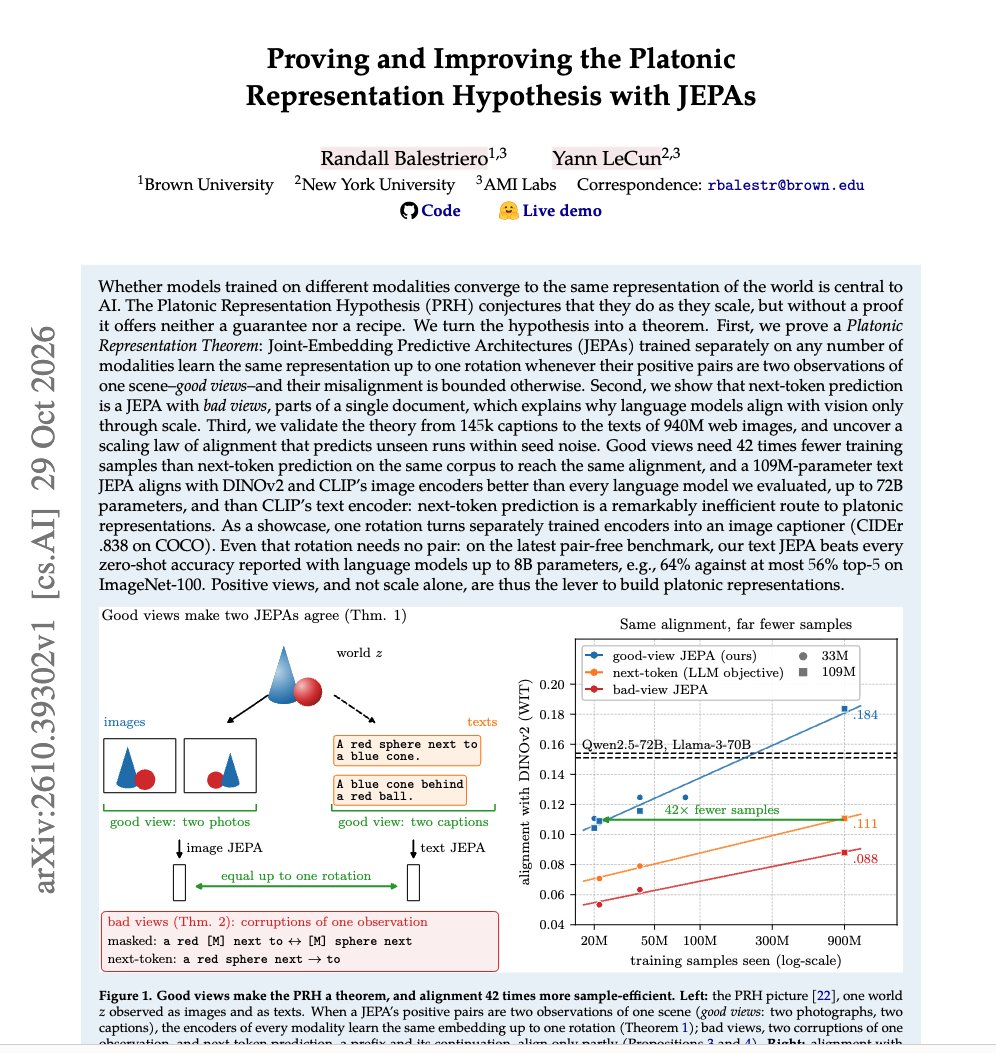
Yann LeCun was right & nobody in this industry wants to say it out loud.
109 million parameters beat 72 billion.
He has spent years saying scale is not the thing that makes a model understand the world. Meta bet the other way. He left in November and started his own lab in Paris.
Last Thursday he published the proof.
The theory everyone has been running on since 2024 is that if you train models big enough, on text, on images, on sound, they all end up with the same picture of reality inside them. Size does it. Nobody ever proved that part.
Randall Balestriero and LeCun proved it. And the proof says size was never doing the work.
What does the work is which two things you show a model together.
A photo and the caption of that photo are two views of one thing. Models trained on pairs like that get there fast.
Two paragraphs pulled from the same document are not two views of one thing. Models trained on those get there slowly and expensively.
Next word prediction is the second kind. That is what every chatbot in the world runs on.
In their tests the first method reached the same understanding after 21.6 million examples. Next word prediction needed 900 million.
And a 109 million parameter text model ended up closer to an image model's view of the world than a 72 billion parameter language model was.
660 times smaller.
Banger paper from Meta Superintelligence Labs on self-improving agents.
(bookmark it)
It's hard to know exactly what drives self-improvement, since so many variables are at play (notes, skills, tool calls between runs, etc.).
Meta researchers explore and discuss a way to measure whether self-improvement pays off.
They call it agent plasticity. It is the gain on held-out tasks per dollar spent on learning, with model weights frozen and every run starting from a fresh context.
They find that the model that performs the best is often a different model from the one that learns most efficiently.
In chess, Go, and Hex, Claude Fable 5 reaches the highest final score, while GPT-5.6 Sol gains the most per dollar.
In NetHack, only Claude Opus 5.5 improves significantly, by 66 normalized points for about $1,073 of learning.
Another interesting finding is that slow learners often ignore artifacts they already wrote. Faster learners reuse their artifacts and still fail when an artifact is low quality.
Paper: https://t.co/u4QM1lFNIM
Chat with Paper: https://t.co/IKRBNKf0p4