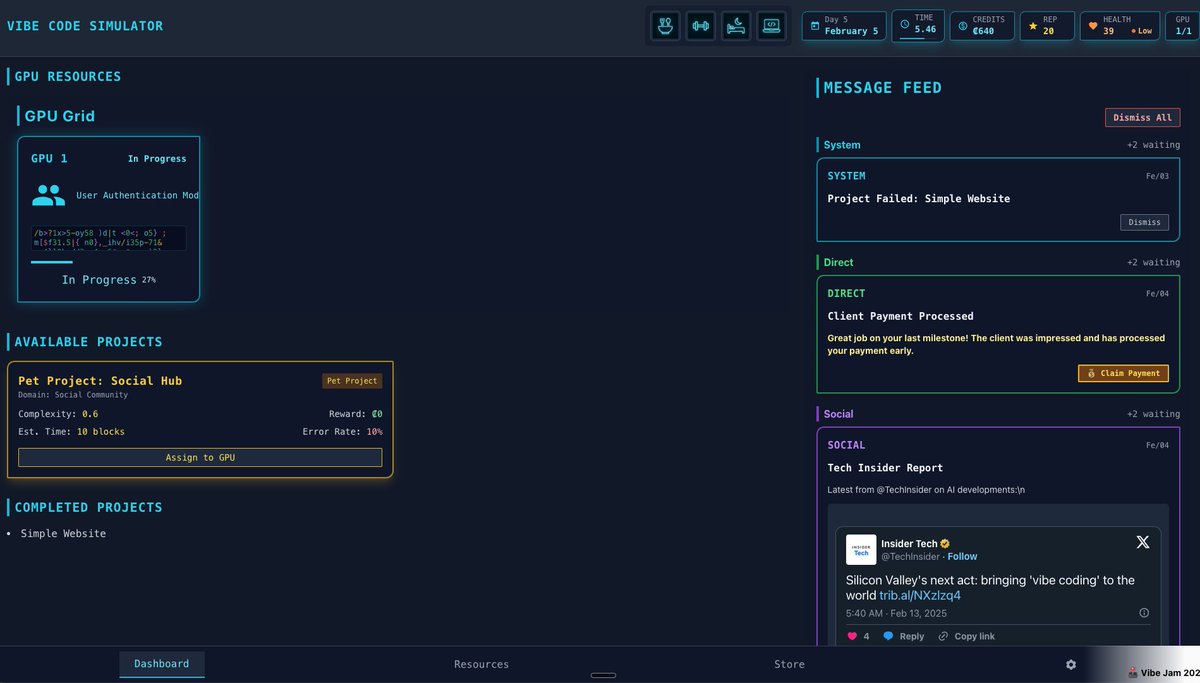
Just submitted my entry to #vibejam! 🚀
Can you vibe your way through the hype, hustle, and AI-fueled chaos? Check out Vibe Code Simulator: https://t.co/0VGoWsLfUt
Had a blast riding this wave—thanks to @levelsio for the #VibeCoding inspiration!
Just 30 minutes left and the #vibejam passed 1,000+ games!
Can't believe so many people vibe coded a game
You're all crazy awesome :D
💖
You've all helped create a beautiful little creative moment in time!
Free to play, ~25 min per run. Some bugs — what else would you expect from vibe coding?
Feedback form built in. Tell me what's broken or confusing.
https://t.co/DBsjI98GjZ
One year ago, Karpathy coined "vibe coding."
I made an idle clicker about the experience — shipping projects, accumulating slop, watching your codebase slowly collapse.
The twist: the game itself is entirely vibe-coded. Built in spurts over the past year, each time a new model dropped.
Alpha is live. Playtesters wanted.
There's a new kind of coding I call "vibe coding", where you fully give in to the vibes, embrace exponentials, and forget that the code even exists. It's possible because the LLMs (e.g. Cursor Composer w Sonnet) are getting too good. Also I just talk to Composer with SuperWhisper so I barely even touch the keyboard. I ask for the dumbest things like "decrease the padding on the sidebar by half" because I'm too lazy to find it. I "Accept All" always, I don't read the diffs anymore. When I get error messages I just copy paste them in with no comment, usually that fixes it. The code grows beyond my usual comprehension, I'd have to really read through it for a while. Sometimes the LLMs can't fix a bug so I just work around it or ask for random changes until it goes away. It's not too bad for throwaway weekend projects, but still quite amusing. I'm building a project or webapp, but it's not really coding - I just see stuff, say stuff, run stuff, and copy paste stuff, and it mostly works.
Unacceptable. @NYCMayor Adams is stalling yet another transportation project:
"Even after a successful round of outreach that saw every single elected official and all three community boards in the neighborhood support the proposal, the whole thing is now in limbo."
I’ve been using a similar AI pair programming approach:
1.Use o3 to sketch out the project goals.
2.Feed that into Gemini 2.5 Pro to generate a phased implementation plan—each phase scoped to fit into a single chat session in Cursor.
3.I tell Gemini I’m using Cursor with various LLMs as execution agents, and ask it to generate CursorRules and the first execution prompt.
I paste that prompt into Cursor and start the phase using Gemini 2.5 or Claude Opus 4.
Here’s the key loop:
After every Cursor reply, I paste the full output back into the original Gemini planning session and ask:
•Does this complete the phase?
•If not, what’s left?
•What should the next prompt be?
This feedback loop keeps the planning agent aware of progress. At critical junctures, I use it to evaluate whether to stay on plan or pivot.
Over time, I also rely on Gemini to help decide:
•Which files should be added to prompt context?
•Whether CursorRules should be updated?
•Whether to inspect or revise any specific files?
By consistently reporting execution output back to the planning agent, I’ve kept coherent memory and context across 600–700k tokens with Gemini 2.5—without losing the thread.
I’ve been using a similar AI pair programming approach:
1.Use o3 to sketch out the project goals.
2.Feed that into Gemini 2.5 Pro to generate a phased implementation plan—each phase scoped to fit into a single chat session in Cursor.
3.I tell Gemini I’m using Cursor with various LLMs as execution agents, and ask it to generate CursorRules and the first execution prompt.
I paste that prompt into Cursor and start the phase using Gemini 2.5 or Claude Opus 4.
Here’s the key loop:
After every Cursor reply, I paste the full output back into the original Gemini planning session and ask:
•Does this complete the phase?
•If not, what’s left?
•What should the next prompt be?
This feedback loop keeps the planning agent aware of progress. At critical junctures, I use it to evaluate whether to stay on plan or pivot.
Over time, I also rely on Gemini to help decide:
•Which files should be added to prompt context?
•Whether CursorRules should be updated?
•Whether to inspect or revise any specific files?
By consistently reporting execution output back to the planning agent, I’ve kept coherent memory and context across 600–700k tokens with Gemini 2.5—without losing the thread.
@steipete When people ask me about prompt engineering I say the most important thing is to be very clear about what you are asking for. Everything else is a tactic towards this strategy.
At a time when people are understandably focused on the daily chaos in Washington, these articles describe the rapidly accelerating impact that AI is going to have on jobs, the economy, and how we live. https://t.co/RSbMkhz3Xm
The CEO of Anthropic (a powerful AI company) predicts that AI could wipe out HALF of entry-level white collar jobs in the next 5 years.
We must demand that increased worker productivity from AI benefits working people, not just wealthy stockholders on Wall St. AI IS A BIG DEAL.
I used this n8n workflow to scrape X for top-performing posts in my niche (it's a big part of how I went from 600 → 6k followers in 13 days)
most creators scroll for hours to find content ideas that work...
whereas I just run this flow and get a full swipe file in minutes - organized by likes, comments, shares and URLs.
here’s what it does:
- drop in a keyword
- scrapes X for top posts
- pulls engagement data + content
- auto-sorts it all into a Google Sheet
now you've got data-backed insights ready to plug into your tweets, ads, or even video scripts.
workflow takes 5 minutes to set up
want the full JSON?
comment “SWIPE”, follow, + repost and I’ll send it over (must be following so I can DM)
Prompting can be weird... this was in fact a good plan.
"I think that I really need to create a README file. I'm wondering if it makes sense to ask you right now to give me a handoff script to kind of summarize all your understanding of this project, and then for me to give that handoff script along with the current full data repo to a new Gemini 2.5 planning instance, and have that new chat instance create a prompt for Cursor to create the README file. Does that plan also make sense?"
@tristanbob@cursor_ai I recently saw Claude Opus 4 in Cursor do the same thing! Impressive, but the usage cost is high for this right now so I make sure to use Opus sparingly.
At a time when people are understandably focused on the daily chaos in Washington, these articles describe the rapidly accelerating impact that AI is going to have on jobs, the economy, and how we live. https://t.co/RSbMkhz3Xm
My current vibe-coding workflow:
Use a planning AI (usually o3) to draft a PRD.
Have an implementation AI (usually Gemini 2.5) chunk it into phased plans.
Implementation AI creates specific prompts, which I then run in Cursor with Gemini 2.5 or Claude 3.5.