İnanması zor ama: Linus Torvalds, 21 yaşında Linux’u yaptı.
Claude yoktu!
ChatGPT yoktu!
AI yoktu!
→ Kurucu ortağı yoktu
→ VC yatırımı yoktu
→ Ofis yoktu
→ Takım yoktu
→ Sadece kişisel bir projeydi
1991’de Usenet’te şöyle yazdı:
“I’m doing a (free) operating system (just a hobby, won’t be big and professional like gnu) for 386(486) AT clones.”
34 yıl sonra:
→ Dünya sunucularının %96’sında çalışıyor
→ Tüm Android telefonların temelinde var
→ Uluslararası Uzay İstasyonu’nda kullanılıyor
→ AWS, GCP, Azure gibi bulutların çoğunu çalıştırıyor
→ Büyük borsaların altyapısında yer alıyor
→ Ve internetin omurgasını oluşturuyor
Tarihin en önemli yazılımlarından biri, birinin yan projesiydi.
Düşündürücü 🤔
The Brutal Math Behind $18B Cardano ADA
Is Cardano (ADA) about to pull off a massive comeback and reclaim its spot in the top 10 cryptos by the end of 2026 or is it officially getting left behind? In this video, we break down the brutal math required for Cardano to hit an $18 Billion market cap, flip Dogecoin, and dominate the altcoin market.
We analyze Cardano’s latest base-layer scaling upgrades including Ouroboros Leios (boosting base TPS to over 1,000) and Hydra (handling 100,000 TPS off-chain) plus the upcoming SEC spot ETF decision window in late October following the 6-month track record of CME Cardano futures.
🎯 Key Topics Covered in This Video:
• Cardano ADA price analysis and 2026 price predictions.
• How Ouroboros Leios continuous parallel streaming solves blockchain scaling.
• The late October SEC decision window and Grayscale Spot ADA ETF possibilities.
• Cardano non-custodial staking dynamics vs inflating meme coins like Dogecoin.
• Macro market perspective: Bitcoin ATH timing and altcoin rally expectations.
Timestamps
00:00 - The Brutal Math Behind Cardano Re-Entering Top 10
01:09 - Cardano vs Dogecoin: The $18B Market Cap Gap
01:41 - Ouroboros Leios & Hydra: Scaling ADA to 100k TPS
03:53 - CME Cardano Futures & The SEC Spot ETF Catalyst
05:56 - Cardano ADA Price Predictions: Bull, Base & Bear Scenarios
08:53 - $120M ADA Ecosystem Fund & Treasury Strength
10:39 - Can Dogecoin Maintain Its Top 10 Spot Against Cardano?
15:41 - Why Cardano Uptime & Deterministic Fees Beat Solana
Novak Djokovic in his documentary on why he refused the COVID vaccine:
"Because I didn't need it. Why should I get the vaccine? I'm healthy, I'm an athlete. I had corona. I had immunity. I wasn't a threat to anyone. There was no reason for me to get vaccinated. It's my freedom to choose which that fundamental right that you have as a human being on this planet — the freedom to choose — which was taken from a lot of people."
Hi everyone!! Our first public (beta) release of cardano-init is out! 🥳🎉
This tool creates new projects ready to go; it encodes how Cardano tools fit together, analyzes and helps you set up the environment, and more! We're making it easy to build new Cardano DApps for newcomers and LLM agents alike! 🤖
This is an early beta release; we haven’t integrated all the tools, we can still make a lot of changes, and we have many improvements in the pipeline! Be sure to check out our plan/roadmap (in the repo) and share your thoughts! 💪😄
Check it out here: https://t.co/MaOxtFg7BF
Sir Alex Ferguson on Lionel Messi’s performances at the 2026 FIFA World Cup.
🗣️ “I’ve spent my entire life watching football. I’ve managed against the greatest players, coached some of the best and witnessed generations of talent. But what Lionel Messi is doing at 39 years old is beyond anything I’ve ever seen.”
“Most players at that age are long retired or struggling to keep up with the pace of the modern game. Messi? He’s carrying Argentina to another World Cup final. He isn’t surviving he’s dominating. That’s the difference.”
“People keep asking how he’s still doing it. The answer is simple: his football brain is decades ahead of everyone else. He doesn’t need to outrun you anymore because he’s already seen the next three passes before you’ve taken your first step.”
“Look at this tournament. Every time Argentina needed someone to stand up, Messi answered. When they were under pressure, he demanded the ball. When England thought they had one foot in the final, Messi completely changed the game with two outrageous assists. That’s what greatness looks like.”
“You can organise your defence perfectly, assign two or three players to mark him and spend months analysing every movement he makes. None of it guarantees anything because he only needs one second to destroy ninety minutes of hard work.”
“What amazes me most isn’t the ability it’s the mentality. The bigger the occasion, the calmer he becomes. While everyone else feels the weight of a World Cup, Messi plays as if he was born for these moments. That’s why he keeps breaking hearts and making history.”
“I’ll say something that some people won’t like, but I don’t care. We will never see another footballer like Lionel Messi. When he retires, an era of football retires with him. Players will win Ballons d’Or, score hundreds of goals and lift trophies, but nobody will combine genius, consistency, longevity and humility the way he has.”
“Enjoy every minute he’s still on the pitch, because when Lionel Messi walks away from football, the game will lose a little piece of its soul. There will be great players after him but there will never be another Lionel Messi.
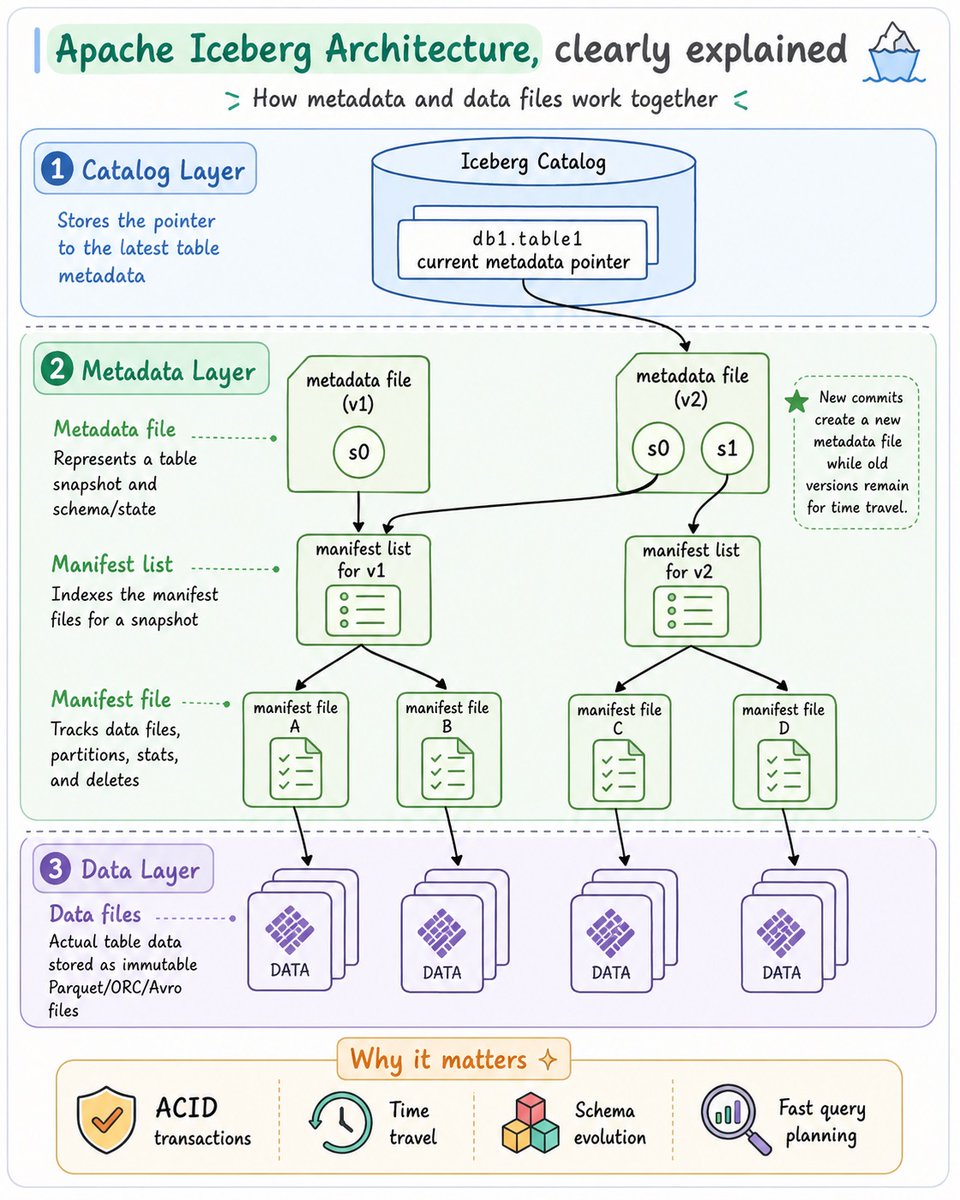
Apache Iceberg for Data Engineering (Quick Guide 📝)
Before understanding Icebergs understand why we even need it.
I don't want to go into detail because I'll create a video about it but here's a quick summary
>> We can use Data Warehouse -> It needs structuring before loading
>> We can use Data Lake -> Does not have ACID Transaction, Time Travel, and ease of managing data
We need something that has both capabilities like Databases (ACID, etc...) and flexibility like DataLake
😎 Enters Open Table Format, now there are many of them like Apache Iceberg, Delta Lake, Hudi
🥶Let's explore one: Apache Iceberg🥶
Think of it as a layer between the storage system and the query engine
Iceberg is not a storage system or database; it’s a table format that sits on top of existing storage systems like S3, HDFS, or ADLS.
It brings structure and reliability to data lakes, which often struggle with issues like slow queries, inconsistent data, and poor performance.
What does it provide?
✅ Schema Evolution: Easily add, update, or delete columns without breaking existing queries.
Time Travel:
✅ Query data as it existed at a specific point in time (e.g., "What did this table look like yesterday?").
✅ Partitioning and Hidden Partitioning: Users don’t need to worry about partition details; Iceberg handles it under the hood.
✅ ACID Transactions: Ensures data consistency with atomic commits, preventing partial or corrupted writes.
✅ Efficient Metadata: Uses a layered metadata system (file, snapshot, and manifest levels) to speed up queries.
=========Let's Quickly Understand Architecture =========
💾 Data Files: The actual data stored in files (e.g., Parquet, Avro, ORC).
🗺️ Metadata Layers
Iceberg uses a multi-level metadata system to keep track of data and make queries faster. Think of it as a "map" that helps you find the data you need without scanning everything.
1. Metadata File: A JSON file that stores high-level information about the table, like its schema, partition details, and snapshots.
2. Manifest List: A file that lists all the manifests for a specific table snapshot (A snapshot is a table version at a specific point in time.)
3. Manifest File: A file that lists data files and their metadata (e.g., file path, partition info, statistics like min/max values).
🐈 Iceberg Catalog: A central registry (like Hive Metastore, AWS Glue, etc.) that knows about all your tables.
There is more to it, Going to publish a video on this soon on my YouTube
DBT(databuildtool) Quick Guide 🧑🏻💻
SQL without version control.
SQL without tests.
SQL without documentation.
That's how most data engineers still write SQL in 2026.
dbt fixes all three.
Here's the Quick Guide 📝
🟦 𝗪𝗵𝗮𝘁 𝗶𝘀 𝗱𝗯𝘁?
dbt = SQL + software engineering practices.
→ SQL transformations as version-controlled code
→ Tests on data quality (uniqueness, freshness, custom)
→ Auto-generated documentation
→ Lineage tracking across your pipeline
→ Compiles to native warehouse SQL (Snowflake / BigQuery / Databricks)
Right? Let me explain why this matters.
📦 𝟭. 𝗧𝗵𝗲 𝗽𝗿𝗼𝗯𝗹𝗲𝗺 𝗶𝘁 𝘀𝗼𝗹𝘃𝗲𝘀
Without dbt:
→ SQL lives in random notebooks
→ Nobody knows which version is "right"
→ Data quality issues are found in the dashboard, not the pipeline
→ Documentation is in someone's head
→ A column change breaks 5 dashboards with no warning
With dbt:
→ SQL in Git, versioned, peer-reviewed
→ Tests catch issues in CI/CD, not production
→ Lineage shows what depends on what
→ Docs are generated from code — never out of date
🛢️ 𝟮. 𝗖𝗼𝗿𝗲 𝗰𝗼𝗻𝗰𝗲𝗽𝘁𝘀
→ Models — SQL queries materialized as tables/views
→ Sources — raw data your models build on
→ Tests — assertions on data
→ Macros — reusable SQL snippets
→ Snapshots — SCD Type 2 done elegantly
→ Seeds — small static reference tables
⚡ 𝟯. 𝗪𝗵𝘆 𝗶𝘁'𝘀 𝘄𝗶𝗻𝗻𝗶𝗻𝗴 𝗶𝗻 𝟮𝟬𝟮𝟲
dbt shows up in 7 of 10 Data Engineer job postings.
Senior DEs use it daily.
Companies are migrating from custom Spark transforms to dbt.
In simple words: "I know dbt" in 2026 is what "I know SQL" used to mean.
🔧 𝟰. 𝗛𝗼𝘄 𝘁𝗼 𝗴𝗲𝘁 𝘀𝘁𝗮𝗿𝘁𝗲𝗱
→ Install dbt-core (it's free)
→ Connect to your warehouse
→ Convert ONE existing SQL query into a dbt model
→ Add a uniqueness test on the primary key
→ Run dbt build, see it pass
That's it. You're a dbt user.