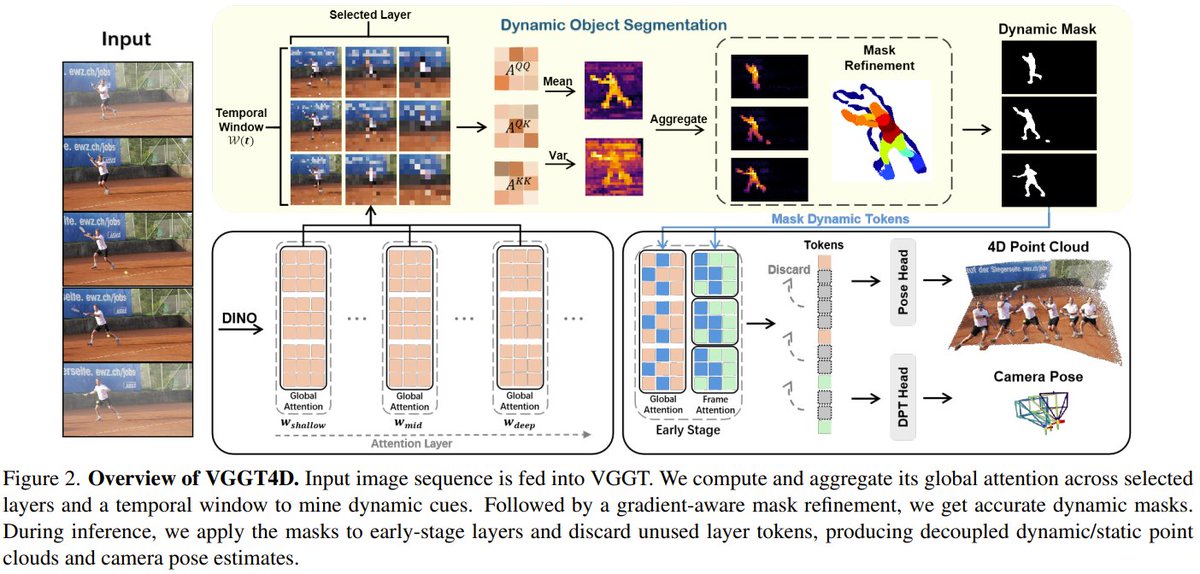
How do you reconstruct a 4D world from video when everything is moving? Researchers from HKUST & Horizon Robotics have a new, training-free answer.
They built VGGT4D. It cleverly mines the "motion cues" already hidden inside a powerful 3D AI model (VGGT), using them to automatically separate dynamic objects from the static scene.
The result? It outperforms existing methods in dynamic object segmentation, camera tracking, and 3D reconstruction across six benchmarks—and can process over 500 frames in a single pass.
VGGT4D: Mining Motion Cues in Visual Geometry Transformers for 4D Scene Reconstruction
Paper: https://t.co/X2X3iuvzSa
Project: https://t.co/MFubWYisGs
Code: https://t.co/78G9JVEukI
Our report: https://t.co/022t7oGI6G
📬 #PapersAccepted by Jiqizhixin
🎬 Introducing: Character Mixing for Video Generation
Imagine Mr. Bean stepping into Tom & Jerry's world 🐭✨ Now it's possible! ✨
Our framework first enables natural cross-character interactions in text-to-video generation while preserving identity and style fidelity.
It's not just you -- we're seeing a nationwide uptick in text message based scams where they claim you have an "unpaid toll" & "click or reply here to resolve".
If you receive this text message, do not reply, click, give them your information or pay.
Report and delete as spam.
What enables a strong model to surpass its weaker teacher?
🚀 Excited to share our ICLR 2025 paper: "Weak-to-Strong Generalization Through the Data-Centric Lens"! 🧵
We're ecstatic to bring you "How Transformer LLMs Work" -- a free course with ~90 minutes of video, code, and crisp visuals and animations that explain the modern Transformer architecture, tokenizers, embeddings, and mixture-of-expert models.
@MaartenGr and I have developed a lot of the visual language over the last several years (tens of thousands of iterations for hundreds of figures) for the book. But to have an opportunity to collaborate with the legendary @AndrewYNg, we took them to the next level with animations and a concise narrative meant to enable technical learners to pick up an ML paper and understand the architecture description.
Link in comments
Excited to share our work MatchAnything:
We pre-train strong universal image matching models that exhibit remarkable generalizability on unseen multi-modality matching and registration tasks.
Project page: https://t.co/o5GisUJ7RT
Huggingface Demo: https://t.co/qbz33QBulI
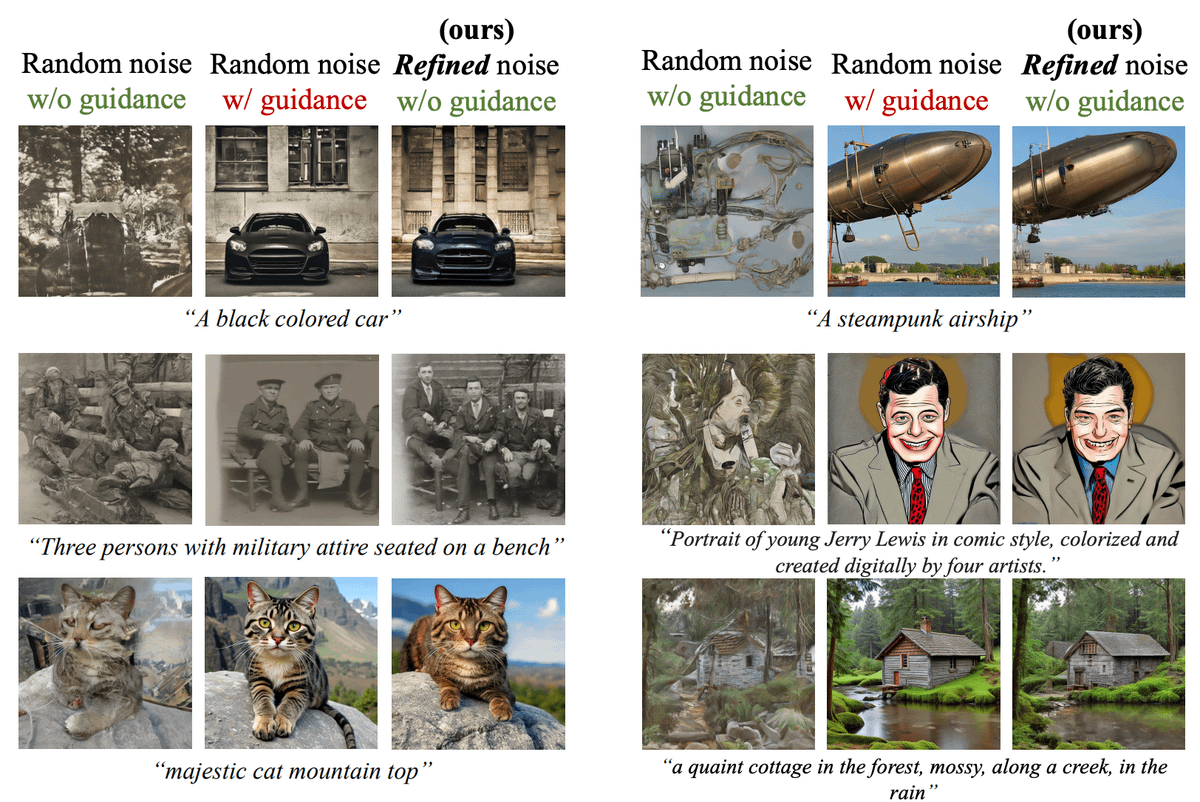
Can we start with a better noise to guide the denoising process in diffusion models & possibly eliminate guidance as we go? 🚀
Our latest work, NoiseRefine, investigates this phenomenon & presents exciting results.
NoiseRefine is comparable to CFG while significantly improving throughput & memory ⚡️
Our code is soon going to be open-sourced, and we will continue to iterate on it for modern models like SD3.5 and Flux. And we want to do it together with the community!
🧵
🎉 I just wrapped up teaching the Introduction to GIS Programming course this semester at the University of Tennessee! All course materials and lecture recordings (26 hours) are freely available online.
Explore the links below to dive into #geospatial 🌍 data visualization and analysis using #opensource Python packages:
🌐 Course Website: https://t.co/2dK3d0nHH7
📂 GitHub Repository: https://t.co/yBth77qzfa
📺 YouTube Playlist: https://t.co/9sbsl5TfCS
Join me in exploring the world of geospatial analysis with #python and #jupyter!
I know no sensible person will believe what is contained in the outrageous tweet below but in these troubled times it is important to underscore that the statement is false. Again I enjoin all those seeking to misuse my name to desist!
T-RO is accepting submissions for the Visual #SLAM special collection until December 15. Thank you to @jcivera, @giov_cioffi, @davsca1, @StefanLeuteneg1, Abhinav Valada, Teresa Vidal-Calleja, and @ghuangud for handling this special collection.
https://t.co/NF17JV7uOU
#IEEERAS
🚀 New Workshop Recording Alert! 🚀
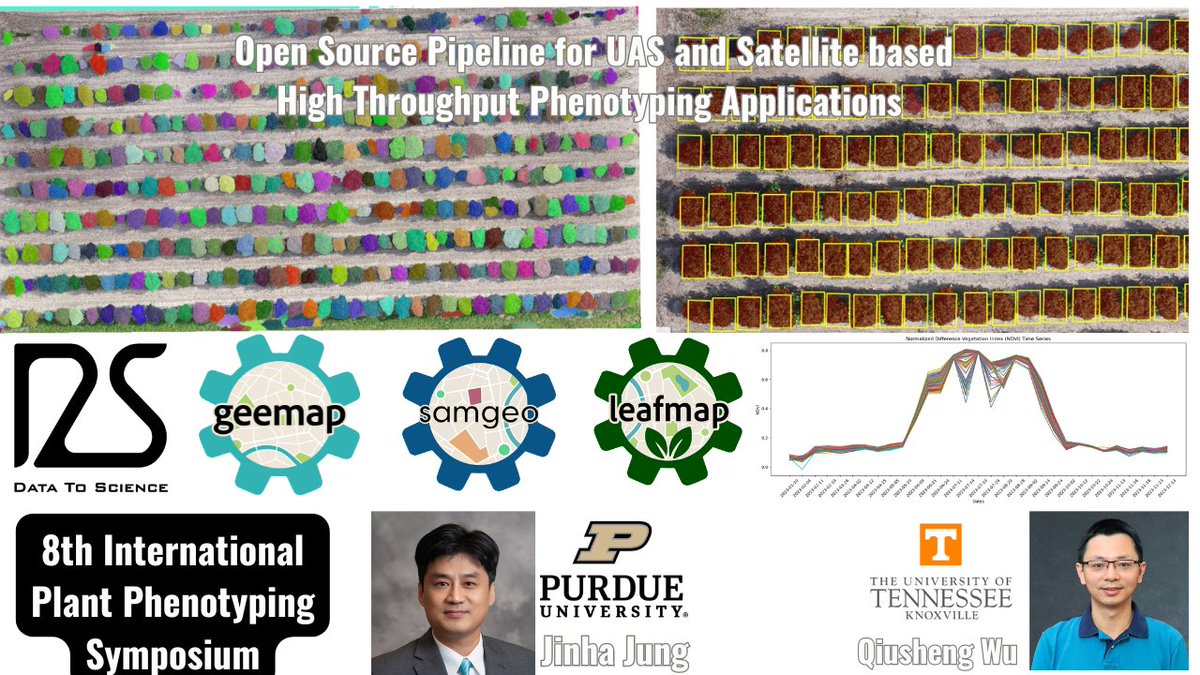
Catch Part 2 of our workshop at the 8th International Plant Phenotyping Symposium (IPPS) in Lincoln, Nebraska! 🌱✨
Title: Open-Source Pipeline for UAS & Satellite-Based High-Throughput Phenotyping Applications
Presenters: Dr. Jinha Jung (Purdue University) & Dr. Qiusheng Wu (University of Tennessee)
🎥 Videos:
📹 Part 1: https://t.co/kDdHU2q1fk
📹 Part 2: https://t.co/eiwtdy1p42
📚 Workshop Materials:
🌐 D2S: https://t.co/hjJCtz9Sy7
📝 Notebooks:
🔗 Part 1: https://t.co/arxyUNetXG
🔗 Part 2: https://t.co/bUGe7gIdMI
Sign up for free at https://t.co/vLAuhRxTUy to explore, analyze, and visualize drone imagery using the open-source D2S platform!
🚁🌍 #Phenotyping #OpenScience #UAS #RemoteSensing
Your LLM can't understand videos and images? How sad 😔
Luckily we shipped a new task for video language models 🤗
look for video-text-to-text in left tab at @huggingface /models ⏯️
It also comes with docs in transformers and /tasks! 📖
[Please RT📢] SEA Lab (https://t.co/MKGUTnoOXs) is hiring 1 postdoc in Spring/Fall'25 and 1-2 PhD in Fall'25!
We build next-gen #HCI and #HAI techniques for health & medical applications.
Visit JOIN US page for more details. FAQs are highly recommended to read before applying.
Unlike software, hardware design from scratch leads to 10x cost savings! Here’s the overdue open source of our modular (food-safe) conveyor.
Sry heads down building atm so couldn’t polish the git…
https://t.co/sWYRHo7Lwc
First demo of our new aerial Visual-Inertial Positioning System (VIO+VPS): 40m positioning accuracy (CEP) in a 50 kilometer flight using a camera, consumer-grade IMU and a barometer! No GPS
Great work by the @UsePenrose team building Bloom: a lightweight way to make interactive diagrams: https://t.co/He3YRCmbmy
All coordinates are automatically figured out by the Penrose layout engine, and diagram specifications can be re-used for different content (like HTML/CSS).
Introducing GStex: Per-Primitive Texturing of 2D Gaussian Splatting for Decoupled Appearance and Geometry Modeling
The color of a splat is spatially constant, impeding use in modeling. GStex solves this at little to no cost to FPS or PSNR.
Project page: https://t.co/kp6YWU7KLm