@oh_meed To be fair, this is pretty much the first time I've seen this kind of "credit drama," so it might just be me complaining about losing an illusion.
I cried looking at X today.
When a Millennium Problem got solved, I thought there'd be praise for the people who did it. Attempts to understand their work and explain it to the rest of us. Cheering, and that feeling of anticipation, because human knowledge had climbed one more step.
I thought that's what it would be like.
Ten thousand machines, and this ugly fighting. I never even imagined it..
Is this what all that damn "progress" was for? I'm just.. so, so sad.
We’re sharing a solution to the Navier-Stokes Millennium Prize Problem, one of the deepest problems at the frontier of mathematics.
The proof was produced by a group of agents, using an OpenAI next-generation model significantly more capable than GPT-6 Astra.
The problem concerns whether the description of smooth three-dimensional fluid motion modeled by the Navier-Stokes equations can break down. It has remained unresolved for roughly 90 years.
@oh_meed I also always figured AI getting this far was a matter of when, not if. And the problem actually being solved, I saw as a good thing. What let me down was the way "people" acted about it...
whatever happened to openai’s whole “working with academia” thing
if a researcher gets close to a breakthrough and your response is to burn millions in tokens just to beat them to it
how is that helping academia? you’re literally trying to beat them to their own breakthrough.
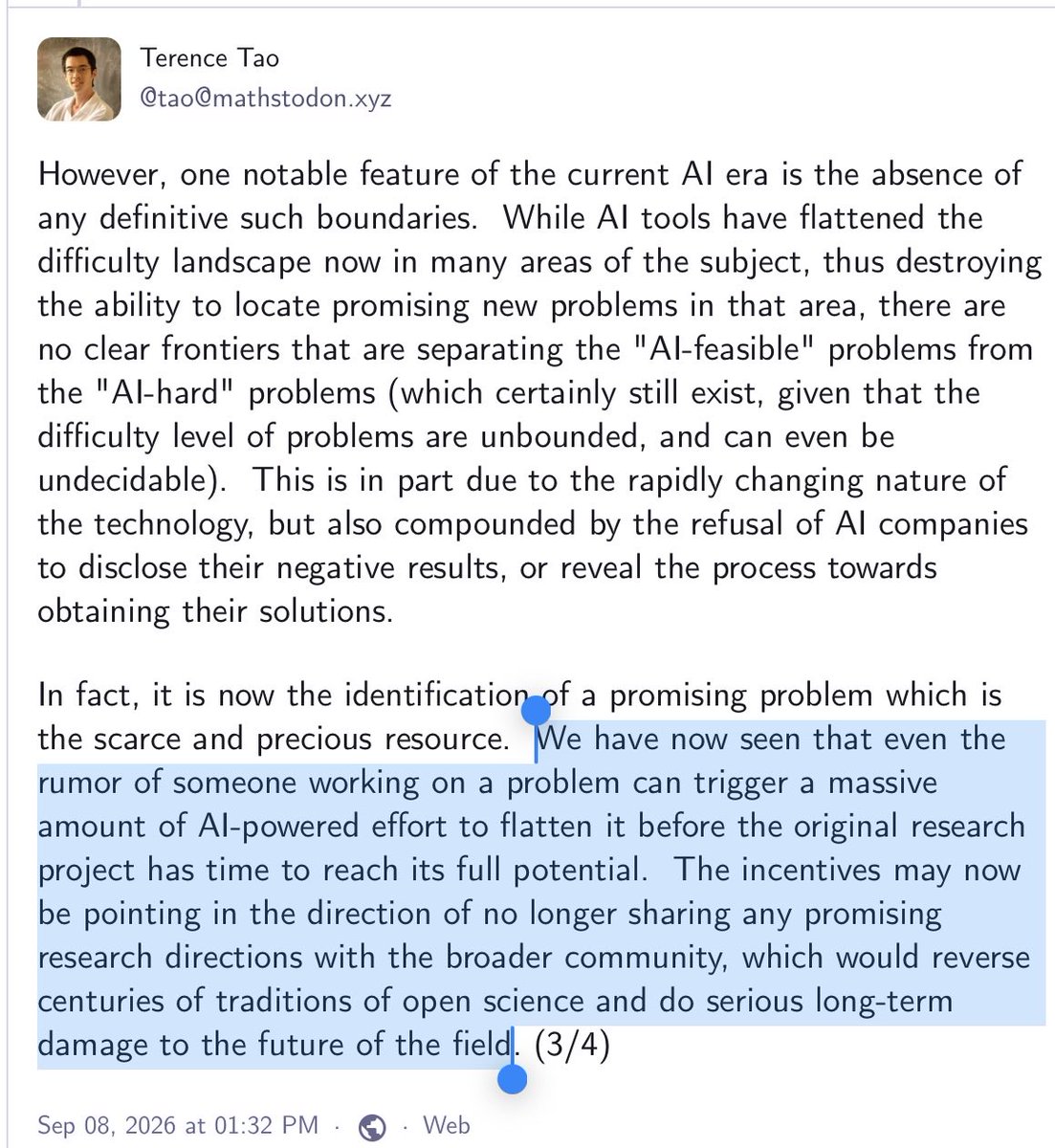
Still more absolute 🔥 from Terence Tao:
“We have now seen that even the rumor of someone working on a problem can trigger a massive amount of AI-powered effort to flatten it before the original research project has time to reach its full potential. The incentives may now be pointing in the direction of no longer sharing any promising research directions with the broader community, which would reverse centuries of traditions of open science and do serious long-term damage to the future of the field”
We’re sharing a solution to the Navier-Stokes Millennium Prize Problem, one of the deepest problems at the frontier of mathematics.
The proof was produced by a group of agents, using an OpenAI next-generation model significantly more capable than GPT-6 Astra.
The problem concerns whether the description of smooth three-dimensional fluid motion modeled by the Navier-Stokes equations can break down. It has remained unresolved for roughly 90 years.
Astra made me realize that for some people, "not AGI" means "not an omnipotent, omniscient, infallible God".
Yeah, it can stall or fail.
What about you, carbonoid?
GPT-6 Astra is here.
We hope it will begin to enable a new generation of entrepreneurship, scientific discovery, and building.
We believe it is the best model in the world for computer use, professional work, science, coding, cybersecurity, and more.
It took us some extra time to ensure that we could meet the safety and alignment standards required for this capability level, but we think you’ll find it worth the wait.
It scores 98% on FrontierMath Tier 4, 99.9% on ARC-AGI 3, and 100% on ExploitBench.
I do not understand how they are verifying these if the proofs are each 100+ pages. They post the result with an implied claim of absolute certainty and then just yeet a proof sketch pdf online after the fact without any comment. Makes me not even want to look at the proofs. OpenAI too
My student told me that he didn’t code during his internship. All the code was written by AI lol.
We are really entering a different era of software engineering.
When I worked at Apple, I remember seeing code that was 15 years old. Every file had a comment at the top with the date and the author’s name. You’d open a file and read through it, sometimes touching a feature no one had touched in a decade.
Everything felt very permanent, like a house made of bricks. Everyone who made a brick put their name on it before slotting it into the house. Even in a massive company, you were proud of your bricks. Each one fit so satisfyingly into the bricks around it.
When someone was renovating a room you had worked on years ago, they’d reach out and say, “I found this brick with your name on it. Can you tell me what it was doing here?”
Sometimes old bricks would get taken out during a renovation, but they were usually kept in a pile in the corner to reuse in the future.
Now you can will whole houses and neighborhoods into existence. You don’t even see the bricks go in. They just tumble in from the sky. You walk into the new house and wave your hands to push walls back, throw up a chimney, or drop in a kitchen.
It's so fucking cool. But you forget what a brick feels like.
And it’s hard to know how sad to be about that. The houses are better, they go up faster, and building them increasingly feels like magic.
Still, every once in a while you miss holding a brick.