Hayli Gubbi volcano in Ethiopia has erupted for the first time in thousands of years🌋
Satellite images from @CopernicusEU Sentinel-5P (left) and @eumetsat's Meteosat-12 (right) captured the ash plume spreading across the region.
Geologists meet
Professionals challenged to embrace technology in harnessing resources
Over 600 delegates attend 30th colloquium of African geologists in Nairobi
#CitizenFridayNight
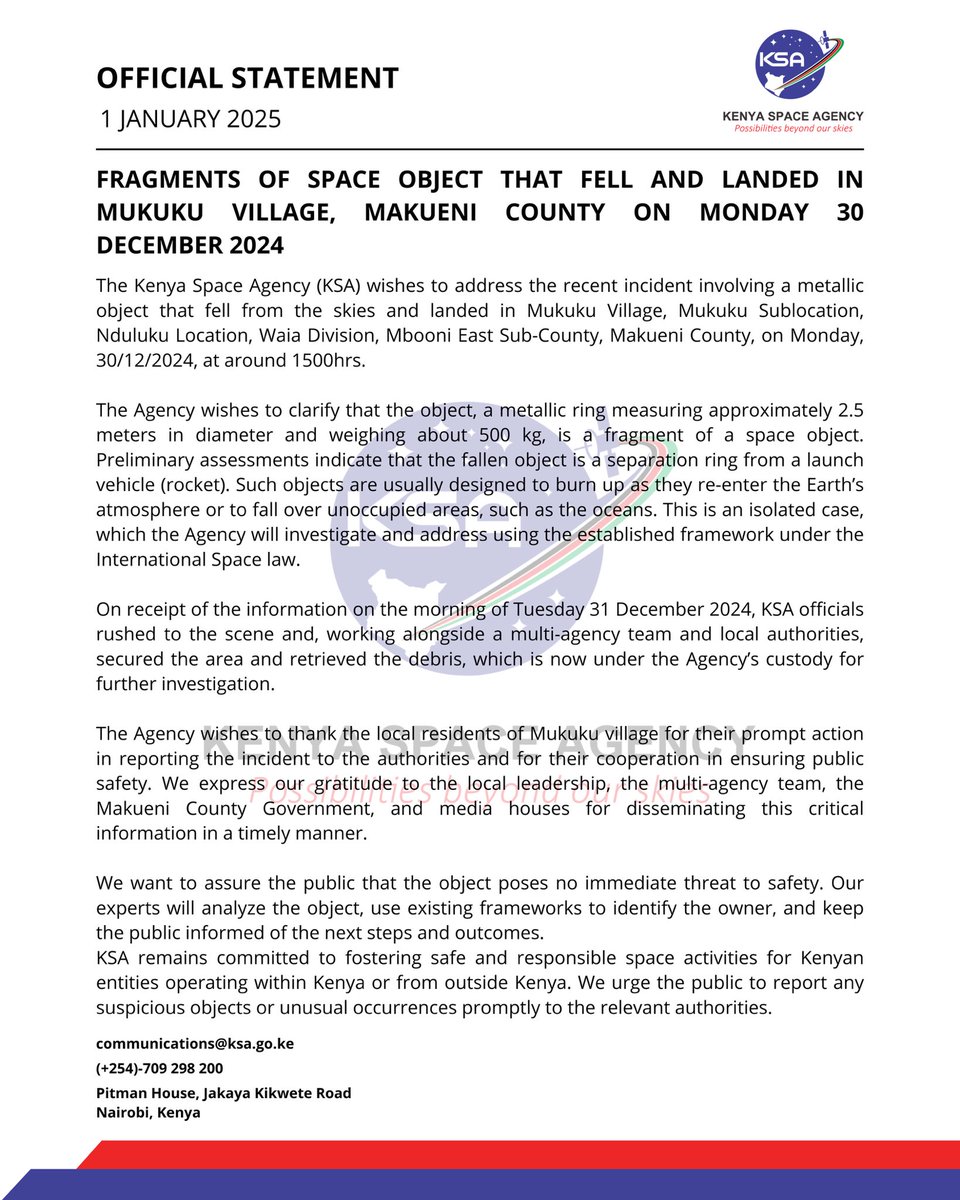
Following the discovery of a metallic fragment of a space object in Mukuku Village, Makueni County, the Kenya Space Agency has issued the following statement. Read more for details on the incident, preliminary findings, and next steps.
Isaac Thande, Regional Manager, Leica Geosystems Eastern Africa, receives a gift hamper on behalf of @LeicaGeosystems during the #RIC2024 . Leica Geosystems Eastern Africa was voted as the best exhibitor during the conference.
"Improving the analysis of harmful algal blooms along the Kenya coast by using machine learning and deep learning techniques for accelerated satellite image processing" was voted as the best poster during #RIC2024 . Poster was done by Sara Opanga, Alphine Musiva and Mercy Ndanu.
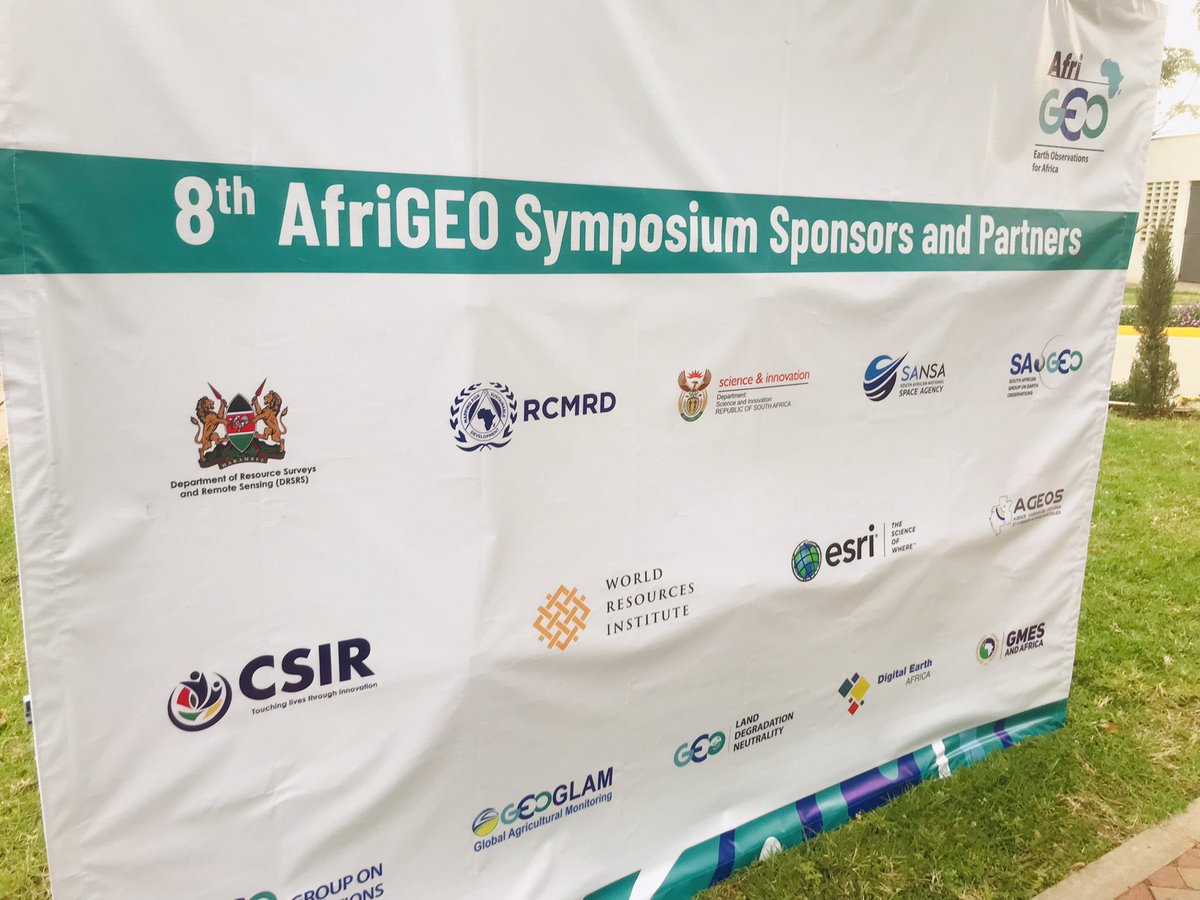
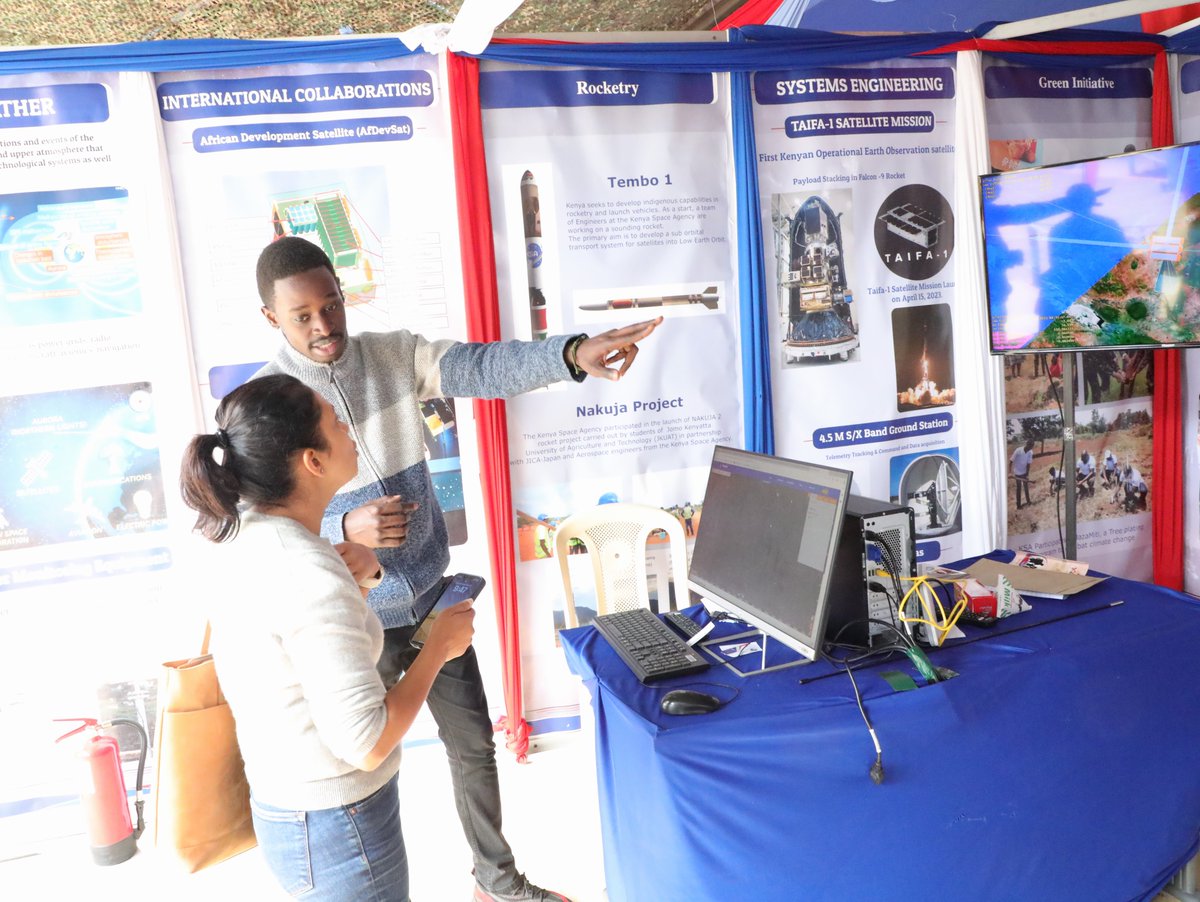
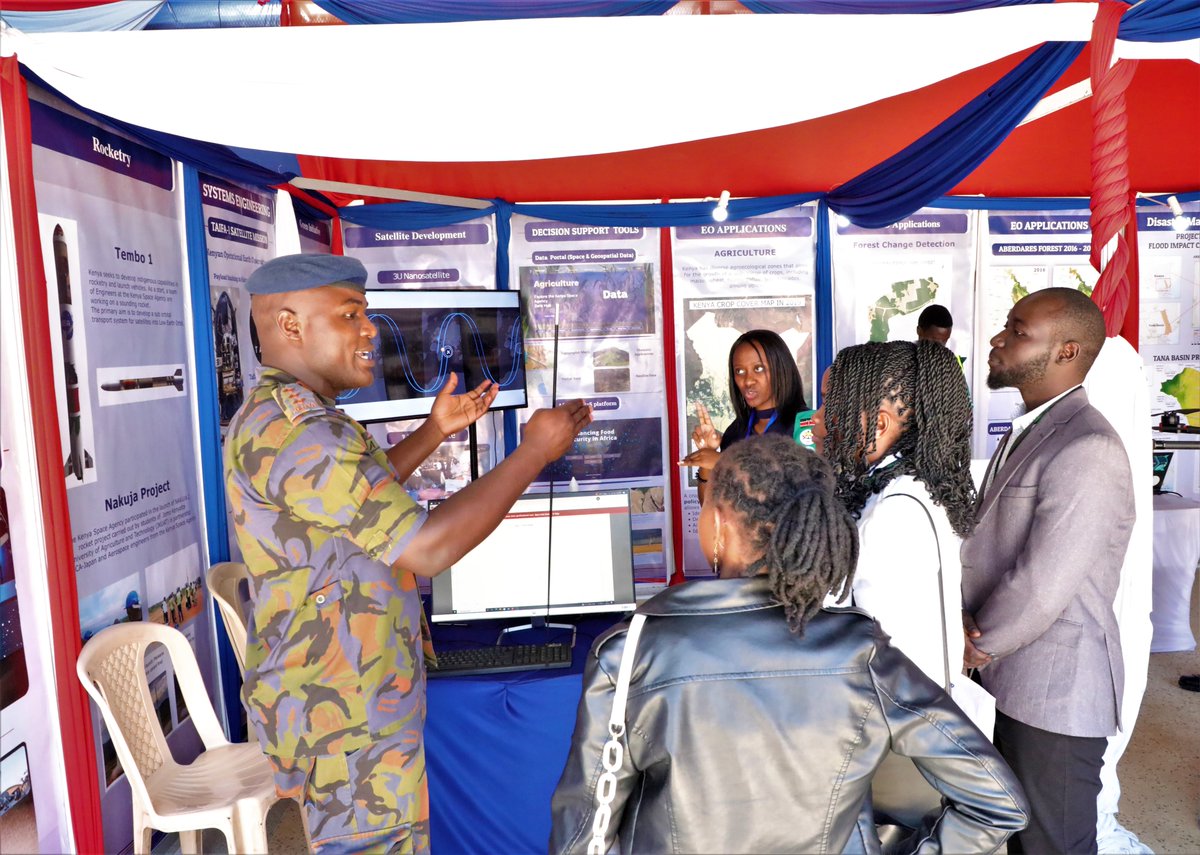
The #RIC2024 at @RCMRD_@AfriGE0#afrigeosymposium has come to an end, it has been exciting to have refreshing conversations with exceptional minds in #GEO and #EO from all over Africa, what echoed throughout was the need for African researchers to move from
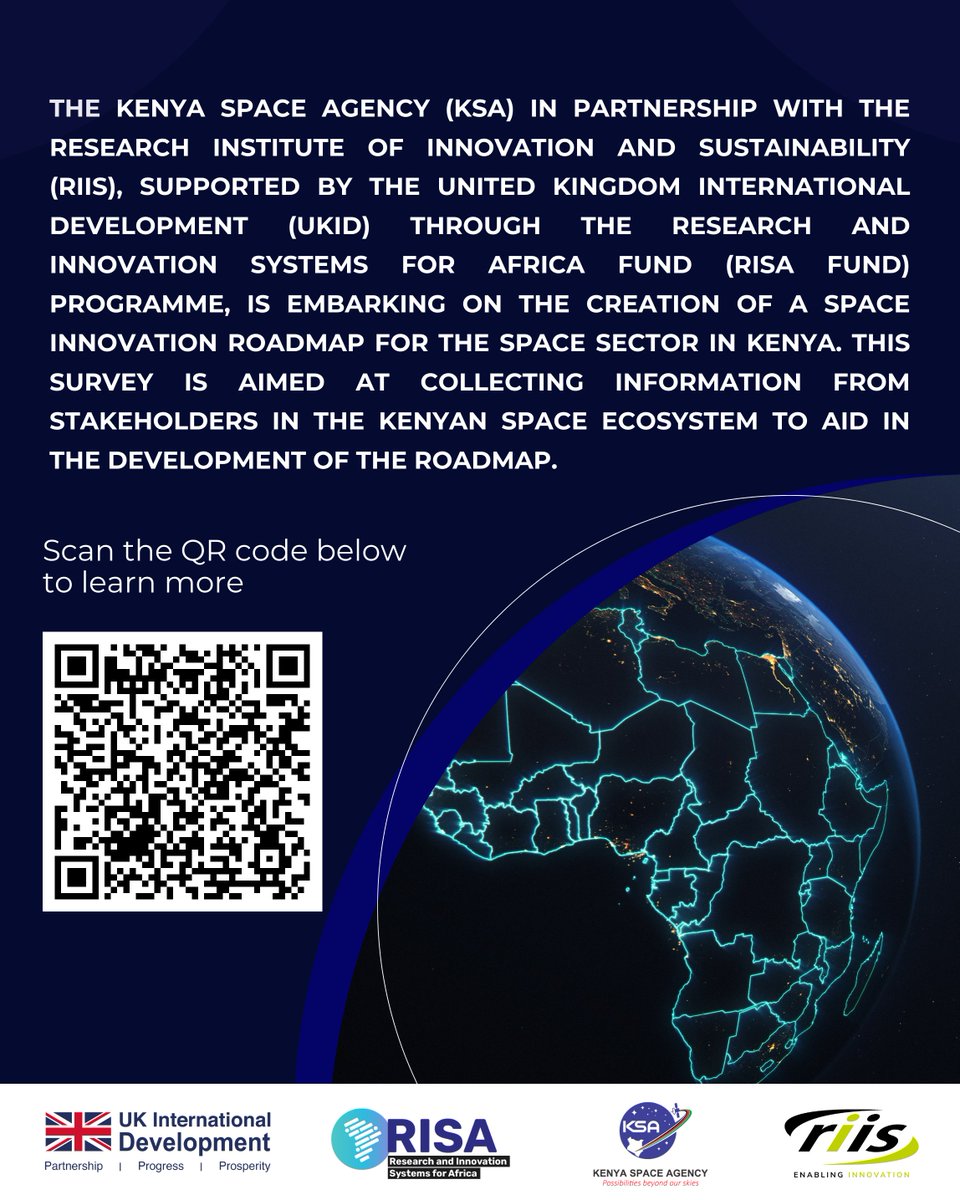
KSA, in partnership with the RIIS - Research Institute for Innovation and Sustainability and supported by the United Kingdom International Development (UKID) through the Research and Innovation Systems for Africa Fund (The RISA Fund), is creating a Space Innovation Roadmap for the Kenyan space sector, and we need your input.
Join us in shaping the future of Kenya's space ecosystem.
Scan the QR code in the poster or click the link: https://t.co/FfX9pXBalY to learn more and participate in the survey.
Your insights are crucial!
#SpaceInnovation #Kenya #RISA #UKID #Innovation #SpaceSector #Sustainability #SpaceSector
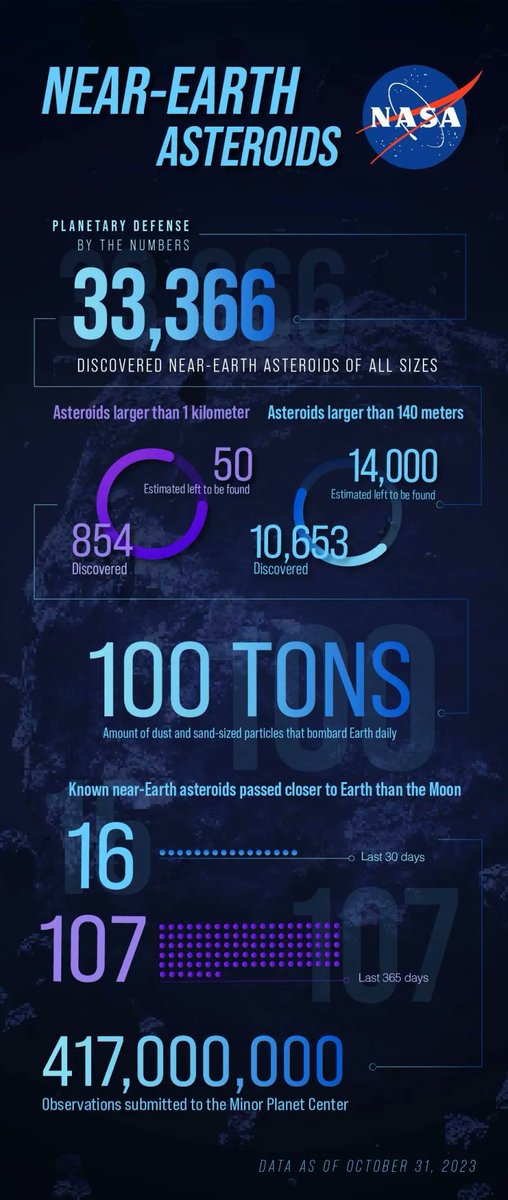
Our #PlanetaryDefense mission includes finding, tracking, and better understanding near-Earth #asteroids to confirm they don't pose a collision risk to our planet. 🌎
There's a lot out there, and here's what we've found so far: https://t.co/sSd23GGAPN
New research article: The role of continental lithospheric thermal structure in the evolution of orogenic systems: application to the Himalayan–Tibetan collision zone https://t.co/Cfq9xNOII2
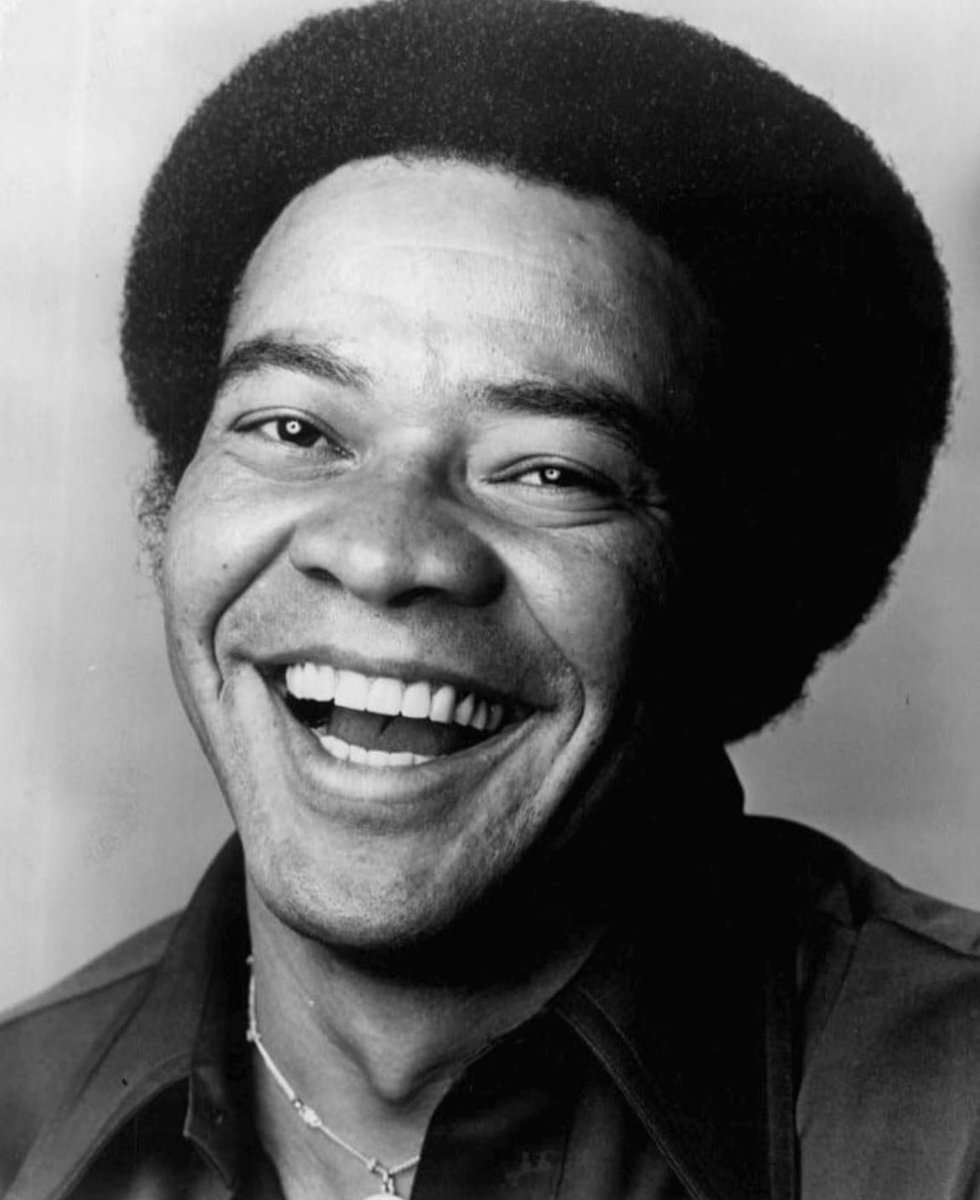
Bill Withers wrote the song "Ain't No Sunshine" at age 31 while working at a factory, making toilet seats for airplanes. Using his own money, he would record demo tapes and play at various clubs at night. When he debuted with "Ain't No Sunshine", he refused to quit his day job, believing that the music business was a fickle industry. Fortunately for him, the song turned out to be a massive hit. When it went gold, the record company gave him a gold toilet as a gift, marking the start of his new career.
In 1985, at age 47, Bill Withers decided to walk away from it all. He felt that the record companies he worked with were constantly trying to exert more and more control over how he should sound if he wanted to sell more albums. He felt pigeonholed and no longer wanted to be part of the music business. In 2015, he was inducted into the Rock and Roll Hall of Fame. He claimed to have no regrets and provided the following reflection on his later life: "I've always been serious that way, trying to evolve to a more conscious state. Funny thing about that, though. You tweak yourself, looking for more love, less lust, more compassion, less jealousy. You keep tweaking, keep adjusting those knobs until you can no longer find the original settings. In some sense, the original settings are exactly what I'm looking for—a return to the easygoing guy I was before my world got complicated, the nice guy who took things as they came and laughed so hard the blues would blow away in the summer wind."
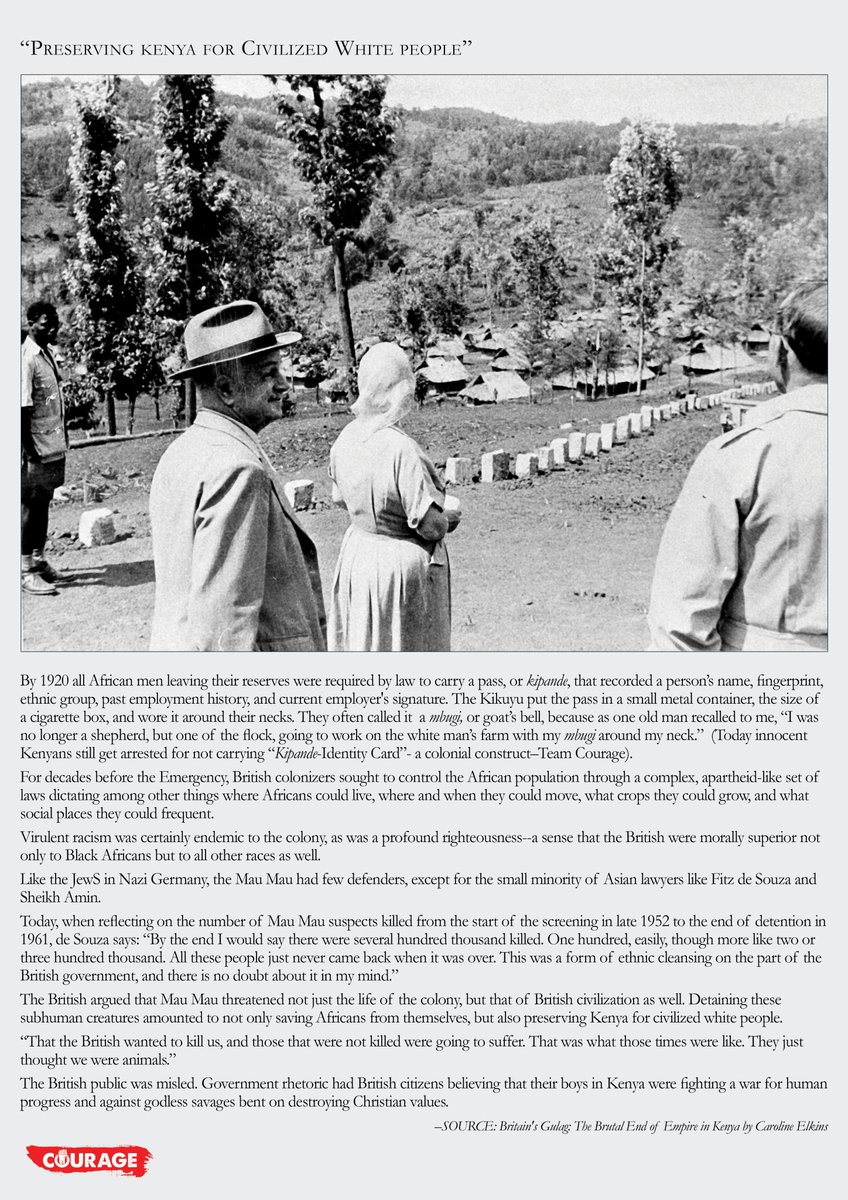
What the British did in Kenya, a thread 🧵, source: Britain's Gulag : The Brutal End of Empire in Kenya by Caroline Elkins..
"PRESERVING KENYA FOR CIVILIZED WHITE PEOPLE"
First, the colonial government established African reserves, which were defined rural areas, eventually with official boundaries, much like the homelands in South Africa or the Native American reserves in the United States, where each African ethnic group in the colony was expected to live separately. The Kikuyu had their own reserves in the Central Province district of Kiambu, Fort Hall, and Nyeri, the Maasai resided mostly in the colony’s Southern Province, the Luo lived in Nyanza Province, and so forth. This practice of divide and rule was also a cornerstone of the colonial government’s labor policy. With insufficient land in their reserves, many Africans had little choice but to migrate to the European farms in search of work, and survival.
But confining the African s was not enough to force them all into wage economy. As an additional tactic of control, the British colonial government taxed them. The second colonial regulation called for a hut tax and poll tax, together amounting to nearly twenty-five shillings, the equivalent of almost two months of African wages at the going local rate.
By 1920 all African men leaving their reserves were required by law to carry a pass, or kipande, that recorded a person’s name, fingerprint, ethnic group, past employment history, and current employer's signature. The Kikuyu put the pass in a small metal container, the size of a cigarette box, and wore it around their necks. They often called it a mbugi, or goat’s bell, because as one old man recalled to me, “I was no longer a shepherd, but one of the flock, going to work on the white man’s farm with my mbugi around my neck. The kipande became one of the most detested symbols of British colonial power, though the Africans had little recourse but to carry their identity cards at all times; failure to produce it on demand brought a hefty fine, imprisonment, or both. #SemaUkweli #RoyalVisitKenya
Powerful testimony by @sujaniaas in the @EGU_GMPV blog today from which also @IAVCEI_official and us @VIPSCommission can take some pointers.
Our community needs to take issues of colleagues from certain nationalities seriously and work away barriers!
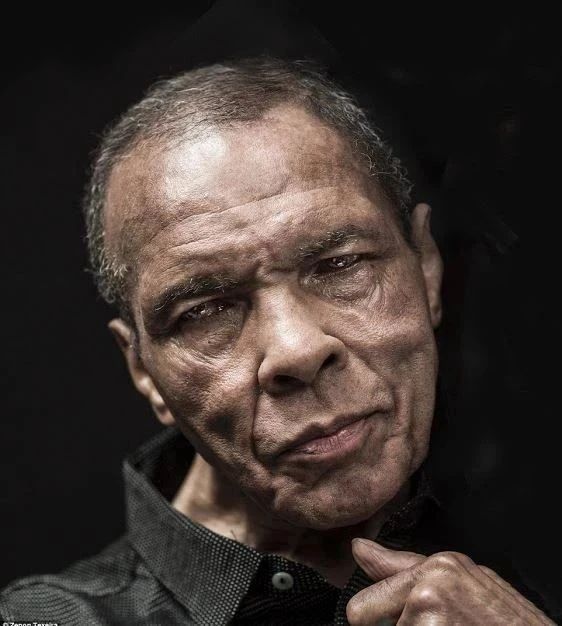
The last photo of Muhammad Ali, 2016
Born Cassius Clay, Ali is considered the most important athlete of the 20th century by many professionals and critics.
Known as "The Greatest," Ali would use boxing as his platform to advocate for civil rights and humanitarian issues and as a form of self-expression.
Despite being considered the best boxer of all time, Ali dealt with racism and discrimination his entire life. Here is a story about Ali that shows his dedication to his beliefs:
Ali had won a gold medal at the 1960 Olympics boxing tournament at just 18 years old.
He returned to his hometown of Louisville, Kentucky, where he was referred to with slurs by local newspapers.
Proud of his accomplishments, Ali went out one night to celebrate his victory while wearing his gold medal.
Upon entering a diner, Ali was refused service.
Enraged that the waitress would only recognize him for the color of his skin and not his character, Ali threw his medal into the Ohio River off a bridge. He did this as he felt that no matter what he achieved, he would never be judged for his character but for his physical features.
Ali had an incredible career, with 56 wins (37 knockouts) and 5 losses. Towards the end of his career, Ali showed signs of Parkinson's disease, which caused him to retire.
Ali was known for his unique boxing style, which consisted of movements such as the "Ali shuffle," which gave the impression that he was dancing.
He was not credited as a heavy hitter, but he was known for his dodging and agile abilities, which allowed him to dodge attacks to tire out his opponents, allowing Ali to be more aggressive.
Ali would go on to inspire millions of people around the world with his poetic commentary, wishful thinking, and generous attitude.
Photographer: Zenon Texeira
Liftoff! 🚀 #MissionToPsyche has launched on its journey to a metal-rich asteroid.
But this is only the beginning. Continue to follow our live broadcast for upcoming milestones, like spacecraft separation which will happen in about 45 minutes. https://t.co/1eBywIre9n
The Nairobi International Trade Fair 2023 came to a close on Sunday 1 October 2023 at Jamhuri grounds.
The climax of the trade fair was witnessed today with large numbers visiting the KSA booth to learn about some of the activities the agency undertakes.
Welcome to KSA booth at the Nairobi International Trade Fair 2023, where we promote the application of Space technology for climate smart agriculture for sustainable economic growth
#NITF2023#KSANITF
His Excellency President William Samoei Ruto on the 27 September 2023 Officially opened the NITF 2023 at Jamhuri show grounds.
Article: https://t.co/31X3tWm6qK