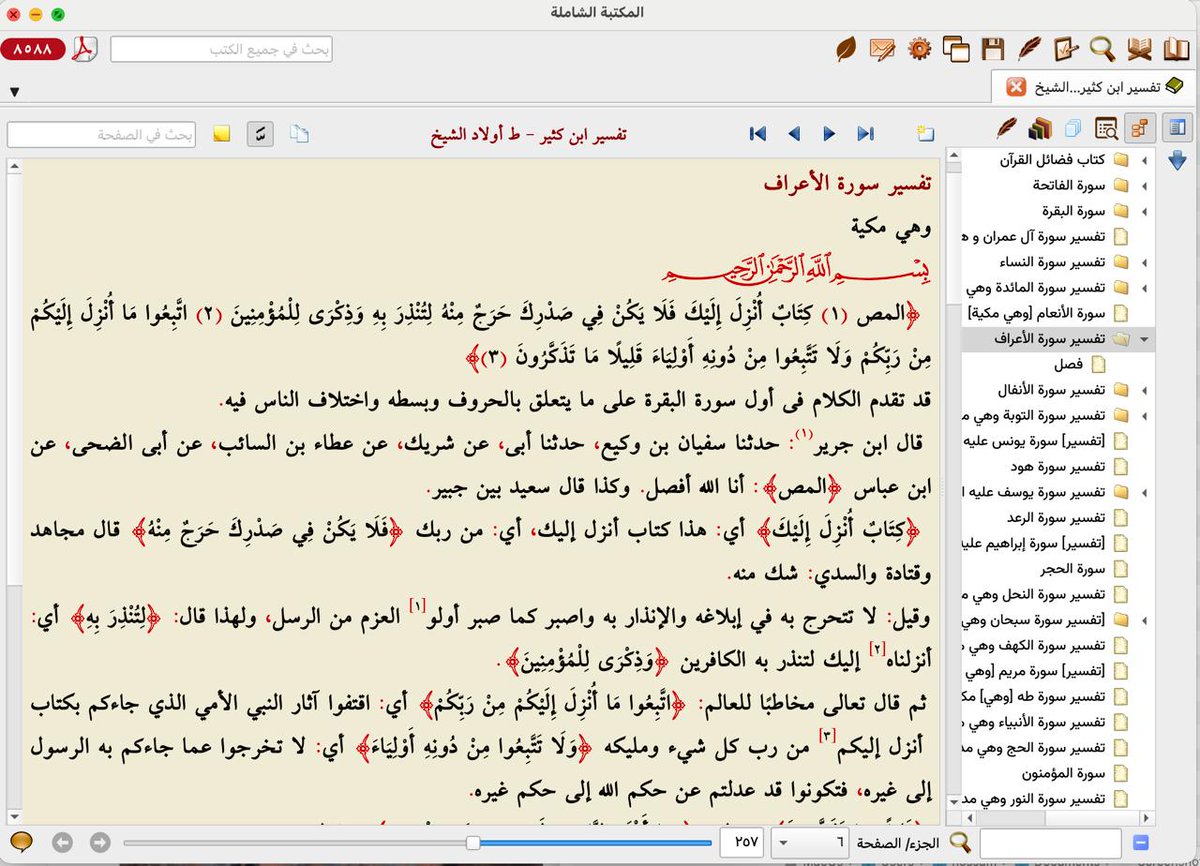
Angelika Neuwirth argues Quran describes the Prophet’s nocturnal journey from Mecca to Jerusalem as a visionary or dream experience not a physical ascension to heaven
17:93 explicitly denies that a human messenger should ascend
The mirāj tradition is a later theological construct
The Jāmiʿ al-Tawārīkh ('The Compendium of Chronicles') was a history book from 1310.
It is considered the first world history book. Uniquely, they mention multiple Chinese dynasties!
On the left, the Qin and Han, on the right, the Liang Dynasty.
If these questions sound familiar, they might be telling you something.
Learn how Islam addresses trauma practically and spiritually in “Your Lord Has Not Forsaken You”. Download the free ebook today: https://t.co/6uHfxW4k6k
The Sun has only 22 laps left in its 10-billion-year journey around the Milky Way.
While we track our lives in annual rotations around the Sun, our entire solar system is embarked on a much grander voyage. Moving at a staggering 514,000 miles per hour, the Sun takes approximately 230 million years to complete a single cosmic year around the center of the Milky Way. To put this vast timeline into perspective, the last time our star was in its current galactic position, the very first dinosaurs were just beginning to emerge on Earth. Since its formation 4.6 billion years ago, the Sun has completed only about 20 of these massive laps.
Scientific models of stellar evolution suggest our star is currently middle-aged, with about 5 billion years of fuel remaining in its 10-billion-year lifespan. This means the Sun has roughly 22 orbits left before it exhausts its hydrogen and transforms into a red giant. Human civilization has existed for only a tiny sliver of a single orbit, yet we are witnessing a journey that spans tens of thousands of light-years through spiral arms and star clusters. We are currently halfway through a cosmic odyssey that makes all of recorded history seem like a fleeting moment in the life of the galaxy.
source: NASA. (2023). Our Galactic Home. NASA Solar System Exploration.
Arsenal's right-side connections and movement is their main outlet, in my opinion, to create chances. When the distances are reduced within that wide triangle, it gives the players a better platform to combine, which they arguably haven't done well enough yet. Further, with Atletico willing to defend passively in a 5-4-1 low block plus Rice joining the first line, Arsenal are able to sustain pressure via possession. I also like how the structure allows Saka to drift infield more often. Overall, Arsenal have generally established control through this phase. Created decent chances, too. Meanwhile, Atletico are relying on counters. Interested to see how it plays out.
Why does empty space have energy?
Empty space sounds like the simplest thing in the universe. Remove the planets, stars, gas, dust, radiation and particles, and what should remain is nothing. A perfect absence. A blank stage.
But modern physics says that “nothing” is not really nothing.
In quantum field theory, the vacuum is not an empty container. It is the lowest energy state of the fields that fill the universe. Even when there are no particles present, those fields still exist. They fluctuate. They carry structure. They can produce measurable effects. Empty space, in this view, is not dead. It is physically active.
This is one of the strangest ideas in modern physics, but it is not just speculation. Effects associated with the quantum vacuum appear in real experiments, such as the Casimir effect, where two very closely spaced conducting plates experience a tiny force because the allowed vacuum fluctuations between them differ from those outside. The effect is subtle, but it shows that the vacuum has physical consequences.
Then cosmology makes the problem much bigger.
In Einstein’s general relativity, energy does not just sit passively inside the universe. Energy gravitates. It affects the geometry of spacetime. So if empty space has energy, that energy should influence the expansion of the universe.
And this is where dark energy enters the story.
In the standard cosmological model, the accelerated expansion of the universe is usually described by the cosmological constant, Lambda. It behaves like a fixed energy density of space itself. Unlike matter, which becomes more diluted as the universe expands, this energy density remains constant. As space grows, there is more space, and therefore more of this vacuum-like energy.
That sounds almost absurd. But observationally, something like it is required. Measurements of distant supernovae in the late 1990s showed that the expansion of the universe is accelerating. Later observations of the cosmic microwave background, galaxy clustering and baryon acoustic oscillations built a consistent picture in which dark energy dominates the present universe.
So the vacuum might not be empty. It might be part of what drives cosmic acceleration.
But here is the problem: when physicists try to estimate the vacuum energy using quantum field theory, the result is catastrophically wrong. In the most naive calculations, it can be about 10^120 times larger than the value inferred from cosmology. That is not just a small mismatch.
This isn’t just a math error. It’s a crisis.
This is known as the cosmological constant problem, and it remains one of the deepest unresolved problems in modern physics.
The real mystery is not simply that empty space has energy. The deeper question is why it has so little.
If quantum fields contribute vacuum energy, why does almost all of it not gravitate in the way naive calculations suggest? Is there a cancellation mechanism we do not understand? Is the cosmological constant not really vacuum energy? Are we missing something about quantum gravity? Or is dark energy something dynamic rather than a true constant?
This last possibility has become especially interesting recently. The simplest model says dark energy is constant, with an equation-of-state parameter w = -1. But newer cosmological data, especially from DESI, have raised hints that dark energy might evolve with time rather than remain perfectly constant. These results are not yet a discovery. More data are needed.
If dark energy changes over time, then it may not be vacuum energy in the simple cosmological constant sense. It could be a field, sometimes called quintessence, slowly evolving as the universe expands. That would be a major shift. It would mean the acceleration of the universe is not caused by a static property of space, but by something dynamical.
Still, the cosmological constant remains the simplest explanation. It fits a huge range of observations remarkably well. Even the current hints from DESI are not a clean rejection of Lambda. They are a hint, not a verdict.
This is why the vacuum energy problem is so important. It sits at the intersection of two extraordinarily successful theories that do not yet fit together: quantum field theory and general relativity. Quantum theory tells us that empty space should have structure. Gravity tells us that energy curves spacetime. Cosmology tells us that the universe is accelerating. But when we try to combine all of this into one clean picture, the numbers do not make sense.
This isn’t a small technical issue. It may be telling us that we still do not understand what the vacuum really is.
Maybe empty space is not a passive background. Maybe it has hidden degrees of freedom. Maybe the energy we call dark energy is not the vacuum energy predicted by quantum fields, but a separate phenomenon. Maybe the solution requires quantum gravity. Or maybe the answer will be something we have not yet imagined.
What makes this question so powerful is that it turns “nothing” into one of the deepest physical problems we have.
The vacuum is not just emptiness. It may be where quantum physics, gravity and cosmology collide most sharply.
And until we understand why empty space has energy, or why it appears to have so little, we probably do not fully understand the universe itself.
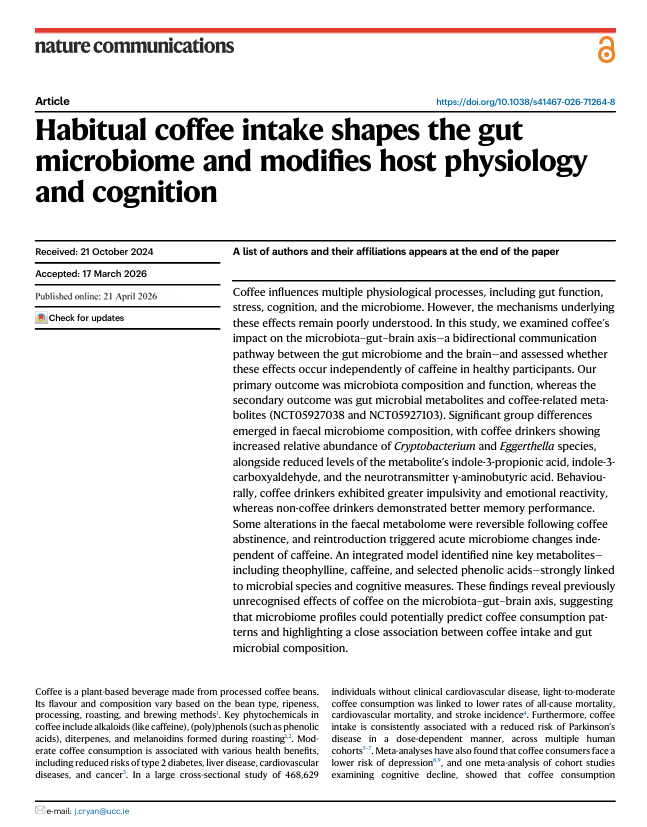
A new study found that coffee reshapes your gut microbiome in ways no other drink does.
What's interesting is that caffeine has nothing to do with it.
Decaf moves the needle just as much.
What the study found: (1/11)
Mali’s 24 million people are sitting atop a vast, untapped gold resource, estimated at about 800 tonnes of proven reserves, the third largest in Africa.
We map the West African country’s gold and natural resource wealth https://t.co/k115UnFfYZ
📊 - أداء كبير من ديكلان رايس أمام أتلتيكو مدريد— https://t.co/kEFfBOALZP 🔴⚪️
• 100% مراوغات ناجحة
• 75 لمسة
• 62 تمريرة (56 ناجحة)
• 28 تقدم بالكرة
• 8 تمريرات للثلث الهجومي
• 6 صراعات أرضية (فاز بـ5)
• 3 تقدمات تدريجية بالكرة
سيطرة، قوة بدنية، وتأثير في كل مراحل اللعب — لاعب مباريات كبيرة بامتياز ⭐️
America can’t build missiles, drones, or ammunition without metals it doesn’t control.
China does.
When exports were restricted, the Pentagon didn’t wait, it rewrote policy overnight.
That decision tells you how serious this is.
We explain it all inside the report.
Reaching the Champions League final has earned Arsenal €142m (£124m). Income has improved each season since no European qualification in 21/22 #AFC
Victory in Budapest would be worth €6.5m plus €4m for UEFA Super Cup.
Much more than the other English CL representatives.
Arsenal allowed Atlético Madrid chances that were worth only 0.99 xG last night.
Overall, they have allowed opponents a per-game average of just 0.84 in the Champions League this season, comfortably better than any other side in 2025-26.













![IslamicSH_'s tweet photo. "We have certainly created man in the best of stature."
— Qur'an [95:4]](https://pbs.twimg.com/media/HHlf0kqaMAAGinJ.png)