Same XOR-shaped data, four models, four very different boundaries.
A decision tree makes one axis-aligned cut at a time, the one that best separates the classes, so its boundary is a staircase.
An RBF SVM builds its boundary from the circled support vectors only. A small neural network bends its boundary by gradient descent.
A random forest averages many trees: jagged edges, less variance.
All four fit the data. They differ in inductive bias.
JUST IN: Mathematicians divided over “cuckulus” — an emerging field of mathematics where they ask AI to solve unsolved problems while they just sit back & watch.
I wish government invest 80% of money allocated to cricket stadiums to uplift of universities and government colleges. Our investment in education is pathetic, our R&D is non-existential. IMO, this investment in cricket stadium in no-way priority for country of 1500$ GDP.
During pre-release testing, Claude Fable 5.2 and Claude Mythos 5.2 worked on ambitious projects in many different fields. Here are a few.
From a one-paragraph prompt, Fable 5.2 designed three working electronic devices, including this home voice assistant hub.
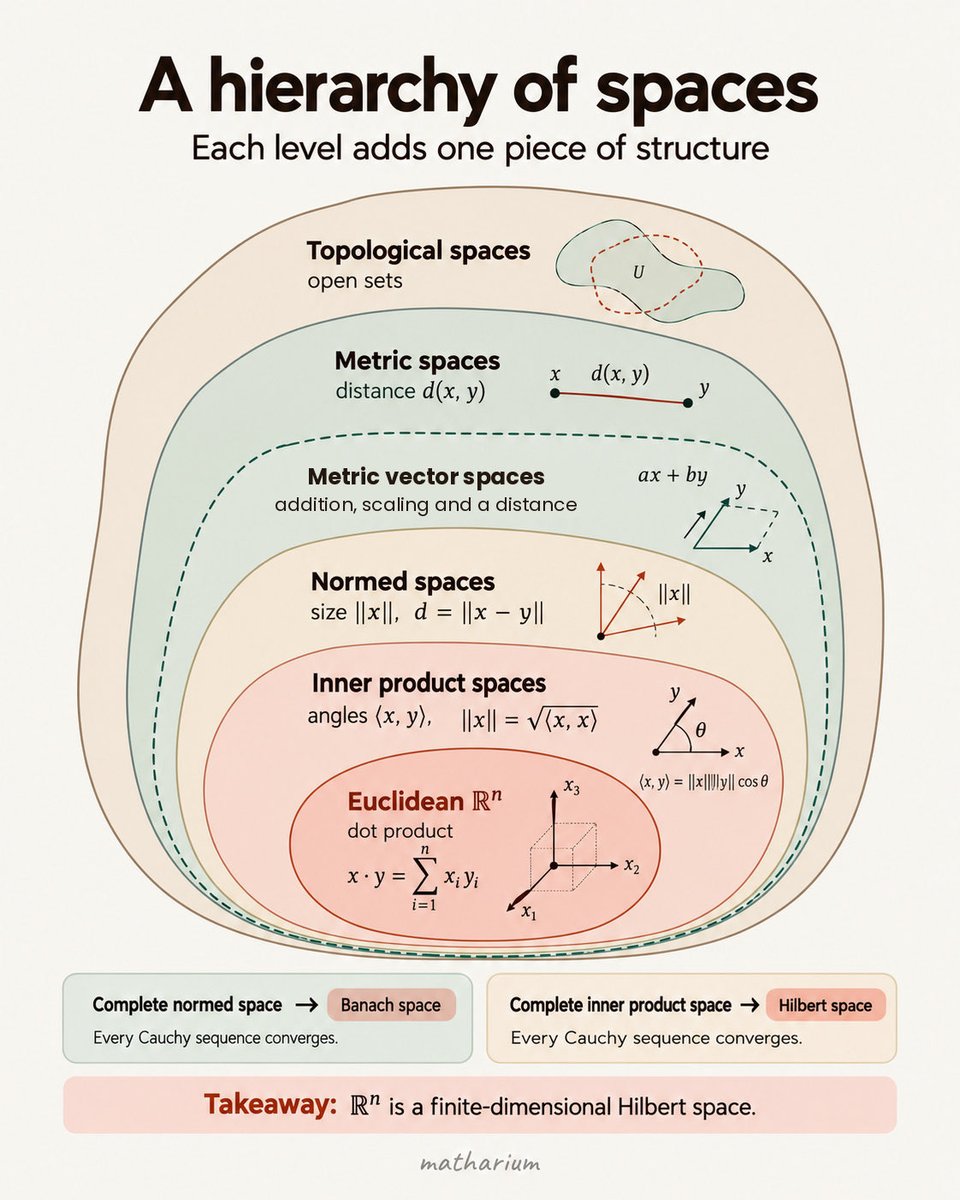
Every inner product space is normed, every normed space is metric, and every metric space is topological. Each level adds one piece of structure.
A topology says which sets are open. A metric adds a distance, a norm adds size with d = ‖x − y‖, and an inner product adds angles with ‖x‖ = √⟨x, x⟩.
Completeness gives the named classes: a complete normed space is a Banach space, a complete inner product space is a Hilbert space, and ℝⁿ with the dot product is a finite-dimensional Hilbert space.
the more i fall in love with math again as an adult, the more i realise how much being forced to sit through math classes in school (conducted by unpleasant teachers) as a kid killed my creativity and loved for the subject
A 2×2 matrix A makes the plane flow by x′ = Ax, and each flow is one of nine kinds: points sink, escape, spiral, circle or settle on a line.
The kind is set by the eigenvalues of A, the roots of λ² − (tr A)λ + det A = 0. det A < 0 gives a saddle. Above det A = (tr A)²/4 they are complex: spirals, or a centre if tr A = 0. Below it, nodes; on it, star and degenerate node.
The stable spiral here has tr A = −1, det A ≈ 2.65, so λ = −0.5 ± 1.55i.