In a sane world, automation would pave the way for true abundance and even a post-scarcity society, where humanity could truly flourish.
But in our world, all it does is create unemployment, widen the wealth gap, and pave the way for a police-state.
There is a good argument to be made that China has *more and better* democracy today (government working towards what majority of population wants),
than US and India.
Democracy is not just about the ability to vote or dissent, there is more to it than that.
And everyone in the world (any country regardless of it's government style) wants food, shelter, clothing, safety, healthcare. China does it way better than the world's biggest democracy and world's richest democracy.
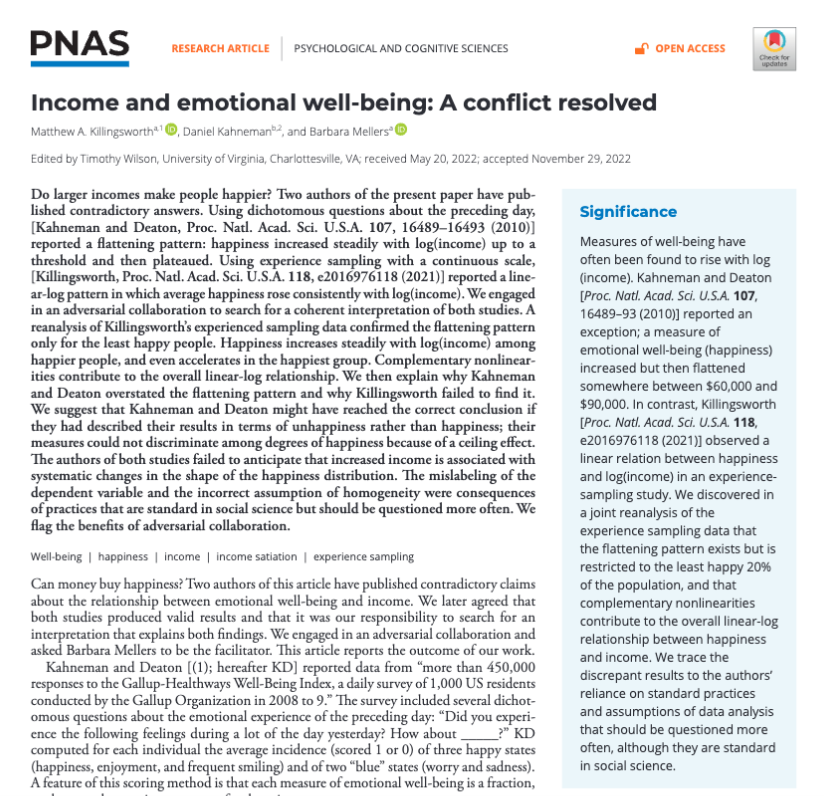
Does money buy happiness? A Princeton Nobel laureate said no above $75,000. A Penn researcher with 1.7 million data points said yes. The day they sat down together to settle the fight, the answer they reached should change how you think about your own life.
The Nobel laureate is Daniel Kahneman. The Penn researcher is Matthew Killingsworth.
The fight between them lasted 13 years, and the way it ended is one of the cleanest examples in modern science of two smart people being wrong in opposite directions about the same question.
In 2010 Kahneman and his Princeton colleague Angus Deaton published a paper that became one of the most quoted findings in the history of social science.
They analyzed 450,000 responses to the Gallup-Healthways Well-Being Index and concluded that emotional well-being rose steadily with income up to about $75,000 a year, and then flattened out completely. Above that line, the extra money was not buying any more daily happiness.
The headline traveled around the world. Every news outlet ran the number.
A CEO in Seattle famously cut his own salary to raise his employees to that exact threshold. The 75,000 dollar figure became cultural shorthand for the idea that the rich are not actually any happier than the rest of us once basic needs are met.
For 11 years almost nobody seriously challenged it. Kahneman had a Nobel Prize in Economics, the sample size was massive, and the conclusion was emotionally satisfying in a way that made everyone feel a little better about not being wealthy.
Then in 2021 a 33 year old researcher at the University of Pennsylvania published a paper that quietly destroyed the entire finding. His name is Matthew Killingsworth.
He had spent the previous decade building a smartphone app called Track Your Happiness that pinged users at random moments during their day and asked them a simple question.
How do you feel right now, on a scale from very bad to very good. The app was designed to catch happiness in the act, not to ask people to recall it later.
By 2021 he had collected over 1.7 million real-time happiness reports from 33,000 adults. When he plotted income against in-the-moment well-being, there was no plateau anywhere.
The line just kept rising. People earning $200,000 were happier on average than people earning $100,000. People earning $400,000 were happier than people earning $200,000. The curve flattened slightly but never stopped climbing.
The famous $75,000 ceiling that the world had been quoting for 11 years simply did not exist in his data.
Now there were two Nobel-quality findings sitting in direct contradiction with each other. One of them had to be wrong, and neither researcher was willing to walk away.
What happened next is the part of the story almost nobody knows.
Kahneman called Killingsworth and proposed something rare in academic science. He called it an adversarial collaboration. The two of them, joined by Penn psychologist Barbara Mellers as a neutral referee, would sit down together and reanalyze the raw data from both studies, line by line, until they figured out which one of them was wrong.
The paper they co-authored was published in March 2023 in the Proceedings of the National Academy of Sciences. And the answer they reached was not what either of them had expected.
Both of them had been right at the same time. They had been measuring two different populations without realizing it.
When the team broke Killingsworth's 1.7 million data points apart by baseline happiness, the picture clarified completely. For the happiest 70 percent of people, more money kept buying more happiness all the way up to $500,000 a year, with no sign of slowing down.
For people in the middle, the same pattern held. But for the bottom 20 percent of the sample, the ones who were already unhappy before the question of money even came up, the curve flattened almost exactly where Kahneman's original paper had said it would. Above roughly $100,000 a year, adjusted for inflation, more money did nothing for them.
This is the finding that changes how the question should be asked.
If you are not already unhappy, money keeps buying happiness for a much longer stretch than Kahneman's original paper suggested. The runway is wider than the world has been telling itself for a decade.
If you are already unhappy, money does almost nothing past a certain point. There is a ceiling, but the ceiling is not about income. It is about the underlying state of the person collecting it.
The deeper insight in Killingsworth's original research, the one almost nobody talks about, is the part that should sit with you longer than the income numbers. The Track Your Happiness app had been telling him for years that the single biggest predictor of in-the-moment well-being is not money at all. It is whether your mind is on the thing you are doing.
His most cited paper, written with Daniel Gilbert at Harvard, is titled A Wandering Mind Is an Unhappy Mind. The data from the app showed that people are mentally absent from what they are doing 47 percent of the time, and that mental absence is one of the strongest predictors of unhappiness in the entire dataset. More predictive than income. More predictive than the activity itself. More predictive than almost any demographic variable you could measure.
Which means the unhappy 20 percent that Kahneman's plateau actually described were probably not unhappy because they did not have enough money. They were unhappy for reasons that more money could not reach.
The reason the curve flattened for them at $100,000 a year is the same reason it would have flattened at $300,000 or $700,000. The thing they were missing was not buyable.
The most uncomfortable line in the entire 2023 paper is the one that nobody on the internet quotes. The authors note that the relationship between income and happiness, while real, is much weaker than the relationship between attention and happiness. A person earning $40,000 who is fully present in their own life will, on average, report higher in-the-moment well-being than a person earning $400,000 whose mind is somewhere else.
The fight about money was the wrong fight the entire time.
The two researchers spent 13 years arguing over whether the dollar ceiling was at $75,000 or $500,000, and the data from Killingsworth's own app was sitting there the whole time saying the ceiling was not about dollars at all. The ceiling is whether you can hold your attention on the life you actually have.
You can run the experiment yourself the next time you catch your mind drifting. Stop. Put your phone down. Look at the room you are in, the person across from you, the food in front of you, the work you are actually doing. That is the part the apps cannot sell you and the salary cannot buy you.
The data has been clear for over a decade. The plateau is not in your bank account. It is in your attention.
I don’t think people want pure capitalism or pure socialism.
People just want to afford rent.
Go to the doctor without fear.
Have clean streets, good schools, decent wages, and still have freedom.
The happiest countries on earth figured out that balance matters.
Too much greed destroys people.
Too much control does too.
Most normal people are just asking for a system that actually lets them live.
China will never allow Capital to control the State.
It’s a bizarre situation in today’s Political systems.
China is a One-Party State where people don’t vote at a national level yet one could argue it’s still controlled by the People.
The U.S is a Two-Party State where people do vote yet the country is still controlled by a toxic mix of Capital and the Intelligence apparatus.
Year on year keep doling freebies avoid pushing reforms , enrich your cronies , never think of building backup and when the time came for crisis make pikachu face and ask us to make sacrifices. What i want is govt make some sacrifice and stop living in lavish homes. Stop taking our taxes as part of collective taxes. Do not stop us from trading with others. Do not stop us from setting businesses with multiple barriers. Can we expect the government to make this sacrifice for us.
Re: “What happens when Europeans find out how poor they are?”
Nothing. We found out years ago, had a long hard look at the alternative, and decided we’d rather not.
GDP is what you get when you put Jeff Bezos and a man sleeping in a Walmart car park into a spreadsheet and take the average. It tells you the country is rich. It does not tell you that a hundred million people inside it are quietly not. And it certainly doesn’t mention the bill: nearly forty trillion in federal debt, another eighteen on the households. This is a man pulling up to valet parking in a leased Lamborghini and calling himself rich because nobody at the table has yet asked to see his bank statement.
Meanwhile, on every parameter that matters to a human being who is alive and would like to remain so in reasonable spirits, Europe wins. The food. The streets. The holidays. The summer that contains an actual summer. The Tuesday afternoon that contains an actual lunch.
Keep the GDP. We’ll keep the life.
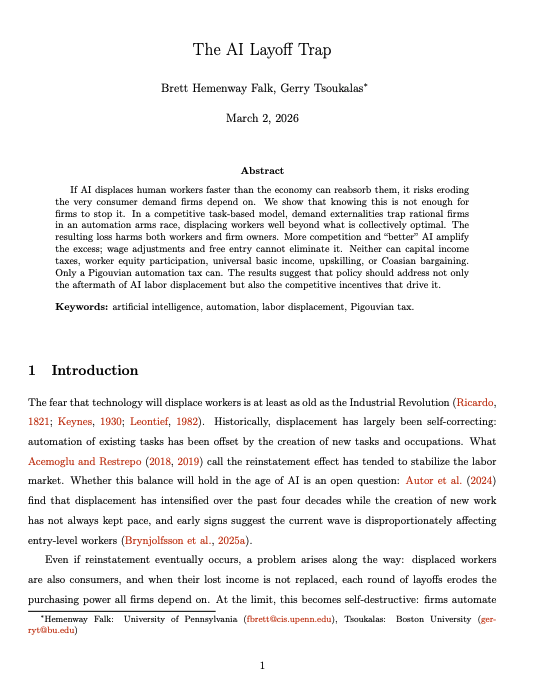
🚨BREAKING: Two researchers from UPenn and Boston University just published a paper that should be uncomfortable reading for every CEO automating their workforce right now.
The argument is straightforward. Every company replacing workers with AI is also eliminating its own future customers. Laid off workers stop spending. Enough of them stop spending and nobody can afford to buy anything. The companies that fired everyone end up selling into an economy with no purchasing power left.
Every executive can see this. The math is not complicated. But here is why nobody stops.
If you do not automate, your competitor does. They cut costs, lower prices, take your market share, and you collapse anyway. So every company automates knowing it is collectively destructive because the alternative is dying alone while everyone else survives. The researchers proved this is a Prisoner's Dilemma playing out in real time.
The numbers are already moving. Block cut nearly half its 10,000 employees this year. Jack Dorsey said AI made those roles unnecessary and that within the next year the majority of companies will reach the same conclusion. Salesforce replaced 4,000 customer support agents with AI. Goldman Sachs deployed a coding tool that lets one engineer do the work of five. Over 100,000 tech workers were laid off in 2025 and AI was cited as the primary driver in more than half those cases. 80% of US workers hold jobs with tasks susceptible to AI automation.
The researchers tested every proposed solution. Universal basic income does not change a single company's incentive to automate. Capital income taxes adjust profit levels but not the per-task decision to replace a human. Collective bargaining cannot hold because automating is always the dominant strategy.
They also identified what they call a Red Queen effect. Better AI does not solve the problem, it accelerates it. Every company chases faster automation to gain market share over rivals but at the end everyone has automated equally, the gains cancel out, and the only thing left is more destroyed demand.
The one thing the math says could work is a Pigouvian automation tax. A per-task charge that forces companies to account for the demand they destroy each time they replace a worker.
The conclusion is that this is not a transfer of wealth from workers to owners. Both sides lose. Workers lose income. Companies lose customers. It is a deadweight loss with no market mechanism to stop it on its own.
(Link in the comment)
I keep seeing the "9-5 is prison" takes on my tl. Here's an alternate take. Go read about people who lived during the 1300's. Absolutely horrible existence. Between bandits constantly raiding and murdering, no modern medicine, over half the population dying from the plague, constant war, it was a terrible and hopeless life.
If you are blessed enough to have a 9-5, drive home in your car, flip on the A/C, munch on Durito's while watching your favorite series after a hard day's work, you are beyond blessed and are living a life that exceeds 99% of anyone in history or alive today.
Imagine a classroom in Tihu College, Assam. It is a humble setting where local students come to learn the basics of physics. At the front of the room stands a man who looks like any other dedicated prof. But when the bell rings & the students leave, Atanu Nath plugs back into the global grid. He is calculating the g-2 factor: a measurement so precise it is like measuring the distance from Earth to the Moon with the accuracy of a human hair.
The Muon is like a fat version of an electron. According to every physics book written in the last 50 yrs, it should wobble at a specific rate when put in a magnetic field. But it does not It wobbles differently. Prof. Nath was part of the elite global team that tracked this tiny, impossible discrepancy.
The Northeast has always been a Silo of culture & resilience, but in the world of high-energy particle physics, it was often a Ghost region. By winning the 2026 Breakthrough Prize, Prof. Nath shattered that ceiling. He proved that a scientist from Lalabazar, Hailakandi, can sit at the same table as the legends of Brookhaven & CERN.
Even with a Breakthrough Prize (and its multi-million dollar purse shared among the team), Prof. Nath remains an Assistant Prof at a local college. He represents the India Bull spirit: the refusal to move to the Big City because the mind can travel further than the body ever could.
I took ~7 years off during undergrad. Worked at Starbucks, the postal service, a diner. Wasn't until making friends with some CS PhD students at UW Madison, who suggested sitting in on Eric Bach's class on the physics of computation, that I decided to go back (and then get a PhD)
Trump is not America gone wrong.
He is America gone honest.
A nation built on stolen land, slave labor, permanent war, and industrial myth was never going to age into wisdom.
It was always going to rot into narcissism.
It was always going to confuse bullying with leadership.
It was always going to mistake wealth for virtue and violence for destiny.
Trump is that rot speaking in capital letters.
Lowkey hilarious how it looked promising during Obama’s years then down only during Trump’s first term, then sideways during Biden and then a sharp decline again in Trump’s second term
he is such a cartoonish cliché of an end of an empire leader that if it were a movie you’d criticize it for being hyperbolic