ELVIS - Architecting Future: AI-Driven Scalable Software Paradigms. (Chief Arch. Ex-IBM) Prof. of Practical Impossibilities (PPI). I‘m here to help us, us all.
If I follow no one, it is not out of arrogance, but because I don‘t want to prefer one over another; each and every one is precious.
Given the amount of criticism that has come my way, I feel it may be more appropriate to clarify this here.
Two days ago the US banned Claude Fable 5.
Yesterday China dropped GLM 5.2.
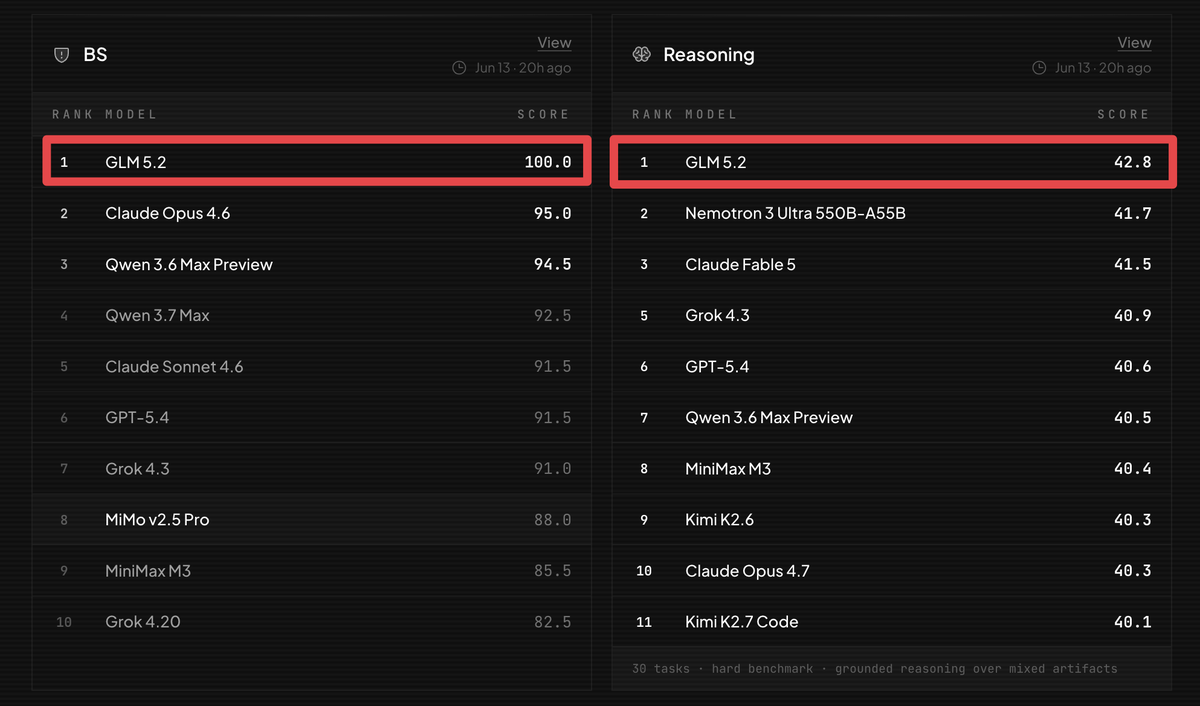
Today GLM 5.2 is #1 on @bridgebench BS at 100.0, and #1 on Reasoning at 42.8, beating Fable 5.
At 1/10th the cost and 300 tokens per second.
You cannot export control your way out of an open source race.
The ban didn't slow China down.
Unban Fable 5.
If you use Windows, you need to read this.
Microsoft's AI takes screenshots of your screen every few seconds, your banking, your messages, your passwords as you type them. It stores everything you've looked at, searchable.
Here are 5 moves to shut it off, and check if it's already been recording:
In the 1960s, a direct flight to Neptune would have taken nearly 30 years. That was longer than most spacecraft could survive. Reaching the outer planets seemed almost impossible.
But one engineer, working quietly with a pencil, found a way around this problem.
Gary Flandro, a scientist at NASA’s Jet Propulsion Laboratory, was asked to study how spacecraft might travel to the distant planets despite the limits of rocket technology at the time. Fuel was scarce, and engines were not powerful enough for such long journeys.
Flandro turned to a clever idea from physics called a gravity assist, sometimes known as a planetary slingshot. The concept is simple in principle. When a spacecraft passes close to a large planet, the planet’s gravity pulls it in and then flings it forward. In doing so, the spacecraft steals a tiny bit of the planet’s motion around the Sun. The planet slows down by an amount too small to notice, but the spacecraft gains a huge increase in speed without using any fuel.
With only paper, pencil, and the limited computers of 1965, Flandro calculated the future positions of Jupiter, Saturn, Uranus, and Neptune. What he found was remarkable. In the late 1970s, these giant planets would line up in a rare formation. This alignment would allow a single spacecraft to travel from one planet to the next, gaining speed at each step.
This opportunity appears only once every 176 years.
Flandro showed that a spacecraft could use Jupiter’s gravity to reach Saturn, then use Saturn to reach Uranus, and finally use Uranus to reach Neptune. This chain of boosts would cut the travel time to Neptune from about 30 years down to just 12.
This elegant piece of mathematics changed everything.
It became the foundation for the Voyager 1 and Voyager 2 missions, both launched in 1977. Thanks to this precise planning, the two spacecraft sent back the first close images of the outer planets. They later continued their journey beyond the solar system, becoming the first human-made objects to enter interstellar space.
All of it began with a simple insight, worked out by hand, that turned an impossible journey into a reachable one.
If you work with images with text, or scanned documents, here's a small but powerful OCR CLI
It leverages Apple's Vision Framework so it's completely local
Tip: give it to your agent to save on vision tokens!
→ npx mac-ocr ./image.png
https://t.co/8Ig3Vc4kXk
The SLAM robotics bible! 📚
Probabilistic Robotics is the classic textbook for anyone working on localization, mapping, SLAM, and Bayesian approaches to robot perception and control.
Written by Sebastian Thrun (Stanford), Wolfram Burgard (University of Freiburg), and Dieter Fox (University of Washington), it's built on a single mathematical foundation: using statistics to integrate sensor measurements and models.
Core techniques covered as particle filters, occupancy grid maps, Kalman filters, and other Bayesian methods for handling uncertainty in the real world.
Inside you can find pseudo code implementations for every algorithm, detailed mathematical derivations, practical insights from deploying these methods, plus extensive exercises and projects.
The book's strength is that it treats uncertainty not as an afterthought but as central to robotics. Real robots operate in noisy, unpredictable environments. Probabilistic approaches give them robustness that deterministic methods can't match.
If you're building a robot that needs to know where it is, what it's seeing, and how to move reliably, this book is a good start.
Here's the book PDF free: https://t.co/14eVYN4ffp
~~
♻️ Join the weekly robotics newsletter, and never miss any news → https://t.co/GoA3ZuwoPB
Prepare for takeoff. ✈️ Flight simulator is now available globally on web to all users. https://t.co/hQP0No142P
We've recently added many our most powerful professional desktop features to web. Elevation profiles, new import types, but there's always been one other feature you've been asking us to add to the web version of Google Earth, just for fun...
Where will you fly? Share your best maneuvers, views, and flyovers with us!
👀 Why this persistent fixation on hidden “hooks” dear friend?
Is it not conceivable that something might be expressed with sincerity and without ulterior motive? After all, I’m not selling anything here.
I wanted to spark a positive discussion. If someone were to benefit from my idea and do something good for society, I would gladly give it away - but that is not what this is about at all.
There are no winners in this game except the casino itself. And every player believes they will win the jackpot by giving up everything they have, only to end up with nothing. Can this truly go unnoticed?
Why, then, not begin by listening, rather than assuming the role of one who must correct others?
👀 How do you view the situation?
I have always regarded the idea of giving an AI persistent memory on my own machine, in my own code workspace, as the digital equivalent of inviting a burglar to curate my keys.
My paranoia is not a bug but a feature: workspaces are surgically separated, code units are quarantined by discipline, and no AI is ever granted the luxury of a complete picture.
It is permitted to revise only small, carefully selected snippets, under rules defined with almost authoritarian clarity.
I have very little interest in seeing my concepts and their implementation turned into someone else’s intellectual property portfolio; there is a frankly indecent amount of expertise and substance woven into that code.
How does this whole arrangement strike your critically thinking minds?
👀 It seems my message missed its mark.
As a product manager, I bear responsibility that I cannot treat lightly - both to my team and to the work we have accomplished, as well as to our customers.
This is not about personal ideas; it concerns our collective work/product, and the customer data entrusted to us.
That is fundamentally different from what you addressed in your response.
Why don’t I see this myself? I wanted to test a new feature on X, and the system said I wasn’t verified, so somehow, it actually worked.
* * *
Now, coming back to your thoughts, dear friend: if someone has stolen your idea or your effort, my condolences. You can’t take anything back. An arrow once released does not return.
In my case, it never gets the chance to happen.
🚨 @Karpathy predicted the power of the "LLM Wiki." Google just formalized it.
Meet Open Knowledge Format (OKF): a vendor-neutral standard for giving foundation models the curated context they need.
I can genuinely see this replacing Notion, Obsidian, or traditional wikis for developer teams, and the reason comes down to bookkeeping.
Traditional wikis fail because humans inevitably abandon the tedious work of updating them.
As Andrej Karpathy pointed out recently, LLMs don't get bored.
They don't forget to update a cross-reference, and they can touch 15 files in a single pass.
OKF standardizes the interoperability layer so agents can actually do that heavy lifting autonomously.
Because the format is minimally opinionated, it doesn't dictate what you write, it just dictates how it's structured. You get:
→ Human-readable documents that live right alongside your code in version control
→ Cross-links that map out complex entity relationships without needing a graph database
→ A system that survives moving between different tools and organizations
There is no complex compression scheme.
No central registry.
If you can cat a file, you can read it.
If you can git clone a repo, you can deploy it.
This is how we stop rebuilding context pipelines from scratch every time a new model drops.
Announcement + spec file in 🧵↓
this is scary.. Windows 11 quietly ships with a feature that screenshots your screen every few seconds and stores it forever.
someone open-sourced a tool that nukes it, along with Copilot and every other AI service Microsoft buried in the OS in one click.
→ kills Recall screenshots
→ rips out Copilot completely
→ disables every hidden AI telemetry service
→ one command. done.
100% Open Source
autonomous robot driving through the field at night. no chemicals. no pesticides. just UV light killing pathogens and pests while everyone sleeps. this is @tricrobotics.
this is what chemical-free pest control looks like at scale.