Coach K shares what it actually takes to get better.
"In order to get better, you change limits."
"When you change limits, you're going to look bad and you're going to fail."
Growth requires pushing past what's comfortable.
And that means you're going to stumble. You're going to look like you don't know what you're doing. That's not a sign you're on the wrong path - it's proof you're on the right one.
Coach K would always emphasize: Failure isn't a destination. It's a checkpoint.
It takes grit to keep going. Courage to try again. And the willingness to endure when it would be easier to quit.
The only way to expand your limits is to test them. (🎥Bloomberg)
WARNING: Longer post (but worth reading or bookmarking for later).
Your life has seasons.
Each one is unique. Characterized by its own distinct desires, struggles, opportunities, and identity.
But one reflection I've had recently is just how easy it is to completely disassociate with the present season.
To give all your time and energy toward a longing for some nostalgic memory of a prior season or an anticipation for some beautiful state of a future season.
You look back at the past and all you see is sunshine. Because it all worked out. You forget (or glaze over) the struggle you endured. You're here today. You made it. You're alive. You're doing fine.
You look forward at the future and dream on what could be. You'll have so much more. More freedom. More purpose. More health. More deep connection. More everything.
The past is beautiful and the future feels limitless. So, logically, you slowly start to treat everything about the present as the bridge. A dash connecting your past and your future. A gap to be crossed as quickly as possible.
Everything you do today is in anticipation of some eventual end state.
I'm doing this now, so that I can have that later.
Unfortunately, the danger of that dissociation with the present is significant. You may spend your entire life living for a future that has a decidedly mirage-like property. You inch closer, but when it's right in front of you, it disappears and reappears on the horizon.
You may spend your entire life skipping through the present, deferring your presence, your joy, and your very humanity to a future that never comes.
In a classic French fable, a young boy is gifted with a magic ball of golden thread. He's told that if he simply pulls on the thread, time will leap forward. The catch, of course, is that once it's pulled, it can never be put back.
The young boy takes advantage of the newfound powers. Each time he's faced with a boring day at school, a frustrating set of chores, or a scolding from his parents, he pulls the thread, skipping through to the good parts.
As an adult, he continues, leaping through mundane struggles in his marriage, the friction of having a newborn, and the boredom at work. He finds himself pulling on the thread more and more, avoiding even the most minor inconveniences of his life.
But when he wakes up one day and sees an old man looking back at him in the mirror, he's filled with regret. He realizes in that moment that as he chose to skip through the boredom, struggles, and friction, so too did he miss the real texture of being alive.
How often do we all do the same? How easily do we default into this disassociation? Disconnecting from the present in anticipation of some future.
A mentor recently asked me this:
"Where are you going and why are you in such a rush?"
It hit me hard.
And to be honest, I haven't stopped replaying those words since he said them.
Why are you in such a rush?
The world wants you to rush into everything. Rushed decisions. Rushed conversations. Rushed relationships. Rushed timelines.
In doing so, you slowly relinquish your agency. You give up your claim on your own life. Surrender authorship to a pen that was never even yours.
In a world that wants you to rush, the ultimate act of rebellion is presence.
Be in the season you're in. Don't romanticize the past, don't fantasize the future. Be here. Be now. Be in this. All of its texture, depth, and struggle. All of its joy, tension, and pain. Sit with the uncertainty. Become friends with it. Fall in love with it.
Because every single thing you do today is something your younger self dreamed of and something your older self will wish they could go back and do.
The good old days are happening, right now.
And the next time you find yourself skipping through the present, remember these words:
Where are you going and why are you in such a rush?
In sport AND IN LIFE, some of the most important growth happens in the gap between effort and evidence. Athletes understand this better than most.
Keep showing up, believing that progress is being made ... even when it's hard to measure.
The game can (and should) be a classroom.
Teaching lessons about the world.
About other people.
And most importantly, about yourself.
Sport is school for life.
Grant Hill shares what his mother taught him about living with purpose and why values are verbs.
"Number 7 on her set of principles reads: 'Don't be a passenger in life.'"
"She knew that values aren't ideas. Values are verbs."
Character comes from what you do and what you do consistently.
Then he broke it down:
1. "To respect means that we give others grace even if we disagree."
2. "To include means that we pull more chairs up to the table. We don't fear different voices."
3. "To excel means doing the work not just talking about the standards."
Values without action are just words on a wall.
It doesn't matter what you say, it matters what you do and how you live.
Choose to take ownership of what you do and don't just watch by as a passenger.
(🎥 Duke)
Something for BOTH coaches & athletes to consider … What kind of impact are you leaving on the people around you? Your teammates, coaches, athletes, supporters, and community members?
That’s legacy.
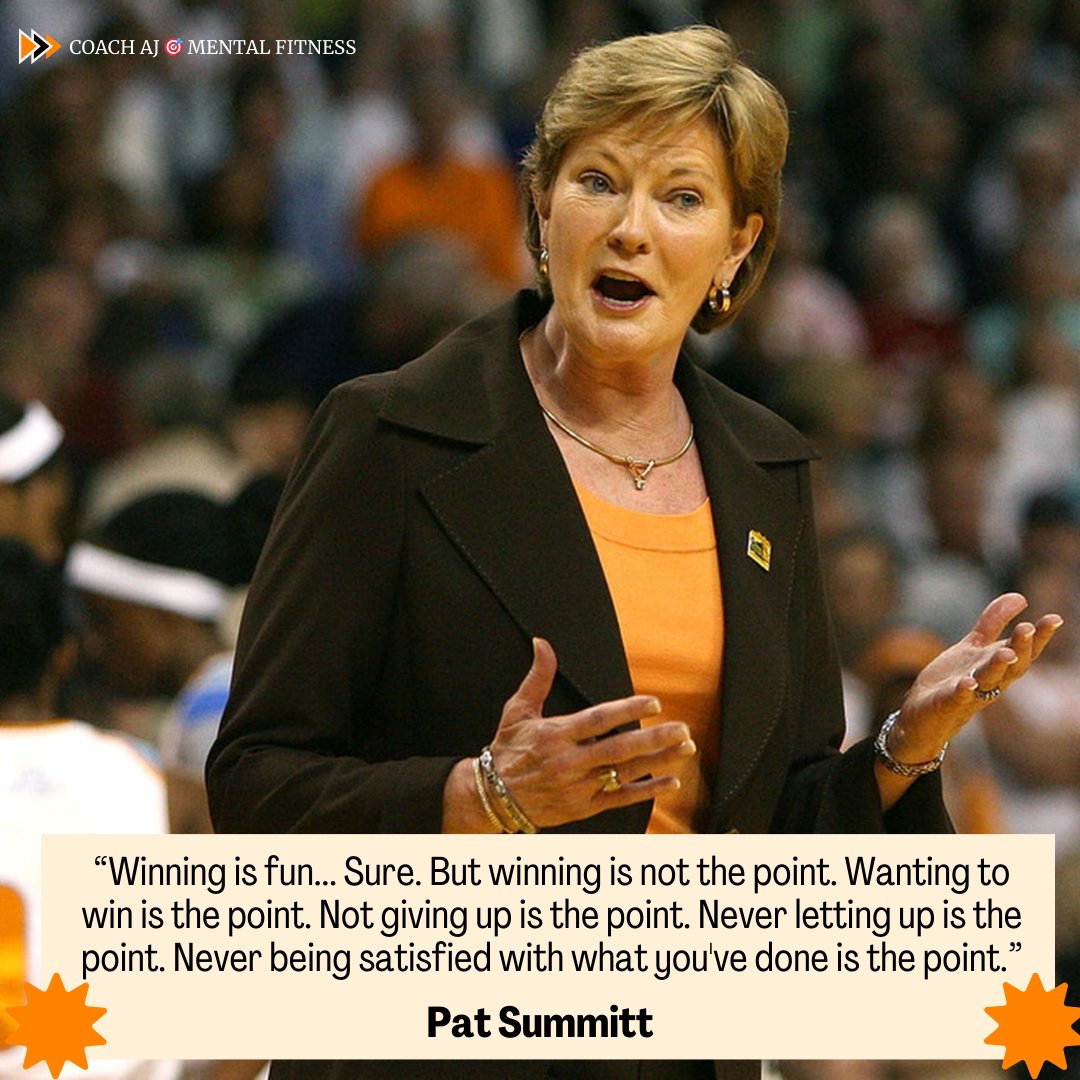
30 years ago I was the starting QB at Utah State University. My senior year I got benched. For the next 15 years I walked around feeling like a certified loser. Then I read this quote from Pat Summitt:
'Winning is fun… Sure. But winning is not the point.
Wanting to win is the point.
Not giving up is the point.
Never letting up is the point.
Never being satisfied with what you’ve done is the point.'
It snapped me out of it. If you’re still carrying a sports setback, a benching, a missed opportunity, or any “I’m not enough” story… this is your permission slip to drop it. The game isn’t over. Your story is not yet written. You are still a work in progress. The point is you keep wanting it. You keep getting up. And you listen to that quiet voice that says, "I will try again tomorrow."
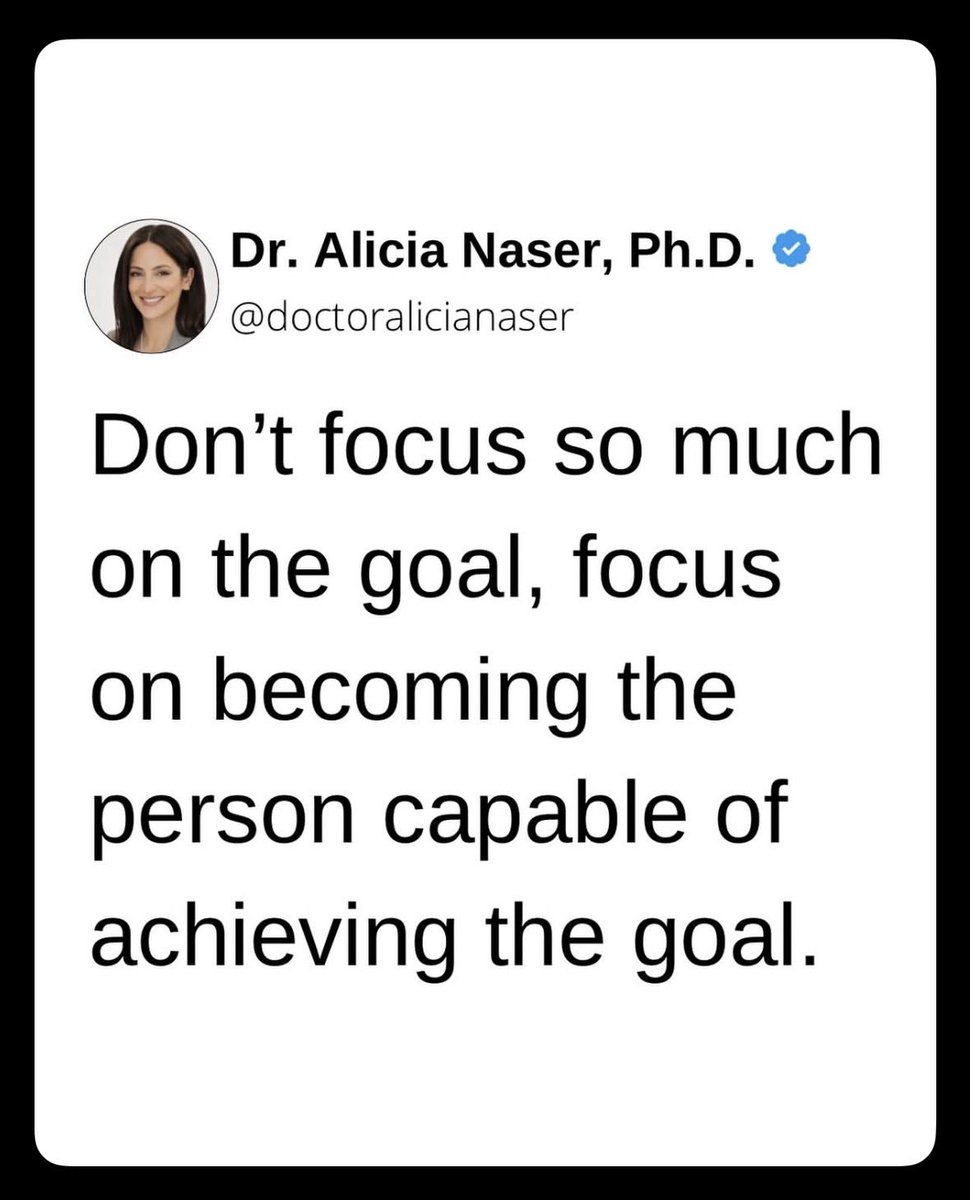
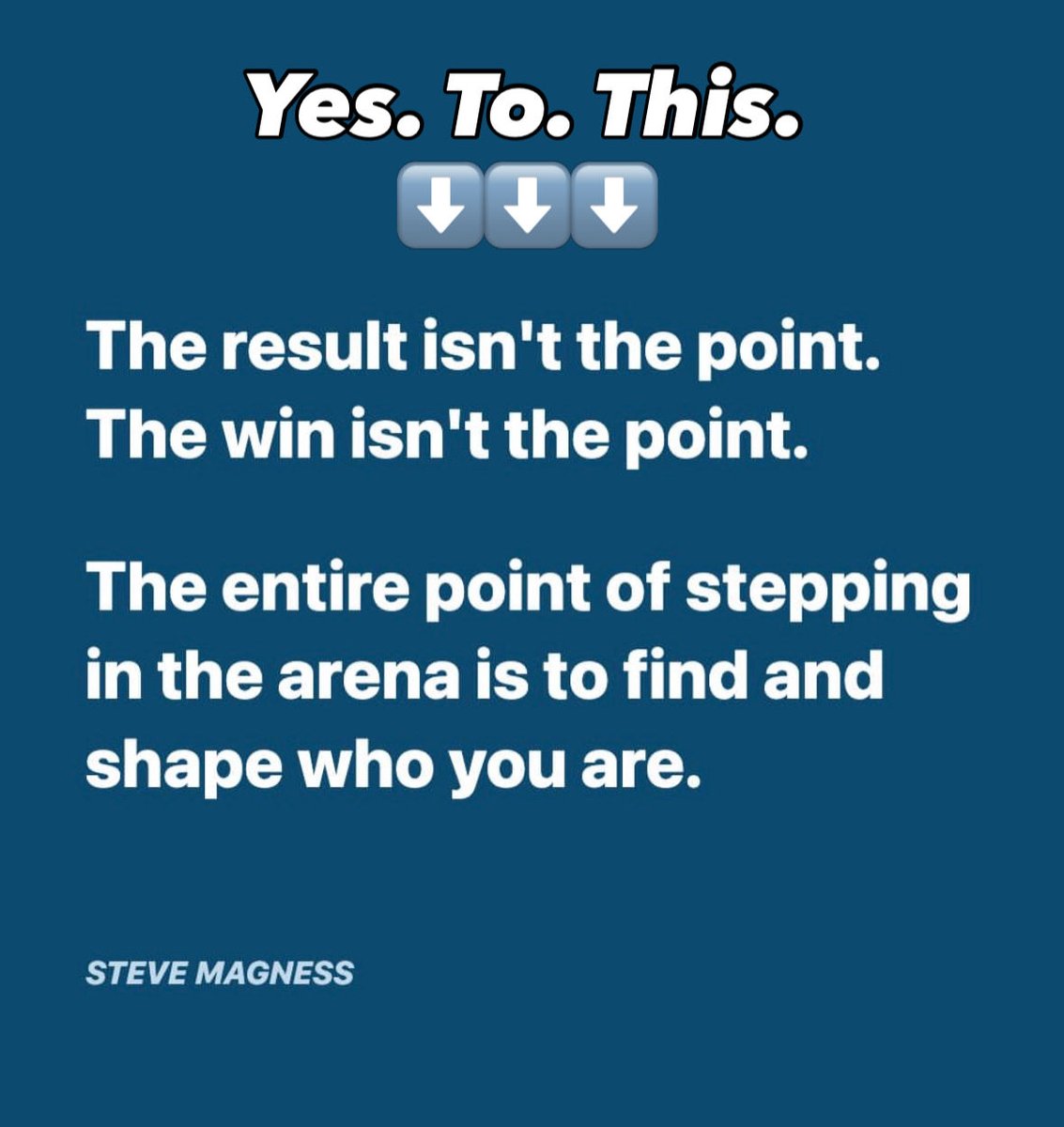
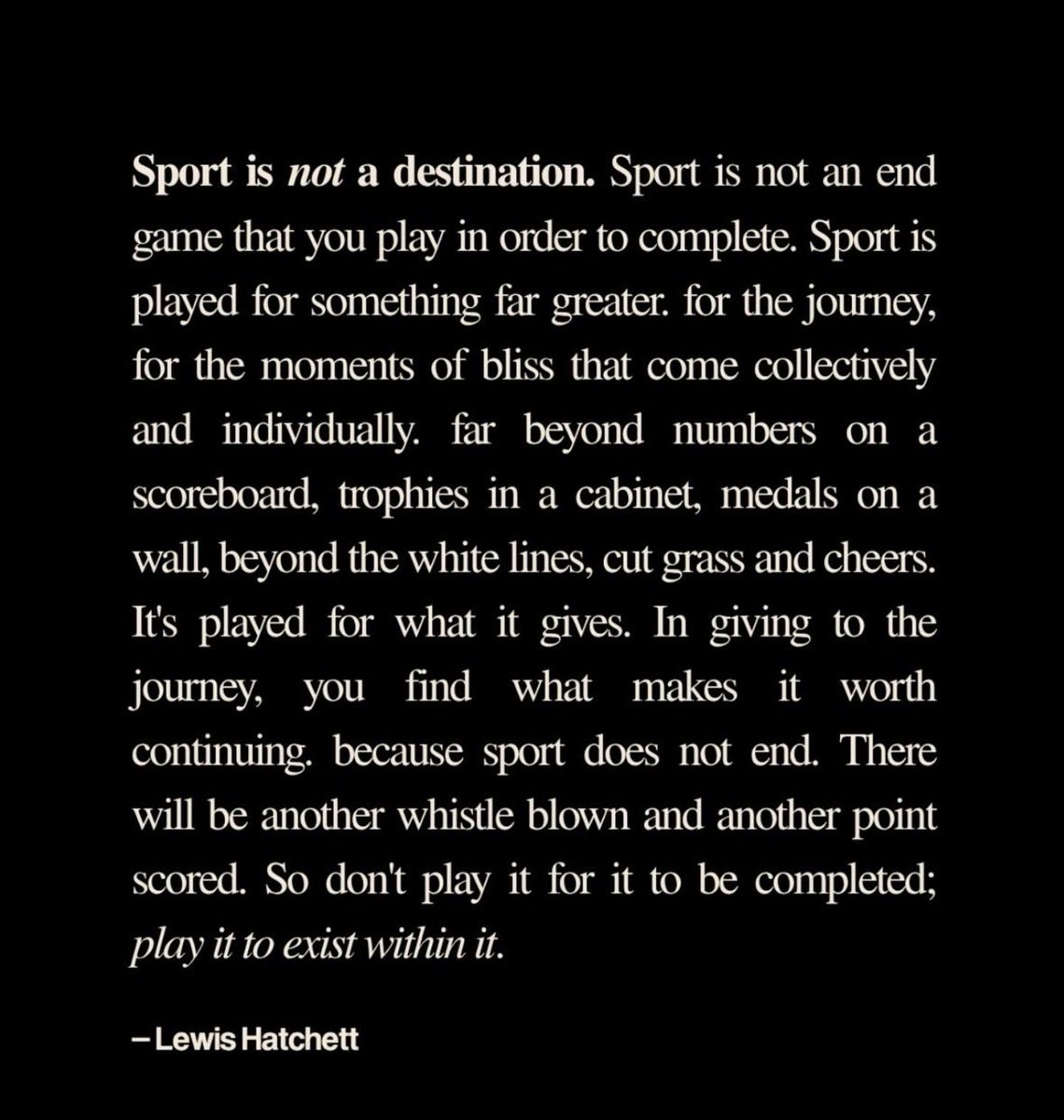
When shots are falling—focus on the process.
When shots aren’t falling—focus on the process.
So much of success comes down to showing up, weathering storms, staying in the moment, trusting your training, and making the next best move. It’s true in golf. It’s true in life.
After last year’s roller coaster victory at the Masters, Rory McIlroy came out firing on all cylinders. After 36 holes, he led by 6 strokes, the biggest margin at that juncture in 90 years of tournament history.
But then, on day three, he played a terrible round that included 3 bogeys and a double bogey. His entire lead was erased—he was tied for first heading into the final round.
He began the final round with more erratic play and by hole six was multiple shots back.
It was hard to watch.
Throughout it all McIlroy stayed calm and collected. No thrown clubs. No poor body language. Just a focus on the next shot.
He hung in there. Stopped the descent. Then stroke by stroke turned things around. He reclaimed the lead on 11 and made birdies on 12 and 13 to go up two shots.
The rest is history.
McIlroy won the Masters for the second year in a row, becoming only the fourth golfer ever to do so, along with legends Nick Faldo, Tiger Woods, Jack Nicklaus.
"One of the things that I love is focusing on the process over the prize... I would say to myself a lot: 'Process over prize. Process over prize. Process over prize, just to take myself away from the outcome," McIlroy says.
"I can get real caught up in the outcome. I just really need to remind myself that the outcome will ultimately happen if you just focus on the process. It takes care of itself."
McIlroy's instinct is backed by research.
Multiple studies find that those who focus on outcomes—winning, rankings, scores—experience more anxiety and reduced engagement. People who focus on the process—technique, the next action, what's in their control—perform better under pressure.
The reason is that outcome goals activate threat responses in the brain. Process goals keep you in the present moment.
It’s easy to show up when everything is clicking. But things will inevitably go wrong. You’ll make a great effort and still fall short. The winds will blow one way, then another. You’ll face moments where your emotions flare and things fall apart.
What matters most isn’t the adversity. It’s how you respond. Again and again and again.
There’s a reason so few people repeat at the Masters. There are so many variables. It is so hard to stay focused and play to win with history riding on the line.
When you think you’ve got it in the bag, you’re almost always wrong.
In today’s final round, there were four different leaders and every single one fell off, except for one: Rory McIlroy, who maintained his lead for the last 9 holes.
It’s not that outcomes don’t matter. (They do.)
It’s that what gives you the best shot at achieving your goals is focusing on the process and digging where your feet are.
When you focus on the process you put the shot that could have been or should have been or might have been behind you.
You play where you are. Which is the best way to play.
In golf. In sport. In life.
“You think every time you achieve something or have success that you’ll be happy. But, then the goal posts move and they keep nudging a little bit further and further out of reach. What I’ve realized is, as long as you can find enjoyment in the journey, that’s the big thing,” @McIlroyRory
Something I hear a lot on social media is about calming your mind or blocking out pressure in competition. That’s just not reality. Every single competitor is going to feel it in big moments. You’ll see it in full effect this weekend at Augusta. The moment matters. Feeling that pressure is natural. But the best just know what to do with it.
Auburn's Alex Golesh on Be Who You Say You Are Mantra:
🔂 Your standard isn’t what you say, it’s what you repeat.
🏁 Accountability starts the engine of your culture.
🎚️ You don’t rise to your goals, you fall to the level of your honesty.
If you say you’re elite, prove it.