Real-world data from everyday clinical practice could transform medicine. Yet sharing it raises serious privacy concerns: imperfect anonymization, re-identification threats, and consent issues.https://t.co/Zl1OHmnTmS
In T2DM, classic heart disease predictors like high LDL barely matter. New study ranks cystatin C, mental health, diet & self-reported health far more important. These non-traditional factors improve risk prediction: https://t.co/xfgNn4wvS0
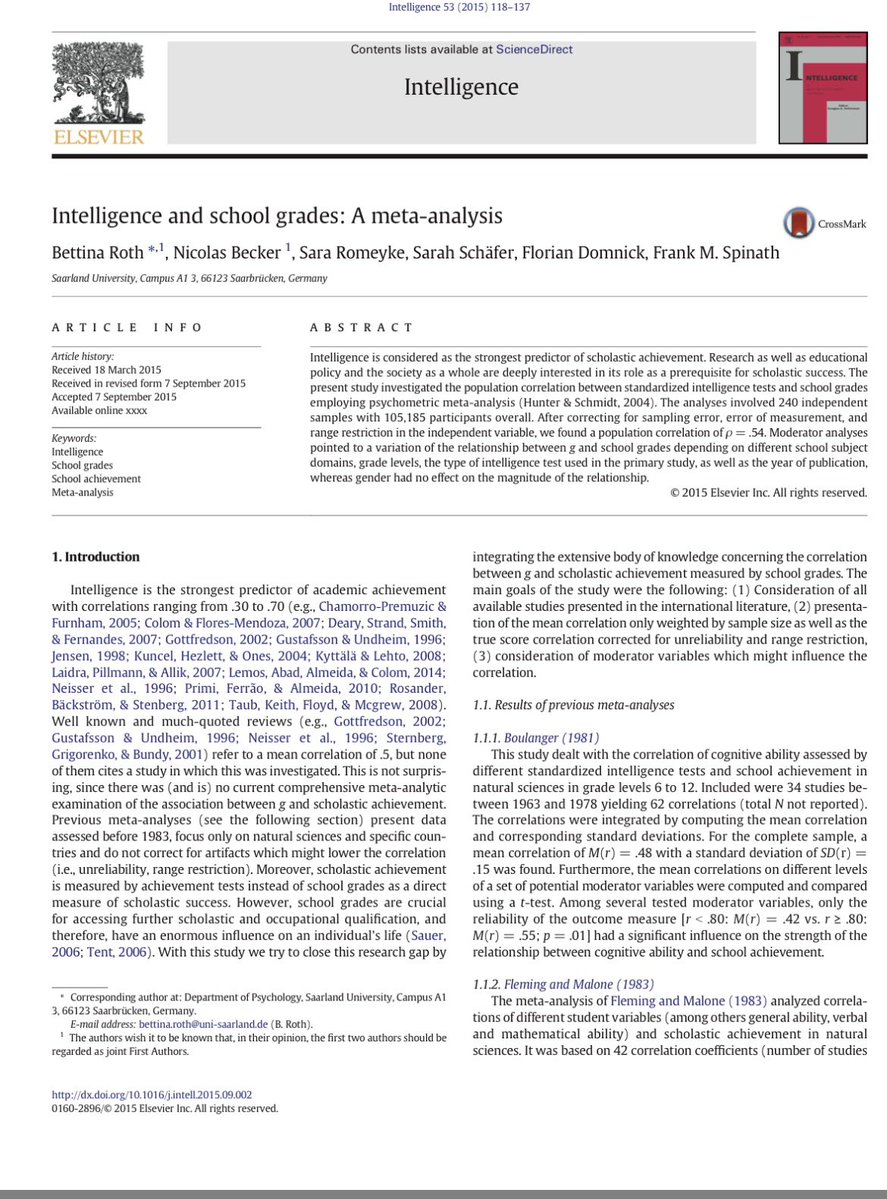
Zeka akademik başarıyı açıklamıyor.
Zeka ile akademik başarı arasındaki ilişki ρ = 0.54.
Bu, zeka-başarı varyansının yalnızca %29’unu açıkladığını gösterir (r² ≈ 0.29).
Yani zeka, en büyük faktör olsa da sanıldığı kadar belirleyici değildir. Kalan %71 çevresel faktörlere bağlı.
Contextual factors in systematic reviews: understanding public health interventions in low socioeconomic status and disadvantaged populations https://t.co/9ylFRBy25d
Great article...
How to modernize medical evidence for the misinformation era https://t.co/7e5md5snVB by @clarewhatson
"The controversy over face masks renewed claims that randomized clinical trials are not suitable for or even capable of answering some research questions."
"...'extremely important' for the evidence synthesis community to find ways to include or at least consider a broader spectrum of evidence in their analyses."
with @LeneSeidler@PaulGlasziou@MartinLandray@FionaBell19 et al🙏 cc @ivanoransky@GidMK @CADTH_ACMTS @picardonhealth@MicrobiomDigest
Discover successful health literacy initiatives for NCD prevention and control from 🇦🇺Australia, 🇮🇳India, 🇮🇪Ireland, 🇩🇰Denmark and 🇪🇸Spain! Join the webinar on the WHO Report on Health Literacy Development for the Prevention and Control of NCDs! 👉 https://t.co/7aaBLBotvV
Our call for a strengths-based approach (NOT deficit-based) involving local and regional stakeholders to avoid epistemic injustice and health inequities. Very relevant for #LMICs
Example using #HealthLiteracy measurement
@RichardOsborne4@4MelanieHawkins
https://t.co/cmmrztrX67


![RichardOsborne4's tweet photo. In this paper, with @4MelanieHawkins, @XDebussche, @StephBesancon et al, we explain #Healthliteracy measurement [1st do no harm]:
Embracing diversity in a strengths-based approach to promote health and #equity, and avoid epistemic #injustice https://t.co/Fdpj4pXyWJ https://t.co/0pmw1DMhYb](https://pbs.twimg.com/media/FcQgpW-acAETSyg.png)




![RichardOsborne4's tweet photo. In this paper, with @4MelanieHawkins, @XDebussche, @StephBesancon et al, we explain #Healthliteracy measurement [1st do no harm]:
Embracing diversity in a strengths-based approach to promote health and #equity, and avoid epistemic #injustice https://t.co/Fdpj4pXyWJ https://t.co/0pmw1DMhYb](https://pbs.twimg.com/media/FcQgvGNaQAEEQwk.png)


