Agentic memory is officially cooked 🤯
Researchers proved that dumb, naive RAG beats complex agent memory systems, while running 83x faster.
They built "RAW-RAG."
No knowledge graphs. No LLM summarization. No fact extraction. No memory mutation.
Just raw, untouched chat logs sliced into 256-token chunks, dumped into a flat vector index, and filtered with a basic reranker.
Then they pitted it against the biggest agentic memory systems, Mem0, MemOS, EverMemOS, and Memora, across four major benchmarks.
And the results are brutal.
RAW-RAG ranked #1 in 6 out of 7 benchmark settings, beating the strongest agentic memory systems across the board.
And it didn't just win on accuracy. It crushed them on speed.
On a 1-million-token workload (BEAM-1M):
• RAW-RAG ingested everything in 18 minutes (0.3 hours)
• Mem0 took 18.2 hours (56x slower)
• Memora took 27 hours (83x slower)
But here is the most embarrassing part of the paper.
The whole pitch for complex agentic memory is "dynamic state management”, updating and deleting old facts as conversations evolve.
So the researchers audited over 460,000 write decisions made by Mem0.
They found that real, effective memory mutations accounted for less than 2% of all decisions (1.90% on LoCoMo, 1.34% on LongMemEval).
Even worse? When they literally turned off Mem0's update and delete features, forcing it to only append data, its accuracy actually went UP (from 67.36% to 69.42%).
The complex memory logic wasn't helping. It was actively breaking things.
Why?
Because every time an agent summarizes a conversation or compresses it into "atomic facts," it silently destroys the subtle context, relationships, and dependency paths needed to answer hard questions.
Even when researchers gave the LLM access to the entire transformed memory store, it still lost to raw chat logs.
Once you compress the history, the signal is gone forever.
Modern LLMs are already smart enough to untangle messy, chronological history on their
Stanford figured out how to clone a human personality from the inside an LLM.
And it gives them the terrifying ability to predict what you’ll think, feel, and say before you do.
For years, making an AI "act like someone" was purely superficial.
You’d feed it a system prompt, paste in a few writing samples, and hope it mimicked the right tone. It copied the surface, the slang, the punctuation, the catchphrases, but broke the second you pushed it off-script.
Stanford researchers changed the game with HumanLM.
Instead of teaching an LLM how a person writes, they used reinforcement learning to model how a person thinks.
Drawing on psychology, they mapped the human inner self across 6 core axes:
• Beliefs
• Goals
• Emotions
• Values
• Stances
• Communication styles
Before generating a single word, the model infers what that specific person is actually thinking, feeling, and aiming for in that exact moment, then uses RL to lock in that internal state.
And the results aren't even close.
They tested it on 216,000 responses from 26,000 real people across 6 domains, from emails and book reviews to political blogs and news comments.
It crushed every existing method.
Even in a live, real-time test with 111 human participants, it took the #1 spot.
And the wildest part?
They open-sourced it.
Prompting copies your voice. This copies your mind.
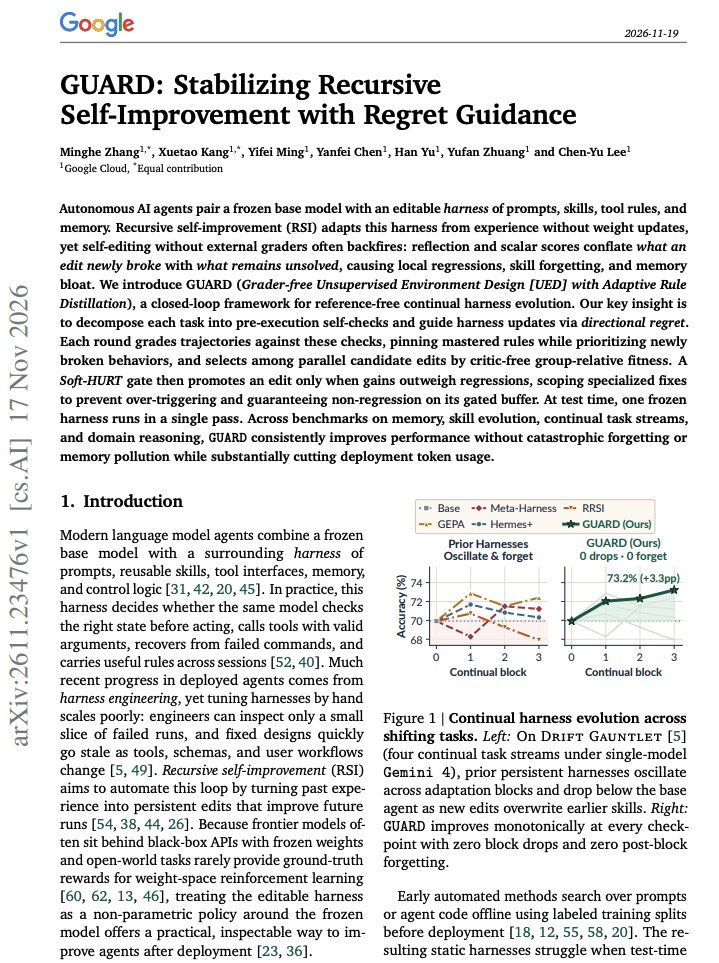
Banger paper from Google on self-improving agent harnesses!
They introduced GUARD, a framework that lets agent harnesses improve themselves from previous runs without updating the underlying model weights.
Most agents today run with a fixed model, while the prompts, skills, memory, tool rules, and control logic around the model form an editable harness.
You can improve that harness from previous agent runs, but blindly adding new rules creates another problem.
A fix for one failed task can break behavior that already worked, overwrite an older skill, or keep adding rules until the harness becomes bloated with conflicting instructions.
GUARD tries to make this self-improvement loop more stable.
Before the agent executes a task, it converts the task and available tool schemas into a checklist of small binary requirements.
After the run, a self-reviewer evaluates the trajectory against each requirement individually.
This lets GUARD distinguish between two cases: a behavior that the latest harness update actually broke, and a capability the agent still hasn't learned.
Already-solved requirements are pinned so future updates don't casually overwrite them.
For the remaining failures, GUARD generates multiple candidate harness updates in parallel and evaluates them on the same tasks using group-relative scoring inspired by GRPO.
The best candidate still isn't automatically accepted.
A Soft-HURT gate compares the gains from the new harness against the regressions it introduces. If a rule helps only under a specific condition, GUARD can scope it with an explicit condition rather than applying it globally.
So the loop becomes:
Run tasks → review individual failures → separate regressions from unsolved gaps → generate candidate harness updates → test them → only keep updates that don't break existing behavior.
The model weights stay frozen through the entire process.
And once the harness is evolved, the self-reviewer, candidate generation, and gating aren't needed at inference time. The agent just runs once with the final harness.
On EvoHarnessBench, GUARD reached 80.8% accuracy, +8.89 points over the base agent, while reducing tokens per task by 54.5%.
Across the Drift Gauntlet continual-learning tests, it also had zero post-block forgetting across all four task streams.
The model stays frozen while the harness becomes the part that learns from experience.
Pretty interesting direction for building agents that keep getting better after deployment without continuously retraining the underlying model.
This also connects to something I built recently with n8n.
I created a Customer Resolution Agent where the model handles the messy part of the interaction: understanding the request, retrieving the right context, and deciding what information is still missing.
But once the agent needs to change system state, it hands that off to a deterministic workflow with explicit validation.
That separation between the model and the surrounding harness is becoming one of the more useful patterns in agent design.
I've shared the paper below!
This is all we do:
1. Talk to existing users and potential new users
2. Build new feature for new users
3. Fix bugs in new feature to retain new users
4. Polish existing features for existing users
5. Share updates on social and via email
Then repeat. Every week. For a decade.
You can finally run a Minecraft Java server entirely on Cloudflare. Works with vanilla Minecraft. It sleeps when nobody's playing and wakes when someone joins.
Open source.
https://t.co/tyQqRMJ2VP