Walked 125 US & Chinese college campuses w/360 camera--all on Youtube @TheArtofCollege; creator of 留学兵法 Yt series; 10+ yrs working with CN int'l students & fams
I visited 100+ universities & made 360 vr campus tours of each, so your kids can visit from home. All free, please rt, thank y'all!!
https://t.co/SxLHXp3TQI
https://t.co/SxLHXp3TQI
🇺🇸/IRAN - The US isn't trying to open the Strait of Hormuz - it is literally blockading it and perpetuating a war that ensures insecurity around it indefinitely.
The US is engaged in a controlled demolition of Middle East energy exports and a large part of the global economy dependent on those exports.
It is playing games to manage prices and markets as it does so - NOT trying to find a way "out" of consequences everyone in Washington knew about before launching the most recent war of aggression.
The US simply doesn't want things to collapse overnight - just like it managed Europe's decoupling from Russian energy (which is still taking place).
Theories otherwise are based entirely on believing US statements at face value, as if the US is in the habit of telling the truth especially when things are going poorly?
And yes, the US would rather pretend a bumbling president caused all of this by "accident" than admit it is deliberately imploding Asian energy sources and thus Asia's economy and beyond (just like it has to Europe already).
That's why elections, the White House and the US Congress exist - a layer between the actual interests running US policy and the public - to serve as scapegoats and excuses easily disposed of and replaced every 4-8 years.
This is one of the best podcasts of the year
Every time Gavin Baker appears on Invest Like the Best, it’s like a primer on semiconductors, chips and macros.
His synthesis and knowledge is really world leading, highly recommend listening to this and everything Gavin had to say
Having spent the past few weeks in Beijing giving talks and attending meetings, here are some quick observations as I wait for my flight to NYC to board:
1. The talk of the town has, of course, been the Xi-Trump meeting, but no one (not even usually well informed elite circle insiders) seems to know what it actually accomplished, other than a continuation of the detente that’s been in place for the past several months. That’s about as good an outcome as one could realistically expect, I suppose, but clearly a real “grand bargain” is not in the cards anytime soon.
2. The Chinese economy seems to be in a steady state, neither improving much nor visibly deteriorating like it was in 24-25. In that sense the government’s stimulus policies have had a positive effect, but the vast majority of industry people I talked to remain very pessimistic about domestic profits and consumption. The dominant sentiment is that the only way for major firms to generate profit growth is through direct overseas expansion.
3. That said, technological advancement is of course very real and quite impressive (although it’s not quite as visible in Beijing as it is in, say, Shenzhen). One interesting and very pleasant side effect of the EV revolution (paired with infrastructure investment) has been that Beijing is now a bike-able city again, given the sharp reduction in exhaust fumes on city streets and the expansion of bike lanes. Armed with a new bike, I could almost explore the city like I used to back in 2000. Hugely nostalgic feeling.
4. Academia is, in general, in a pretty dour mood. STEM subjects and the social sciences/humanities alike have seen very significant funding reductions over the past 2 years, but the latter have of course gotten the worst end of the deal. Political censorship also seems to be visibly ramping up again, with the sheer scale of perceived “red lines” snowballing to levels unprecedented since the early 1990s. As the recent Yang Nianqun incident suggests, administrative regulation of faculty members’ personal affairs has also expanded (i.e., consensual extramarital relationships between adults who were not in a direct teacher-student relationship would almost certainly have gone unpunished as recently as 5 years ago).
5. In general, it’s hard not to notice the steady increase in government presence in everyday life—in both positive and negative ways. The city feels safer and cleaner than it ever has been, and yet the layers of administrative review needed for just about any kind of professional activity have clearly proliferated on a vast scale (made less painful by the digitization of most government services and more uniform law abidance, but still more onerous than it used to be despite all that).
6. The most alarming thing, I suppose, is that general optimism (personal or socioeconomic) seems to be in particularly short supply among the younger generations. This is obvious even among the most intellectually gifted kids at Tsinghua and PKU, where the level of career anxiety seems to be at a level that I have never encountered before. Unsurprisingly, willingness to form families or plan ahead in general at the personal level is very low.
All in all, it was, as always, a very informative couple of weeks. The stay was also made much more pleasant by the fact that I managed to do it before Beijing becomes brutally hot. I look forward to being back more often in the near future.
In 1972, Nixon did not fly directly to Beijing.
In 1984, neither did Reagan.
Before actually arriving in China, both presidents stopped somewhere across the Pacific to rest, read briefing materials, and adjust to the time difference.
These seemingly minor travel details are precisely among the most fascinating parts of the history of China-US relations.
I once visited the Nixon and Reagan Presidential Libraries, where I reviewed and researched many declassified files related to their China and Japan policies. The archives contain countless moving historical details, which I would be happy to share gradually if people are interested.
These are the schedules I photographed at the time for President Nixon's visit to China in February 1972 and President Reagan’s visit to China in April 1984.
President Nixon first arrived in Honolulu on February 17, 1972. There, at a Marine Corps camp, he spent two days reading briefing materials with his wife Pat. They were extremely thick, almost like dictionaries, covering all kinds of background information and analysis about China. They even included dozens of mock scenarios for questions from reporters, along with A/B/C-style response options for each one.
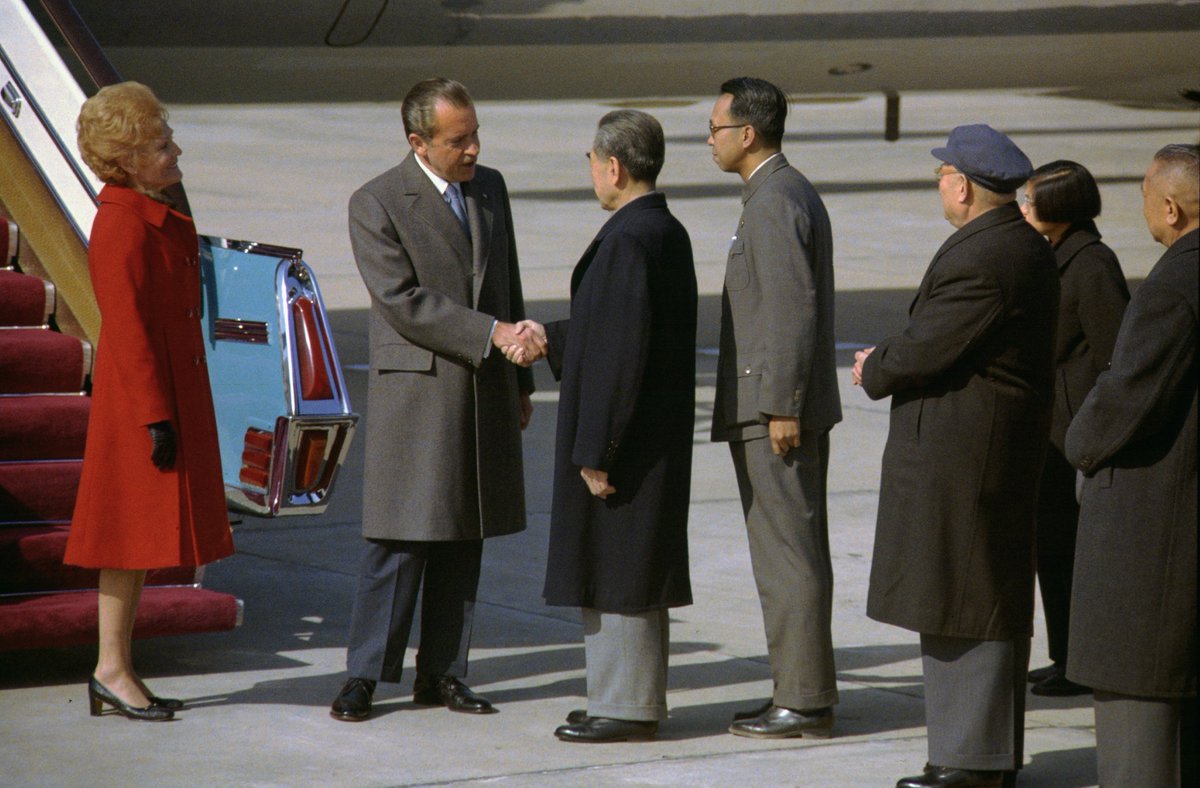
On February 19, Nixon flew to Guam. After spending one night at a naval residence there, they flew to Shanghai on February 21. Following a brief tea break at the terminal, Nixon took off again for Beijing, arriving shortly after 11 am that day.
It was then that he had the handshake with Chinese leaders that crossed the Pacific and changed history.
Reagan's itinerary was equally fascinating.
On April 18, 1984, he was still busy in DC with meetings, phone calls, and briefings, and even got a haircut at the barber shop. He also called Nancy in LA but was too busy to complete the chat. In his diary that day, he described it as "a busy time tying up loose ends," and ended the entry with: "back to packing."
On April 19, he first flew to Seattle, where he met with several business executives, including people whose companies were doing substantial business with China. Even today, Seattle remains one of the cities in the United States most closely connected to China through trade and commerce.
That evening, Reagan flew to California, where he reunited with Nancy. The two spent two days resting at the ranch, riding horses and cutting wood, getting recharged.
On April 22, they flew to Hawaii and stayed at the Kahala Hilton. Nancy, who wanted to swim in the ocean, borrowed a villa so she could enjoy swimming without being followed by the press.
On April 25, they flew to Guam and stayed at the former residence of Admiral Nimitz. The following afternoon, at 1:35 p.m., Reagan arrived in Beijing and immediately went to the Great Hall of the People to attend the welcoming ceremony hosted by the Chinese president.
That evening, at the Diaoyutai State Guesthouse where Reagan was staying, the Chinese side served a 12-course dinner. Reagan wrote in his diary:
"We heeded Dick Nixon's advice & didn't ask what things were-we just swallowed them...We both did well with our chopsticks."
Nancy told the press that, for this trip to Asia, she and Reagan followed a "feast-and-fast" diet recommended by the White House physician to help adjust to jet lag. For example, on one day she ate only clear soup, fruit, and a salad; the next day, she had macaroni and cheese, baby corn, and blackberry pie.
To prepare for the China trip, she also spoke by phone with former First Lady Pat Nixon to seek advice, and read a large number of books and articles about China. She said she read everything and there's so much to see because China was so big. She also said she's very excited about the trip, and that the only thing that confused her was the constant time changes while flying across the Pacific.
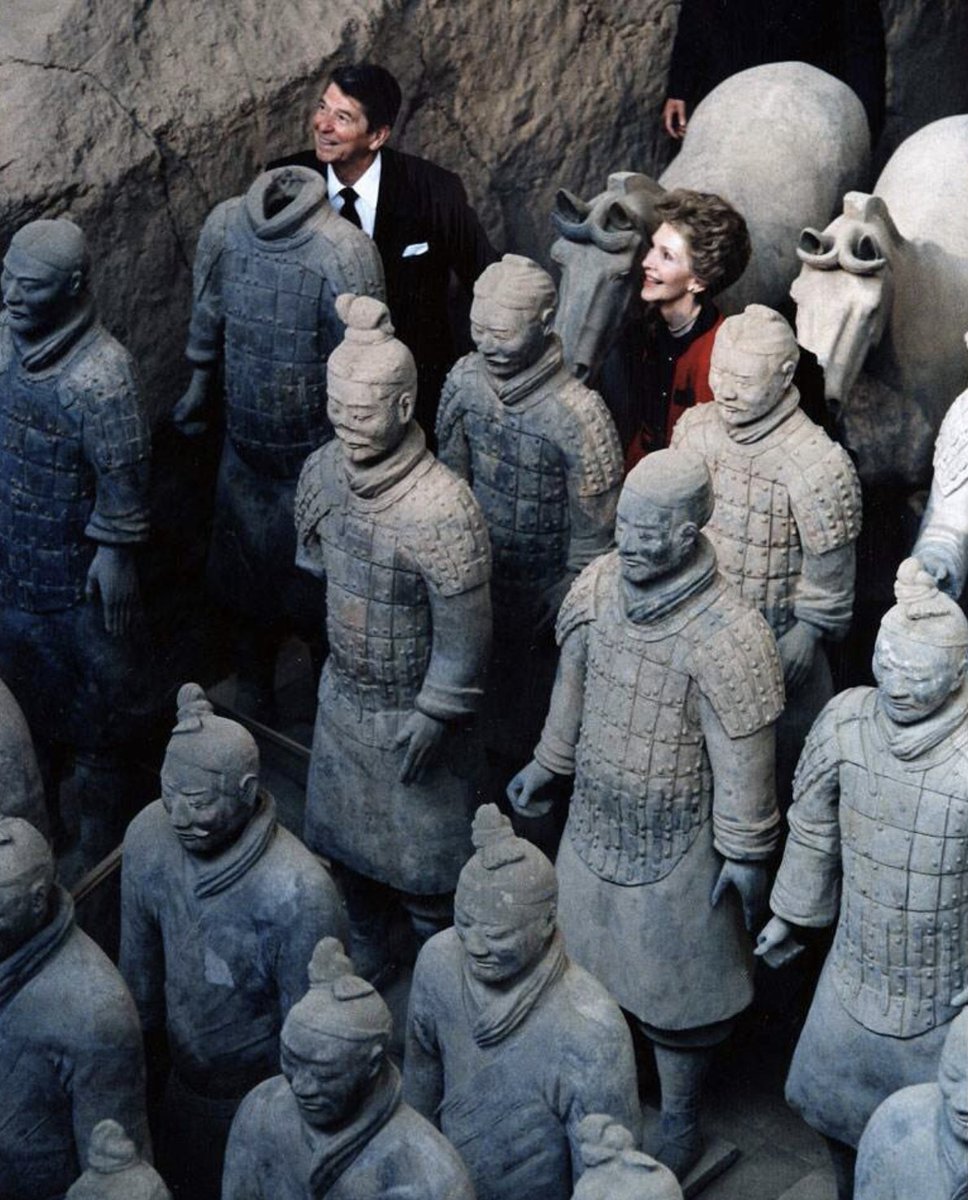
Nancy hoped to do some shopping in China. In fact, as far as I know, after visiting the Terracotta Warriors, she did buy several small ornaments at a Chinese free market and used them to decorate that year's Christmas tree.
Judging from the archives, neither Nixon nor Reagan flew directly to China, and neither did Trump. The first two presidents stopped in Hawaii and Guam to rest and adjust. According to posts by @EricTrump and White House reporter @Emilylgoodin, President Trump stopped briefly in Alaska for refuel this time on his way to China. In 1984, Reagan also made a brief stop there on his way back to the United States from Shanghai.
The details preserved in these records often speak more powerfully than grand narratives.
Beyond presidential aircraft, state banquets, handshakes, and formal meetings, there were also ordinary moments: packing luggage, adjusting to jet lag, learning to use chopsticks, cutting wood at the ranch, and buying Christmas tree ornaments in front of the Terracotta Warriors.
History is never made only of statements, communiques, and strategic calculations. It also lives in these small moments of human warmth, hesitation, curiosity, and exploration.
We've had ups and downs over the past decades. But when we look back at these archives, we may find that what moves history forward is often not fear or hostility, but those who are willing to cross the Pacific, walk toward one another, and try to understand each other anew.
Perhaps today's world still needs that kind of courage.
I think people are really underestimating this gesture from Xi to Trump. Zhongnanhai visits themselves aren't rare but it's almost always to the Ziguangge or Yingtai ... so this is a part of Zhongnanhai that I don't think foreign leaders are taken to very often if ever. Xi mentioned Putin but that is probably just about it - maybe Kim Jong Un too. So I read this both as skilled Chinese stagecraft but also a mark of respect with an embedded signal. In any case, it was meant to be something really nice.
Great insight by @mawangcun1 about the uselessness of nostalgia and the usefulness of clear-eyed thinking about the new nationalism-driven world the US and China are navigating.
POMP AND CIRCUMSTANCE, SIGNIFYING NOTHING.
That's my Trump-Xi take... Few deals. No breakthroughs. But thankfully no US concessions on Taiwan or tech.
Hard to call this summit a success, since it didn't really address any US-China structural problems. Yet not a disaster either.
4/ The two leaders operated on different planes and different timelines. Xi was looking through Trump to set longer-term expectations for a relationship that takes greater account of PRC interests/concerns. Trump was focused on securing near-term movement on US priorities.
Zhongnanhai of course is also where Xi Jinping's father Zhongxun worked in the 1950s (in West Flower Fall in the northern part) and 1980s (in Qinzheng Hall in the southern part). In the summer of 1958, Mao summoned Zhongxun to a fateful meeting at Zhongnanhai swimming pool.
Interesting that Trump called Takaichi immediately after leaving China to discuss the Chinese economy esp economic security.
This confirm the core argument of my new paper in Law and Geoeconomics: Trump’s economic security agreements are all about China.
Download the paper now at
https://t.co/z0S8pr1wRj
Note: You can get free access to the journal in 3 easy steps:
1. Go to Create Account at the top of https://t.co/8nbRk9ervQ.
Alternatively, go to Login, if you already have an account.
2. Click on your account name and click on the 'Token Redemption' tab.
3.Enter the token (LGEO4U) and click on “Redeem Token”.
@safetyth1rd Don't look at people for leadership, we all fallable, even the pope. It's like you can't judge math/science because of a bad teacher.
Look to the source of life and truth, God himself. Yt "christian apologetics", they examine with evidence and reason. Can dm vids I found helpful