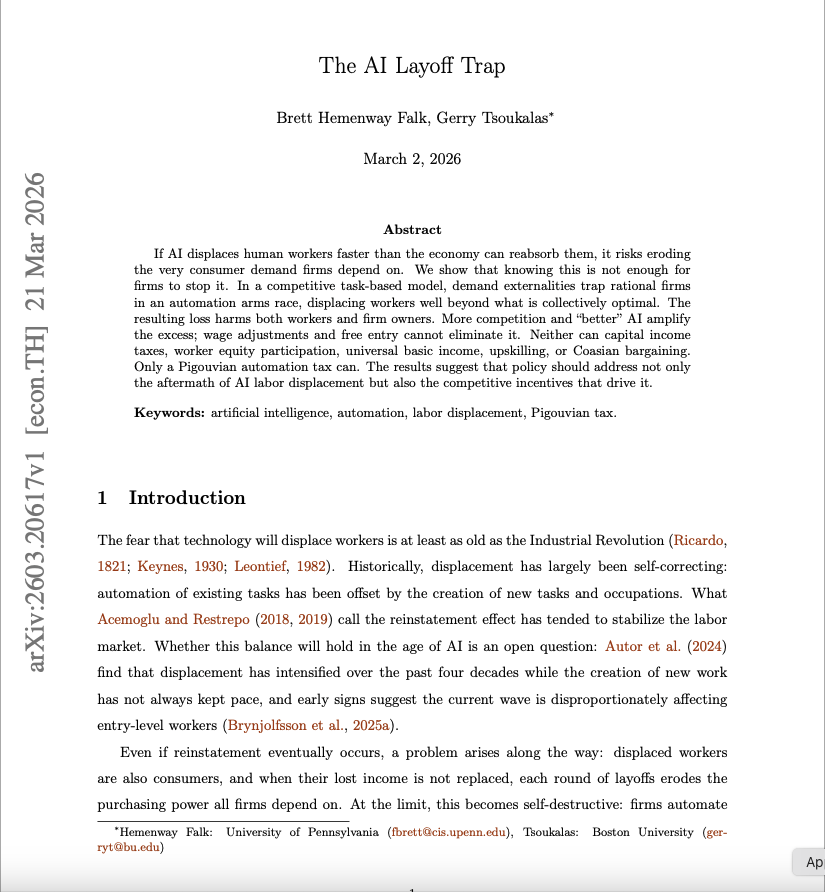
Two economists just published a mathematical proof that AI will destroy the economy.
Not might. Not could. Will — if nothing changes.
The paper is called "The AI Layoff Trap." Published March 2, 2026. Wharton School, University of Pennsylvania. Boston University. Peer reviewed. Mathematically modeled.
The conclusion is one sentence.
"At the limit, firms automate their way to boundless productivity and zero demand."
An economy that produces everything. And sells it to nobody.
Here is how you get there.
A company fires 500 workers and replaces them with AI. A competitor fires 700 to keep up. Another fires 1,000. Every company is behaving rationally. Every company is following the incentives correctly. And every company is building a trap for itself.
Because the workers who were fired were also customers.
When they lose their jobs faster than the economy can absorb them, they stop spending. Consumer demand falls. Companies respond by cutting costs — which means automating more workers — which means less spending — which means more falling demand — which means more automation.
The loop has no natural exit.
The researchers tested every proposed solution. Universal basic income. Capital income taxes. Worker equity participation. Upskilling programs. Corporate coordination agreements.
Every single one failed in the model.
The only intervention that worked: a Pigouvian automation tax — a per-task levy charged every time a company replaces a human with AI, forcing them to price in the demand they are destroying before they pull the trigger.
No government has implemented this. No major economy is seriously discussing it.
Meanwhile the numbers are already tracking the curve. 100,000 tech workers laid off in 2025. 92,000 more in the first months of 2026. Jack Dorsey fired half of Block's workforce and said publicly: "Within the next year, the majority of companies will reach the same conclusion."
Nobody is doing anything wrong. Companies are following their incentives perfectly. That is exactly the problem.
Rational behavior. At scale. Simultaneously. With no mechanism to stop it.
Two economists built the math. The math leads to one place.
Source: Falk & Tsoukalas · Wharton School + Boston University ·
https://t.co/4m8E9jQNYm
There's a physicist at Stanford named Safi Bahcall who modeled this exact principle and the math is wild.
He calls it "phase transitions in human networks." When you're stationary, your probability of a lucky event is limited to your existing surface area: the people you already know, the places you already go, the ideas you've already been exposed to. Your opportunity window is fixed.
When you move, your collision rate with new nodes in a network increases nonlinearly. Double your movement (new conversations, new cities, new projects) and your probability of a serendipitous encounter doesn't double. It roughly quadruples. Because each new node connects you to their entire network, not just to them.
Richard Wiseman ran a 10-year study at the University of Hertfordshire tracking self-described "lucky" and "unlucky" people. The single biggest differentiator wasn't IQ, education, or family money. Lucky people scored significantly higher on one trait: openness to experience. They talked to strangers more, varied their routines more, and said yes to invitations at nearly twice the rate.
The "unlucky" group followed the same routes, ate at the same restaurants, and talked to the same 5 people. Their networks were closed loops. No new inputs, no new collisions.
Luck isn't random. Luck is surface area. And surface area is a function of movement.
The lobster emoji is doing more work than most people realize. Lobsters grow by shedding their shell when it gets too tight. The growth requires a period of total vulnerability. No protection, no armor, soft body exposed to the ocean.
That's the cost of movement nobody posts about. You have to be uncomfortable first. The new shell only hardens after you've already moved.
🇨🇳 China is scaling agricultural robots.
Autonomous harvest at 24/7 cadence is the new baseline for food security.
Vision models pick, arms place, logistics sync, human supervisors handle exceptions.
Cheaper fruit, fewer bruises, happier supply chain
there is a game called "data center" on steam which let's you build and manage your own data center.
this is lowkey genius, the best way to educate people on a new trait. hyperscalers should learn a thing or two from "edutainment".
Perceptive Humanoid Parkour (PHP) introduces a modular framework that enables the Unitree G1 humanoid to perform long-horizon, vision-based parkour.
- It chains retargeted human motion clips into diverse, long-horizon kinematic reference trajectories.
- RL expert policies learn individual skills that are distilled into a depth-conditioned student policy.
- The robot autonomously selects the appropriate skill based on the obstacle geometry.
This aired tonight to 1 billion people in China. A year ago these robots could barely wave a handkerchief, now they can do backflips and kung fu with nunchucks. Physical intelligence is the next frontier.
@nainar92@nbrichtova@heyitsbeaaaaaaa@oliver_wang2@m__dehghani Want to create containers that hold & prompt dynamic/animated images, like a mini app. This would allow the container when opened to auto regenerate a dynamic & updated image or animation inside. Would be a powerful way to auto prompt and embed nano into other apps non statically
Warren Buffett: "I like to deal with people where I feel a one-page contract will do the job. If I have to have 50 pages in there to protect me against the guy I'm dealing with, I'll always wonder whether I needed 51."
@sama it would be great if internal links within chatgpt were clickable so a user could go directly to a referenced conversation. right now chatgpt can find old chats but users can't click through. real issue. It would improve internal referencing & search 10x
@ShaanVP My take- black demographic are generally seen as cultural trend setters. ref Hiphop & other forms of music, tiktok media trends etc. trends started in black culture tend to carry over to younger consumers then spread across the gen pop. aspirational positioning for cool points.