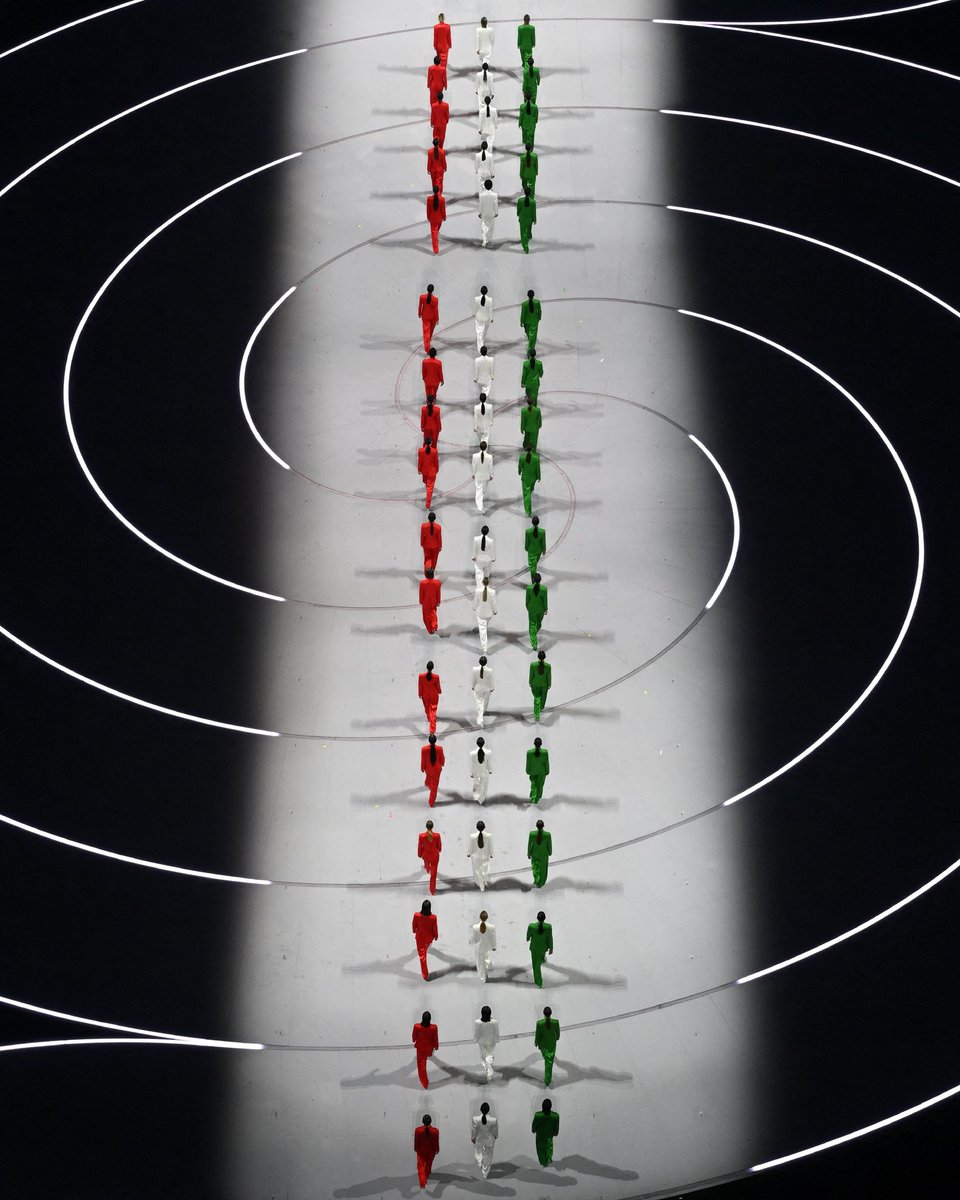
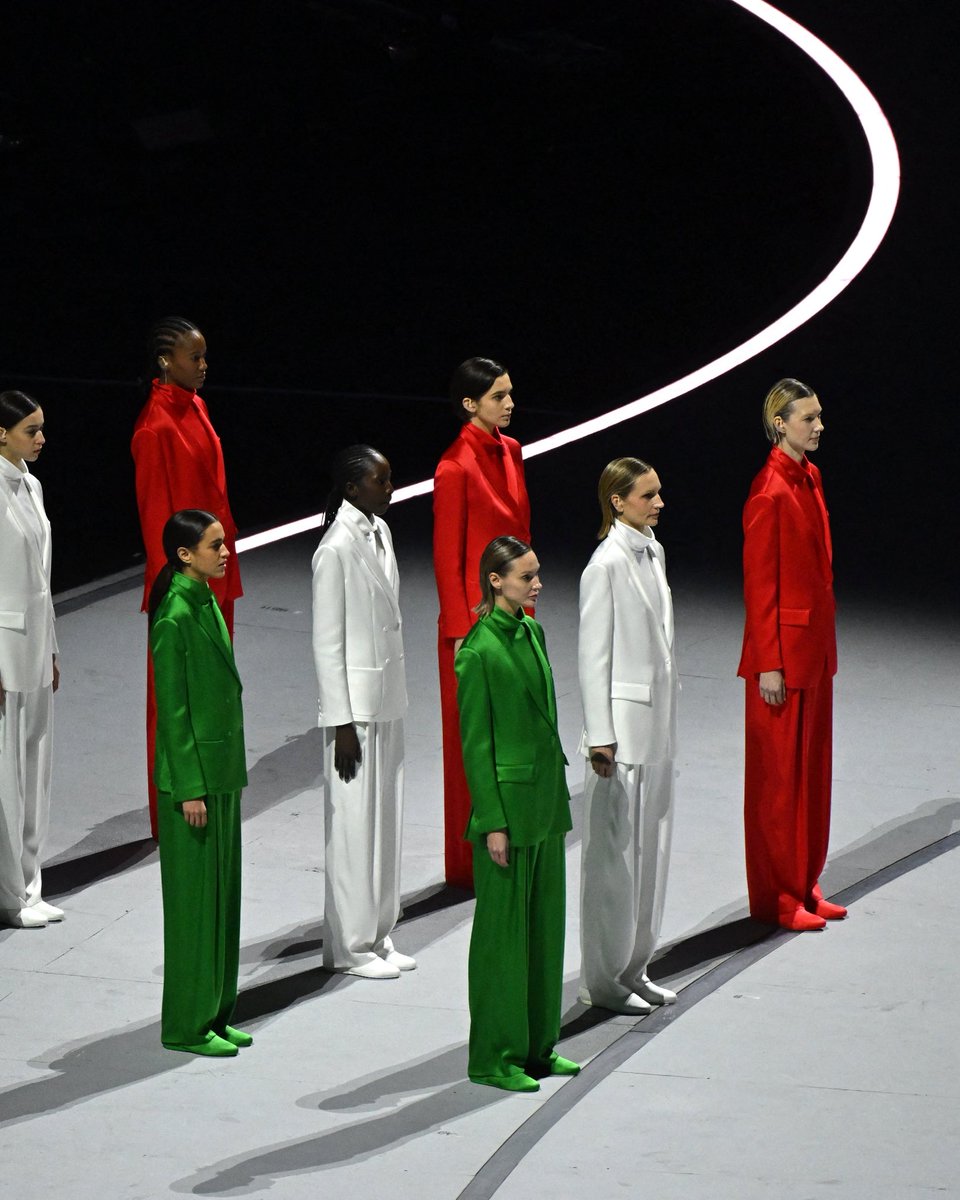
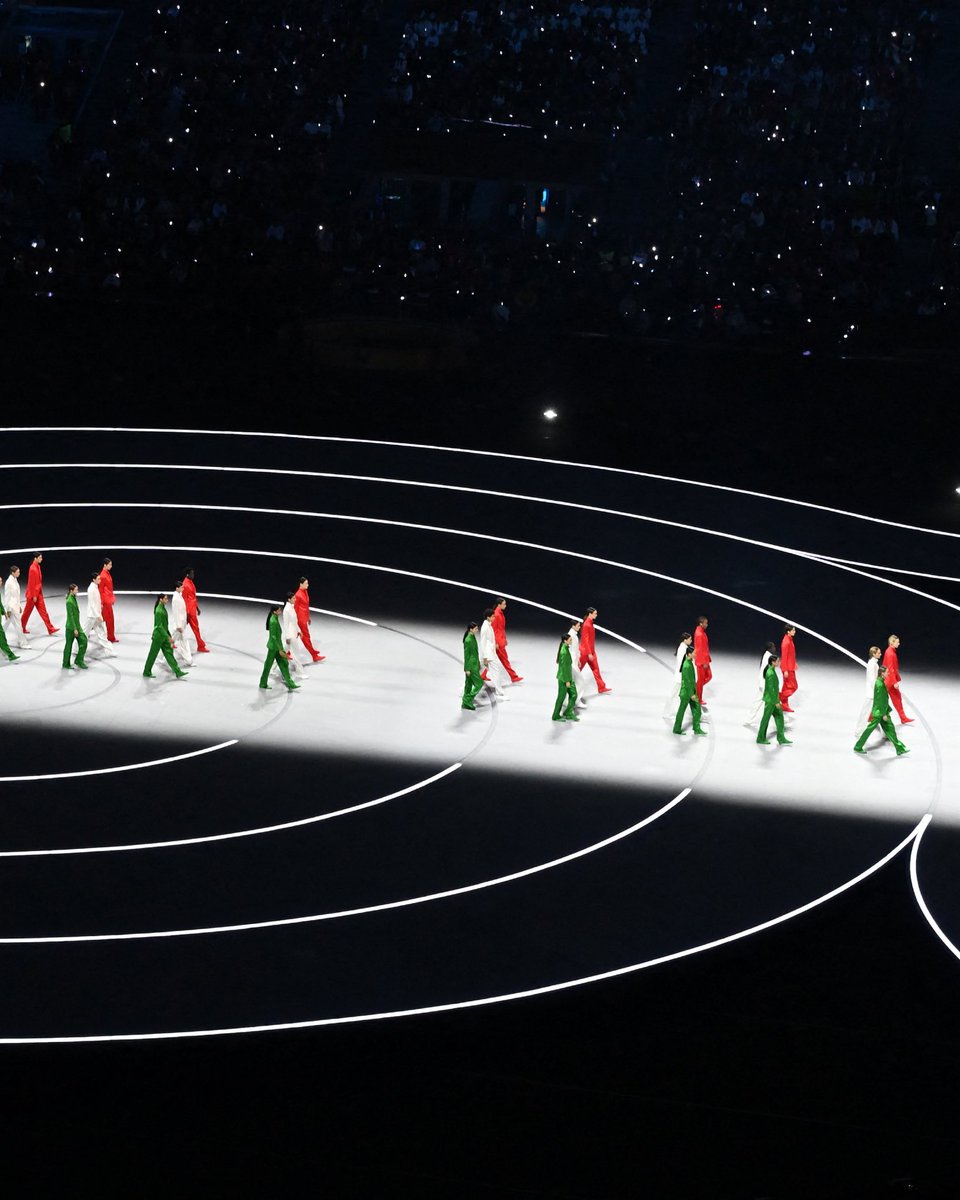
At the opening ceremony of the Milano Cortina 2026 Winter Olympic and Paralympic Games in Milan, Italy, sixty models in elegant, monochromatic Giorgio Armani trouser suits came together to form the Italian national flag—a powerful image of unity, elegance, and identity.
#MilanoCortina2026 #WinterOlympics #OpeningCeremony
I've never felt this much behind as a programmer. The profession is being dramatically refactored as the bits contributed by the programmer are increasingly sparse and between. I have a sense that I could be 10X more powerful if I just properly string together what has become available over the last ~year and a failure to claim the boost feels decidedly like skill issue. There's a new programmable layer of abstraction to master (in addition to the usual layers below) involving agents, subagents, their prompts, contexts, memory, modes, permissions, tools, plugins, skills, hooks, MCP, LSP, slash commands, workflows, IDE integrations, and a need to build an all-encompassing mental model for strengths and pitfalls of fundamentally stochastic, fallible, unintelligible and changing entities suddenly intermingled with what used to be good old fashioned engineering. Clearly some powerful alien tool was handed around except it comes with no manual and everyone has to figure out how to hold it and operate it, while the resulting magnitude 9 earthquake is rocking the profession. Roll up your sleeves to not fall behind.
New 3h31m video on YouTube:
"Deep Dive into LLMs like ChatGPT"
This is a general audience deep dive into the Large Language Model (LLM) AI technology that powers ChatGPT and related products. It is covers the full training stack of how the models are developed, along with mental models of how to think about their "psychology", and how to get the best use them in practical applications.
We cover all the major stages:
1. pretraining: data, tokenization, Transformer neural network I/O and internals, inference, GPT-2 training example, Llama 3.1 base inference examples
2. supervised finetuning: conversations data, "LLM Psychology": hallucinations, tool use, knowledge/working memory, knowledge of self, models need tokens to think, spelling, jagged intelligence
3. reinforcement learning: practice makes perfect, DeepSeek-R1, AlphaGo, RLHF.
I designed this video for the "general audience" track of my videos, which I believe are accessible to most people, even without technical background. It should give you an intuitive understanding of the full training pipeline of LLMs like ChatGPT, with many examples along the way, and maybe some ways of thinking around current capabilities, where we are, and what's coming.
(Also, I have one "Intro to LLMs" video already from ~year ago, but that is just a re-recording of a random talk, so I wanted to loop around and do a lot more comprehensive version of this topic. They can still be combined, as the talk goes a lot deeper into other topics, e.g. LLM OS and LLM Security)
Hope it's fun & useful!
https://t.co/75mXcUBI8L
Everything you love about generative models — now powered by real physics!
Announcing the Genesis project — after a 24-month large-scale research collaboration involving over 20 research labs — a generative physics engine able to generate 4D dynamical worlds powered by a physics simulation platform designed for general-purpose robotics and physical AI applications.
Genesis's physics engine is developed in pure Python, while being 10-80x faster than existing GPU-accelerated stacks like Isaac Gym and MJX. It delivers a simulation speed ~430,000 faster than in real-time, and takes only 26 seconds to train a robotic locomotion policy transferrable to the real world on a single RTX4090 (see tutorial: https://t.co/bEkIlCKqdf).
The Genesis physics engine and simulation platform is fully open source at https://t.co/DhBv7NdyqH. We'll gradually roll out access to our generative framework in the near future.
Genesis implements a unified simulation framework all from scratch, integrating a wide spectrum of state-of-the-art physics solvers, allowing simulation of the whole physical world in a virtual realm with the highest realism.
We aim to build a universal data engine that leverages an upper-level generative framework to autonomously create physical worlds, together with various modes of data, including environments, camera motions, robotic task proposals, reward functions, robot policies, character motions, fully interactive 3D scenes, open-world articulated assets, and more, aiming towards fully automated data generation for robotics, physical AI and other applications.
Open Source Code: https://t.co/DhBv7NdyqH
Project webpage: https://t.co/SBNyhFB0yn
Documentation: https://t.co/3yuBoaealV
1/n
This is what will matter 1000 years from now.
Not your politics. Not your stupid tantrums about who platformed who on some website. Not your incomprehensible desire to send NASA's entire budget to the third world.
This guy reignited the Space Age.
He spent his own money, hired a bunch of dudes, and reignited the Space Age. And together, they underbid and outdid NASA and its pet dinosaur corporations on every conceivable level.
This is history happening before you.
If you are a puddlefish, if you think this is a wasteful showpiece or science project, then you don't understand physics, economics, astronomy, or in fact the basic layout of the universe you live in.
We live in a tiny puddle at the bottom of a well.
Out there is an entire universe, full not only of stuff to explore, but full of stuff to build things out of.
Big things. Wonderful things. Things that are going to make all of the cool stuff you have today, all of human civilization to date look like early Assyrians writing stuff down on wet clay with a reed.
Infinite resources. Infinite energy. Infinite space.
Instead of fighting over little patches of land, we will have an infinite 3d volume. Enclose it in steel, pump it full of air, spin it, and it's a habitat.
Instead of scratching tiny scraps of metal out of the crust of one planet, we will break down entire asteroids and smelt them.
Instead of drilling for hydrocarbons and turning water wheels, we will harness entire suns, split the atom, and eventually draw our fuel from the substance that makes up 99% of the entire universe.
None of your local, temporal Earth politics matter compared to this. This is more important than pride parades and abortions, more important than tribal conflicts in eastern Europe and southwest Asia, more important than tensions with Russia and China.
More important, in the long run, than the United States of America.
America's most important function, its one most vital purpose, is to serve as an incubator for this.
Because this changes everything.
All of our arguments about conditions on this planet become obsolete, because the whole planet becomes just one suburban neighborhood.
All of our wars over resources and territory become obsolete, because no one has time to brawl when we're all sitting on top of a dragon horde with sacks and shovels.
Everyone who was alive at the time remembers where they were when Kennedy died in Dallas. When the towers fell. When the Eagle landed. When the Wall came down.
But this... this is the real moment, one of the first of many. They are what every child will know about a thousand years from now, even if they have four arms and are genetically engineered for zero-g, or are sentient blocks of code running on a sphere of computronium enclosing an entire star.
You may not live to see that, depending on what we do or don't invent, and when.
But it will happen, and you will live to see wonderful things.
If the puddlefish don't get in the way.
Don't be a puddlefish.
Here's my conversation with Pieter Levels (@levelsio), self-taught developer and entrepreneur who designed, programmed, shipped, and ran over 40 startups, many of which are hugely successful. In most cases, he did it all by himself, while living the digital nomad life in over 40 countries and over 150 cities. This was a fun and inspiring conversation!
It's here on X in full, and is up on YouTube, Spotify, and everywhere else. Links in comment.
Timestamps:
0:00 - Introduction
2:03 - Startup philosophy
9:34 - Low points
13:03 - 12 startups in 12 months
19:55 - Traveling and depression
32:34 - Indie hacking
36:37 - Photo AI
1:12:53 - How to learn AI
1:21:30 - Robots
1:29:47 - Hoodmaps
1:53:52 - Learning new programming languages
2:03:24 - Monetize your website
2:09:59 - Fighting SPAM
2:13:33 - Automation
2:24:58 - When to sell startup
2:27:52 - Coding solo
2:33:54 - Ship fast
2:42:38 - Best IDE for programming
2:52:09 - Andrej Karpathy
3:01:34 - Productivity
3:15:21 - Minimalism
3:24:07 - Emails
3:31:20 - Coffee
3:39:05 - E/acc
3:41:21 - Advice for young people