@elonmusk@FilmLadd Yup.
Chain of events = warning, 1 or more getting shot down, satellite vs satellite warfare, then NNEMPs from losing side (as they have no satellites left in space). SpaceX launch cadence leveraged for restoring satellite coverage. Pads become targets.
https://t.co/pk6MBj7vyQ
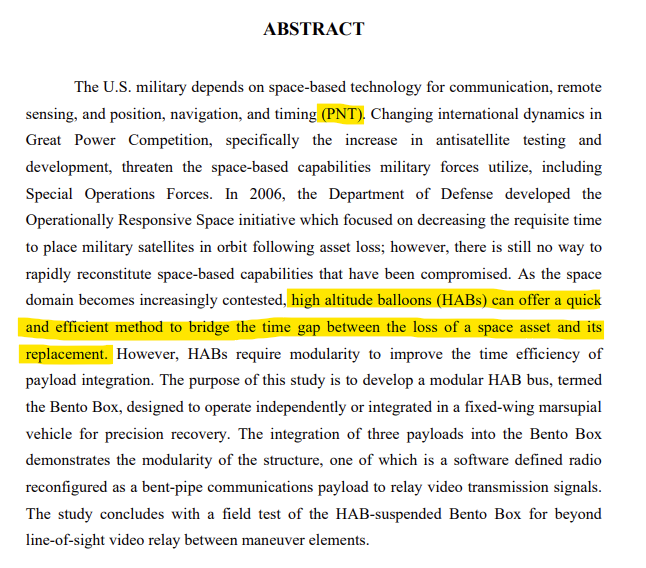
Now that everyone is concerned with Houthi drones and America's perceived "weaknesses", it makes sense to remind people about the balloon stuff earlier this year.
In the case of a future near-peer war, all of the US mil satellites will be targeted (civilian satellites as well). This is why balloons are key assets, they can patch or supplant satellite service. Acting as HA relays they can use laser beams to transmit data across large distances.
In one of the attached images, you'll see SpaceX mentioned during a cost comparison experiment. During a future war with a competent foe, their satellites will surely be targeted. Due to their great coverage and Ka, Ku, X,V, etc bands that can be used (and commandeered) by the US military. This may come as a surprise to many civilians/NPCs that don't realize how much of a US military asset SpaceX is.
Balloons are cheaper to deploy and much harder to destroy than satellites - thus indispensable for an advanced military that relies on sat networks for navigation, targeting, and communication.
Two relevant companies that most don't know about but that I expect will become more commonly known are @RavenAerostar (deleted their twitter during the China balloon saga) & @AalyriaTech. One creates the aerostats, and the other creates the internal hardware/software stack. The latter is Google's old project, Loon, rebranded and spun-off.
These types of balloons + complimentary HAPS like Zephyr will work in conjunction to enable communication in an ASAT/NNEMP contested and degraded GPS environment. Stuff like Tightbeam and NASA's DSOC/LCRD show that the US is ahead of the game when it comes to optical communication but it is important to note that our adversaries have made similar strides.
Estimated delivery timelines vs energization vs producing tokens can all be different things.
The TDLR forms are just estimates, it's best to look at satellite images/time lapses of sites Crusoe or other speedy modular companies have worked on.
DPR's speed on getting the site ready to pump tokens out of Project Ludicrous Building 1; in about one year, is among the fastest amongst American prefab'd DCs.
If you pull the docs up that shell was done 5/30/2025 and the building was officially ready for tenants 9/15/2025. But tokens were coming out to some degree by 7/2025. Some would say that last figure is probably a better measure of delivered capacity.
All that to say the facility can become a powered and operational asset well before the estimated times.
Those photos especially the one of the Firmus Batam site, are not free. If you look at the image it has a little "tilt shift" effect that is generally done with Vantor satellites (not free). The ones in the collage yeah, but they are labeled as such.
This Crusoe site in Childress will make insane progress in the next 2 months.
Well ok then, I'll bite.
@SemiAnalysis_ is once again full of crap.
"And here’s the truth for you: onepicture, >24GW of datacenters in advanced stage of construction, all to be delivered in 2027."
No your "platform" does not have accurate tracking, nor does it have a right interpretation of such.
E.G. Crusoe - Texas.
According to SemiAnalsysis, 1GW of the Childress "Hyper" Campus for $META, will be delivered in 2027.
What does the more accurate tracking show us?
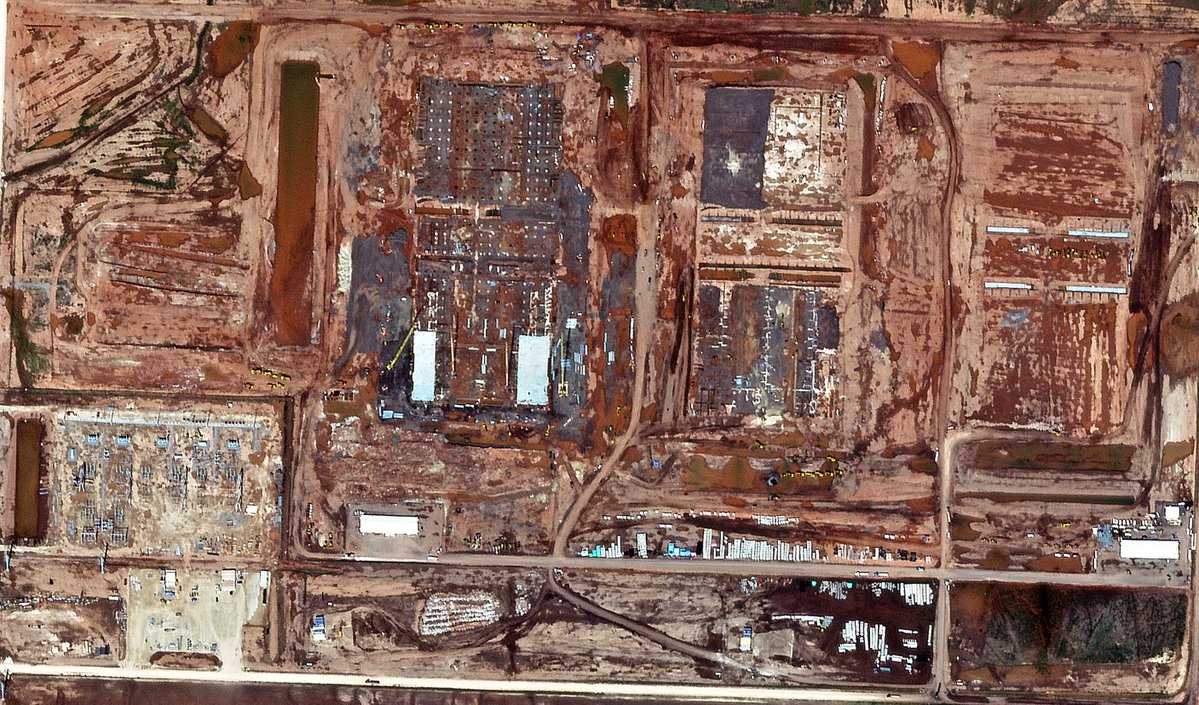
Pic 1. Satellite image from 10/18, yes, that was yesterday.
Pic 2. Aerial image from 10/9, 1.5 weeks ago.
Clearly this is in very early stages of construction, they have 6 transformers in their bulk substation, but there is hardly any step-down infrastructure in place.
Lookign at the actual building foundations, this is absolutely not a 2027 story.
But why would you trust me? My last name isn't Patel, I'm no famous headphones wearing AI quant?
Maybe listen to the actual company itself?
Crusoe has 3 TDLR filings for Project Hyper, 3 separate buildings, which 3 separate completion date. February, April, and May of 2028.
I added building 1 as the 3rd image, to make it clear this will not be a 2027 deployment.
So, a picture with many data centers may look very impressive, but SemiAnalysis uses free satellite imagery for its paid subscribers, to then mislead them with wrong intel that could be sourched for absolutely free with ChatGPT.
STOP PAYING MONEY TO THESE CROOKS, THEY ARE NOT RESEARCHERS, THEY FILL THEIR POCKETS WITH YOUR MONEY TO BUY NEW HEADSETS FOR EVERY NEXT INTERVIEW, STOP GETTING FLEECED BY THESE BASEMENT DWELLERS AND CANCEL YOUR SUBSCRIPTION TODAY.
@madebygps Using raw summary you miss the impact/weight of the words—worse recall.
I have a tool I made that I can drop videos into, and it’ll grab relevant clips from the video and cycle through them. Using peak points but also key phrases/topics. Good for exercising.
@YingjunWu true but hard to prove you can do this, regardless of if you are biased more towards sales or engineering. easier to buy off the shelf ronny g, led and bred, databricks guys. snowflake, mongodb, confluent work too. few have the breadth needed to execute without that background.
One would think but not true; sales was easier to break into in 2010s. Now you have to convince people you can full cycle sell technical products ie build demos/fde. And people often think only ex sales engineers can handle “technical” products. Because it’s so rare to see someone break the mold, they don’t often bother with other backgrounds.
Also in the current sales environment almost all channels are saturated with AI enhanced throughput. I’d say face to face, in person is probably the most effective channel rn. As in qualify in person then send your team on-site and compress the sales cycle.
And in reality non-paid work trials should be widespread, best way to vet. But they’re not that common for “legal” reasons.
been following this, so cascading. you are doing that for the love of the game? like to benchmark one vs two retimers. comparing tp=8 vs tp=4 to see what is gained by not going through the cpu (not cores or ram) just the pcie root complex?
or just to get that 9th card on without using two retimers and two uplink? ive always have seen cascading as a means to make something work with constraints vs performance/latency. i remember you were going to have just 8 on, packed max-q and gapped pros. and had lots of retimers on deck.
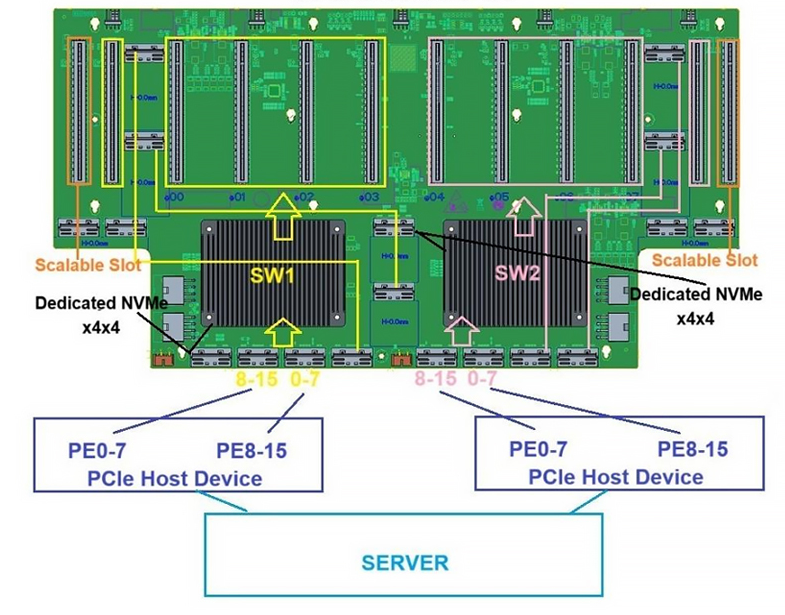
fyi for other people that get these, it is easy to get confused because the diagram for the Stars Micro variant has the same heatsink as the Broadcom. but remember pin fin heatsink = chinese. B on the model number = Broadcom.
Mainstream people are finally learning about this possibility.
You don't even need this amount of dexterity and speed, the name of the game is saturation.
Imagine a starling-esque, drone "murmuration" descending on you. Large hail stones that cause serious harm or death - reach about 100mph, and the drones would be just as fast.
You can place a small camera in each, use lasers, or use a combination of both guidance systems. A variety of shapes can increase the kinetic effect.
Future wars will be too gruesome for unmodified humans, drone vs drone combat = future. NNEMP production, EMP shielding, and sheer manufacturing (esp electronic) capacity will be the determining factors in the next near-peer conflict.
https://t.co/Ax0DZIYxiO
Marc Andreessen: "You should go through life doing the things that uniquely people can do...
I think people explore. I think people create. I think people help other people. My aspiration would be that increased technology, and in particular AI, should actually make it possible to be more human.
You should be able to spend more of your life doing things that are human in their nature and human in the sense of fulfillment, as opposed to doing the things that the machines can do for you."
@pmarca with @JTLonsdale speaking to @uaustinorg students.
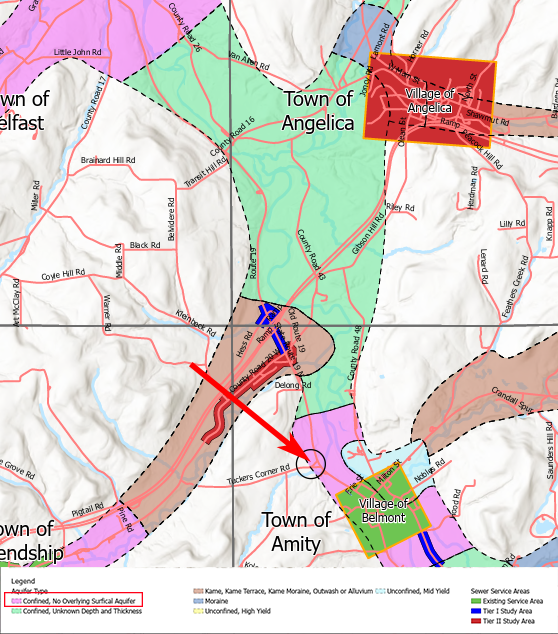
I haven't heard the developer make this point, but out of curiosity I pulled the local aquifer map. And the proposed site sits perfectly inside a confined non-surficial aquifer zone!
So literally next to freeway (loud), in a non-leaching zone, in what used to be a vehicle repair lot (loud). And people are still against it and believe misinformation like that it consumes lots of water.
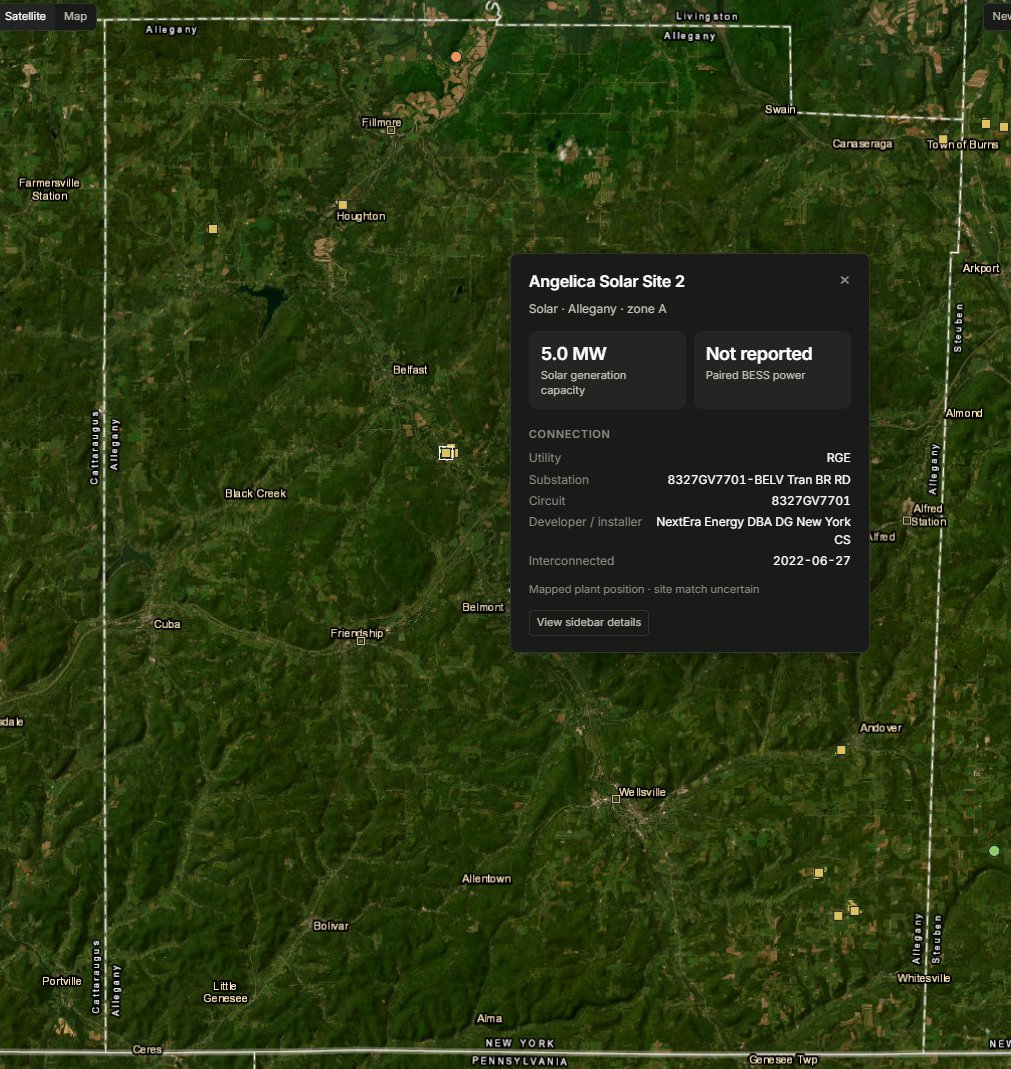
Worth mentioning this site would also enhance the county's grid (and potentially lower prices). No energy storage exists for the decently large solar site(s) located in the county. When you produce excess power; but have weak infrastructure, power goes to waste. Put simply a BESS helps with smoothing and storing that power. New York knows it needs these systems and has been standing a bunch up. They have a goal of 6 Gigawatts of storage by 2030.
All in all, more needs to be done to educate people. Even conventional technical people don't know much about this topic, it is sorta niche. So you can't really blame rural non-tech people for not knowing how battery storage systems work. It's actually a good use case for AI video gen. As it makes it easier to produce and distribute informative mainstream content.
Reindustrializing America and thereby dominating the pivotal years to come depends on a unified and power/compute-pilled populace.
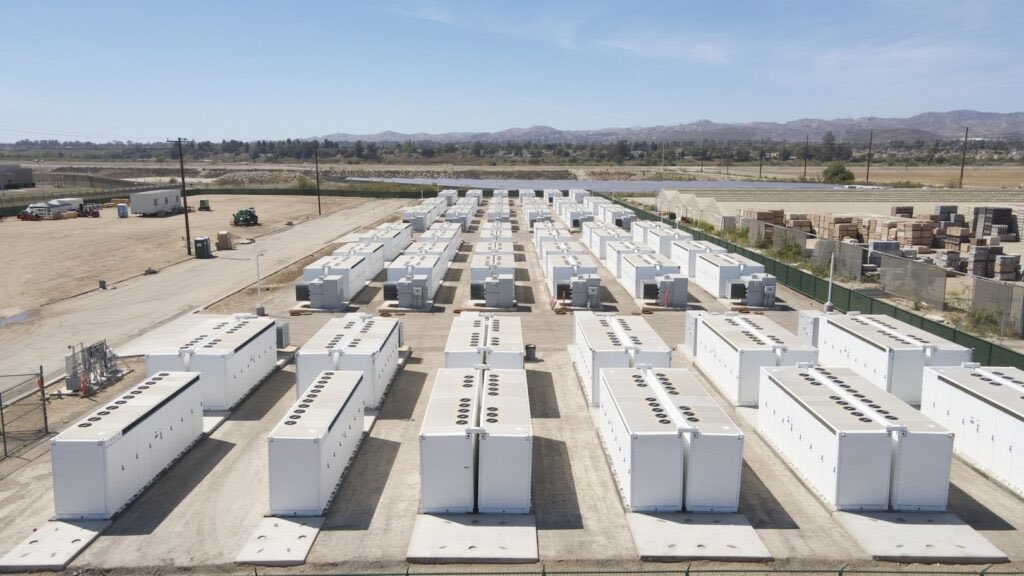
Fast forward three years, this is now a well-established meta. The main thing I got wrong in 2023 was basing calculations on math involving a 1C rating (charge/discharge). Other than that, liquid now lowers associated cooling power draw %. But funnily despite the savings, counter-intuitively it doesn't drop PUE by much. Weird technicality on how it's calculated.
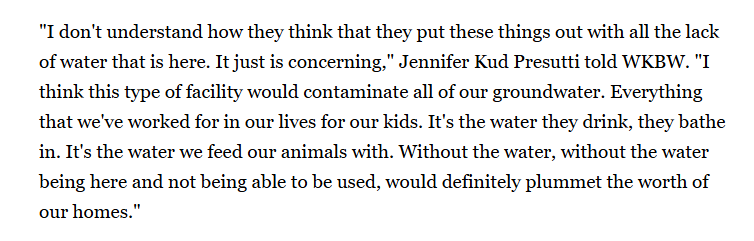
But in 2026, what is more surprising is how many people are against these BESS projects. They've sorta been lumped together with datacenter hate. In WNY there's currently a relatively small buildout that is being rejected. The main concern being danger to the ecosystem/local water supply. Which btw would generally require a catastrophic fire + secondary leaching facilitated by the water used to extinguish the fire.
Sound wise these things are not insanely loud and can even be programmed to run at lower speeds to comply with nighttime ordinances. You can also just place them far from people, use acoustic shielding, hide them with vegetation/terrain etc. In the case of this Allegany county project, the proposed site is right next to a freeway. The sound generated by cars moving at those speeds is about the max dB output the equipment is capable of at full load!
On the road or when parked and charging in the garage?
Their Megapack has lots of potential to disrupt stuff, super underrated, same w competitor Energy Vault.
Stackable modular 3 MWh vs 20-80+ MWh monolithic structure.
Thought experiment: 24,000 GH200’s = ~ 24 MWh. (8 Megapacks).
But assuming a modest 3K GH200s, you’d just need 1 Megapack per hour, running at 1 kWh TDP. 24hrs = 24 Megapacks and each one would need only 3K sq meters of panels (20% efficiency) to charge back up within 24hrs. 72k sq meters of panels with no buffer, 86.4K for 20% wiggle room (not accounting for cooling).
Anywhere red on this map could provide the required levels of solar irradiance. The needed solar energy is available even next to the coast. This opens up the ability to use solar for power and seawater for cooling which is like 40-56% of the energy use.
Microsoft’s Natick sort of proved the concept of cooling via seawater.
https://t.co/Iibd07AlMv