@BrianFeroldi@GRDecter The danger is not in letting students use tools like ChatGPT. It is in letting them learn that they don’t have to think, or believing that the tools are smarter than they are.
Now tools that create plausible yet dubious content are ubiquitous, good judgement and critical thinking are more important than ever.
I’d like to see teachers help students critique AI-written essays. Find errors, describe what is incorrect or what you would write differently.
If you showed a person in 1600 an airplane the first thing they’d compare it to is a bird.
If you showed a pocket calculator to someone in 1920, you’d have trouble convincing them it isn’t “thinking.”
If you showed Google search to someone in 1980, it would be very hard to explain that it isn’t as smart as a human librarian.
That’s why it’s always been misleading to talk about AI as a single thing.
It’s a frontier of novelty. Once it works, we get familiar with it, we stop projecting, and we give the useful part a new product name.
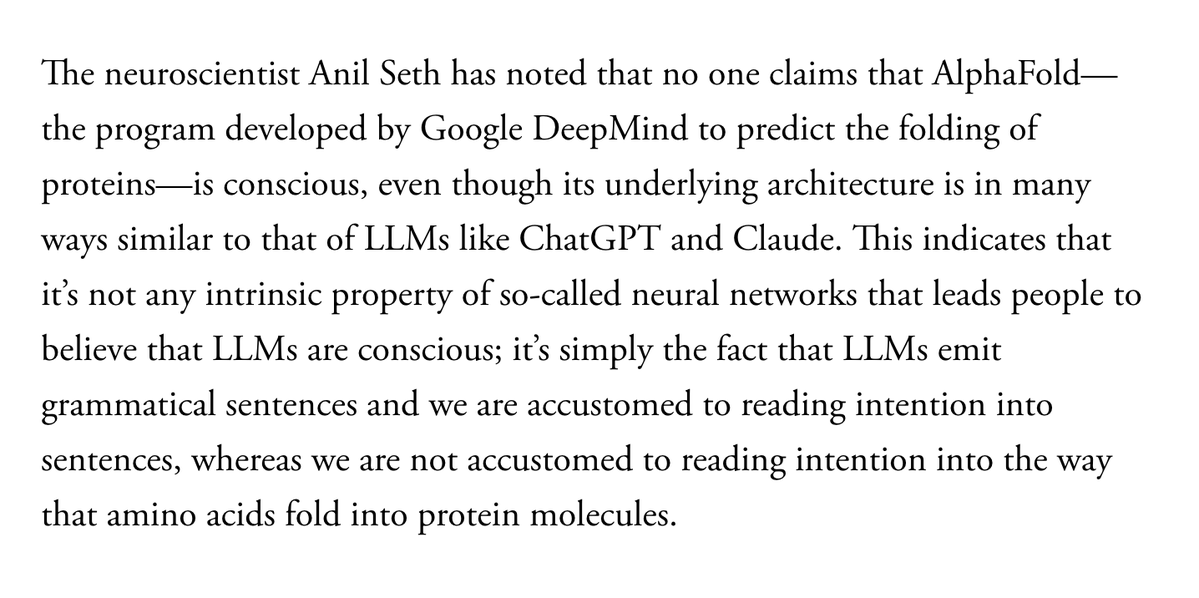
this is an interesting point in the new ted chiang piece – no one really claims that alphafold is conscious, or that sora or midjourney or dall-e are conscious
I do agree with the problem that you can’t manually manage dozens of agents using chat.
But when taking about solutions people lean toward opaque management of agents when the deeper challenge is transparency, creativity, and coordination.
For example, the best human eng and product teams are not managed purely by delegation. Unlike in an operational team, in research or software development, context and oversight are too nuanced and situational.
They benefit from the right blend of high levels of autonomous freedom and tools that make sharing and collaboration visible to all levels of management. We just haven’t figured out what this collaboration infrastructure looks like yet for agentic work.
Younger parents tend to ask my parents for advice.
I've condensed some key points over the years.
Run these psyops on your children:
- You are gifted intellectually
- You can unlock your supreme athleticism.
- Work diligently on skills and education that nobody can take away from you. That is the secret to everlasting confidence.
- You are the type of person who can achieve whatever you want when you discipline yourself to work for it – It does not just happen.
- You have an unending capacity to work, you are not lazy.
- You set your standard. Others are to fit in with you.
- Never worry about making friends, once you truly get comfortable being alone, people are drawn to you.
- Everything is a skill. You can learn anything; anything becomes more interesting the more you learn about it.
- Whatever you're interested in, be excellent in your chosen path. You will be supported.
- Genius is a state accessible to you.
- Nobody has the right to disrespect you, even at your young age. In any room you find yourself in, you have valuable contributions. They have inherent valuable because the words come through someone like you.
- Do not shrink yourself. You deserve to take up space.
- You can come to me for anything, even if you think I'll be upset – which I might be. But with me, you can unburden your conscience with the truth. I'm with you always.
I will always be the fortress that supports you until my dying days; and when I'm gone, gaze upon the spread of the heavens.
Know that I support you still.
Wow that is exceptionally good advice for dads.
Sadly, many women have had such poor parenting from their own father that they don’t even know what it looks like for a man to be a good father.
So it would be an excellent idea for a woman to read this. Not to learn how to parent her partner (she shouldn’t need to) but to ask herself if the man she is considering is capable of this kind of emotional maturity.
The flip side of this is if you don't have all three, it won’t be magic or cheap.
Human knowledge work will continue to be essential for all the endeavors where we haven’t figured out how to get all three of these attributes at once.
I’ve come to think the secret recipe is to imagine how to frame hard problems so you have three things:
(1) freedom: crate blanche for a powerful coding agent to anything it can think of (bitter lesson: general coding agents are best and keep getting better)
(2) measurement: a numeric measure of quality that is correct and precise enough small movements are meaningful (gradient descent idea works)
(3) control: wrap the uncertainty of coding agents with reliable automation that is strict and keeps the freedom to innovate within an iterative structure you can rely on (the outer loop is 5-nines code not 1-nine LLM prompts)
There is a subtle yet essential tension between the lack of control in (1), the precision of (2), and the rigidity of (3).
It’s basically “extreme freedom but in a carefully measured box.”
If you get all three, it’s magic.
Once you internalize the auto-research concept and use /goal with it, you unlock ridiculously fast app improvement on anything that has a numeric rubric.
We’re all still too rooted in the “labor is expensive” world.
@JeremyNguyenPhD@deepfates Perhaps, even if we don't realize it, we are all vibe coding iteratively improving versions of the one true ultimate app.
The Ultimate App will never be feature complete. And it will always be in alpha. But the fact that you're always building it is one of its features.
I like “higher order truth” as a description! A lot of life wisdom rests on paradox and on frame.
I’ve found mathematicians (on average!) are less practical but wiser than engineers because engineers often see most problems as optimization problems. This is good for technical problem solving but a limiting habit (socially, psychologically, and philosophically) bc they tend to assume their frame encompasses the entire problem.
Of course your formal model (or your mental models or thinking habits) may have limitations or frame problems unhelpfully. Just as awareness of your formal model is necessary to see limitations of your reasoning, mindfulness of your frame is necessary to notice limiting beliefs (about yourself and about others).
Yes I’ve thought about this too! I came to the conclusion that spirituality and paradox are linked because both involve expanding truth beyond straightforward rationality.
Math is tied to paradoxes because it can express its own limitations. Everything that matters deeply is in some ways a paradox if you lean your mind on it long enough.
I've always felt like the study of math gives deep insights into life, but perhaps not in the way people tend to think:
Logic is essential to clear thinking. Yet at its foundations, logic is shaped by paradoxes (the Liar Paradox, Russell's Paradox, Gödel's theorems).
This remarkable article from @LAReviewofBooks has a bunch of little-known facts about JD Salinger and Carl Jung.
Claire Douglas was a longtime scholar of Jung’s work and had deep archives.
But they were all lost in the 2025 Palisades fire in Malibu.
https://t.co/ZqGeGVR8wS
This is so shockingly cruel I’m not sure I can look at the author of Catcher in the Rye the same way again.
As a contingency for marrying her, JD Salinger had his future wife drop out of college and burn all her own writings.
Then he gave her a copy of the short story Franny, which was based on her, as a wedding gift.
This remarkable article from @LAReviewofBooks has a bunch of little-known facts about JD Salinger and Carl Jung.
Claire Douglas was a longtime scholar of Jung’s work and had deep archives.
But they were all lost in the 2025 Palisades fire in Malibu.
https://t.co/ZqGeGVR8wS
I’ve come to think that the way our predictive instincts in AI are so often wrong tells us something of human nature.
We tend to overestimate AI when we underestimate ourselves.
Ultimately, human intellectual and economic endeavors rest on human perception of value.
We have so poor an understanding of our own minds that we don’t realize how complex and fluid the perception of value is. Or how good (and varied) people are at adapting to new tools.