Canada, Mexico, and the US are all out of the World Cup, despite the "home bias" that has historically helped hosts advance further than expected (a bias that revealed itself in novel ways in the case of the US this time around!).
All three countries have all the ingredients to be highly successful at football. Especially the US and Mexico. The US is the world’s wealthiest country, the third most populous in the world. Even if “soccer” is the country’s fourth/fifth sport, as some apologists have demurred, it should be a perennial contender.
For Mexico, there are no excuses. Football is definitively Mexico’s passion. And at 130+ million, its population dwarfs some Latin American neighbors to the south that have made far bigger splashes in recent years (like Argentina, Uruguay, and maybe even Chile!).
I’ll give my Canada a bit of slack, since they just won their first ever game! But yes, they should aim higher as well.
So, what’s my solution? I know that there is a huge debate about youth soccer in the US, the “pay to play” nature of the game, etc. That’s all fine and well and I will leave that line to the youth sports experts. It does not hold for Mexico, however, and yet Mexico has also struggled. As such, it is a bit too much of an idiosyncratic solution to what I think is a regional problem.
For me, it’s all about the MACRO explanation (shocking, I know, but hear me out). From a top-down perspective, there is one thing that Canada, Mexico, and the US all share: lack of regional competition. The problem for all three is that qualifying for the World Cup has become automatic. CONCACAF – North America’s regional football grouping – is a joke. The three North American giants play to their competition in qualification and treat their ticket to the World Cup as an heirloom.
I think the solution is simple. Canada should join UEFA. The US and Mexico should go down to compete via South America’s CONMEBOL for the spot to play in the World Cup. Now, the critics would say that this would reduce odds of playing at the World Cup. Of course it would! But that is how you build the grit necessary to become a footballing nation.
Mexico and the US keep losing in the round of 16. Why? Because that is when you start to face serious competition that they simply do not have in the CONCACAF. The Ghanas and Belgiums await in that round. And the only way that you will get to beat those “middle powers” is if you constantly play them in regional qualifications.
Think of the gauntlet that a European or Latin American country has to get through, on a yearly basis, just to qualify for Copa America, the Euros, or the World Cup. You’re constantly cycling through incredible competition year in and year out.
If there is anything that I learned from Why Nations Fail (the incredible piece of research that got Acemoglu and Robinson their Nobel Prize), it is that institutionalizing competition and creative destruction is essential for the success of a nation. Same goes for parenting. If you constantly engineer success for your kids, they grow up into incessant brats with no grit who collapse the moment they meet real competition from kids whose parents did not coddle them in youth. Setting up a nation or a child for success requires institutionalizing failure. That is how you develop grit.
Stop trying to guarantee participation. Engineer grit.
(And yes, I am sure that FIFA would allow it. If we know anything about FIFA, it's that if there is a will -- i.e., a check and or any other form of payment -- there is a way).
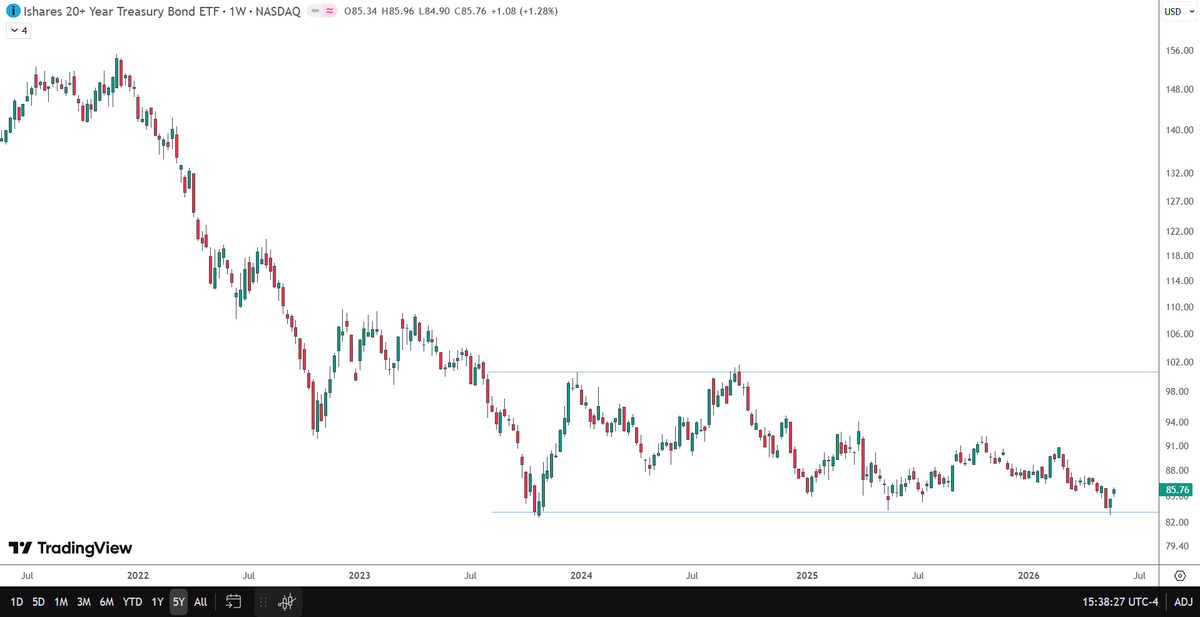
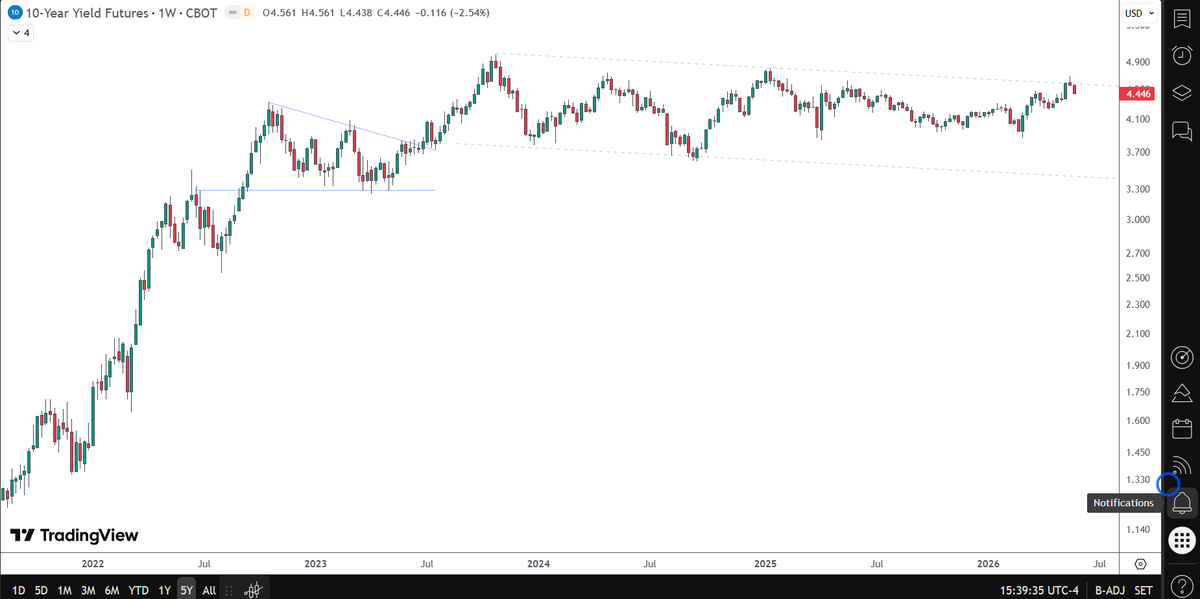
US bonds looking tasty. The weekly 10-year yields chart shows a clear rejection at the top range of a declining channel. Moreover the 20-year bond ETF just bounced from the lower range of its ~3-year channel/range. This is bullish for US long bonds. $TLT
In 1944, Danish farmer Søren Poulsen found a stone shaped like the Jutland peninsula of Denmark, inspiring him to create an entire world map by hand.
Over the next 25 years, he transformed a lake near Klejtrup, Denmark, into a massive miniature world measuring about 45 meters tall and 90 meters wide (roughly 147 × 295 feet).
Using soil, grass, and thousands of large stones, Poulsen carefully shaped every continent and country. Some stones weighed several tons, and he often dragged them across the frozen lake during winter to place them correctly.
Today, the handmade world map remains one of Denmark’s most remarkable landmarks and can even be explored by small boats around the continents.