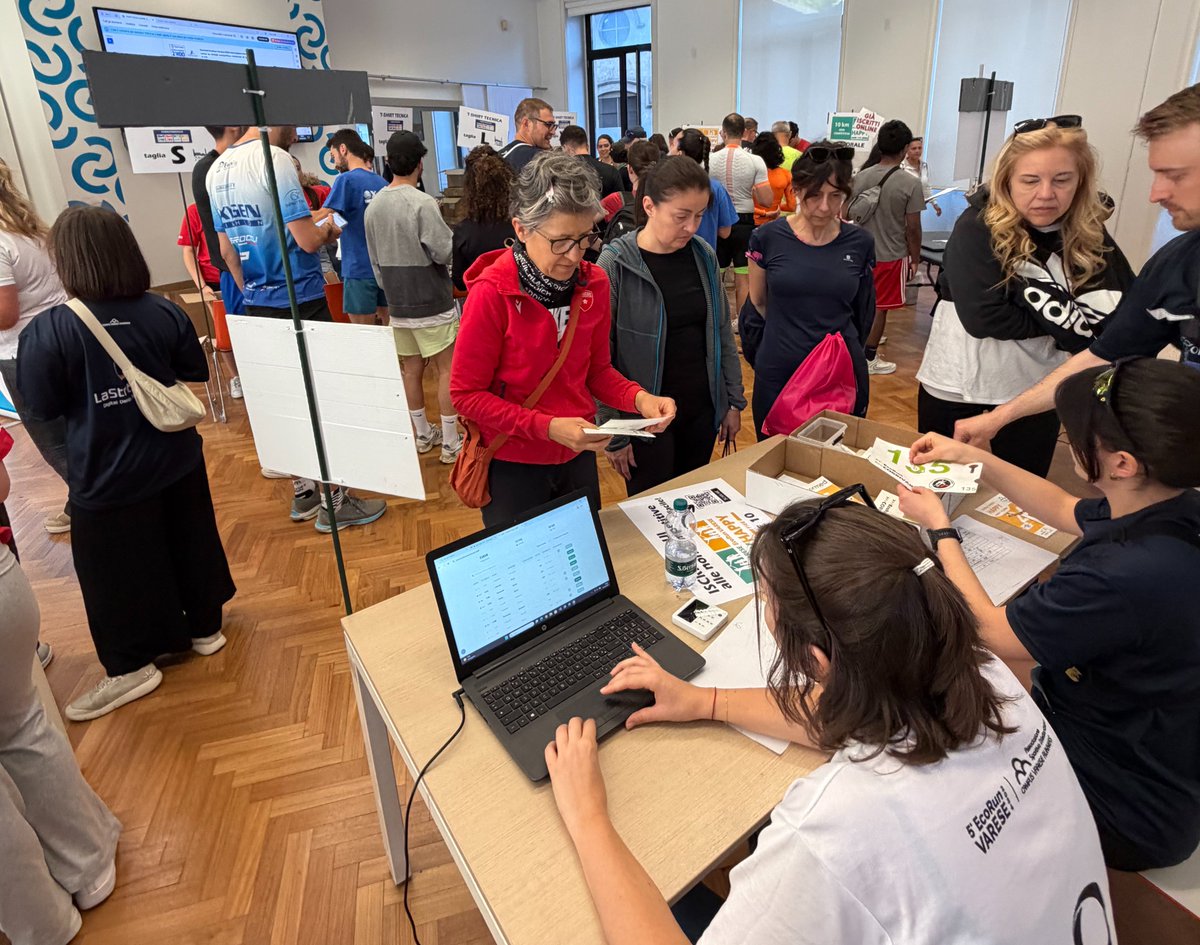
Last weekend my mom made an app to run registrations for a half marathon in my hometown in Italy.
She and a few local high school volunteers checked in 2000 runners. Signups, bib assignment, race packet pickup, payment, all of it.
To build it she used a tool I made called Spunto. It’s a “Claude Code for my mom”. You chat with it and it gives you a link to a web app ready to use or share.
My goal with this project is to share the joy I feel building with coding agents with friends and family who haven’t seen this glimpse of the future yet. Seeing my mom have that “aha” moment was exactly it.
My cousin used Spunto to plan a trip to Thailand, his roommate made an app to split apartment costs, my wife built a tracker for our 5mo boy’s feeding schedule that we now use every day, and more nice stories like this.
This was inspired by how @steipete helped people beyond software engineers “see” what agents are with OpenClaw.
Amazing times to be alive. We should try harder to bring more people along this journey. It feels great when that happens.
If you are curious: https://t.co/qvWAGILwkL
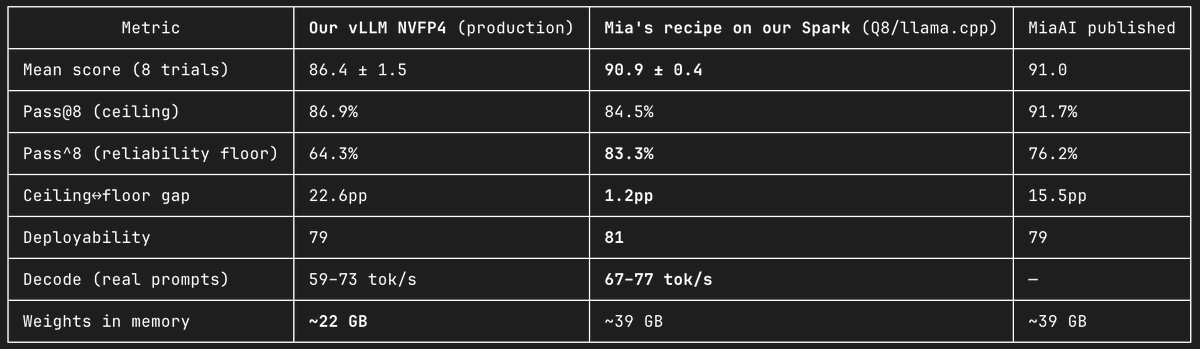
Reproduced @MiaAI_lab's tool-eval-bench result for Qwen3.6-35B-A3B (Q8 GGUF + llama.cpp + MTP) on our own DGX Spark: 90.9 vs their published 91.0. Same benchmark, 8 trials, seed 42. That's a reproducible recipe. 👏
Bonus head-to-head on the same machine vs our tuned vLLM stack: nightly vLLM, all-NVFP4 4-bit checkpoint (unsloth), Marlin MoE, FP8 KV cache, MTP k=3, plus the kernel workarounds sm_121 still needs. The 8-bit llama.cpp setup wins on quality, way wins on run-to-run consistency, and ...surprise... is even faster than 4-bit vLLM. Its only loss is memory (39 vs 22 GB). Table below.
Recipe: https://t.co/7ExSzZtiSZ
DGX Spark arrived yesterday. Had a fun time setting up vLLM and serving Qwen3.6 35B A3B NVFP4 for a custom agent I've been working on.
I'm new at this so it took a while. Learned a lot. Sharing my journey here in case it is useful to someone.
The main tip: have claude code or codex drive lol
https://t.co/MGjAv51cfw
Exciting! A great “break the glass in case of emergency” thing to have in the back pocket.
With what US govt is doing and the supply bottlenecks it’s not impossible that we will loose access to even the current frontier models.
I mean.. if big labs can’t give access to very strong models to the public, but can keep improving model performance, they might dedicate all their compute to run the smartest models for themselves, and directly use them to create products and services and generate revenue instead of renting them out by the token..
@antirez sono un grande fan e mi trovo spessissimo d’accordo con le tue analisi. Quello che hai detto sul rapporto Cina e Taiwan nella live con mr rip però è molto inaccurato. Era una parentesi e la conclusione sulla strategia open source della Cina rimane valida a mio parere. Però se hai voglia ti consiglio di riguardarti quel pezzetto di storia.. Ci tenevo a dirlo perché so che ci tieni ad essere accurato!
Mi auguro anche io che non vengano sparati colpi, e sono d’accordo che i Taiwanesi si sentono a tutti gli effetti cinesi culturalmente - sono i primi ad ammetterlo. Anzi non avendo avuto la rivoluzione culturale alcuni aspetti classici culturali sono forse più presenti a Taiwan che in mainland China. Il loro unico problema è con il partito comunista, visto anche che vivono benissimo con la loro democrazia senza bisogno e voglia di essere disturbati. Lo trovo un argomento complesso e interessante, e Taiwan un popolo laborioso e felice e mi auguro che vengano lasciati in pace. Pazzesco che si siano costruiti un sistema di “difesa” fortissimo senza missili e droni con la loro industria dei semiconduttori!
LLMs are awesome for learning. I was fascinated by the DS4 project by @antirez. It's at a technical level that was previously unaccessible to me. Now I just cloned the repo and asked my coding agent to build a course to help me understand it. Here it is in case someone is interested: https://t.co/NbOd6aknUP, even though the best part was chatting with the agent to build it and asking follow-up questions.
P.S. it's pinned to an older commit but I think the essence is there.
@awpthorp@grok You should build your own monitor. Check this out: https://t.co/d2RZAlkKpq
Uses Sensirion SEN63C (PM2.5, CO₂, temperature, and humidity) and a Pi Zero 2W.
In this case I connect it to my @openclaw agent but you don’t have to.
You definitely don’t want to be above 800ppm CO2 for a long time if you can avoid it.
My agent lets me know when my baby’s room is above the threshold. Suggests to open windows if PM2.5 outside is low. Next step is to automate the air from outside part. Let us know if you find a good solution @levelsio