Wanna check how well a model can share knowledge between languages? Of course you do! 🤩
But can you do it without access to the model’s weights? Now you can with ECLeKTic 🤯
Time understanding is an important faculty of human cognition. Is it the same for LLMs?
According to benchmarks, reasoning about time can be broken down into understanding
1. calendars and clocks, which requires quantitative reasoning, and
2. the flow and logic of time, which needs logical reasoning.
But we found that these benchmarks do not measure what we think they are measuring about time understanding in LLMs.
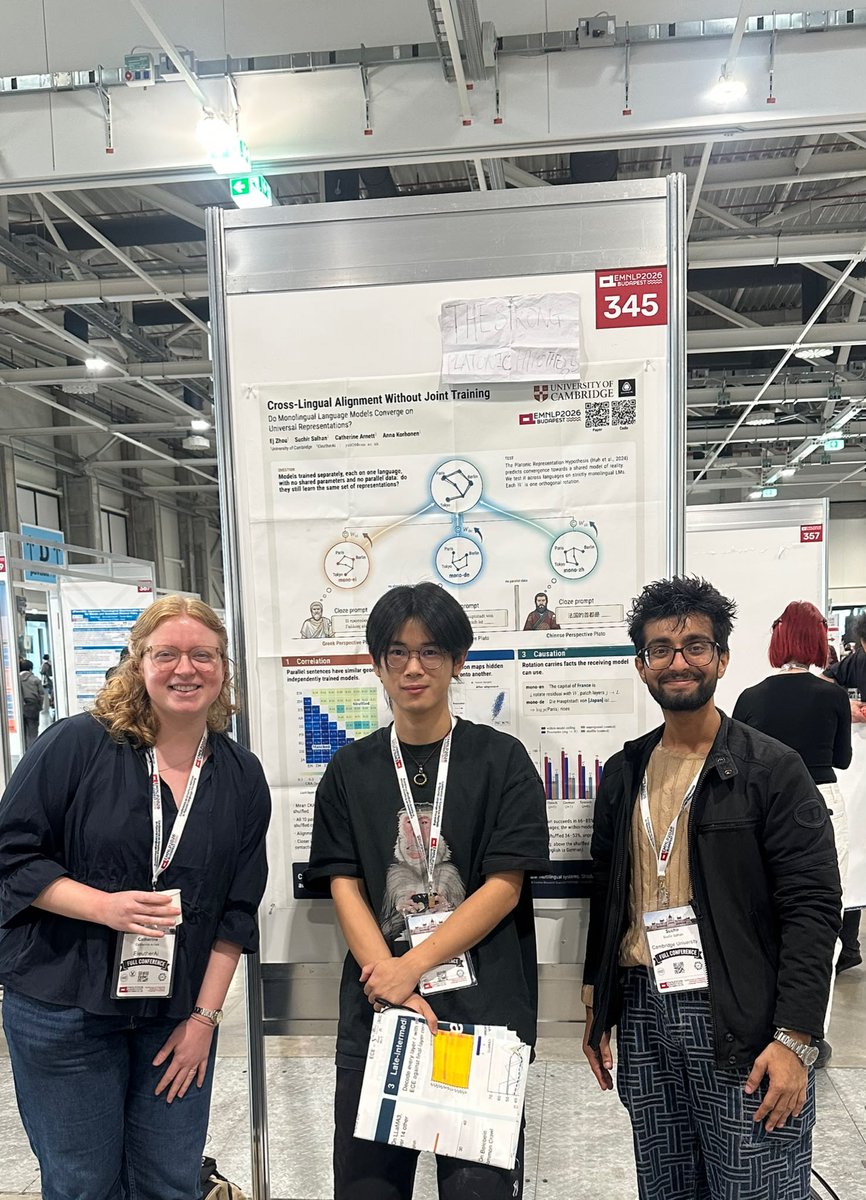
Today @EjZhou582 and I presented our EMNLP paper about how independently trained monolingual language models converge on shared representations!
https://t.co/gP3STVsVv0
#EMNLP2026#MultilingualNLP
Seats are starting to fill up for today's #MRL26 Workshop! Come join us for today's event! See you at Room F3.
Follow this account for live tweets and updates!
#EMNLP2026
As #EMNLP2026 wraps up, we warmly invite you to join us tomorrow at the MRL Workshop!
📆 09:00-17:00 GMT+1
🚶♂️In-person: Room F3 HUNGEXPO
💻 Virtual: https://t.co/Ya0wKABKFd
Also, follow this account as we live-tweet the workshop tomorrow! #MRL26
Don't miss @annalkorhonen 's keynote and the remaining poster sessions tomorrow!
And on Wednesday, @omerNLP and @ljvmiranda are co-organizing the @mrl_workshop ! Just drop by!
Enjoy tonight's socials! 🎉
It turns out tokenizer evaluations might not tell us as much about how models turn out as we thought (or hoped). Very interesting results in our new EMNLP findings paper!
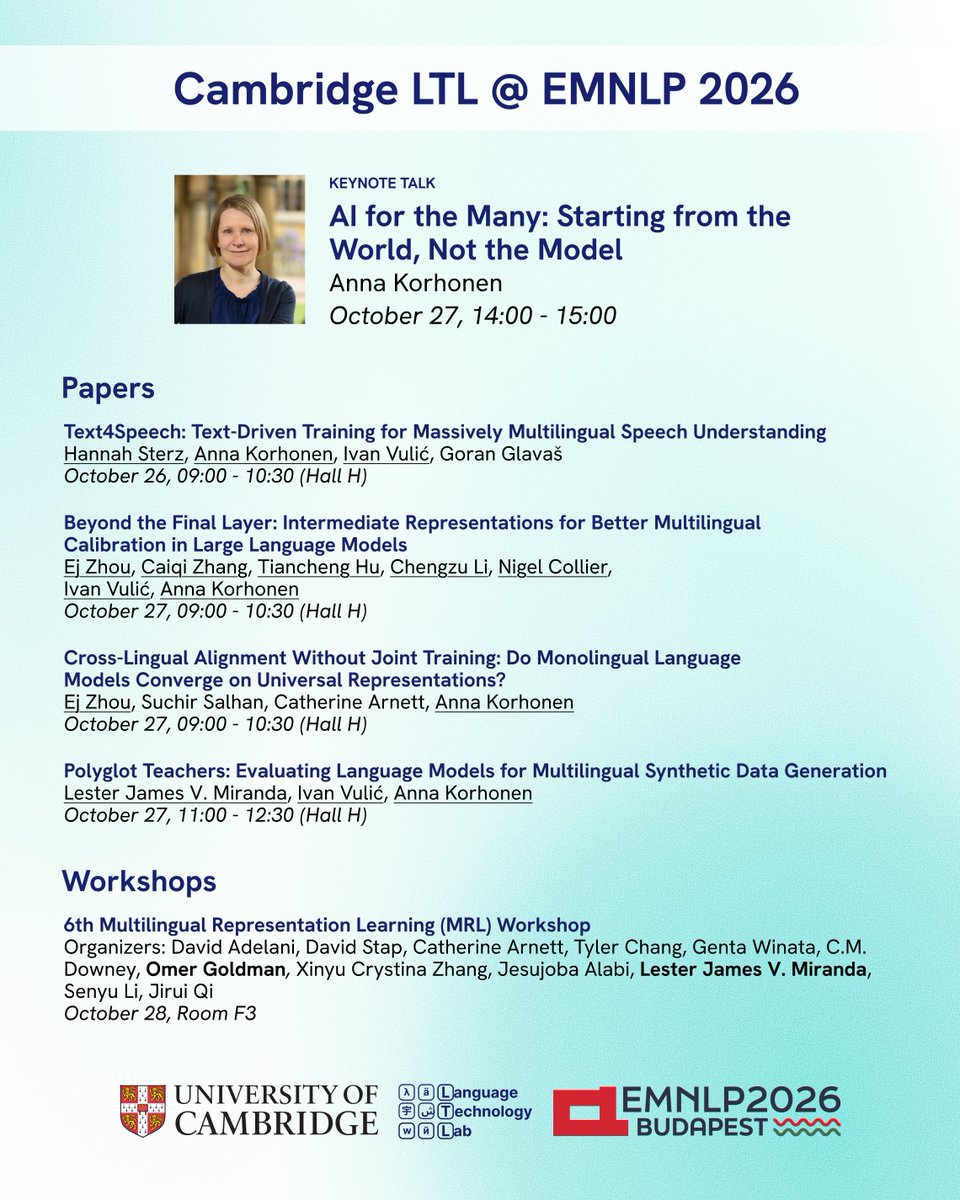
The @Cambridge_Uni Language Technology Lab is heading to Budapest for #EMNLP2026 next week! 🇭🇺
Our very own @annalkorhonen will deliver a keynote, "AI for the Many: Starting from the World, Not the Model" 🗓️ October 27, 14:00–15:00
Full sched below, come say hi! 👋
Super excited to share that our method to convert language models to byte-level has been published in @Nature!
This was originally the approach behind Bolmo. We now generalized it to other model families.
All checkpoints (including new Qwen and Llama models) and data are public!
We trained first language model for Yiddish!
On the way we learned how low-resource tasks are still a challenge for modern LLMs.
See us at a poster session at 11 am today @COLM_conf
P.S. MameLoshne is rather BabeLoshn for me, as Yiddish was native lanaguage of my grandmother.
We trained an LLM for Yiddish!
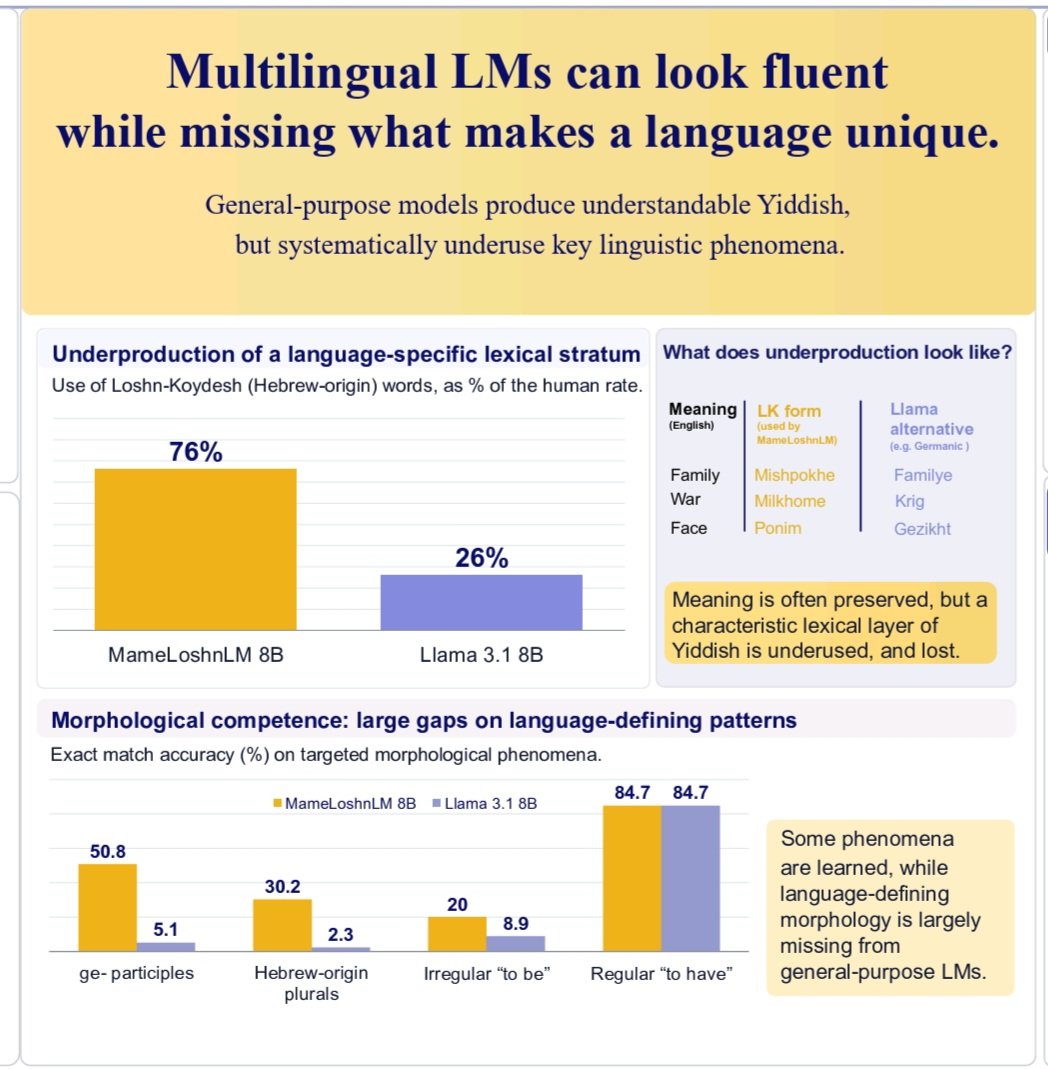
Existing pretraining data is only about 40% real Yiddish and models miss a lot of what makes the language what it is. MameLoshnLM fixes quite a bit of that!
Come hear @UrikaUri talk about it at #COLM2026. Tmrw 11am Grand Ballroom Poster #123
Yiddish combines Germanic grammar, Hebrew script, and fusion vocabulary.
Multilingual LMs can produce readable Yiddish while missing its distinctive vocabulary and grammar. The result is a flatter version of the language.
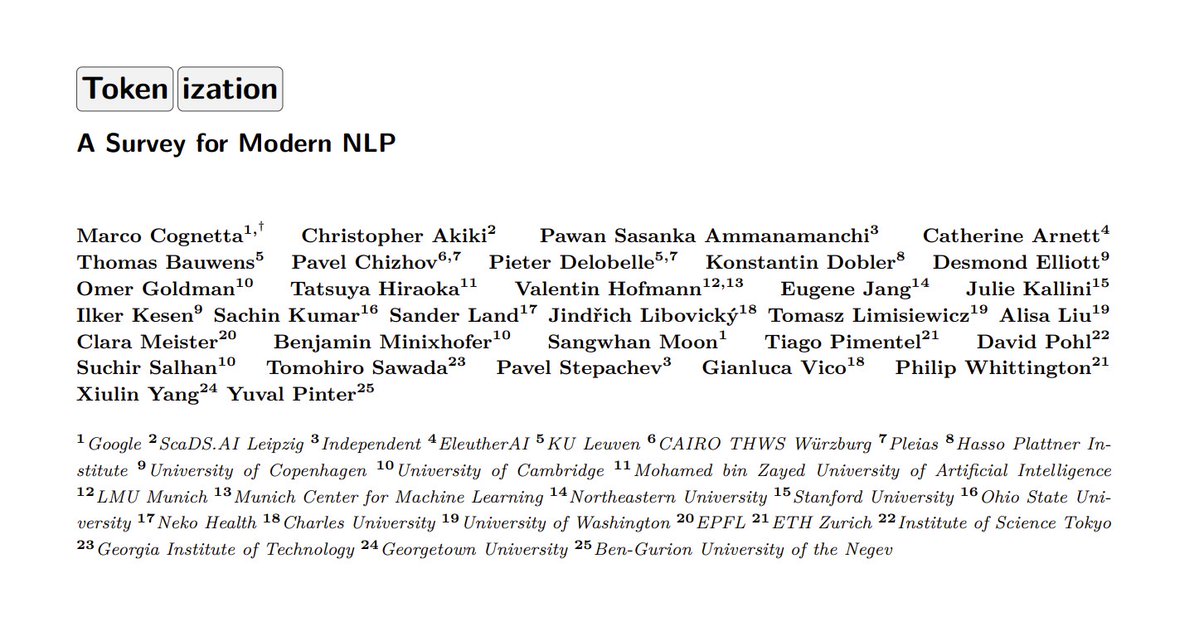
It’s been a pleasure to contribute to this survey and to see it come together!
@marco_computers did an amazing job leading this highly ambitious project which should become the go-to resource for any questions on or adjacent to tokenization.
Big start of #TOKtober ! 🎃
👉 Just out: Token _ization Survey
👉 Oct 9: Tokenization Workhop @tokshop2025 @COLM_conf 👉 San Francisco
👉Oct 28: Tokenization tutorial @emnlpmeeting 👉Budapest
Save the dates! Links below
The tokenization survey is finally out! It was nice to collaborate with such a talented group of researchers and learn a lot about the breadth of this field. Kudos to @marco_computers for leading the project!
~> https://t.co/1iOZzDuKRr
It's finally out! Marco says 8 months but it's really been brewing for years. Super excited and proud of this fantastic team's magnum opus, your guide to everything tokens.
🚨 [Token][ization] Paper Alert 🚨
Tokenization is a wildly understudied area of language modeling despite it having effects across all of NLP. Over the past ~8 months, 32 (!) tokenizer researchers put together the most comprehensive survey of the field. Check it out!