Following today’s #UN Security Council briefing, I am publishing the core elements of the proposed 15-point “Roadmap to Complete the Implementation of President Trump’s Gaza Comprehensive Peace Plan” in plain language.
• Points 1–5: Principles
• Points 6–11: Security
• Points 12–14: International Stabilization Force and IDF Withdrawal
• Point 15: Reconstruction
A thread (1/16) 🧵
There's a saying in VC: always raise from a position of strength. Founders hear it constantly. It's frustrating advice when you're not in one. But it's true.
Nobody says the same thing about CEO transitions. They should.
A CEO walking into momentum can attract great talent, earn the team's trust faster, and amplify what's working. A CEO walking into pressure is instantly playing defense.
Founder CEOs who want to get this right don't wait for the window to open. You manufacture it. You build the quarter. You get the team, the product, and the balance sheet into the best shape you can before you make the move.
That's not delay. That's what you owe your people.
I wrote about this, and the two other signals that tell you the window is opening, in a longer piece for Not Another CEO.
Grateful to the team at Not Another CEO what they're building - honest, thoughtful, and interesting stories from the CEO seat.
You have no experience.
You’ve never started a company.
You’ve never had a full time job.
Nike is going to kill you.
You’re a kid.
You don’t have technical skills.
You shouldn’t build hardware.
Apple is going to kill you.
You can’t build hardware.
You can’t measure heart rate non-invasively.
Athletes don’t care about recovery.
Under Armour is going to kill you.
It won’t be accurate.
You don’t listen.
You’re an ineffective leader.
You can’t recruit great talent.
You’re going to have to pay every athlete.
You can’t measure sleep non-invasively.
It’s too expensive to research.
Athletes are a small market.
The product costs too much to make.
The product costs too much to sell.
Your valuation is too high.
Consumers aren’t going to want it.
Hardware is too hard.
You should measure steps.
Fitbit is going to kill you.
You can’t build a marketing engine.
You can’t raise enough money.
You need a real CEO.
Google is going to kill you.
You can’t be a subscription.
You can’t build a brand.
You can’t do consumer in Boston.
Your valuation is too high.
You shouldn’t make accessories.
You shouldn’t make apparel.
Lululemon is going to kill you.
You can’t predict Covid.
Stay in your niche.
You are going to run out of money.
You can’t build a health platform.
Amazon is going to kill you.
You can’t measure blood pressure.
You can’t get medical approvals.
The market is too small.
You don’t understand AI.
The market is too competitive.
It won’t work internationally.
The supply chain is too complicated.
You can’t build an AI.
You can’t raise enough money.
It’s too competitive.
Healthcare isn’t going to want it.
…
Just keep going ✌️
prediction re the end of spreadsheets
AI code gen means that anything that is currently modeled as a spreadsheet is better modeled in code. You get all the advantages of software - libraries, open source, AI, all the complexity and expressiveness.
think about what spreadsheets actually are: they're business logic that's trapped in a grid. Pricing models, financial forecasts, inventory trackers, marketing attribution - these are all fundamentally *programs* that we've been writing in the worst possible IDE. No version control, no testing, no modularity. Just a fragile web of cell references that breaks when someone inserts a row.
The only reason spreadsheets won is that the barrier to writing real software was too high. A finance analyst could learn =VLOOKUP in an afternoon but couldn't learn Python in a month. AI code gen flips that equation completely. Now the same analyst describes what they want in plain English, and gets a real application - with a database, a UI, error handling, the works. The marginal effort to go from "spreadsheet" to "software" just collapsed to near zero.
this is a massive unlock. There are ~1 billion spreadsheet users worldwide. Most of them are building janky software without realizing it. When even 10% of those use cases migrate to actual code, you get an explosion of new micro-applications that look nothing like traditional software. Internal tools that used to live in a shared Google Sheet now become real products. The "shadow IT" spreadsheet that runs half the company's operations finally gets proper infrastructure.
The interesting second-order effect: the spreadsheet was the great equalizer that let non-technical people build things. AI code gen is the *next* great equalizer, but the ceiling is 100x higher. We're about to see what happens when a billion knowledge workers can build real software.
In 2026, ambitious people will become even more ambitious when they experience the mind-blowing capabilities of AI agents in a business setting. I’m fired up to see what humanity can deliver, and very excited to take part in it.
The Onion Theory of Risk by Marc Andreessen:
"I think the single biggest thing entrepreneurs are missing, both on fundraising and how they run their companies, is the relationship between risk and cash.
The relationship between risk and raising cash, and then the relationship between risk and spending cash.
So I've always been a fan of something that Andy Ratcliffe taught me years ago, which he called the onion theory of risk.
Um, which basically is, you can think about a startup like on day one, um, as having every conceivable kind of risk, right?
And you can basically just make a list of the risks. And so you've got, you know, founding team risk.
You know, do the founders, are the founders gonna be able to work together?
Do you have the right founders? You're gonna have product risk. You know, can you build a product?
You'll have technical risk, right? Which is maybe you need a machine learning breakthrough or something to make it work.
Are you gonna be able to do that? Um, you'll have, you know, launch risk.
Will the launch go well? You'll have, you know, market acceptance risk.
You'll have revenue risk.
A big risk you get into in a lot of businesses that have a sales force is, can you actually sell the product for enough money to actually pay for the cost of sale?
So you have the cost of sale risk. If you're a consumer product, you'll have a viral growth risk.
Well, you get the thing of viral growth. And so, a startup at the very beginning is basically just this long list of risks.
And then the way that I always think about running a startup is also the way I think about raising money, which is it's a process of peeling away layers of risk as you go.
And so you raise seed money in order to peel away the first two or three risks.
The founding team risk, the product risk, and maybe the initial launch risk.
You raise the A round to peel away the next level of product risk.
Maybe you peel away some recruiting risk because you get your full engineering team built.
Maybe you peel away some customer risk because you get your first five beta customers.
And so basically the way to think about it is you're peeling away risk as you go.
You're peeling away risk by achieving milestones.
And then as you achieve milestones, you're both making progress in your business, and you're justifying raising more capital.
And so you come in, and you pitch somebody like us, and you say you're raising a B round.
The best way to do that with us is you say, okay, I raised a seed round, I achieved these milestones, I eliminated these risks.
I raised the A round, I achieved these milestones, and I eliminated these risks.
Now I'm gonna raise a B round. Here are my milestones, here are my risks.
And then by the time I go to raise a seed round, here's the state that I'll be in.
And then you calibrate the amount of money that you raise to spend to the risks that you're pulling out of the business.
And I go through all this, in a sense this sounds kind of obvious, but I go through all this because it's a systematic way to think about how the money gets raised and deployed.
As compared to so much of what's happening, especially these days, which is just, my God, let me go raise as much money as I can.
Let me go build the fancy offices, let me go hire as many people as I can, and just kind of hope for the best."
B2B enterprise software is inherently 10x stickier than any given consumer software category.
That’s because of some combination of implemention cost, network effects (multi-sided, data, etc.), switching costs, and brand.
ChatGPT and Gemini are proving to be some of the stickiest products ever made in consumer software.
Prediction: 2026 and beyond will be about vertical AI companies building agents in B2B software categories that have generational impact because they are 20x stickier than anything else.
He only moved back to Australia two weeks ago, to fight the explosion of antisemitism there. Now @Ostrov_A was injured in the Bondi Beach terror attack—and bounced straight back up to tell the media about the ordeal.
Vertical AI founder reflections on a Saturday:
In a world where AI tools (and slop) is stacking up, founder-led growth is not just about 0 to 1.
More and more #Construction and #CRE companies are struggling to figure out signal from noise in the crowded AI landscape.
I’ve been enjoying spending time with customers to get a sense for how they are thinking about AI. More often than not, by returning to the early-stage customer development playbook, conversations become significant growth opportunities without a hard sell.
I keep it to four questions that guide the discussion:
1. What’s the hardest thing about [describe problem]?
2. How are you solving that problem today?
3. What don’t you love about this solution?
4. If you could wave a magic wand and you have this, how valuable would it be?
Founder-led growth is critical to make the AI magic happen.
The worst part of the “Gaza genocide” lie isn’t the politics. It’s what it does to our kids.
It teaches an entire generation that facts don’t matter. Only volume, victimhood, and hashtags.
It teaches them that morality is optional as long as you shout the “right” slogan.
It teaches them that violence is justified if you can frame yourself as the oppressed.
And the most dangerous part?
It raises kids to believe that Jews are uniquely evil, not because of anything they’ve done, but because the world around them repeats it often enough.
This lie doesn’t just distort reality.
It normalizes hate. It rewards ignorance.
It makes empathy selective and cruelty fashionable.
If you want a future where kids can think for themselves, where truth matters, where hate isn’t branded as “solidarity” then the biggest threat isn’t misinformation.
It’s the adults who know it’s a lie and repeat it anyway.
They’re not just poisoning the debate.
They’re poisoning the next generation.
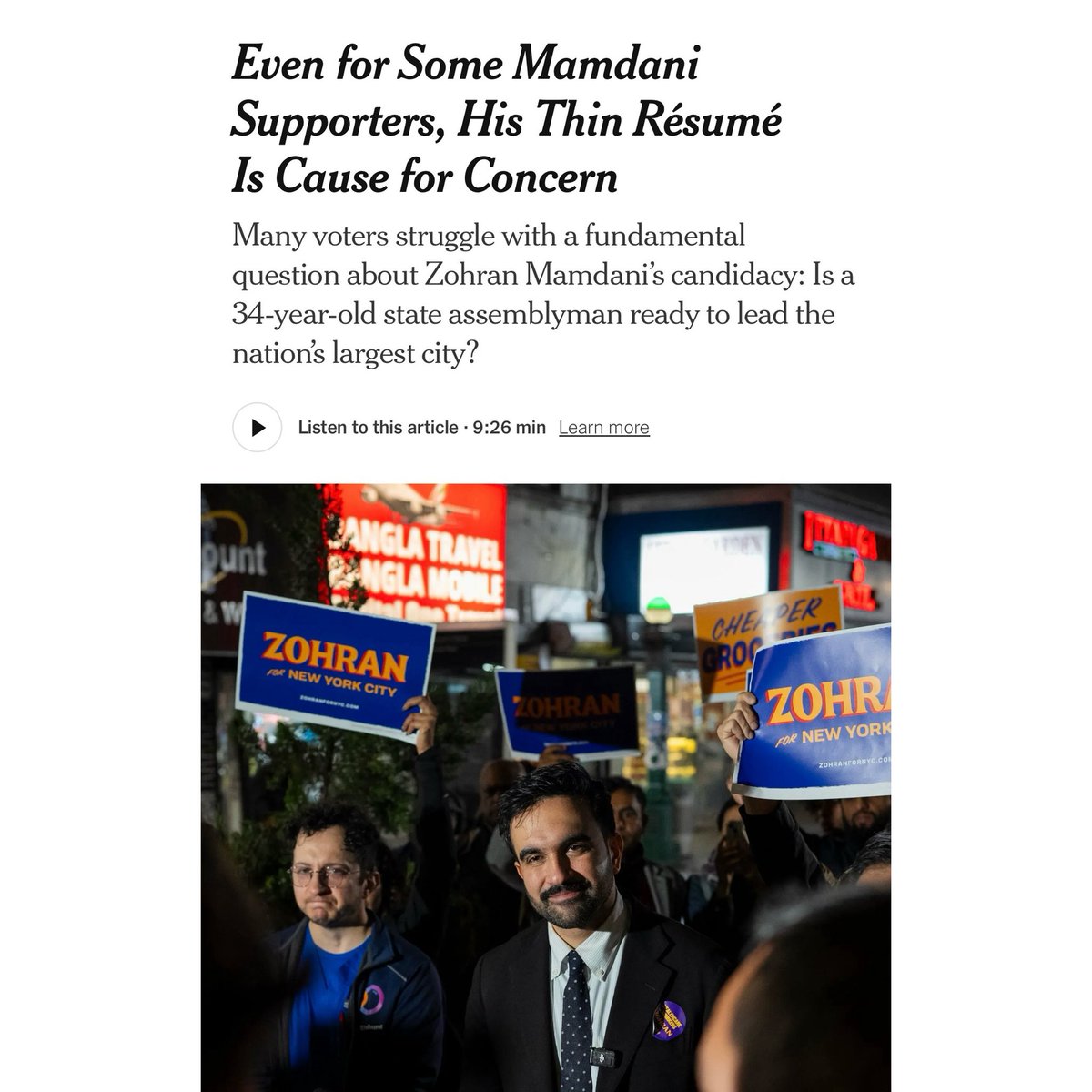
After 9/11, New York elected Michael Bloomberg: a competent, non-ideological, self-made billionaire.
Bloomberg—despite, or perhaps because of, his lack of previous government experience—went on to be a highly effective mayor. He balanced the city’s budget, even in the aftermath of 9/11 and the 2008 financial crisis. He oversaw record low crime rates. He modernized city operations; opened over 100 charter schools; supported major redevelopment projects, from the High Line to Hudson Yards to the World Trade Center.
Unfortunately, New York voters are now on the verge of electing Zohran Mamdani, a candidate who, in every way possible, is the polar opposite of Michael Bloomberg.
Where Bloomberg was self-made (his dad was a bookkeeper, his mom was a secretary, and he worked his way through college), Mamdani has spent his life riding the coattails of his wealthy and influential parents (his mom is a prominent filmmaker, his dad a Columbia professor). Despite the significant privilege into which he was born, Mamdani has few—if any—accomplishments to show for it.
Where Bloomberg spent his career in the private sector, building one of the most important companies in the finance industry and creating tens of thousands of jobs, Mamdani has literally never held a job outside of politics. He’s never had to manage a budget, let alone be responsible for payroll.
Where Bloomberg was data-driven and dispassionate, Zohran Mamdani is ideologically captured and impulsive. His interviews and speeches are a hodgepodge of social-media talking points from the Democratic Socialists of America, Students for Justice in Palestine, and other fringe leftist groups. His policy positions—rent freezes, free busses, city-run grocery stores, green infrastructure, reduced policing—are more than simply not data-driven; they’ve been categorically disproven by mountains of data and evidence from failed leftist policy experiments in other cities, time and time again.
Zohran Mamdani is the anti-Bloomberg. His background, his character, his temperament, and his platform are the exact opposite of Michael Bloomberg’s.
And the results of his administration will be as well.
This is obviously an extreme example of the productivity gains with AI agents. We can debate the numbers on this. Maybe it’s 10X or 100X vs 1000X, but the direction is correct.
What’s going to happen is we’ll just completely change our expectations for the kinds of things we can tackle now. This will benefit both sides of the barbell of complexity of projects.
The small annoying things that just keep stacking up can now be much more easily taken on - because you can just parallelize working on them in the background trivially.
But probably the bigger deal is we can begin to wrap our head around much gnarlier projects that are always hard to signup for because of resource constraints. The default of all software projects, regardless of complexity, is just going to be “yes we can take that on” going forward.
Leaders in construction and real estate face a tough choice: should you partner with vertical AI providers or build solutions in-house? This decision isn’t just about technology—it’s about how quickly you can create value, manage costs, and handle risks. https://t.co/yJGYnNstCv