My summary of CARTITUDE4, MajesTEC3, MajesTEC9 and MoumenTAL3. In anti-CD38 refractory patients and EMDs -->TCE anti-BCMA or anti-GPRC5D are >> to Cilta-Cel
It changes our algorithm for relapse. And this is what we already incorporated to https://t.co/SRJelvwfKj
First relapse dara refractory: Tec alone (or other bispecific)
First relapse dara sensitive: Tec-Dara
(Don’t substitute Tec with another bispecific till we have more data on dosing)
Immune effector cell-associated enterocolitis (IEC-EC) post-BCMA directed CAR T-cell therapy https://t.co/Het9HkEMP1
➡️Incidence 4.6%, late onset (median ~81d)
➡️severe diarrhea/colitis (84% grade ≥3), bowel perforation or pneumatosis (32%)
➡️Rx responses poor and heterogeneous, specially if no response to steroids, 1/3 improved, 1/3 persistent s/s, 1/3 died w bowel complications
➡️No clear association with ALC=hard to predict & pre-empt
➡️Often normal appearance on EGD (see supplementary)
➡️All pts with severe ongoing diarrhea post CAR T should get EGD w random biopsy (duodenum), histopathology eval, and TCR clonality studies. It seems harder to treat than GI GvHD.
#MMSM #CART #Medtwitter @BloodCancerJnl
Updated mSMART guidelines for relapsed myeloma. This is a major revision. https://t.co/9SVglZ15Ce
1) First relapse: Options are BCMA CART, Tec-Dara, BCMA bispecific, or standard triplet. How to choose?
See below.
Lenalidomide Plus Rituximab for Relapsed/Refractory Indolent Non-Hodgkin Lymphoma: 5-Year Follow-Up and Subgroup Analyses From the Phase III AUGMENT Trial | Journal of Clinical Oncology https://t.co/RNaYEb7c75
Check our recent paper @BloodCancerJnl@UAMSMyeloma@utswcancer#mmsm
Clinical outcomes and risk factors of cytomegalovirus reactivation in teclistamab-treated multiple myeloma patients
➡️n=177
➡️CMV reactivation occurs in ~22% of teclistamab-treated myeloma patients
➡️90% are asymptomatic, no end-organ damage, and no survival impact.
▶️Key risk factor: prior CMV reactivation (3x increased odds)
Read full article: https://t.co/ww7CZYZIry
@asis_shr
Check out the fully updated https://t.co/hSZd4gaUvz
The one stop site to simply enter variables and calculate current risk stratification of
Myeloma
Smoldering Myeloma
MGUS
Amyloidosis
Waldenstroms
Link: https://t.co/OpldwF6gsy
@eamadoutoure@myelomaMD@FrancescoMaura4
How specific are therapeutic monoclonal antibodies, really?
In our new paper, @Yile_Dai led a collaboration with Adimab to profile 174 FDA-approved and clinical-stage mAbs against 6,172 human extracellular proteins.
What we found surprised us.🧵
https://t.co/ONTSF60B2g
Just published:
RWE patterns in DLBCL tx show a rapidly evolving landscape. Despite progress, outcomes still decline with each LOT. No clear standard after CAR T—sig unmet need for effective, durable options. #DLBCL@fredhutch
https://t.co/7R6ddNtTYq
With almost 1,000 myeloma-related communications at this @ASH_hematology#ASH25, it is now impossible to come up with a “Top 10 abstracts” list. Here are 10 topics I found interesting and speak to the continued progress in the #mmsm field on bright display this year
Monitoring ctDNA in aggressive B-cell lymphoma: a prospective correlative study of ctDNA kinetics and PET-CT metrics | Blood Advances | American Society of Hematology https://t.co/CTuNvaoCG6
🚨Just out @CCR_AACR 🚨
V proud of our manuscript on polatuzumab efficacy by cell of origin in DLBCL
We show COO by Hans predicts pola sensitivity in 740 pts
Pts w R/R non-GCB DLBCL have higher ORR, CRR & PFS
Massive thanks @dgermain21 & collabs!
https://t.co/kGyRneMAuo
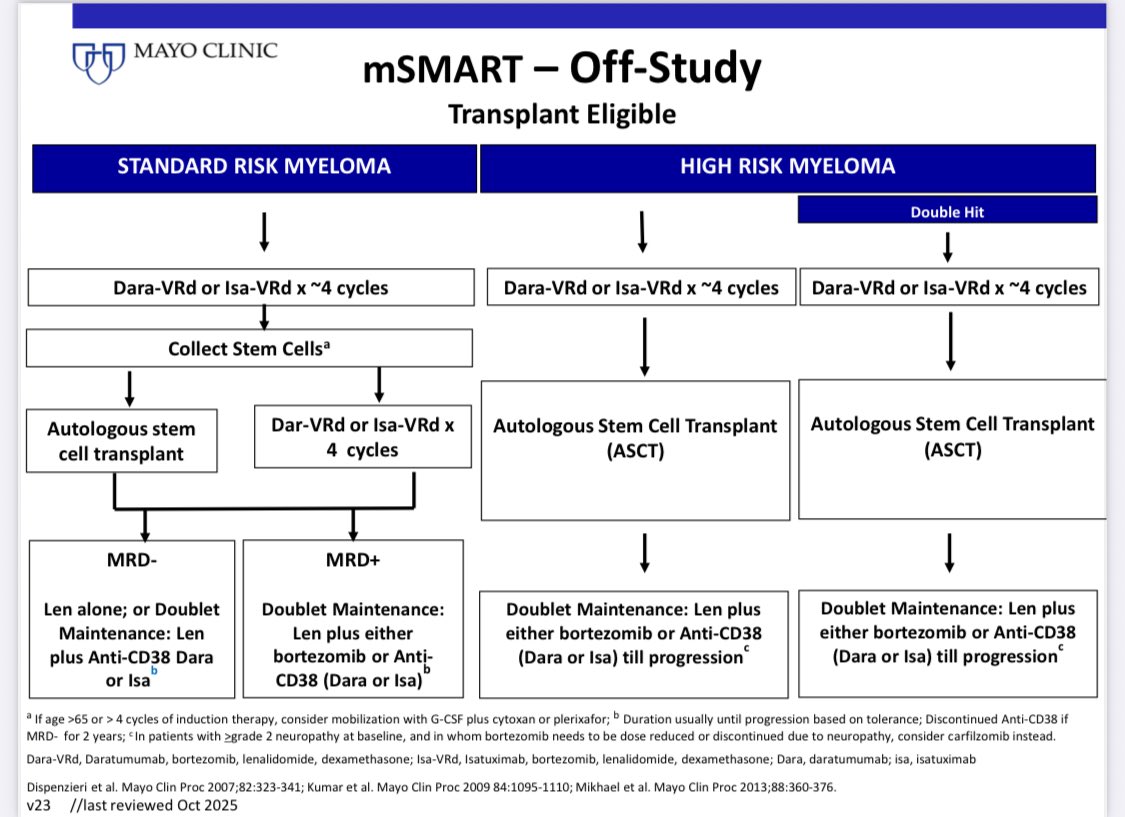
Updated mSMART guidelines on treatment of newly diagnosed myeloma.
Major change: For standard risk myeloma, doublet maintenance (lenalidomide plus anti CD38) recommended if MRD+ post transplant.
https://t.co/R4hz7ulYPb
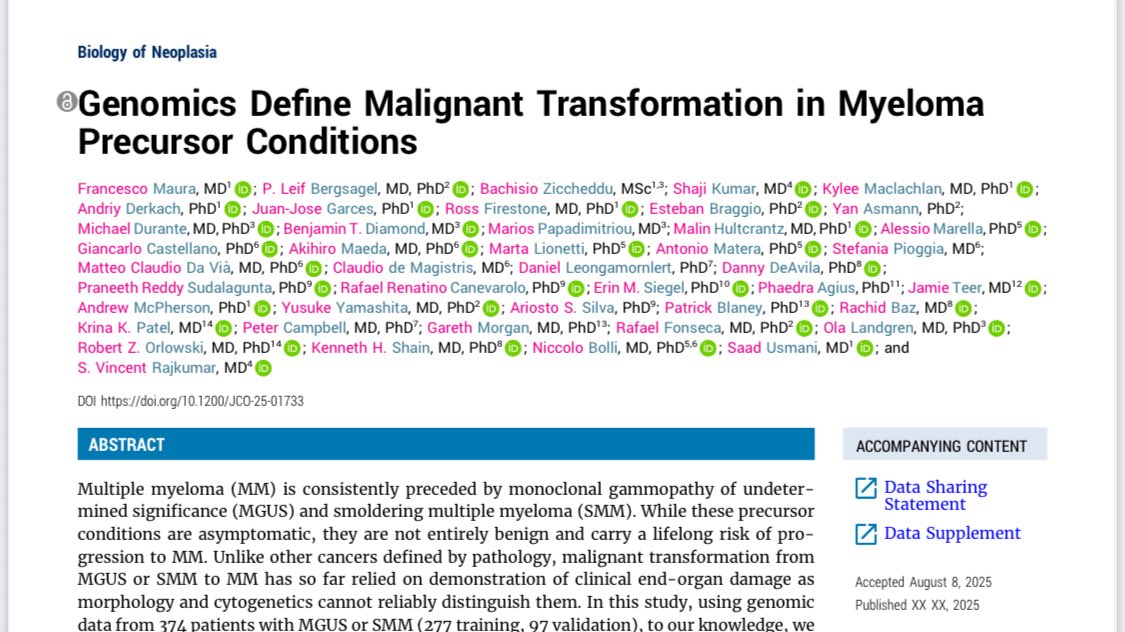
Just out in the Journal of Clinical Oncology! @JCO_ASCO
A paradigm changing paper on MGUS and Smoldering Myeloma @FrancescoMaura4
And it’s Open Access!!
https://t.co/svHThmjiCm
KEY FINDINGS:
1) We identify for the first time myeloma defining genomic events to differentiate biologic premalignancy (genomic MGUS) from biologic malignancy (genomic Myeloma).
2) We find that most of smoldering myeloma and almost all of high risk smoldering myeloma is biologic malignancy with genomic features indistinguishable from active myeloma
3) We show that some myeloma defining genomic events are also associated with high risk of progression resulting in a genomic model of risk stratification of Smoldering Myeloma.
4) We show that combining the genomic model (genomics) with the IMWG2020 model (clone size) provides a better risk stratification than either alone.
5) We provide the code and information where if you have access to sequencing you can run this yourself to determine whether the patient has genomic MGUS or genomic Myeloma
This is a major collaborative international effort with top centers and researchers pooling data so we can finally address these important questions. @FrancescoMaura4@szusmani@Leif_Bergsagel@myelomaMD@DrOlaLandgren@DrKrinaPatel@Myeloma_Doc@Rfonsi1@DrGarethMorgan1@MSKCancerCenter@MayoClinic@SylvesterCancer@Perlmutter_CC and more.
#Myeloma Paper of the Day: IFM2017-03 trial of Revlimid/Darzalex w/ 2 cycles of dex versus triplet w/ continuous dex finds DRAMATICALLY reduced progression risk (53.4 mos (95% CI 35.3-not reached) vs. 22.5 mos (HR 0.51, 95% CI 0.37-0.70, p<0.0001)): https://t.co/2xJYCJGIFo. #mmsm