it's unclear if most ppl realize that ozempic’s real effects on culture haven’t even started.
cuz what you’re seeing now is the first order effects & some glimpses of second order where ppl get thinner & some products experiencing a resurgence.
but the second & third order effects are where things might get gnarly due to the fact that these drugs seem to dampen desire itself across a surprisingly wide range of behaviors (it's not universal or obvious yet). food is simply the first & most obvious target.
liek what happens when millions of people suddenly spend less time thinking about consumption? what happens to industries built around cravings, indulgence, impulse purchases, addiction loops, or even certain forms of entertainment?
entire sections of the economy assume humans will remain governed by the same reward circuitry we’ve had for thousands of years. if these drugs meaningfully alter those circuits, we’re talking about a tool that edits human motivation.
we are gonna see thinness but in a lot of diff ways it seems like.
Measuring someone's productivity by their token usage is a horrible idea. Giving everyone the same fixed token budget isn't much better. So what's the right way to roll out AI across your org?
We built a system to measure how many productive engineering hours every Devin task is worth, validated against a dataset of real engineers’ times estimates. The goal is to answer the fundamental question that companies are grappling with: how much real value are you getting from each of your agent sessions?
On top of that, we're giving an AI productivity guarantee! Now if Devin delivers less engineering value than you're paying for, we fund your usage until it does.
The whole industry needs to move from measuring activity to measuring output. We hope to see more AI companies taking this approach.
this is like a leading franchise recruiting someone who’s simultaneously the best player & the league’s best broadcaster & its most watched developmental coach all in one.
"SaaS was Software as a Service. I believe it's going to be service as software."
@generalcatalyst's Madhu Namburi on the AI roll-up thesis. Services is a $20 trillion market.... multiple times the size of software.
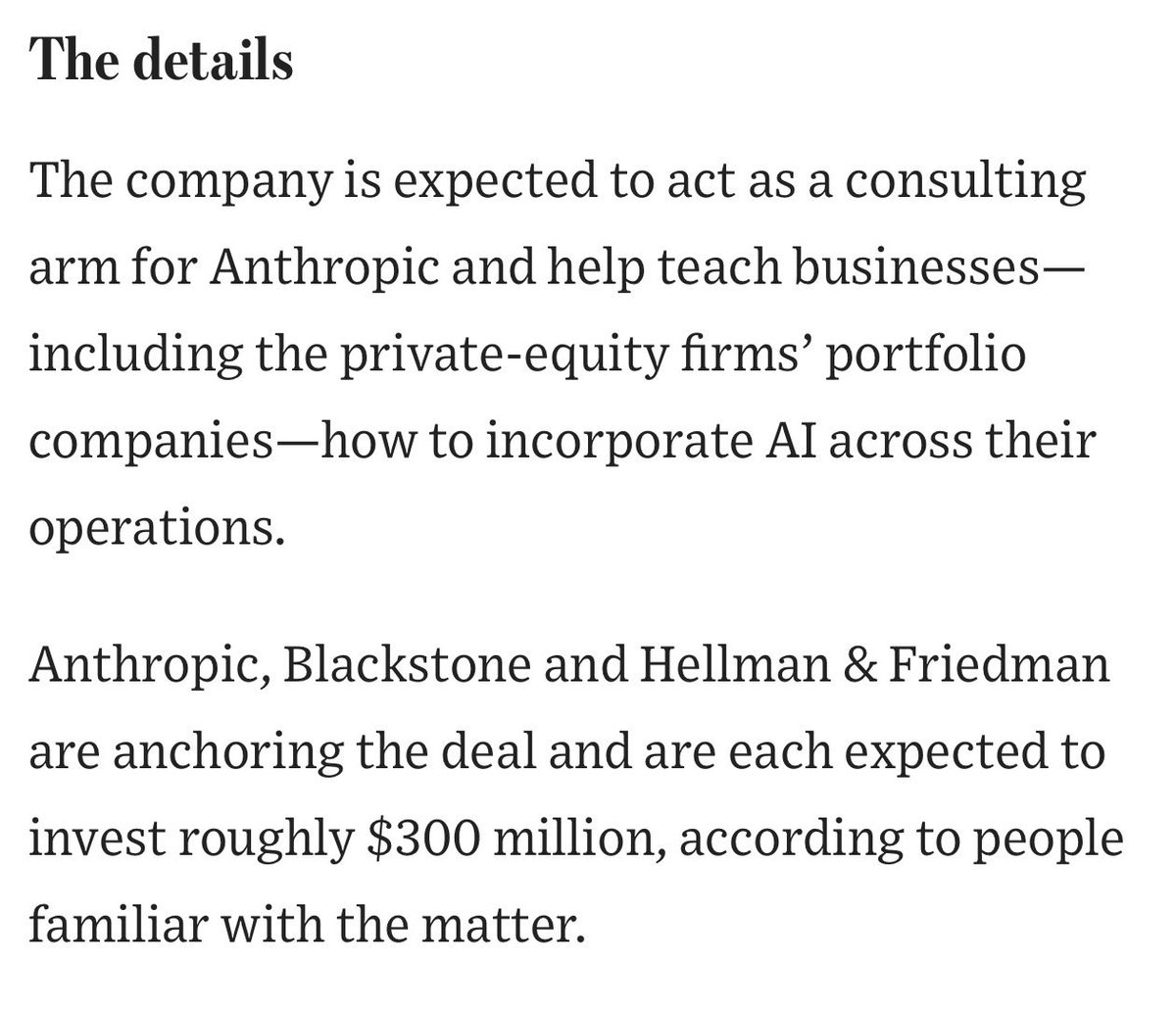
not the PE playbook of debt and cost-cutting. Venture is buying legacy companies and using AI to drive growth
The need and opportunity for professional services and FDEs to deploy agents right now is massive.
Every tech wave offers a new era of consulting and tech services requirements. Moving from analog to digital led to a massive wave in the 90s. Moving from on-prem to cloud did the same in the 2000s. But this is going to be at a scale far greater than the others.
The reason is that agents fundamentally change the underlying workflows of an organization. Unlike most prior eras of technology, where it was a change in medium of the service being delivered (on-prem CRM to cloud CRM), agents rewire the business process itself. And unlike upgrading a tech system, business processes are full of idiosyncrasies.
Every industry will have its own variants, and every department within those industries will have variants as well. Not to mention the bespoke difference between firms. Bringing agents to marketing in CPG will look different from marketing in healthcare. Bringing agents to sales in a B2B software company will look different from a car dealership.
And none of the change is easy technically. You need to first modernize your infrastructure and data and make sure it’s ready for agents; access controls, entitlements, and permissions need to be mapped in a way that works for agents and people; you need to make sure agents have the right context to work with; you need to consistently eval and maintain the agents when there are model upgrades; and you need to drive the change management of the process itself to figure out which parts the people do and what agents do.
That’s an insane amount of technical and domain-specific process work to be done to make this all happen. Huge opportunity for new service providers, as well as internally teams and roles to emerge, to help drive this change.
One interesting trend over the past year is how quickly vibes complete the full circle. In just the last few months, we’ve done multiple round trips:
- PMs went from “the role is dead” to “we still need PMs” to “PMs might be the most important function.”
- Software engineering went from “AI will wipe out coding jobs” to “new grads can’t get hired” to “software hiring is booming again.”
- SaaS itself went from “software is dying” to SaaSpocalypse to “actually, AI is software too. We are so back!”
do you notice what's happening?
> coinbase just fired 14% of their workforce to restructure the entire company around AI-native pods
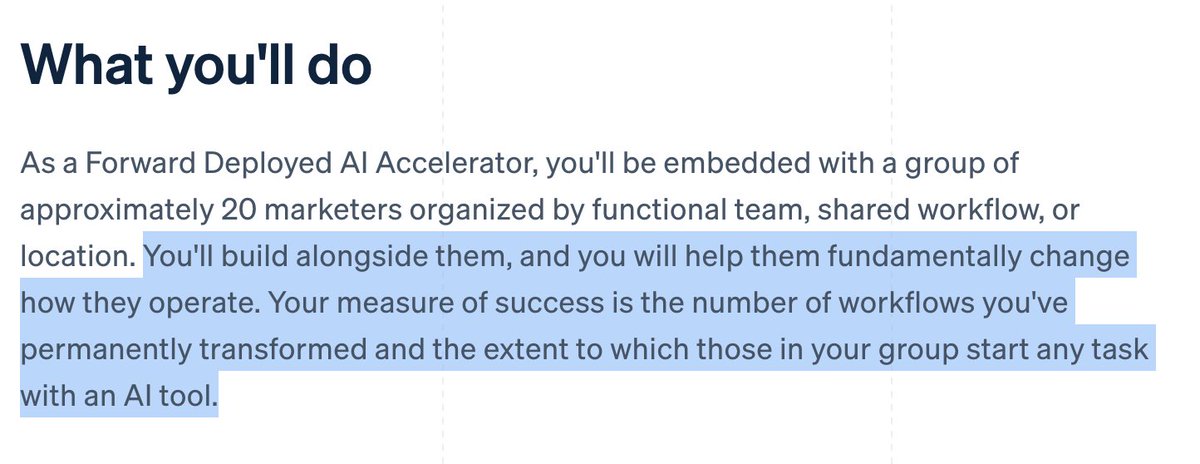
> stripe is paying multi-6 figures for a 'forward deployed AI accelerator' to permanently transform how their marketing team works w/ AI.
> anthropic and openai are both backing billion-dollar consulting companies to do the same thing across entire enterprises.
all 4 companies are telling you the same thing this week:
AI deployment is the current bottleneck.
everybody has access to incredibly powerful AI models now, but barely anything has changed about how companies actually work.
this is the same "lag pattern" that played out with electrification 140 years ago.
when electricity first became available in the 1880s, every factory ran on one giant steam engine in the middle of the building.
so when electricity showed up, factory owners did the obvious thing:
they just swapped the steam engine for an electric motor and changed nothing else.
productivity barely moved for 30 years.
then someone realized: electricity meant every machine could have its own small motor built right into it.
you could rearrange the entire factory floor around how the work actually needed to flow.
that single shift is what caused the productivity explosion.
now look at AI.
most companies gave everyone access to claude/chatgpt and changed nothing else.
same workflows and processes, just with AI bolted on top.
that's the electric motor in the steam engine's spot.
what stripe, anthropic, coinbase, and openai are all betting on is the next phase:
AI built directly into how every team works, with the workflows themselves redesigned around what AI makes possible.
that's the full factory redesign
and it's about to happen to every company in the world.
90% of tokens are wasted on iterative work. Every builder in AI knows how big a problem that is.
And it will never be solved by frontier models because of the incentive misalignment.
Harness/wrapper/app-layer, whatever you call it, will flourish just by solving that.
Because to customer thats THE VALUE.
Both Anthropic and OpenAI have new initiatives to help enterprises deploy AI agents within their organizations. This is a trend that’s early but going to get very big fast.
As agents enter knowledge work beyond coding, there is very real work to upgrade IT systems, get agents the context they need, modernize the workflows to work with agents, figure out the human-agent relationship in the workflow, drive adoption and do change management, and much more.
While AI models have an incredible amount of capability packed into them, there’s no shortcut to getting that intelligence applied to a business process in a stable way. This is creating tons of opportunities across the market for new jobs and firms, and the labs are equally recognizing the criticality here.
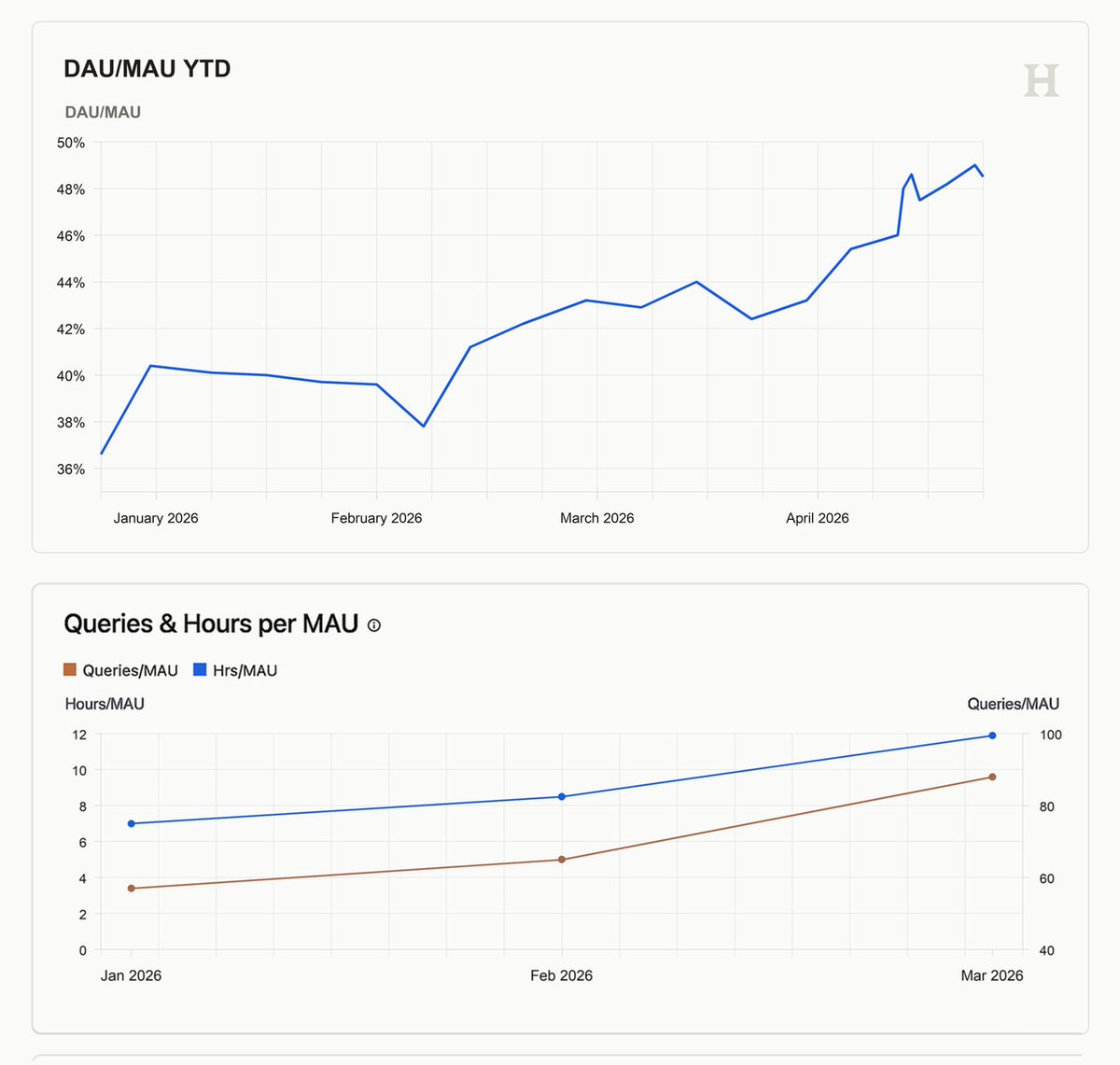
We had an incredible April at Harvey.
- Net new ARR is up 6x YoY
- We’re about to break 50% DAU/MAU
- Our average user now spends 12 hours a month using Harvey
Job's not finished.