Disability is a way of life & happy is the goal. Write, read, & craft as I’m able. 👩🦽🚶🏼♀️🌈at the sky same @, she/her Teach, homeschool mom, to all girls.
This is why I mask. Now, ask yourself who the “cigarette lobby” is after ready this article.
Then, I hope you will decide what you are going to change.
I lived through the time of getting rid of smoking in public places. Let’s at minimum do it again.
https://t.co/UgnaHc9vWQ
Preferences? Coming up with a name for the cumulative multisysytem damage from COVID so there’s a word to point to without citing 500k studies
SARS-CoV-2 Infectious Burden (SC2-IB)
COVID Injury Burden (CIB)
Cumulative COVID Injury Burden (CCIN)
COVID Reinfection Burden (CRiB)
@_P4charmed This is not normal.
COVID killed Anthony Head.
6 months after his partner Sarah Fisher died.
2 months after Nicholas Brendon died.
1 year after Michelle Trachtenberg died.
COVID didn’t end. Sarah Michelle Gellar still wears a mask (taken Sep 2025).
https://t.co/2uAH8cUNSd
@envidreamz@heysugardumplin Did you have a red eye? Like a blood vessel burst? Or you’d been up without sleep for days?
I ask because I had a vein burst, it has a name but I have to look it up. One eye has a hole. It has been two years. I get shots to close it. But with EDS & anemia, it hasn’t done it yet
@envidreamz@thecahoonfamily I had to switch from Restasis to Xidra; it does more for my eyes. However, I’m almost always carrying a container of preservative free eye drops so I can put them in all the time.
: "The happy and powerful do not go into exile, and there are no surer guarantees of equality among men than poverty and misfortune! [ALEXIS DE TOCQUEVILLE]" ⏰️
If you care about kids being on the internet but not about them being repeated infected with Covid, then you’re a stooge who only gets worked up about things because you are told to.
Time to actually be a parent, talk to your kid about the internet and put a fucking mask on.
A Grand Total of 5 Masks (including mine). * Yesterday I flew from Seattle to Maui. I saw many thousands of people hustling and bustling and breathing about as I made my way through the airports and with approximately 300 fellow breathers on the 5+ hour flight. According to the great work of Mike Hoerger, PhD MSCR MBA @michael_hoerger , there are currently between 1 in 30 to 1 in 300 cases - depending on where in the US one lives. There was a lot of SARS2 being circulated and only 5 people had the good sense to wear mask. 👀
* Iʻm not counting baggie blues - one below the nose and the other one being used as a strap under the chin. (???)
"We shouldn't overreact before we have definitive proof."
It's a common argument in public health discussions, especially when new risks emerge and uncertainty remains.
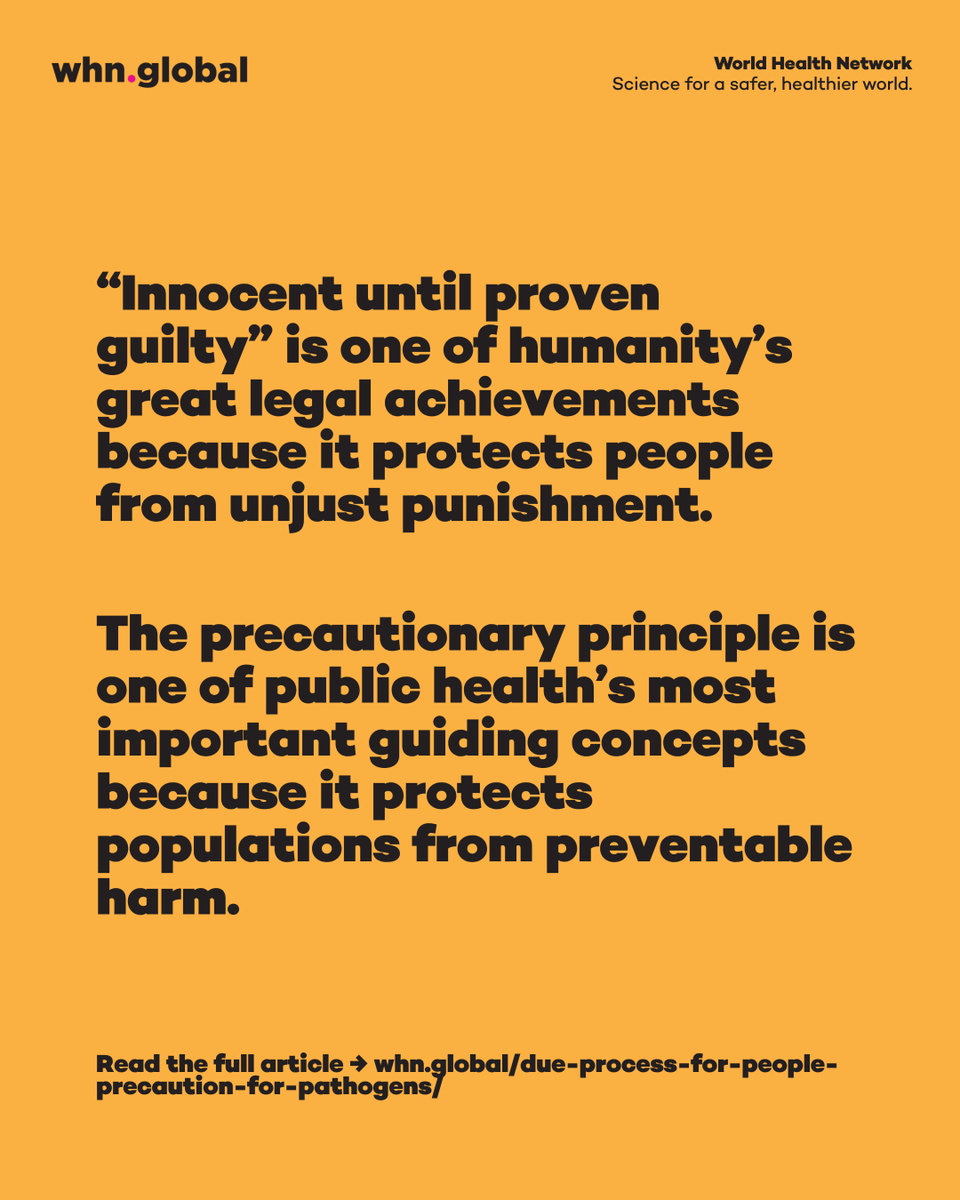
But public health isn't a criminal trial.
The principle of "innocent until proven guilty" exists to protect people from unjust punishment. Pathogens are not people. Viruses don't have rights, intentions, or due process claims. They spread, mutate, disable, and kill while we debate evidence thresholds.
The precautionary principle offers a different framework: when there is a credible risk of serious harm, lack of complete scientific certainty is not a reason to delay protective action.
From asbestos and lead to tobacco and airborne disease transmission, history has shown the cost of waiting for absolute proof before acting.
In this new article, Naomi Bar-Yam explores why public health must be guided by precaution, not certainty, and what that means for emerging threats like Andes hantavirus.
Read the full article: https://t.co/6jbRmCX754
#PublicHealth #GlobalHealth #HantavirusAndes #Hantavirus #AndesHantavirus #HealthPolicy #Pandemic #AirborneTransmission #Ebola #COVID #COVID19 #LongCOVID #InfectionPrevention
One of the strangest side effects of chronic pain is becoming an expert in things you never wanted to learn.
You learn medication half-lives.
Insurance rules.
Medical terminology.
Prior authorizations.
Imaging reports.
Appeal processes.
Pharmacy inventory.
The difference between 10 different kinds of pain.
Meanwhile, people assume all you do is sit around thinking about being sick.
The truth is, many chronic pain patients have a part-time job they never applied for:
Managing their own healthcare.
The problem is that too many people in society can’t face the reality that severe chronic illness can’t simply be “overcome”.
They can’t fathom getting sick and never getting better.
They have to believe it’s lack of effort on our part.
This aired on CNN — Laura Coates Live. And it is the most powerful single television appearance in the entire data center fight.
Consumer advocate and environmentalist Erin Brockovich joined the fight against AI data centers as communities nationwide raise concerns about secrecy, environmental damage, and quality of life. Brockovich tells Laura Coates that “the size of these places is unbelievable” and says the rapid expansion of the projects across the country is “shocking.” 
The size is unbelievable. The expansion is shocking.
Those are not words from an abstract policy debate. Those are words from the woman who drove to Hinkley, California and looked at what a corporation was doing to a community and decided she was going to do something about it. Who spent years being told she was wrong. Who helped win a $333 million settlement that changed American corporate accountability forever.
She looked at AI data centers — the size of them, the speed of them, the secrecy of them — and said: it is unbelievable. It is shocking.
And then she built a map. And 6,615 Americans filled it with their stories in 30 days.
Here is what Erin Brockovich said on CNN that every American needs to hear:
She called the secrecy surrounding data center approvals the most troubling part of the entire phenomenon. Not the water. Not the electricity. The secrecy. The fact that communities find out after the deal is done. After the NDA is signed. After the permit is approved.
After the bulldozers are already warming up.
She has seen this before. She knows what it looks like when an industry moves fast and in secret and counts on communities not finding out until it is too late.
She is not going to let it happen again.
And this week — with 71% of Americans opposed, with working class communities fighting at five times the rate of wealthy ones, with Kentucky voting out data center supporters, with Blue Island packing a council chamber tonight, with Nashville Zoo’s legal challenge filed today and 332,000 signatures still climbing —
@DEC0L0NIZE@SerenaBarton17 I actually was thinking about how small my social circle is, how small that village around me is, and how far apart it really spreads. It’s hard.
In 2009, dozens of cedar waxwings dropped dead in a Georgia yard. A lab opened them up and found their stomachs packed with one thing: bright red berries picked off the shrub by the porch.
That shrub was nandina, sold all over the South as "heavenly bamboo."
It's not bamboo, but an Asian barberry relative, and its berries contain cyanide compounds. A bird that eats a few is usually fine. But cedar waxwings don't eat a few. They descend in flocks and strip plants bare, and in late winter, when those berries are one of the few foods left hanging, a whole flock can swallow a deadly dose in minutes.
The Georgia birds were found dead beneath the shrubs they had been feeding on. It's happened since, including more cedar waxwings found dead at UNC Chapel Hill.
The berries are also how the plant spreads. Birds eat the fruit and scatter the seeds. Nandina has escaped gardens into woods across much of the South, from Virginia to Texas.
It tolerates deep shade, which means it doesn't stop at the trail edge. It can establish in intact forests and crowd out native plants. State after state lists it as invasive. It's still sitting on the shelf at the big-box nursery.
It's easy to recognize. An upright evergreen shrub three to eight feet tall, with lacy leaves that turn red in cold weather, clusters of white flowers in spring, and bunches of glossy red berries that hang on all winter.
So yank it. Get the roots, because it resprouts. If you can't remove the whole thing this year, at least cut off every berry cluster before the birds find it.
Then plant something that actually feeds them: winterberry, American beautyberry, chokeberry, or native hollies.
The birds deserve better.
Speak up and make your voices heard
The fact that there is already steel coming means there is not time. He has to understand not everything can be what he wants.
Six weeks ago I told you they were coming for Big Bend. Yesterday a court cleared the way for border wall construction in the Big Bend National Park region.
Here's what makes this so enraging:
Big Bend National Park is one of the quietest stretches of the entire southern border. In FY2025, the Big Bend sector recorded just 3,096 apprehensions — 1.3% of all crossings nationwide. Border encounters there have dropped 74% since 2023. The land is remote, rugged, and brutal. It has always been its own deterrent.
And yet — a 30-foot steel wall is coming anyway.
What that wall will actually do: fragment critical habitat for black bears, mountain lions, and the endangered black-capped vireo. Sever one of the last wildlife corridors connecting the U.S. and Mexican Chihuahuan Desert — an ecosystem that doesn't recognize borders.
Block the natural movement of over 450 bird species that pass through Big Bend. Flood one of the darkest night skies in North America with construction lights. Slice through 100+ miles of the Wild and Scenic Rio Grande.
To stop 1.3% of border crossings. On land that was already stopping them on its own.
The administration has now waived the Endangered Species Act, the National Park Service Organic Act, and the Wild and Scenic Rivers Act — all at once — to make this happen. The first time in U.S. history any of that has been done inside a national park.
They awarded $4.3 billion in contracts. Steel bollards are already on the ground near Van Horn. Construction starts this summer.
Who do YOU think this wall is actually for?
#DemsUnited
Big Bend has never needed a wall to keep people out. It keeps itself — with heat, with distance, with silence so deep you can hear your own heartbeat. For a century it has asked only one thing of us: to leave it as we found it.
This isn't really about the border. It's about whether we're still the kind of country that understands some places are worth protecting not because they're useful — but because they're irreplaceable. The Rio Grande doesn't know what a contract is. The canyon just keeps going.
What we decide to do to Big Bend will outlast every policy that brought us here.






![ReddLegend's tweet photo. : "The happy and powerful do not go into exile, and there are no surer guarantees of equality among men than poverty and misfortune! [ALEXIS DE TOCQUEVILLE]" ⏰️ https://t.co/HqMSwTSsAL](https://pbs.twimg.com/media/HKid8GvXsAA_bNR.jpg)


