Text Time-lapse is a tool I made for seeing how a text changes across its saved drafts.
It runs in your browser. Your files stay on your computer.
Try it: https://t.co/qCwnXw9rN6
Code: https://t.co/zjrj7yuW5w
Announcing my new substack! "The Science of Storytelling." Focused on bringing you the latest from the growing world of empirical research into narratives of all kinds. Will arrive weekly. Come subscribe for nuggets of wisdom about human storytelling!
🚀 Breaking news: Literary critic unconvinced that computers can tell us anything interesting about literature.
Why You Should Read More Fiction gets its first negative review!
We're definitely on to something!
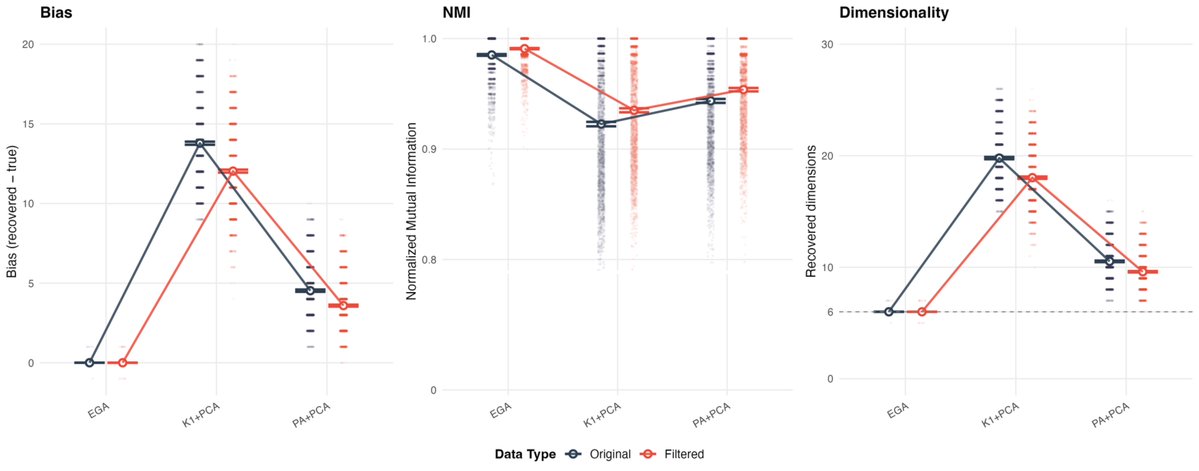
Coming soon: "Network Methods Outperform PCA in Recovering Dimensional Structure from Large Language Model Item Embeddings".
Abstract:
As large language models (LLMs) increasingly inform psychometric practice through item generation and semantic analysis, embedding-based approaches offer a pre-empirical pathway for assessing dimensional structure before human response data become available. However, the methodological choices used to recover dimensions from embedding spaces remain underexamined. The present study compared principal component analysis (PCA), which currently dominates generative psychometric applications, with network-based exploratory graph analysis (EGA). Using Monte Carlo simulations across six personality facets nested within two domains, we generated 180 items per condition using three LLMs (Claude Sonnet 4.6, GPT-4o, and GPT-5.4) and embedded them using two models (OpenAI's text-embedding-3-small and Jina v3). Across every LLM-embedding combination, PCA combined with Kaiser’s rule or parallel analysis severely overestimated dimensionality and yielded poorer recovery of the generating structure, a bias only partly reduced by network-based filtering for redundancy and item instability. EGA, in contrast, recovered the correct number of dimensions in nearly every replication, with filtering further improving structural recovery. This pattern was replicated using the Multidimensional Schizotypy Scale, an instrument with established empirical response data and a known dimensional structure. These findings indicate that network psychometric workflows, implemented in the AIGENIE R package, provide more accurate and consistent structural representations than component-based approaches when analyzing embedding spaces, with direct implications for generative psychometric workflows in which item pools are evaluated prior to data collection. More broadly, the findings demonstrate that analytic choices made during pre-empirical assessment can have substantive consequences for item selection, construct validity, taxonomic clarity, and downstream theoretical interpretation.
What a terrific AI and History Conference at Johns Hopkins! Historians tackled archives, research tools, teaching, and reliable evidence. Explore the talks and recordings:
https://t.co/5ucHVkBxBf
2025 marks the first year in my career that I feel completely lost when it comes to peer review and academic publishing. It was never easy, it always felt somewhat random, but now it’s just impossible. Journals are routinely taking 3 to 5 months just to find a reviewer. Publishing truly interdisciplinary technical papers is becoming almost impossible in psychology. Journals can’t handle the volume of submissions, finding peers to review is gruesome, and the randomness of the process has skyrocketed IMO. We can’t even plan our careers,or our students’. Preprints might be a temporary workaround, but we can’t rely on them fully because of the lack of institutional recognition. Again, it was never easy, but it now feels like we’re in a very complicated crisis.
I put together this visual interactive blog explaining Isomap, a classic non-linear dimensionality reduction technique.
Please check it out: https://t.co/MuzZownRwk
My new project: "The Physics of Psychometrics."
The results below show how informational and structural order in psychological systems behaves analogously to physical phase transitions. Each panel represents a core "law" of this psychometric thermodynamics. More information soon...
How to measure the depth (or abstraction) of Eiji Yoshikawa's Musashi famous quote ("There are people who die by remaining alive and others who gain life by dying"), vs a concrete counterpart ("There are people who don't enjoy life and others who live forever through their work.")? In my new paper, I propose a new framework to quantify linguistic depth, combining Kolmogorov (algorithmic) complexity, psychometrics, and large language models.
I demonstrate the method in a simulation and a linguistic experiment comparing abstract vs concrete phrases! Check this out!
Rethinking Personality: What if the Big Five isn't the full story?
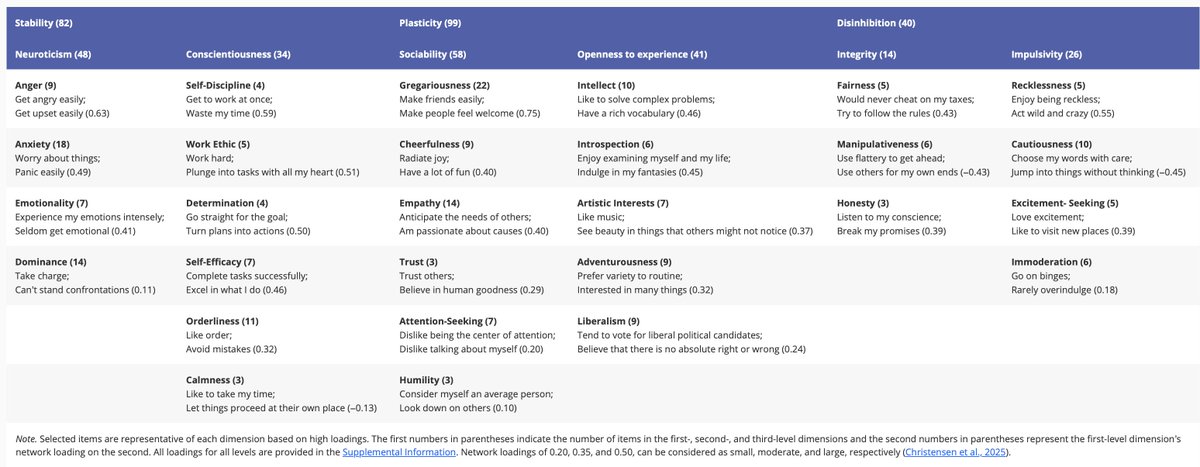
Our latest research using Topological Graph Analysis (TGA) has uncovered something remarkable, entirely new personality dimensions that challenge how we understand human traits.
While traditional models give us five familiar factors, TGA revealed three novel trait domains:
- Sociability - Not just extroversion, but a rich blend of outgoingness, empathy, trust, and social comfort that spans multiple Big Five domains
- Integrity - A standalone dimension that emerged independently
- Impulsivity - Forming its own distinct trait category
Perhaps most intriguing: at the highest level, a meta-trait called "Disinhibition" emerged as an overarching organizational principle.
Our result suggests our personality structure may be more nuanced than we thought. Sociability, for instance, combines the best of extroversion AND agreeableness while incorporating reduced self-consciousness. It's a more holistic view of how we connect with others.
What excites me most? These findings could reshape how we approach everything from team dynamics to personal development. Sometimes the most important discoveries come from looking at familiar data through an entirely new lens.
#PersonalityPsychology #Research #BigFive #Innovation #PsychScience
What personality insights have surprised you the most?
1/ 🎉 Excited to share our latest paper on LLMs for Narrative Discourse! We explore how AI can analyze the three key linking functions of narrative, inspired by Genette’s classic narratological triangle. 🧵👇 #NarrativeAI#Storytelling#Narratology
Delighted to be speaking on storytelling for good during World Logic Day next week, and truly honored to be heading to the UN as honorary co-chair this year and a luncheon celebration the next day for this Logictry/ UNICEF/ UN initiative. Thank you!
@IntuitMachine You don't need Goedel to prove that language models will always hallucinate. The fact is they never do anything other than hallucinate because nothing they produce passes the basic test of justified true belief. We only notice when generated sentences do not match what we know.