@BioavailableNd What about @the_no_mind argument that vitamin c and antioxidants in general aren’t good for you. I’ve been taking antioxidants for years. I can’t tell what they’re doing because I’m taking so many things and I’m aging in general. But I would love to hear your response to this.
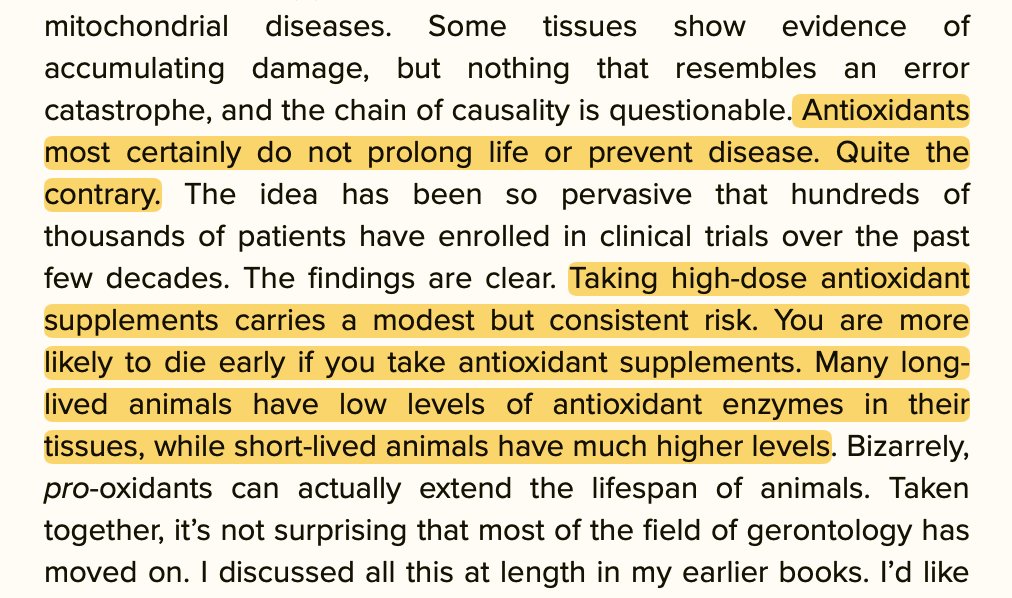
Hundreds of thousands of people took high-dose antioxidants expecting to live longer.
The opposite happened.
Clinical trials found a modest but consistent increase in the risk of dying early.
Here's the mechanism nobody selling vitamin C wants to explain:
Nick Lane — one of the world's leading biochemists studying mitochondria — explains why in his book The Vital Question:
Free radicals leaking from mitochondria aren't just damage.
They're a signal — one that tells the cell to build more respiratory complexes and more mitochondria to meet energy demand.
Researcher Antonio Enríquez ran the experiment directly.
He compared cells with mitochondria that leaked a lot of free radicals against cells with mitochondria that leaked very few.
Both types produced the same amount of ATP.
The high-leak cells did it by doubling their mitochondrial DNA copy number and building more mitochondria.
More leak, more signal, more capacity.
Then he added antioxidants.
The free-radical leak dropped, as expected. But so did the mitochondrial DNA copy number. And so did ATP synthesis itself.
Muting the signal didn't fix anything.
It just cut off the instruction to build more capacity — and energy production fell with it.
This also explains something that contradicts the entire oxidative stress framing around exercise:
Free-radical leak doesn't rise when you work out.
It falls, or stays flat, because electrons move faster through the respiratory chain and don't sit around reacting with oxygen.
Leak is actually highest at rest, when demand is low and electrons back up waiting to be used.
In other words: fast electron flow can be cleaner electron flow.
As Lane puts it: "Best go for a run."
The species data makes the same point at a larger scale.
Long-lived animals — the ones you'd expect to be flooded with protective antioxidants — often have low levels of antioxidant enzymes in their tissues.
Short-lived animals frequently have far more.
Some pro-oxidants have even been shown to extend lifespan in animal studies.
None of this fits the story sold in supplement aisles.
As Lane writes in The Vital Question:
"Some celebrated scientists, notably Linus Pauling, bought into the myth of antioxidants, taking several spoonfuls of vitamin C every day.
He did live to the ripe old age of 92, but that's still squarely in the normal range, including some people who drank and smoked throughout their lives.
Plainly it's not as simple as that."
And Lane isn't the only researcher warning that high-dose antioxidants can block signals the body actually needs.
Gabor Somlyai — who has followed 2,649 cancer patients over 32 years using deuterium-depleted water — advises against high-dose antioxidants including vitamin C, vitamin E, vitamin A, selenium & CoQ10 while undergoing deuterium depletion therapy.
In Deuterium Depletion, he lists them among the things that can interfere with the therapy.
His reasoning:
DDW is intended to increase free-radical signaling inside tumor cells, which can trigger apoptosis — programmed cell death.
High-dose antioxidants scavenge those radicals before the signal can fire.
The result: the cancer cell survives instead of being pushed toward apoptosis.
Lane's favourite quote on the matter comes from Barry Halliwell and John Gutteridge, authors of Free Radicals in Biology and Medicine:
"By the 1990s it was clear that antioxidants are not a panacea for ageing and disease, and only fringe medicine still peddles this notion."
That's not to say you should avoid dietary antioxidants — vegetables and fruit are different.
But the supplement industry has been selling a story the research dismantled thirty years ago.
@kieralwellness Since I’ve started taking progeste I haven’t had a period or ovulated…since Dec. Do you think it could be because of the progesterone? I’ve stopped taking it for a week now and I’ve done the same in previous months, but always started taking it after two weeks.
@BioavailableNd Would you recommend modified citrus pectin for helping to remove toxins? If not, what would you recommend besides sweating and staying hydrated. Thanks.
@nicknorwitz You lost me during the second part of the video. I’m trying to learn but not there with all the medical jargon. I wish it was more accessible because I’m interested in what you have to say.
What are the harmful effects of lectins? Maybe consider being more balanced when promoting things. I want to follow you to be reminded of all the good properties of fruits and vegetables. But when you only sing about the positives without informing people of the negatives, you’re not helping anyone.