@CosmosNetwork Lead is extremely toxic. You have to realize if something can still be a serious problem after being diluted by very large factors in the environment, it must be very potent. It is. I know you won't understand and I'm not going to explain.
I was reading about the Paradox project, custom wheelchairs for like 1/20 of the price of the usual approach. https://t.co/Xb3JHYxRL4 The off road thing is separate, personally that doesn't seem like that big a deal to me and it wouldn't be that hard to just whip one up out welded tubes etc. anyway.
If you think about it, we see this kind of thing in other contexts as well, such as eyeglasses and CPAP machines. I have both, and have been through the process and seen things in detail many times on both counts.
You'll probably start reading about the articles on the subject wondering if either there is some serious hidden flaws to the wheelchair or wtf the other guys are messing up, or some combination thereof. I do think it is a combination.
We see this "unregulated backup option, just give us your measurements and get stuff in the mail" on all 3 subjects, I am sure there are many more. The cpap etc guys do not express interest in repairability etc. though.
It seems to me to be largely an outgrowth of strategizing and pursuing different goals at a fairly basic level. I am not convinced the "non-profit" side of things is particularly important. I think it's more the focus on a different, more to the point way to get the fundamentals in the bag.
We should be doing this for other things, too. It was a long time there that people couldn't get wheelchairs are a reasonable price, and that matters.
I also think the fabrication of an object like this does not require a dedicated facility, and if we could overcome the need to set up dedicated facilities for every single thing like that that could be even more fundamental progress.
There are cnc tube bending shops, welding shops and cnc machine shops in many cities. You usually have to order metal parts from far away if you want a decent price, though. There are always a few custom parts like the spokes that would be uneconomical to make through digital manufacturing methods.
We could however improve those methods. As I am with the resin casting. The resin casting I could see being useful for many of the parts in a machine like this. The wheels, the back and seat, in particular. You can mix 30% carbon fiber into the polymer and it should be approximately 2/3 the yield strength of 6061 aluminum, with a good polymer. On all axis, not like 3d printed parts which are always far weaker in the Z axis.
Every city imo should have some kind of flexible fabrication facility, and this kind of thing would happen 100x more often on 100x as many subjects, many of which would improve life for as many people as much. Perhaps more, there some things you cannot really buy at any price right now that people are wanting, the long tail of rare but valuable use cases.
In the case of wheelchairs, they might be $2000 instead of $1000. But you'd actually have had them 15 years ago and ever since. Also you could start there then make this factory anyway whenever you want. You just don't have to do that before you are rolling.
There is a book "fab city" that talks about this kind of thing, but it is pretty disappointing. The authors last I checked were kind of in the clouds there, untethered to the realities of manufacture.
In the end a lot of it comes down to the capital intensity to get things done. If everything takes a ton of money to even get rolling, you are inevitably not going to get a lot of the stuff done. It's not always about per unit cost, not by a long shot. Not everyone is the same, the variety of equipment needs in this society is imo much larger than first appears.
It may remain largely mysterious what the impact of ordinary noise is, but I think it's like pollution, it's generally detrimental and just under-emphasized. It's worth going around one's home and checking what the various noise sources are, imo. Almost all of them in my experience seem to be various fans. The main exception being compressors in fridges and for some periods AC units. Laundry machines would be a distant third, since they are not on very often.
There isn't much else really is there? Sometimes electric heaters make various noises. The rest of the noise is basically coming in through the window.
You can see there is a considerable history and societal acknowledgement of each of theses, there are soundproof and triple glazed windows, people certainly value quieter neighborhoods highly and pay a ton of money to be located in such areas, ac and fridges are usually a lot quieter than they used to be. But it took a really long time to get there.
And they are all treated separately. And there is an undercurrent that it's always an uphill climb to get the impact recognized, and it's rarely quantified.
I tried to read up on the impact of background noise on test scores in schools but there doesn't seem to be much science on the subject. Logically it seems to impact the degree to which students pay attention and learn and think. But it is not very well studied. There seems to be about as much to discover here as there was on airborne disease 7 years ago. Despite it having been a serious issue for far far longer for a great number of people. These things just sort of get grandfathered in, apparently. That doesn't mean the detrimental effect is not considerable and serious and harmful.
As I've commented previously, luxury buildings and neighborhoods certainly reveal the amount which people are willing to pay for such things. But for us proles it's always "well can't be sure it even matters so no point investing"...
I recommend you read the article in full. The media has been full of reporting regarding the potential future risks of AIxBio for some time now, when the real, tangible risk is this: avian influenza burning through a mink farm in Utah.
We are giving this beast too much room.
It's been about 45 days since I decided to pull the trigger on resin casting. I'm making a mini version (1/3 scale) of the first mold now. I think the basics are all sorted out, which is progress. But 1.5 months... I have to remember this is instead of $50k usd of molds, plus the molding machine, basically. I mean it's not quite as good in some ways, but it's actually better in some (no dependence on very specific other people doing their part. Of course I need the resin etc. but there are many sources any many other people that buy that so it's pretty reliable). Cost per unit is looking about as expected, including labor, which is only slightly higher than the injection molded parts, given the quantities expected in the upcoming year or two. So not too bad really, this should be a more common process.
I read up on the usual approach used in resin casting, and I tweaked a number of things for my case. The largest change is not using vacuum during the actual casting process. I do use vacuum for removing bubbles (degassing) the resin (and the silicone).
They also usually use mold halves, as with injection molding. I changed it so there is a "bowl" and a "plug". This makes things simpler in many ways. The bowl side contains the fluid without any need for things to fit precisely. It also helps with bubbles considerably.
I also add the goop to the mold before closing it, rather than trying to inject/pour it after. This helps in several ways. Mainly it allows higher viscosity and helps with bubbles. Higher viscosity allows filler and fibers at much higher density, which is also helpful in many ways, at controlling exotherm and increasing strength and reducing cost.
The adhesion problem was the hardest, I am still trying to get some stoner a324. Someone in the US from the community is helping me to obtain it, they don't ship it here, just a random thing regarding industrial materials (it's not toxic, it's a petroleum distillate). The Ease Release 200 works mostly for now. The resin is also from smooth-on, and so is the tin cure silicone. Smooth cast 300 is the resin I'm using and mold max 60 is the silicone. So they make pretty good stuff, I guess.
I do wish the resin was more heat resistant, there are resins like that but they may have other issues and I already tried 5 resins so I'm going to roll with this for a while and level up another day.
Some of that time was spend basically just learning to SLA print. The usual approaches are not geared to making relatively good quality mechanical parts, it's all about decorations etc. Same problem that FDM has. The machines are inherently geared towards this in several ways. I had to figure out how to get good but not excessive bed adhesion without supports, get good accuracy and so on. I chamfer the bottom of the print, make it solid for the first 5 mm or so, add a brim, then use internal scaffhold/infill with drain holes to save resin and reduce shrinkage.
Sla printing really is a hassle in many ways compared to FDM, I'm not sorry I avoided it for this long. I probably should have stuck with FDM and just used TPU to print the mold directly, that was mostly working. But this has more of a future, higher quality more accurate parts that look better.
That would be quite interesting, I did look into that, initially from jlc3dp. They can print it in a single part. However I was worried I would wait and they'd send me back warped stuff or something. Also I needed to dev the process in various ways. can you DM me and we could talk briefly, then I may look you up in the future for future molds. I am not sorry I bought my own printer for now as the process in my own hands is important. But it is a lot of work and collaboration does help a lot. Do you do actual resin casting? You can actually make the parts? This is not metal casting, it's plastics.
@emm0sh This is a serious problem in air purification. I've complained about it a number of times. Manufacturers know people can't check their assertions regarding test procedures etc. because of the paywalls so they make shit up and never get caught.
We could totally collaborate to make a smaller one, all you need is printer, and willingness to do a ton of experimenting. Using CFD would make it easier. But it's a matter of taking the fundamental lessons of the bqf an applying them, merely scaling it down wouldn't even give a particuarly good fan, I think. All kinds of stuff like the motor flywheel would be redone as you know there are scaling laws that do not go linearly in many cases.
@Engineer_Wong But asking them to do otherwise is also not sustainable. We need a structural solution. In Canada the gov negotiates prices in bulk etc. But when the rest of society enforces the mechanisms they use to overcharge, they are condoning and rewarding such behaviour.
Yeah me too, but those are easier to check fortunately. Sound is a tricky one. I've verified the pc fan units seem to be as claimed. And I do think the physics of the testing protocol used by intertek etc. are fairly durable. But noise figures are always bouncing around because they are so hard to measure they know nobody will check, also let's be honest mostly people probably don't care that much anyway in these ranges. So they make shit up, people never check or care. Except us :D
Found another amazing paper, this time which puts into perspective very low noise levels often claimed by air purifier mfrs. It goes to show how much many air purifier mfrs are lying. For example, some quote 26 dBa and somesuch, but most adults literally cannot hear that even in an anechoic chamber, certainly not in a normal environment. So if you can hear the machine at 1 meter distant, it's probably not as quiet as they claim.
Outdoors in a quiet area, which is pretty quiet compared to most of our indoor environments, looks like more than half of adults cannot even perceive a white noise less than about 30 dBA. Like you can't actually tell if the noise is there, even if you listen as much as you can. It could alternate on and off you couldn't know it if your life depended on it, you can't perceive it.
These are young adults only, we lose our hearing slowly over time, not abruptly at advanced age as most people believe. This is partly from accumulated damage from louder volumes. I have 11 decibel hearing, which is very good for my age. It is strongly frequency dependent, I forget which frequencies and how they weigh them for the standard test, but I did the test in the standard chamber while getting treatment for a problem only a few years ago. Theoretically a child should usually have 0 dB hearing, which when I was a kid I did a similar test and indeed I did have very close to that.
So the average for the population is that probably way less than half of people can even hear 30 dBA of white noise anywhere in the real world. However fans often have tonal noise, which could be much more easily discerned, because the noise is concentrated in a spectral band, not even psychoacoustically, but this is inherently a stronger signal for a given dBA reading. You can detect much fainter sounds as pure tones, this is widely known and easily read up on.
https://t.co/F129HdP5Zr
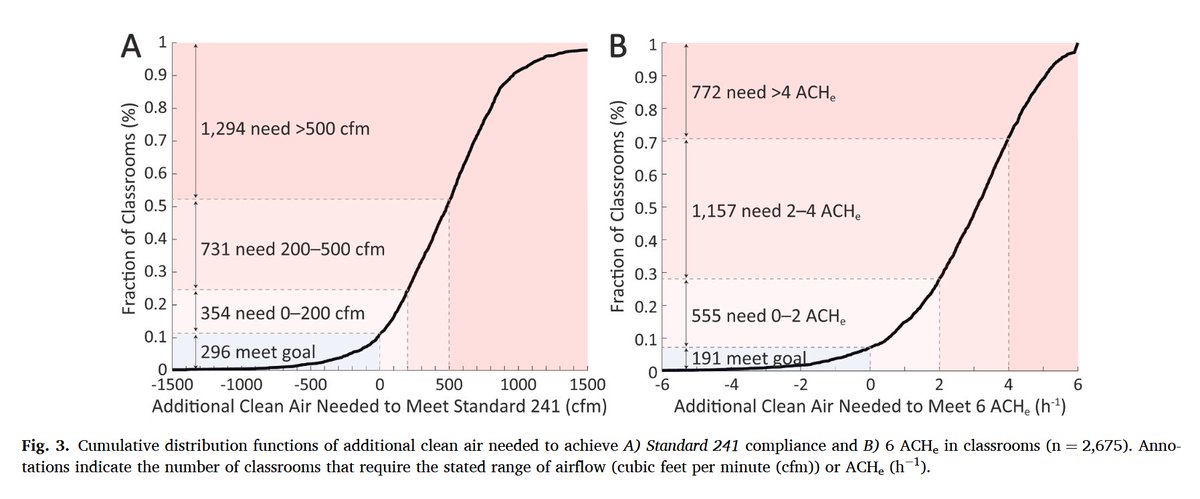
I have a cold today so have been reading etc, and I found this great graph that shows how much supplemental clean air various classrooms in Oregon's largest school district need to meet ASHRAE 241.
https://t.co/6lAWaps4HC
It indicates the fraction of classrooms that would meet the standard with X many supplemental CFM, factoring in the clean air the existing HVAC system supplies (filtration included). I would add that the time of the year should have been figured in, as it will be quite different for different times of the year, probably. They share the dates of airflow measurements but it's all over the map. That may have a considerably impact actually.
It's not clear if they are assuming the 30 or 40 cfm per person level, ASHRAE 241 specifies two levels, one for infectious risk management mode and one for ordinary periods. It's also a bit wacky that IRMM is only marginally higher... but anyway.
I kind of just wish they would give the raw data for the baseline ventilation, it does not appear in the supplementary stuff either.
Also they made the grevious error of simply assuming the mfr noise figures are correct. They also seem to have misinterpreted the limits on noise in classrooms.
But, well it's a useful figure to say that's what the experts said, I guess. Clearly a lot of classrooms need a lot of clean air, even when you factor in existing HVAC stuff.
Last of all, I would add that AHSRAE 241 is a good start but we may be able to prevent even more infections with more airflow. I would prefer to talk in terms of infections prevented by intervention X or dollars per infection prevented, but that requires even more extrapolation from other studies and gets a little shaky of course. And for all diseases that are prevented, not just COVID. You know, big picture, objective metric.