They told us that being a doctor will give you immense "satisfaction" and "content".
Then why are so many of us regardless of the stage of our professional journey are ending up with anxiety, stress, depression ?
@MedicosUnited@MedicosUnite#MedTwitter
Female doctors are not asking for special treatment.
Only something simple:
To be recognized for their training, merit, and expertise—not judged by outdated assumptions.
Respect the doctor.
Regardless of gender.
“Sister ji, please change the drip.”
“Sister, patient ko feed kara dijiye.”
She hears this every day in the hospital.
The problem?
She is the doctor.
Read the thread
Psychologically, this reflects something deeper.
For decades, authority in medicine has been socially associated with men, and these stereotypes still shape how people perceive doctors today.
But it raises an uncomfortable question:
Why does the mind instinctively assume
that a woman in a hospital must be a nurse…
and the doctor must be a man?
This is not about disrespecting nurses.
Nurses are the backbone of healthcare and one of the most indispensable parts of the system. Hospitals simply cannot function without them
Stop threatening doctors, you fraud supplement companies.
Liver doc blasts Miduty Supplements for 'threatening' instead of showing evidence of its 'fraud' supplement's effectiveness
https://t.co/QocGv3dP2J
Yrrr who is this rank 1703, broooo you really shook the entire medical community, by taking MD PATHOLOGY.
kudos to you!
@MedicosUnited#MedTwitter#neetpg2025
This caveat is necessary.
A lot of General Medicine's popularity stems from the fact that it is the broad specialty with the broadest range of subspecialties and later on, fellowships to choose from.
A lot of medicine oriented people go for Pediatrics and then subspecialize in adult subspecialties like Neurology and Endocrinology since pediatric subspecialties have far less seats than adult ones.
A lot of people who want to practise the conventional idea of medicine go for Family Medicine/Geriatric Medicine/Emergency Medicine but those are quite distinct from General Medicine and require a different skill set.
For example, I knew I wanted to do Neurology long before I chose General Medicine.
Same thing with seniors I know who have chosen Rheumatology/Medical Gastroenterology/Endocrinology etc.
In fact, I don't think I know anybody from my social circle who chose General Medicine because they want to work as an internist.
Out of my batch of 23 people who passed MD in 2022, I know of only two who are practising as internists.
I know full AP of medical colleges who have sacrificed career progression to subspecialize.
An interesting conundrum
#MedTwitter
#NeuroTwitter
#NEETPG2025
https://t.co/MouVGopwT4
Ask 100 Naive MBBS students who join MBBS. - half of them will say they want to be Neurosurgeon/CTVS
50 end up choosing Radio.
Passion gya tel lene.
Everyone wants money at lower cost.
Full support.
And there should be zero shame in that.
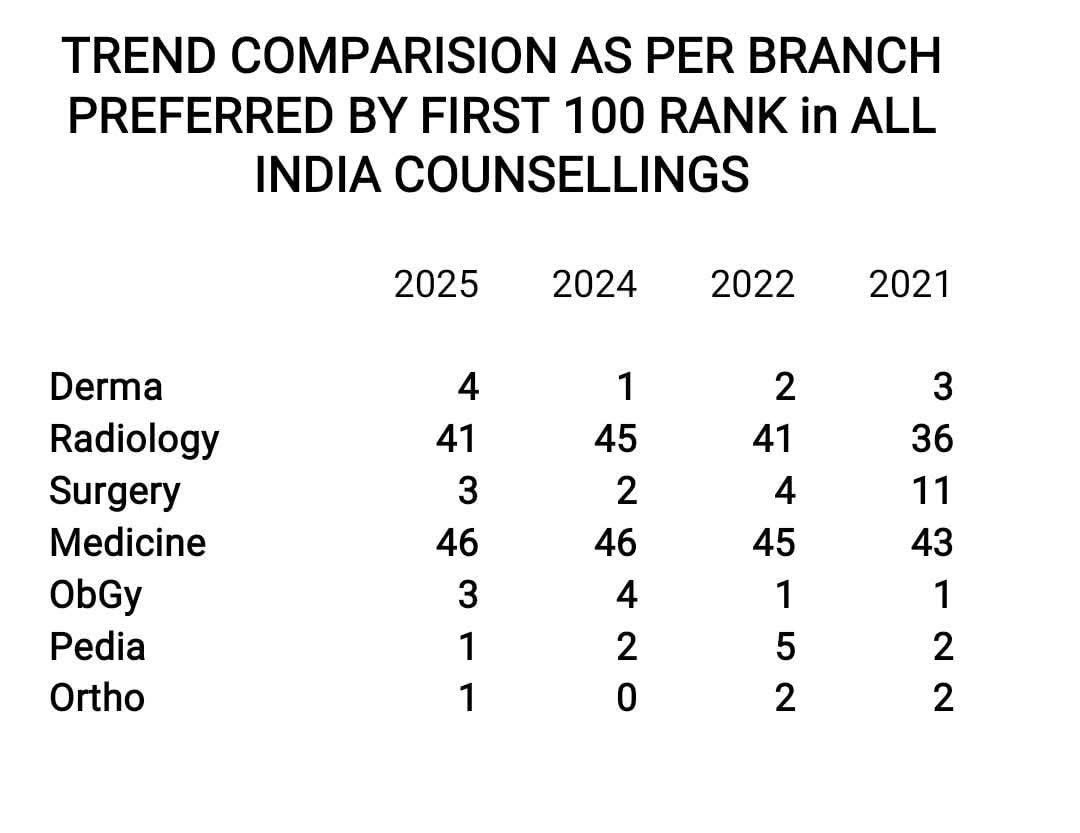
If this data is true, it should worry all of us.
The decline in top rankers choosing surgery isn’t about students changing—it’s about the system they’re entering.
Surgical residency still carries the image of long hours, hierarchy, limited mentorship, and delayed operative independence. And earlier, surgery was the primary procedural branch—if you wanted to “do something with your hands,” you chose surgery.
That’s no longer the case.
Today, most medical superspecialties offer procedures too. So procedural satisfaction + financial security is now possible without a decade-long surgical training journey.
So students aren’t running away from hard work—they’re choosing environments that feel structured, supported.
Instead of criticising their choices, we need to reform surgical training—respect, mentorship, monitored hands-on opportunities, simulation labs, mental-health support, and cultures that build surgeons rather than break them.
What do you think? Comment below