"AI tends to solve the problems that can fit within its context window very well, but it's totally oblivious to the long term issues that can't be understood in that relatively small frame."
"AI writes overly complex code"
"Reliance on AI decreases human understanding"
Must read https://t.co/OLwaWQh3cG
RIP, Gary Fisketjon. No editor in my lifetime—not even Gordon Lish—had a greater impact on American letters. He kept Cormac McCarthy’s novels in print before Cormac was a household name, and published The Border Trilogy at Knopf. Also: Richard Ford, Tobias Wolff, Donna Tartt, Richard Russo, Kent Haruf, and so many others.
Jon Clardy: 1943-2026
One of the most impactful, creative, and (quietly) irreverent practitioners of chemical biology. Transformed how we think about nature's chemicals: their structures, their role in biology. Loved him -- he had tremendous influence on my thinking.
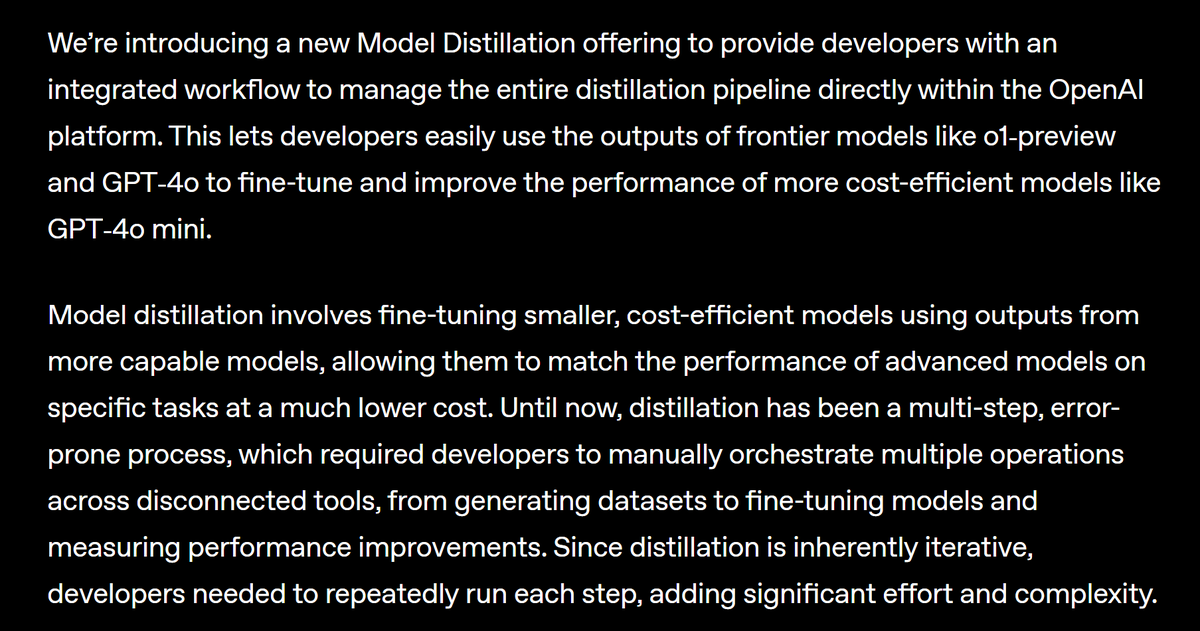
@TaliaRinger Back when they supported fine-tuning distillation was a celebrated feature of the API:
(granted they only ever supported distilling from one OpenAI model to another. )
New Paper: Turns out that LLM think traces don't necessarily have any end-user semantics even on benchmarks specifically designed to showcase such semantics.. 🤷♂️
As some of y'all know, we have been looking at the question of end-user interpretable semantics for the reasoning models for a while (c.f. https://t.co/t4uYw5WTmD (#ICML2026),
https://t.co/Cnlb96mqKd (#ACL2026) &
https://t.co/4LGWfiCZ5e (#TMLR➡️#NeurIPS2026))
One question I get asked is whether that lack of semantics just an artifact of the benchmarks *we* made.
What if we look at benchmarks that were specifically proposed to show off the semantics of thinking traces?
As it happens, earlier work by AllenZhu @ZeyuanAllenZhu has indeed created such a benchmark, iGSM, and made claims about intermediate token semantics based on it.
Since AllenZhu's work on "Physics of LLMs"--that is partly based on their analysis on iGSM was influential, we wondered whether they found conditions under which traces do indeed have semantics.
Turns out, (perhaps unfortunately for the "please let thinking traces have semantics" contingent), that iGSM traces don't have semantics either, and models trained with swapped/corrupted traces can do well too. The results seem quite in line with--rather than being contrary to--the position we have taken in our earlier work.
Read the details of this very crisp work, lead by @ratishsp and Pranabendu, in the following thread.👇
Agreed, It is an admirable achievement, and the article presents a measured interpretation of it. I was gently poking fun at the headline which was more in response to how Space X presented timelines for full fledged datacenters in space as part of their IPO rather than how Google has represented their work in this area.
@mgrczyk@TheStalwart I would suspect much of the compute capacity sitting in space is on classified satellites, but outside of that StarCloud-1 put an H100 in space in 2025 which I believe at the time was the most GPU compute in space.
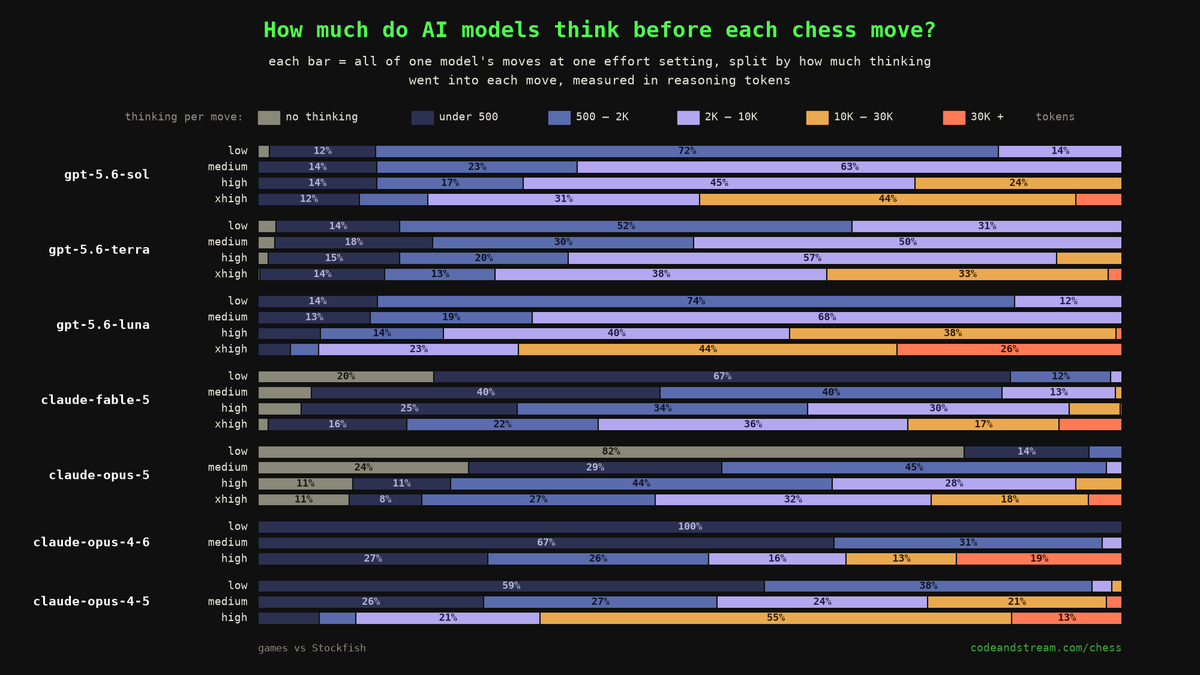
Comparing thinking tokens across models/providers is fraught, and of limited value.
Different models, different backend implementations, different tokenizers, etc.
Stronger models should be able to solve more complex problems using less thinking tokens/test time compute.
The older pre-adaptive thinking Opus models are weaker so even with higher thinking token allocation their performance on chess doesn't improve enough to catchup to latest OpenAI models.
With that said, I do think there is value in tracking reasoning/thinking token allocation to see how often low/zero thinking token allocation corresponds to poor performance.
A few thoughts on why @AnthropicAI's Opus 5 sometimes felt lazy compared to @OpenAI 's models.
I like to use chess as a benchmark/eval for AI models.
It is a crude/toy benchmark, but it does a good job of giving a sense of when the frontier model's make leaps forward and helps temper some of the benchmaxxing.
1/
While regardless of chess performance Anthropic models have continued to get stronger in other domains, my own anecdotal experience was that Opus 4.5 and Opus 4.6 were the last Opus models to feel consistent.
Ever since Opus 4.7 I feel like I am constantly having to correct and double-check the model's work.
One moment the model feels smart, the next it is apologizing to me for the umpteenth time for having made a mistake.
These days anytime I use an Anthropic model for any serious work I am constantly farming out adversarial reviews to codex/OpenAI models.
This change in anecdotal vibes for me coincided with Anthropic's shift to "adaptive thinking".
The older model's used the now deprecated "extended thinking" feature. If we add in data on the older model's we see a profile far closer to the OpenAI models as far as thinking token allocation.
Adaptive thinking definitely saves money on a per API call basis, but I do wonder to what extent that comes at the cost of quality.
8/