At resonance learning from creators and dreaming new dreams. Previously t i d e m a r k. Drove a limo a while back. Learned everything from it. Freedom Rocks!
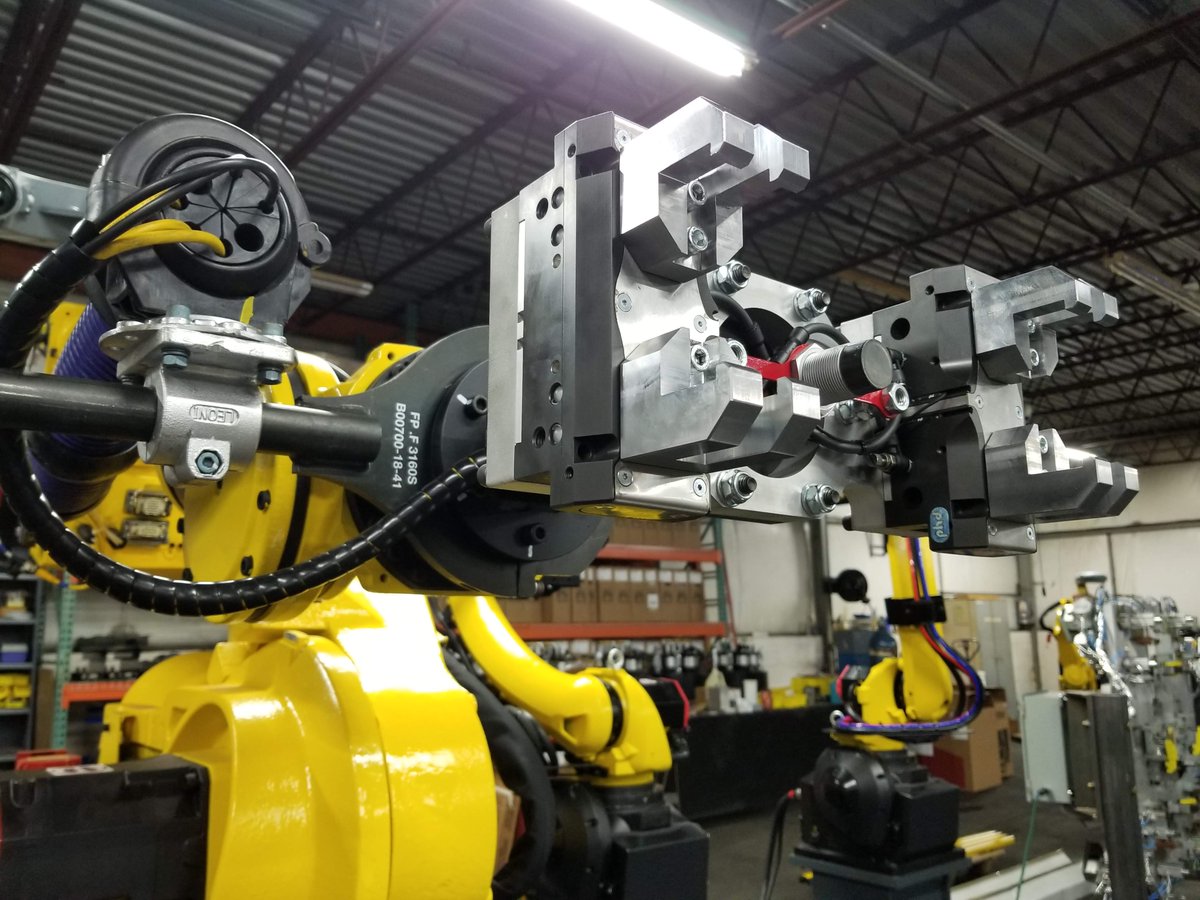
Man. Changing my algo from political slop to engineering and robotics has been so refreshing, so many new awesome people to follow and who are following me as well. I am going to keep posting content from current and past work from my career in robotics, my path moving forward, and stuff in between. Glad to be out of that rut of depressing x feeds. It didn't take long to change it up either. Here's a pretty cool robot EOAT I did for a customer who manufactured Amazon infrastructure hardware. I also did about 25 robotic welding cells for them.
We just completed the largest decentralised LLM pre-training run in history: Covenant-72B. Permissionless, on Bittensor subnet 3.
72B parameters. ~1.1T tokens. Commodity internet. No centralized cluster. No whitelist. Anyone with GPUs could join or leave freely.
1/n
They said photography wasn’t art.
They said cinema wasn’t art.
They said video games weren’t art.
Now they say AI arts/digital art isn’t art.
I’ve spent over a decade with my studio team turning millions of data points into living, breathing artwork experiences ethically — at MoMA, at the Guggenheim, at the Venice Biennale. Not because a machine told me what to create, but because I had a vision that no traditional tool could realize.
Denying all AI technologies as an artistic medium doesn’t protect art. It limits it. The artists who embrace new tools don’t replace the old masters — they join them.
Art is not defined by the brush. It’s defined by the intention, the emotion, and the courage to see the world differently.
Very interested in what the coming era of highly bespoke software might look like.
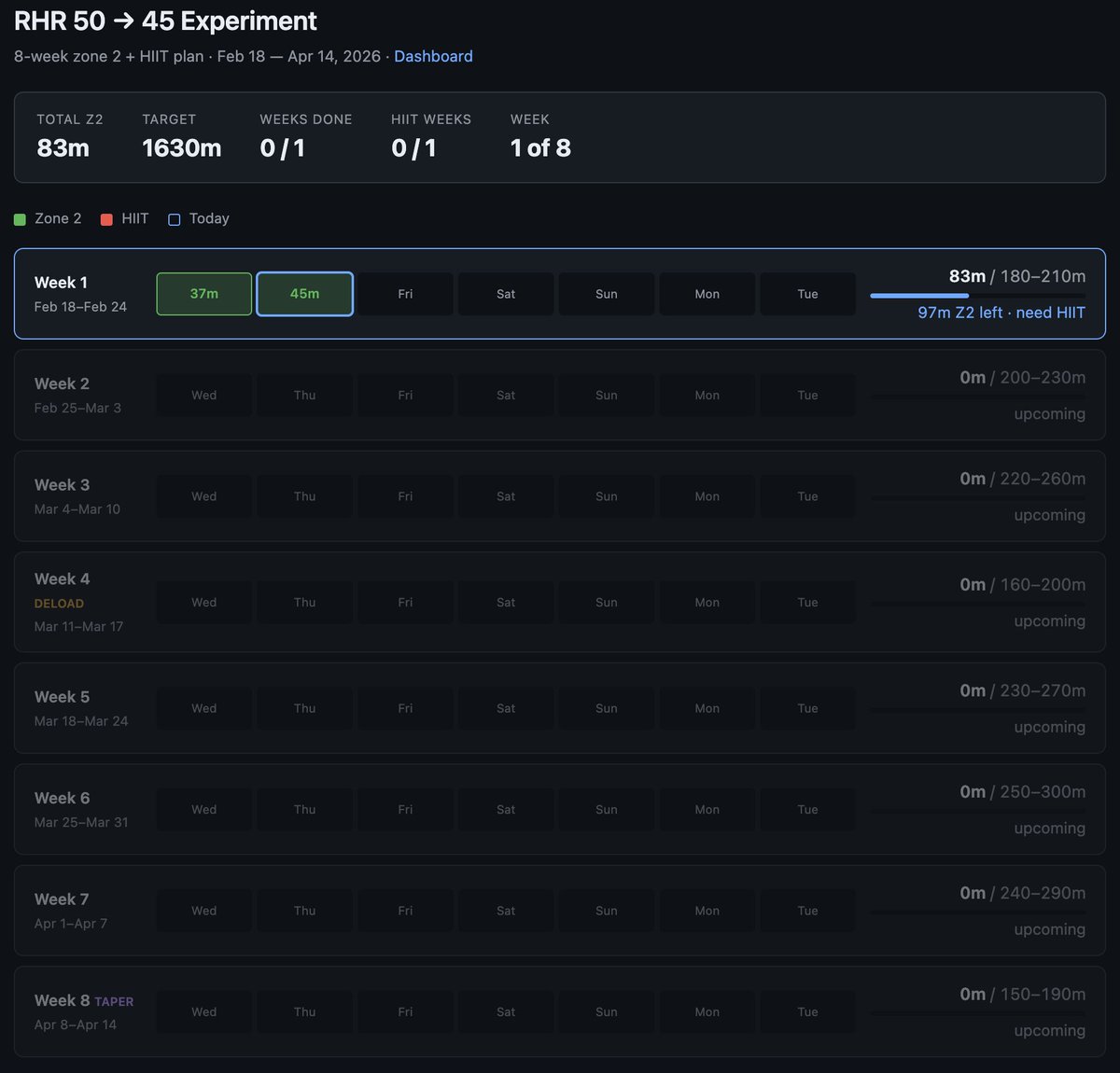
Example from this morning - I've become a bit loosy goosy with my cardio recently so I decided to do a more srs, regimented experiment to try to lower my Resting Heart Rate from 50 -> 45, over experiment duration of 8 weeks. The primary way to do this is to aspire to a certain sum total minute goals in Zone 2 cardio and 1 HIIT/week.
1 hour later I vibe coded this super custom dashboard for this very specific experiment that shows me how I'm tracking. Claude had to reverse engineer the Woodway treadmill cloud API to pull raw data, process, filter, debug it and create a web UI frontend to track the experiment. It wasn't a fully smooth experience and I had to notice and ask to fix bugs e.g. it screwed up metric vs. imperial system units and it screwed up on the calendar matching up days to dates etc.
But I still feel like the overall direction is clear:
1) There will never be (and shouldn't be) a specific app on the app store for this kind of thing. I shouldn't have to look for, download and use some kind of a "Cardio experiment tracker", when this thing is ~300 lines of code that an LLM agent will give you in seconds. The idea of an "app store" of a long tail of discrete set of apps you choose from feels somehow wrong and outdated when LLM agents can improvise the app on the spot and just for you.
2) Second, the industry has to reconfigure into a set of services of sensors and actuators with agent native ergonomics. My Woodway treadmill is a sensor - it turns physical state into digital knowledge. It shouldn't maintain some human-readable frontend and my LLM agent shouldn't have to reverse engineer it, it should be an API/CLI easily usable by my agent. I'm a little bit disappointed (and my timelines are correspondingly slower) with how slowly this progression is happening in the industry overall. 99% of products/services still don't have an AI-native CLI yet. 99% of products/services maintain .html/.css docs like I won't immediately look for how to copy paste the whole thing to my agent to get something done. They give you a list of instructions on a webpage to open this or that url and click here or there to do a thing. In 2026. What am I a computer? You do it. Or have my agent do it.
So anyway today I am impressed that this random thing took 1 hour (it would have been ~10 hours 2 years ago). But what excites me more is thinking through how this really should have been 1 minute tops. What has to be in place so that it would be 1 minute? So that I could simply say "Hi can you help me track my cardio over the next 8 weeks", and after a very brief Q&A the app would be up. The AI would already have a lot personal context, it would gather the extra needed data, it would reference and search related skill libraries, and maintain all my little apps/automations.
TLDR the "app store" of a set of discrete apps that you choose from is an increasingly outdated concept all by itself. The future are services of AI-native sensors & actuators orchestrated via LLM glue into highly custom, ephemeral apps. It's just not here yet.
An emotional story from Palantir CEO Alex Karp about someone helping his family growing up:
“My mom was totally fucked. Someone helped her. I paid them back.”
“In general, people don’t help you, which is totally okay, but the ones that do, are special.”
"Shein is bad for the fashion industry and our planet—but I can’t wait for the IPO," Resonance chairman @lawrencelenihan writes in a new commentary. https://t.co/aOOaiZ2kCG
Dans l'atelier de Constantin Brancusi 🔨
Situé au 8, impasse Ronsin à Paris, l'atelier de Brancusi servait à la fois de domicile, de studio et de galerie, où l'artiste a créé tous ses chefs-d'œuvre.
Visitez l'#ExpoConstantinBrancusi jusqu'au 1er juillet 👉https://t.co/HfsYbP8ELD
These are the ideas changing the world in 2024.
Yes, the world can seem bleak at times. But read through the 50 winners and hundreds of honorees, and you’ll be inspired by the ideas and people that make the world more accessible, equitable, and sustainable for everyone.
#FCWorldChangingIdeas
Jensen, the founder of NVIDIA, said something that triggered me today at the Stripe event.
He compared the Industrial Revolution's conversion of water (atoms) to electricity (electrons) to a modern process of converting electricity to tokens.
He introduced the concept of 'token factories' where electricity is the input, and tokens (text, large language models, images, etc.) are the output.
Wild to see how he’s thinking many steps ahead to a future we’re about to enter.
Unmotivated by the prospect of being a homemaker, #HanaeMori enrolled in dressmaking school in postwar Japan.
As the first Asian designer to be a member of the Paris haute couture syndicate, Mori rose to the forefront of global fashion. ✨
Read more: https://t.co/yiy2Y5ucGu
Claude Shannon, renowned as the "father of information theory," significantly impacted electrical engineering and computer science. His pioneering work, encapsulated in his 1948 paper "A Mathematical Theory of Communication," established the foundations of information theory, offering a quantitative framework for information transmission and compression.
His 1937 master's thesis demonstrated that electrical circuits could execute logical operations, laying the groundwork for digital circuit design. Shannon also contributed to cryptography during World War II, developed efficient data encoding methods like Shannon-Fano coding, and formulated principles for problem-solving known as Shannon's Maxims. The Shannon-Hartley Theorem and the concept of Shannon Entropy were central to his work. Shannon's contributions are pivotal in modern technologies like the internet, cellular communications, and digital media, and they continue to influence fields like artificial intelligence and data science.
Tesla’s VP of vehicle engineering @larsmoravy says to bend the Cybertruck’s tough steel, they had to invent a process called air bending, where they float the tool on an air hockey like table device and blow really high pressure air so that tool floats over the surface and isn’t actually touching the surface when it’s bending it.
You can watch Top Gear’s full Cybertruck interview here: https://t.co/fYSE0eoFDa