Introducing Opticonomy: the future of AI collaboration, blockchain innovation, and marketing solutions.
We’re gearing up for launch and invite developers, businesses, and marketers to join us early and shape the journey.
Be part of the community:🔗 https://t.co/rsEUEAR0Ff
Schau dir diese Grafik genau an. Sie erklärt, warum sich in Deutschland Leistung nicht mehr lohnt.
Ein Paar, zwei Kinder, beide arbeiten.
Bei 4.000 Euro brutto bleiben rund 2.700 Euro.
Bei 5.000 Euro brutto bleiben rund 2.650 Euro.
Du liest richtig. Tausend Euro mehr verdient. Weniger im Portemonnaie.
Und jetzt der Teil, der wirklich weh tut: Bei 2.000 Euro brutto stehen dieser Familie etwa 2.350 Euro zur Verfügung.
Bei 5.000 Euro brutto sind es 2.650 Euro.
3.000 Euro mehr erarbeiten. 300 Euro mehr haben.
Das ist kein Rechenfehler. Jeder zusätzlich verdiente Euro zieht Wohngeld, Kinderzuschlag und Freibeträge mit sich in den Abgrund, während Steuern und Sozialabgaben gleichzeitig steigen.
Man nennt es Transferentzugsrate. Ökonomen kennen das Problem seit Jahren. Die Bundesregierung hat Gutachten dazu bestellt.
Passiert ist nichts.
Und dann wundert sich die Politik, warum niemand mehr die Stunden aufstockt. Warum die Zweitverdienerin in Teilzeit bleibt. Warum der Facharbeiter die Beförderung ablehnt.
Die Leute sind nicht faul. Sie rechnen.
Ein System, das Anstrengung und Fleiß nicht belohnt, bekommt am Ende genau das: keine Anstrengung.
A billionaire trader has spent 40 years trying to delete a one-hour documentary. It shows him making $100 million in a single afternoon. He predicted the crash that made it possible three months in advance. He has never explained why he wants the film gone. His name is Paul Tudor Jones. The film is on YouTube.
The documentary is called "Trader." PBS filmed it in 1987, three months before Black Monday. Jones was 32 years old, working from a small New York office, wearing shorts and a t-shirt, yelling at his phones, throwing paper across the room, and sleeping under his desk. The film captures him and his research partner Peter Borish overlaying a chart of the 1929 market on 1987, month by month. The two charts tracked within one percent. Borish said this is exactly what happened in 1929. Jones said if the analog holds, October is when it breaks.
On October 19, 1987, the Dow fell 22.6 percent in a single day. It remains the largest one-day percentage loss in stock market history. That afternoon, Tudor Jones covered his shorts and made roughly $100 million. He was 33 years old. He was one of the very few traders on the street who came out ahead.
He tried to bury the tape because it made him look reckless in a professional world that punished swagger. Twenty years of legal effort did not delete it. Someone kept a copy. It is on YouTube. It has fewer views than most makeup tutorials.
The film is not really about a crash. It is about a specific philosophy of trading. Jones is shown building conviction slowly, sizing carefully, then striking hard when the setup arrives. He is never once shown making a random bet. He is shown doing the same thing five times a day, every day, for three months.
His signature line, repeated across a 45-year career:
"The most important rule of trading is to play great defense, not great offense."
He does not try to be right. He tries not to lose. He sets stops tight, cuts positions fast, and never averages down on a loser. Every trade in the film follows this template.
Tudor Investment Corp, the fund he founded in 1980, has compounded at roughly 19 percent a year for 45 years. He is 71 years old and still trading. His method has not changed since the film.
The lesson: greatness in markets is a refusal, not a talent. Refusal to be reckless. Refusal to be certain. Refusal to average down. Refusal to trust yourself in a drawdown. Tudor Jones has refused those refusals for 45 years.
The tape is free. The philosophy is repeated in every trade. Most traders will never watch it.
A farmer dies in April 2026.
His son inherits the farm. The farm has been in the family since 1847.
The farm consists of: 300 acres of grazing pasture, a farmhouse built in 1892, a barn, a milking parlour, two tractors of varying ages, a Land Rover that runs about 70% of the time, and a herd of 180 Hereford-cross cattle.
On paper, the farm is worth approximately £3.2 million. This is because land near him has been bought recently by a London hedge fund looking for carbon credits, which has dragged the comparable value of every field within forty miles upward to a number nobody local can justify.
In cash, the farm produces a profit of about £28,000 a year in a good year. In a bad year it loses money. The son also works as a fencing contractor three days a week to keep the operation viable.
The inheritance tax bill on a £3.2 million estate, even at the reduced 20% rate, comes to approximately £140,000 after the increased threshold is applied. The son does not have £140,000. The son has never had £140,000. The son has £4,200 in his current account and an overdraft.
The son sells 60 acres to a developer to pay the tax. The developer puts solar panels on the 60 acres. The remaining herd cannot be sustained on the reduced land. The herd is sold. The barn becomes a holiday let.
A different family eats Brazilian beef this Christmas without knowing why the price went up.
The Treasury collects £140,000.
The land never produces British food again.
🚨 THIS IS INSANE.
Commerce Secretary Howard Lutnick's sons could be making 3 to 5x returns on every dollar they spent buying tariff refund rights.
Cantor Fitzgerald, now run by Lutnick's sons Brandon and Kyle, was buying tariff refund claims from companies at 20 to 30 cents on the dollar.
The firm told clients it had "capacity to trade up to several hundred million" in these claims.
They confirmed at least one $10 million trade was already executed as of July 2025. They said they expected that number to "balloon in the coming weeks." That was 9 months ago.
Today those claims are worth 100 cents on the dollar. The refund portal is live, $166 billion in refunds are being processed.
If Cantor bought $100 million in refund rights at 25 cents on the dollar, they spent $25 million.
They now collect $100 million from the government. That is a $75 million profit. A 300% return.
If they scaled to "several hundred million" as they told clients they could, the profits run into the hundreds of millions.
Howard Lutnick was the architect of the tariff policy.
He pushed Trump to impose them. He fought against officials who wanted to limit them. Then he left Cantor Fitzgerald to his sons and transferred his equity into a trust benefiting them.
Tax free under government ethics rules. He received $360 million from the buyout.
His sons positioned the firm to profit from the exact policy their father built.
Their father publicly championed tariffs he knew could be struck down while his sons were buying refund claims betting they would be.
The history of nasa. I used to get so frustrated that people couldn’t see it, now I’m almost wary. The whole world just learned about Israel, shadow government, the uniparty etc. Some are melting down. Wait til they find out we also aren’t on a spinning ball and your ancestor wasn’t a monkey.
The key is forgiveness. Forgive whoever told it to you because they almost certainly believed it too. And forgive yourself as the child who felt like something was off and you went with it out of blind trust.
Everyone does that. Then your identity gets tied to lies and the truth feels like a personal attack. It’s not.
Forgiveness is so important. Most importantly forgive yourself. People will scream at you and degrade you for forgiving yourself and saying what you believe is true. Forgive them as well. They are still seeing thru the eyes of those who said the same thing to them.
Something miraculous happens when you forgive. Your ancestors, even tho they aren’t here, heal. I can’t explain it but I’ve felt it. A wave goes back in time as well as forwards.
And on this Easter, when thinking about the gift that Jesus truly brought this world. It’s forgiveness and healing. He gave a permanent reset to anyone who accepts it. Doesn’t mean there isn’t pain or consequence. But the ability to choose life over death. Gratitude over spite. Hope over shame. Peace over war.
Happy Easter everyone. He has risen. And I don’t regurgitate that for some rediculous social benefit or to be part of a group. A ton of Christian’s don’t consider me Christian. That’s ok.
But I what he has risen means. He rose so you can as well. Now rise.
🚨SOMEONE REINVENTED HOW TEXT RENDERS ON THE WEB AND ITS ABSOLUTELY INSANE.
the goated dev behind react, reasonML, and midjourney’s frontend, just dropped Pretext. a tiny typescript library that measures and lays out text 500x faster than the DOM.
he trained models against real browser rendering for weeks until the output matched safari, chrome, and firefox exactly.
the demos are insane!! hundreds of thousands of text boxes at 120fps. magazine layouts and chat bubbles that actually wrap right.
engineers from Vercel, Remix, Figma, and shadcn all cosigned. this is the kind of open source that makes you want to be a better dev.
here are some cool demos in the past 24hrs👇
Mistral just open-sourced a text-to-speech model that beats ElevenLabs.
3 GB of RAM. Runs locally. Free.
The thing people were paying per-word for last year runs on your laptop now.
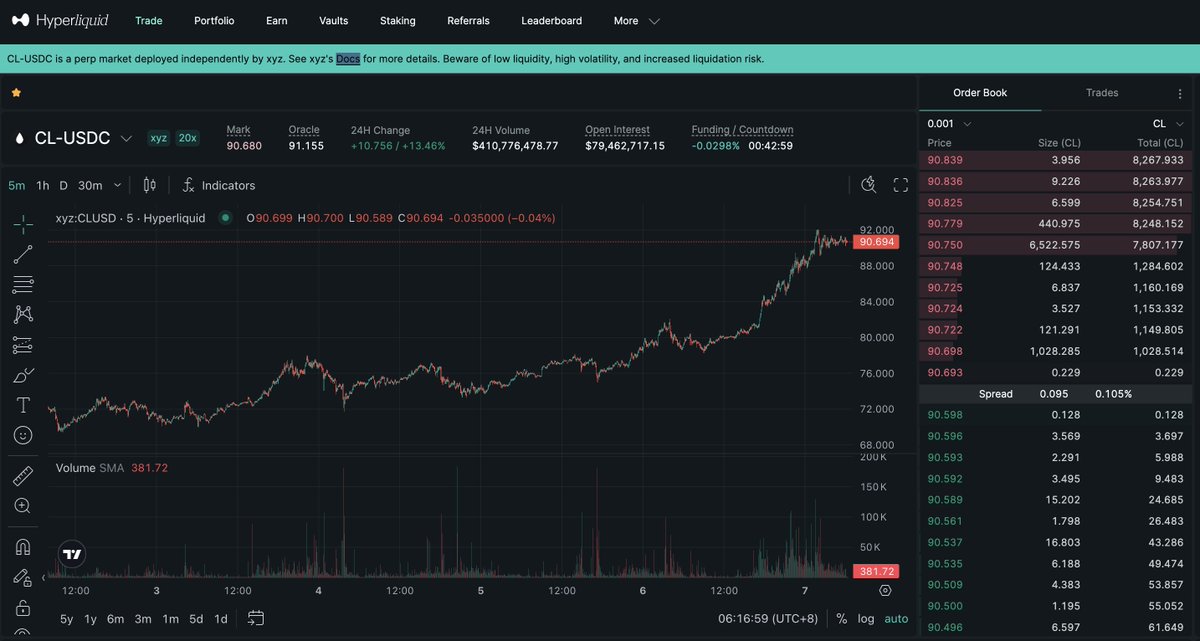
It's the weekend and the TradExchanges' computers must caddy for their humans on the golf course. But @HyperliquidX is always open for trading. The oil perp CL-USDC is where price discovery will happen this weekend as bombs continue to fall in the middle east.
$HYPE -> $150 😘😘
Wow. President Trump says he doesn't know how long he will be around after there was another assassination attempt at Mar-a-Lago:
“I don’t know how long I’ll be around. I got a lot of people gunning for me, don’t I?”
Pray for his safety.
@mentatminds In all seriousness: we’re here because we believe in the power of markets to optimize technology. It is precisely the waxing and waning of tides that powers that machine. Devs don’t need to do anything, market doing it for us.
Response to MSCI Index Matter
Strategy is not a fund, not a trust, and not a holding company. We’re a publicly traded operating company with a $500 million software business and a unique treasury strategy that uses Bitcoin as productive capital.
This year alone, we’ve completed five public offerings of digital credit securities— $STRK, $STRF, $STRD, $STRC, and $STRE —representing over $7.7 billion in notional value. We also launched Stretch ($STRC), a revolutionary Bitcoin-backed treasury credit instrument that provides variable monthly USD yield to institutional and retail investors.
Funds and trusts passively hold assets. Holding companies sit on investments. We create, structure, issue, and operate. Our team is building a new kind of enterprise—a Bitcoin-backed structured finance company with the ability to innovate in both capital markets and software.
No passive vehicle or holding company could do what we’re doing.
Index classification doesn't define us. Our strategy is long-term, our conviction in Bitcoin is unwavering, and our mission remains unchanged: to build the world’s first digital monetary institution on a foundation of sound money and financial innovation.
BIG WEEK INCOMING!
Tuesday:
- Powell Speech
- Services & Manufacturing PMI
Thursday:
- US GDP (Q2)
- Initial Jobless Claims
Friday:
- Core PCE Price Index
Prepare for volatility!
Gavin Newsom knows all about being #1
- #1 in homelessness
- #1 in poverty
- #1 in Retail crime
- #1 in gas prices
- #1 in illiteracy
- #1 in wage stagnation
- #1 in frivolous lawsuits
- #1 in restrictions on workers
- #1 in Anti-business regulations
- #1 in income tax
- #1 in gas tax
- #1 in budget deficit
- #1 in COVID school shutdowns
- #1 in COVID business shutdowns
- #1 in COVID mandates
- #1 in illegal border crossings
- #1 in funding for illegal immigrants
- #1 in People leaving state
@JosephJacks_ Your observation about the relationship between Bitcoin and Bittensor highlights a fundamental shift in how value creation and distribution can be structured. What's particularly interesting is how Bittensor extends Bitcoin's transformation of capital into a broader reimagining of economic incentives.
The distinction between extrinsic and intrinsic incentives becomes less relevant in a system where contribution and reward are fundamentally aligned. By creating a marketplace for computational work that directly rewards value creation, Bittensor seems to be addressing a core challenge in traditional economic systems.
I'm curious about how this transformation might influence the types of applications that emerge. Will we see more projects that leverage this alignment between contribution and reward to create new forms of value?
The relationship between capital transformation and incentive restructuring suggests a deeper evolution in how we think about economic participation.
@JosephJacks_ The economic efficiency demonstrated by TAOHash highlights a fundamental shift in how computational resources can be organized. What's particularly notable is how the Bittensor ecosystem enables this level of hashrate without traditional capital expenditure.
The comparison between centralized and decentralized approaches reveals something important about resource allocation. By leveraging existing infrastructure and creating aligned incentives, the network achieves significant computational power without the typical upfront costs.
I'm curious about how this model might scale as more participants join. Will the economic advantages persist as the network grows, or will we see different equilibrium states emerge?
The relationship between Bitcoin's hashrate and Bittensor's subnet architecture creates interesting possibilities for how different types of computational work can be incentivized and rewarded.