Run MiMo-V2.5 on 2× DGX Sparks, Full OMNI, Hassle-free! ✨
1M context · 3 concurrent sessions
~31 tok/s → single, ~56 tok/s → 3 sessions
Full Omni = text, images, video, and audio on the same endpoint. The more I use this model the more I love it.
→ https://t.co/Y1D4Fcvbji
GPUs for all 🤗
Creating ZeroGPU demos or apps is now available to ALL @huggingface users
tell your agent: "Build a HF ZeroGPU demo for this model"
New Space: https://t.co/kSdMdiemPP
Agent skill: https://t.co/JuQVcthoM0
You can now run Claude Code & Codex right from Grok Build!
I've just open-sourced a plugin to make it possible.
With Grok-Delegate you can use Grok 4.5 as your main fast orchestrator and delegate hard tasks to models like Fable 5 or GPT 5.6 Sol.
Just install the plugin and run /delegate-claude or /delegate-codex.
If you're seriously considering using Grok Build as your only harness, as I am, but can't do that because of the need for the big models, this plugin can really help.
The link is in the comments ⬇️
Atomic Chat has launched DFlash for macOS, Windows, and Linux.
A new speculative decoding mode that runs local Qwen models 2.2x faster on llama.cpp, with byte-for-byte identical output.
A separate small model can draft up to 15 tokens at once, and the full model only verifies them, making sure the weights and the final text don’t change.
ThinkingCap-Qwen3.6-27B is really good.
Much faster than the original Qwen3.6-27B thanks to shorter thinking, while preserving accuracy.
Also one of the best evaluation I have seen for a custom Qwen3.6 27B: lot of benchmarks, sigtest, token count, etc. That's all very convincing.
I'll publish my own evaluations for this model soon.
DFlash makes Qwen 2.2x faster with no quality loss!
We ran the same Qwen3.6-27B locally three ways on one RTX 6000: baseline, MTP, DFlash. The tasks only differ in one thing - how predictable the next word is: quicksort, describe a file in JSON, a logic puzzle, a sci-fi story.
Outputs:
Baseline: 44 tok/s · 1.00x
MTP: 65 tok/s · 1.45x · 71% accepted
DFlash: 98 tok/s · 2.20x · 30% accepted
Baseline writes one token per step. MTP works inside the model itself and guesses 3 tokens ahead. DFlash is a separate small model that writes 15 tokens at once, and the big model only checks them. In JSON the same words repeat all the time, so most guesses were right: 152 tok/s, 3.4x speedup. In the story 9 guesses out of 10 were wrong. DFlash did all that extra work for nothing and became slower than baseline: 42 vs 44 tok/s. MTP guesses only 3 tokens, so a wrong guess costs very little: 46 tok/s and the win in that round. The output is identical in all three modes - DFlash is the pick for tasks with predictable output, like coding, and for chat and creative writing MTP works better.
DFlash is now natively integrated into Atomic Chat on llama.cpp - speed up your Qwen models!
Maestro v1.1.3 is out!
Maestro is a free, open-source creative studio that lets you generate videos, images, music, voices, and sound effects on your own computer without having to piece together a collection of complicated AI tools, using the latest open SOTA models.
Director mode can take (or generate) a song or story idea, plan the scenes, generate the visuals and video clips, and assemble them into a complete music video or short film.
New features
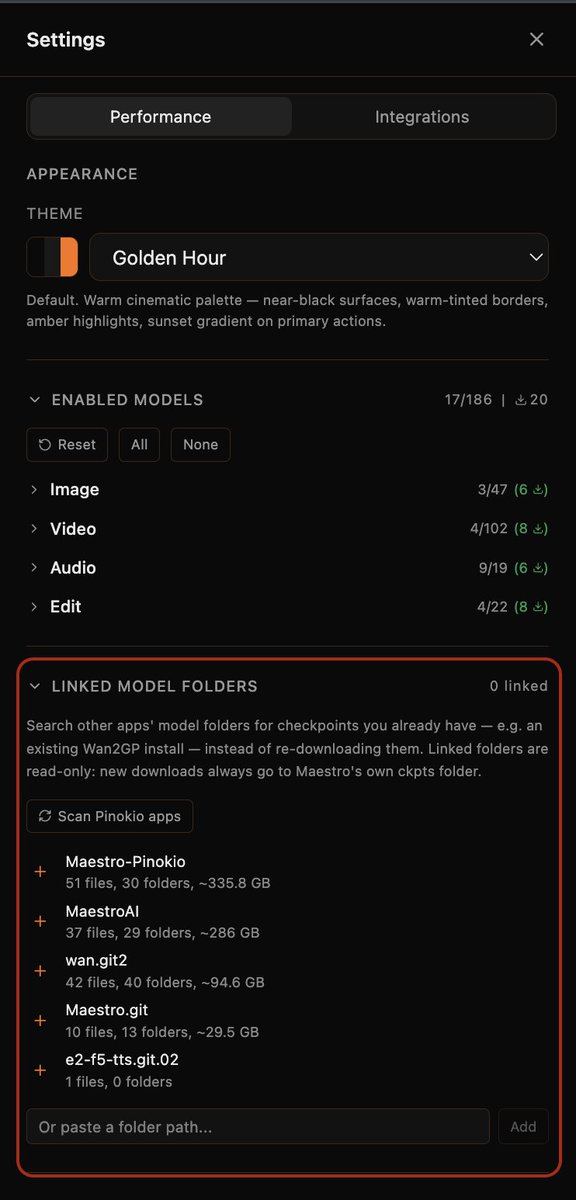
• Linked Model Folders: point Maestro at your other installs (like Wan2GP) and reuse their checkpoints and LoRAs instead of re-downloading hundreds of GB. One-click scanning of your Pinokio apps, strictly read-only, and AI LoRA guides work on linked LoRAs too.
• Krea 2 image models (Raw and Turbo).
Quality and performance
• Major quality fix for LTX-2 Dev and 10Eros: a leaked sampler setting was making output blurry and oversaturated. This was the root cause of the "Dev models look bad" reports.
• The STG slider actually works now (it was silently doing nothing).
• Performance Auto-Tune gives audio its own memory profile: cards with 12 GB+ VRAM now unlock the fast ACE-Step song decoder instead of a slow fallback. Re-run Auto-Tune after updating to pick this up.
• ACE-Step song generation no longer looks like it hangs forever. The runaway progress counter was a display bug; it now reads honestly.
Director mode
• Regenerating a clip from the Pipeline Dashboard keeps the original song, conditioned on the exact segment of the soundtrack that clip covers.
• Re-join works end to end: full-length clip reruns, original soundtrack overlaid, nothing drifts out of sync.
• The gallery refreshes automatically when new clips or rejoined videos are saved.
• Fixed bogus "Generate N missing" counts, broken start-image thumbnails, and LoRA recommendation colors showing wrong on some themes.
Click the Update button in the Pinokio launcher.
Grok Build uninstalled from the Mac:
rm -rf ~/.grok
rm -f ~/.config/fish/completions/grok.fish
rm -f /usr/local/bin/grok /usr/local/bin/agent
rm -f ~/.local/bin/grok ~/.local/bin/agent
clean grok region from your .zshrc or .bashrc.
That's all folks.
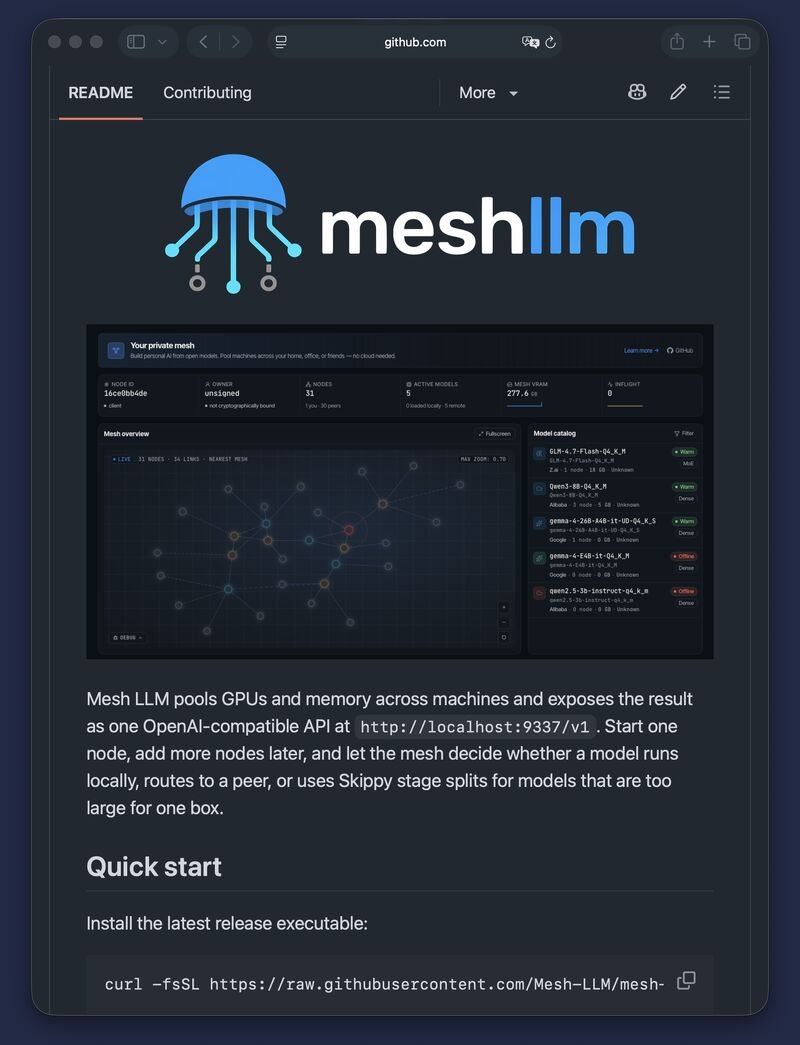
Want to run a 70B+ model but don't have an 80GB GPU? Mesh LLM distributes inference across the devices you actually have.
The architecture is incredibly smart:
→ If a node can fit the model, it runs locally
→ If not, it routes to a peer that can
→ If the model is too big for any single box, it uses "Skippy stage splits" to shard the model by layer across your hardware
Open source in Rust. Worth checking out
I removed 423 GB from GLM‑5.2 without changing the model.
1,403 GB → 980 GB.
753B weights.
Bit for bit exact.
No quantization or retraining.
The weights remain compressed in VRAM instead of rebuilding the full model first.
Full writeup and repo in the next post.
A French developer built a free tool that turns your Android phone into a desktop app in one command.
And it is used inside giant bot farms in China and Russia.
It’s called scrcpy.
Connect your phone through a cable or Wi-Fi, run one command, and the entire screen appears on your computer.
You can click with your mouse.
Type using your keyboard.
Copy text between both devices, drag files onto the phone, record the screen, forward audio, and control several phones at once.
That last part is why scrcpy shows up in phone farms.
Instead of hiring one person to hold every device, an operator can place dozens of Android screens on one monitor, check which accounts are running, restart failed apps, and manage an entire wall of phones from one keyboard.
The tool does not create fake views or followers.
It just makes hundreds of phones easier to control.
The wild part is what scrcpy does not require.
No root access. No account. No ads. No internet connection. Nothing stays installed on your phone after you close it.
It runs on Windows, macOS, and Linux, reaches up to 120 frames per second, and usually shows the first image in about one second.
Your phone was already a computer.
scrcpy just gives it a proper screen and keyboard.
100% open source.
Just published: a complete operational validation playbook for running the full NVIDIA GLM-5.2 NVFP4 checkpoint (~433 GiB) on NVIDIA DGX Spark clusters.
After extensive testing across 2–8 node topologies, only the 8-Spark eager TP8 configuration succeeded on every operational gate. Smaller clusters revealed important capacity and runtime limits that are now fully documented.
Repo + #2 section: https://t.co/RiQ6Xzf721
Run the new @UnslothAI Qwen3.6-35b-NVFP4 on your @NVIDIAAI DGX Spark ease! ✨
256K context • 24 concurrency
~81 tok/s single session
~350+ tok/s at 24 sessions
This is now the recommended Qwen3.6-35B terms of accuracy/performance.
Get it here 👇
https://t.co/ULJkq3A7rN
SOMEONE BUILT AN OPEN SOURCE GAME ENGINE MADE SPECIFICALLY FOR BUILDING 2.5D GAMES WITH AI
instead of using a complex general purpose engine, this one is built from the ground up for the ai workflow
it keeps everything the ai needs to control in one small, simple place, so the agent can actually understand the whole engine and build with it instead of getting lost in a giant codebase
> generate all your assets with ai, the maps, characters, props, audio and ui, then the agent drops them into a real playable game
> a built in server sdk handles the boring stuff, player accounts, cloud saves, even multiplayer, in a line or two
> it ships with claude and codex agent setups baked in, so it works with whatever youre already using
> free and open source
most people vibe code games inside engines that were never meant for it, so he built one where the ai workflow is the whole point
the whole idea is dead simple, keep it small enough that an agent can understand all of it at once, then let it go wild
this is what tooling built for the agent era actually looks like
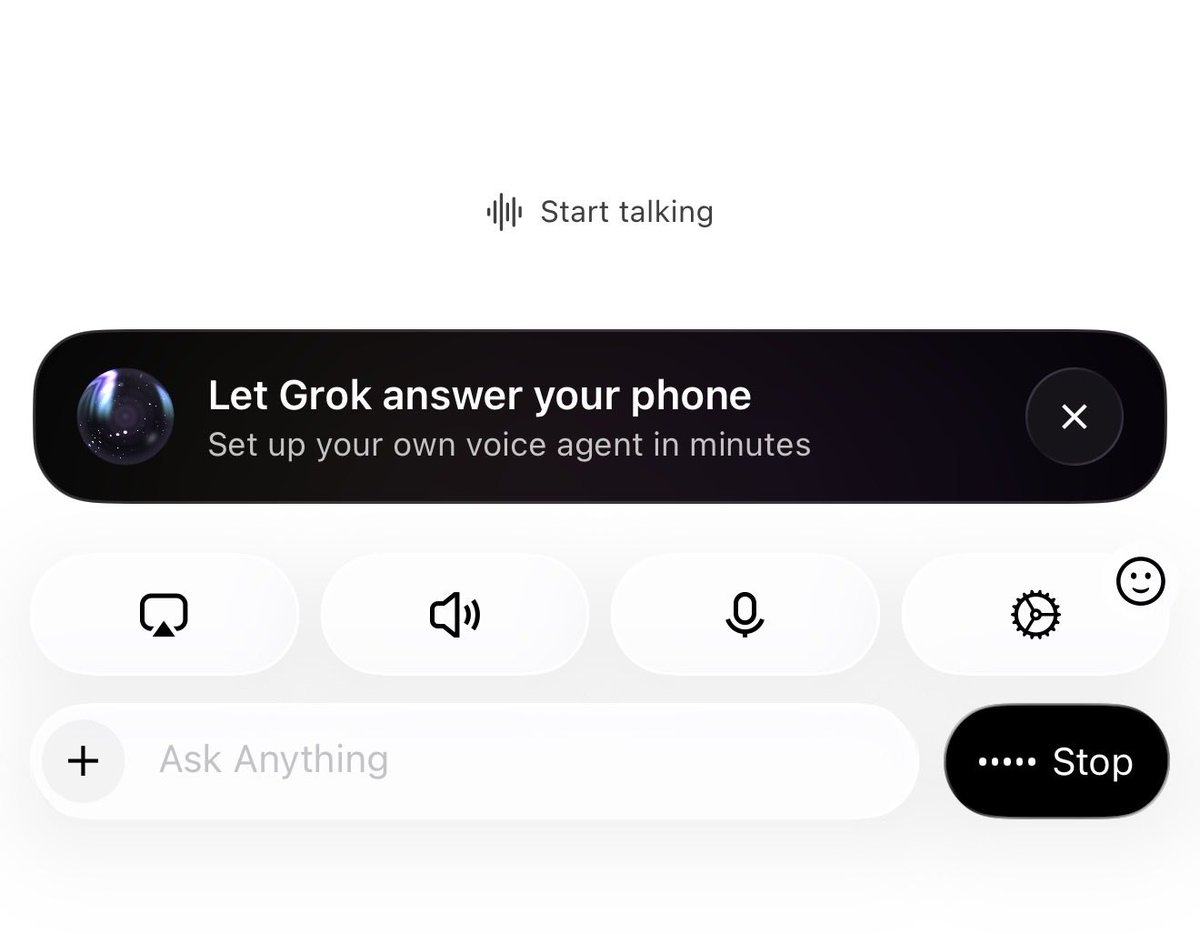
Your AI can now answer phone calls for you
Create your own voice agent in under 2 minutes, customize its personality, and let it handle conversations on your behalf