Pretty simple:
The OpenAI paper only looks at users who are logged in to consumer ChatGPT accounts. They find 50/50 share.
But this ignores other account types! There are lots of enterprise account users (including me!) and we think the share of men amongst those accounts is probably very high.
More broadly, the problem at hand is not estimating the gender share conditional on using account/tool X, but what fraction of men and women use AI tools. Different estimands, different samples, and so not surprising we get different estimates!
My read of survey and other analytics data is that the gap is slowly closing but far from closed, and is still large for frontier models and tools.
In @PeterMcCrory and team's awesome analysis of AI's role in social science is yet more evidence that the AI gender gap is far from closed:
- Women use Claude ~3pp less than men
- Women use Claude Code ~13pp less men
These and dozens more new estimates in a soon to be released update to a working paper w/ @CranneyKatelyn and @solenedelecourt.
To what extent will AI automate innovation? How will social science research change with the advent of agents able to execute research end-to-end?
New Anthropic Economic Research from Thomas Lyttelton, Nathan Wilmers, & Maxim Massenkoff out today tackling these questions. 1/6
Also worth noting that productivity from AI is measured as releases, not user or revenue growth, so AI's impact surely gets weaker on economic outcomes!
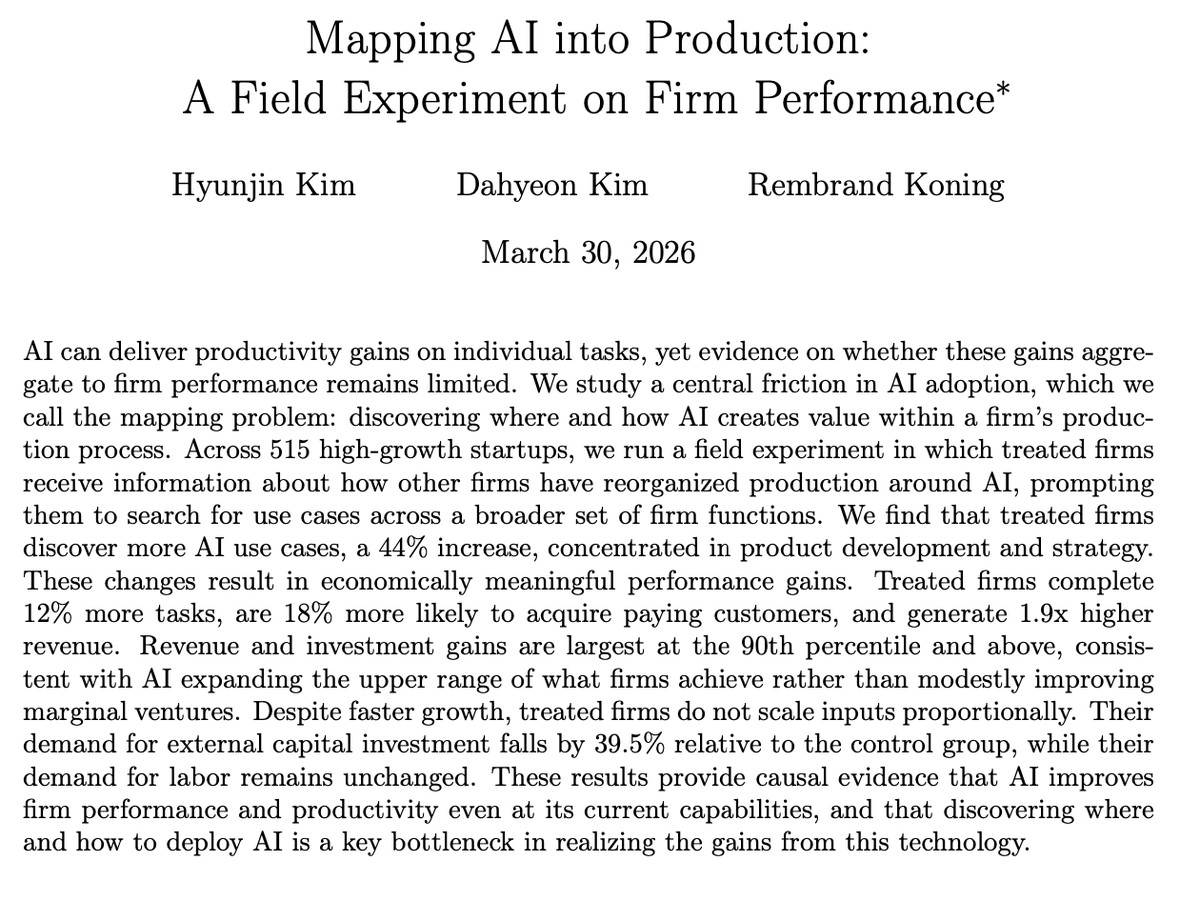
That said, when founders learn to map AI into their ventures, we do find meaningful performance improvements:
https://t.co/uY8AjWl4Dy
Why? Founders learn where to use AI so that it improves firm growth. That could be lines of code, it could be marketing, or something else. Firms are messy so applying AI to generate growth is messy too.
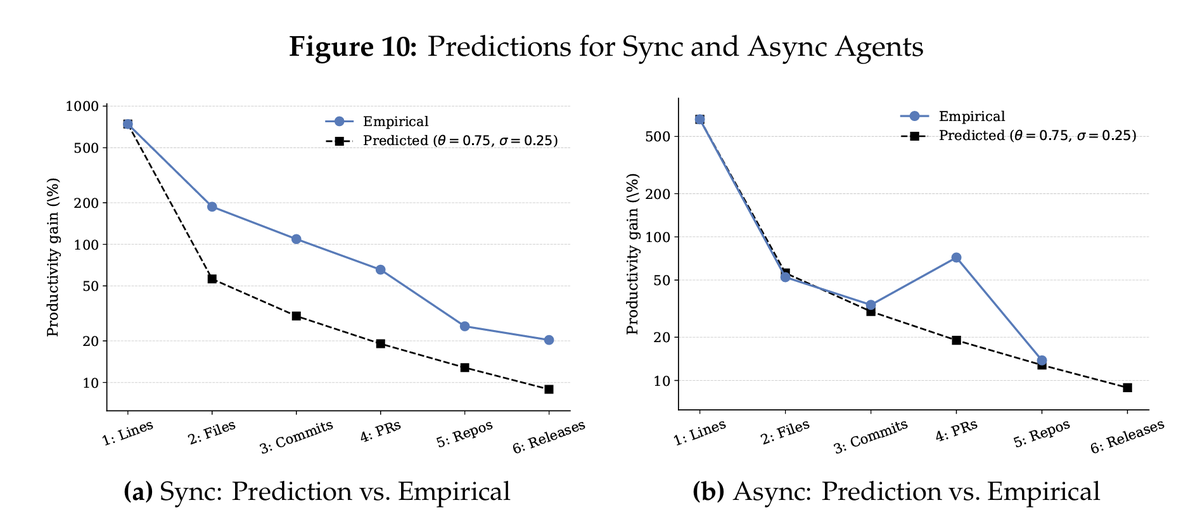
AI appears to lead to LOTS more code, but because of weak link problems, results in muted gains in production of (high quality) software.
Building on our "Mapping AI into Production" RCT, would be cool to see an RCT that trains developers (especially OSS teams) to better map AI into their projects.
https://t.co/gL3fnUb9Yr
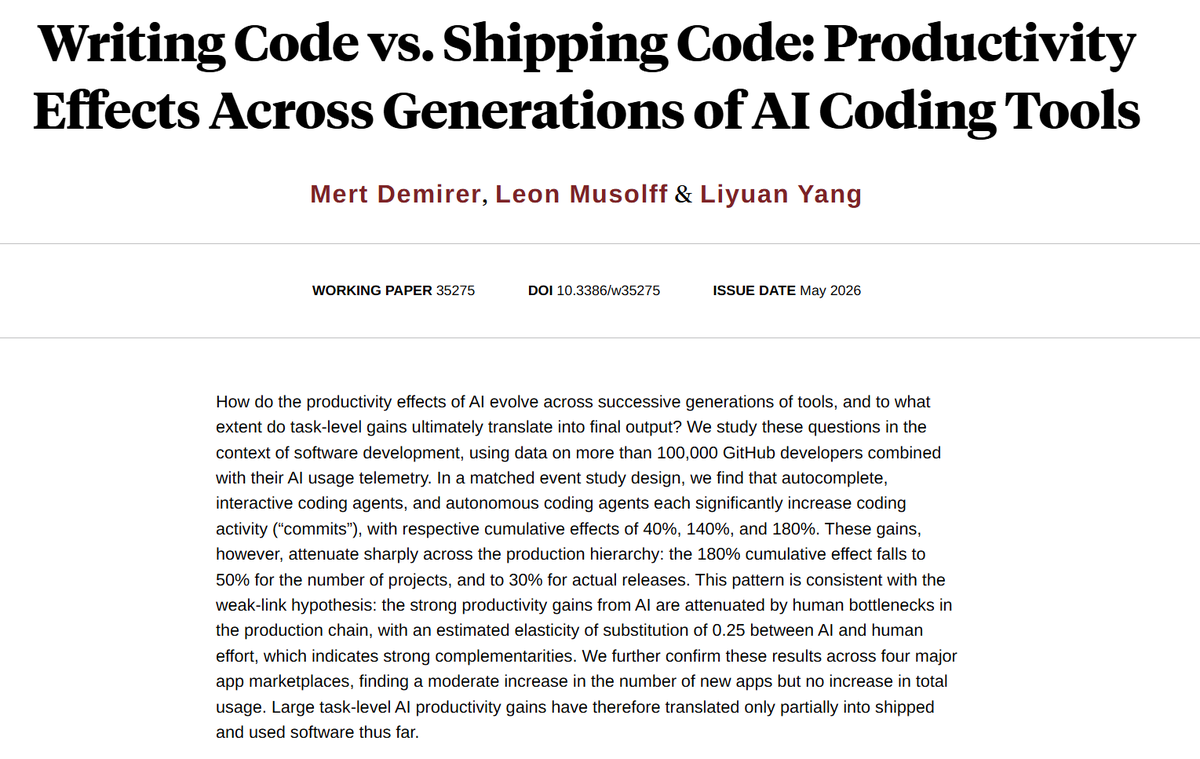
Large productivity gains from AI don't lead to equally big gains in software.
+40%/+140%/+180% commits from autocomplete/interactive/autonomous agents but only +50%/+30% projects/releases
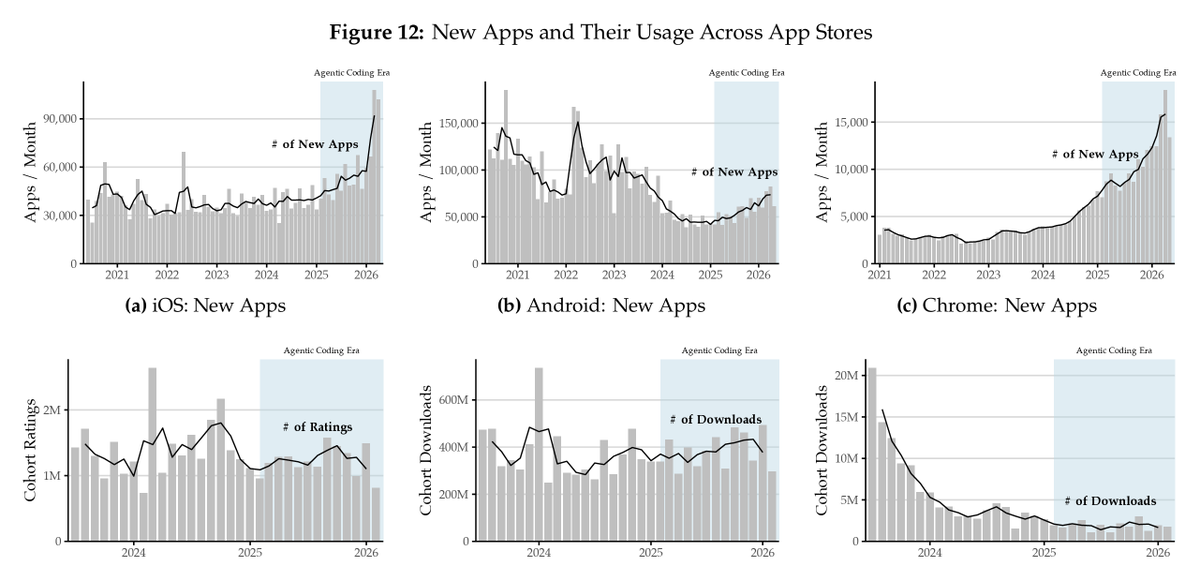
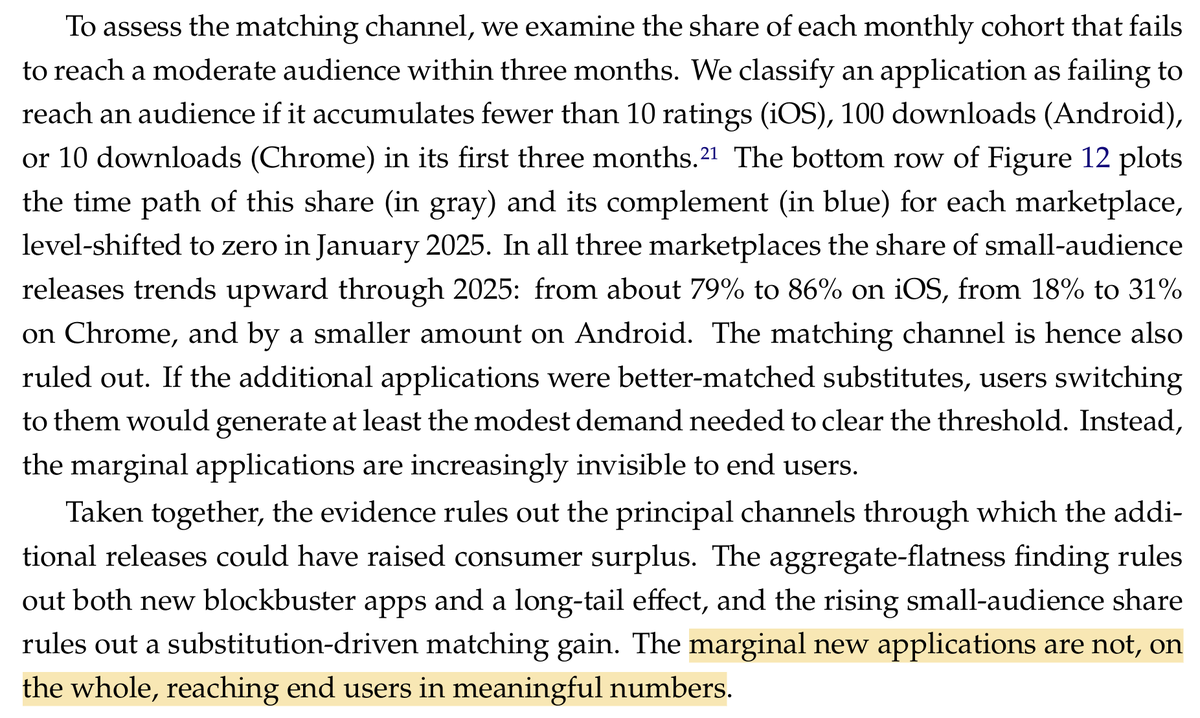
And does this new software get used by consumers? Not really. It's invisible/irrelevant.
Flip side is of weak-link problem is that if managers can work out where AI matters in production, impacts on productivity and growth should be substantial. Our recent RCT with hundreds of startups shows exactly this!
https://t.co/gL3fnUb9Yr
As long as people play a key role in allocating intelligence in the workplace, my guess is AI's impacts will not arrive all at once but will be uneven and slower than AI enthusiasts think... but for those enthusiasts who can AI to address real bottlenecks the impacts will be meaningful (our experiments shows this is already the case!)
🚨 Excited to share a new working paper! 🚨
AI can improve individual tasks. But when does it improve firm performance?
Our paper proposes one key friction firms face: the "mapping problem" -- discovering where and how AI creates value in a firm's production process.
🧵1/
@abhishekn My kids love all the stuff we print out ...love the idea of having a claw that both prints out interesting worksheets for them and then gives feedback.
Also, why do we have to limit this to kids? I want them for my writing!
here's my vision for education + AI for kids - esp elementary kids.
premise: screens are bad (esp for this age), but customized, tailored instruction is good!
solution: a scanner + printer connected to agents.
kid gets sequential worksheets - each one graded with annotations like a real tutor would, and a new worksheet, generated on the fly, customized and tailored to what the kid needs to know.
right now my 6yo is doing mind numbingly boring worksheets, and even nicer techniques like beast academy don't adapt or provide feedback.
anyone building this?
Will do!
And will bring your piece into the classroom next time I teach my HBS cases on @GammaApp (in the @a16z portfolio!) and @Lovable.
Both get at the idea that AI has fundamentally shifted the production function in how startups grow, with big implications for who gets to work in these firms, how they should be organized, and strategy.
@RaoulRuparel check out our paper: https://t.co/gL3fnUb9Yr
Experiment is from late 2025, tools include Claude Code, we find strong evidence that when entrepreneurs learn to map AI into their firms they get more done faster and more efficiently.
I think generalizing this type of experiment to other occupations/settings would be amazing, we need more realtime "evals" that are simply RCTs in the field.
🚨 Excited to share a new working paper! 🚨
AI can improve individual tasks. But when does it improve firm performance?
Our paper proposes one key friction firms face: the "mapping problem" -- discovering where and how AI creates value in a firm's production process.
🧵1/
Hi everyone - excited to announce our next i3 Upskilling session. We are very lucky to have Vitaly Meursault of the Philadelphia Fed do the following presentation on Friday, May 29th at noon (zoom link below)
Building Personal Research Factories
A recurring finding from recent economic research on AI: gains accrue to those who restructure the way the work is done, not to those who shoehorn AI into the existing process. This talk is about that restructuring for research. Tools like Claude Code, OpenAI Codex, and Open Code can now write code, run analyses, draft sections, and search the literature. The question that follows isn't "how do I use them" but "what should the research process itself look like, so AI helps without outpacing your understanding?" The answer this talk proposes is a personal research factory: an evolving body of files and rules — specifications of what you want, plans for how AI should produce it, explicit checks against the spec, and logs of what was actually tried and why — that sits between you and AI and mediates every interaction. The factory evolves with you across model upgrades, keeps outputs defensible because every decision stays visible, and steadily improves what you and AI can do together. The talk introduces the idea, walks through the structure that makes it work, and closes with a way to start building yours this week. The structure is universal; the shape reflects your taste.
https://t.co/H7boAelKDg
Join us! -Matt
We've seen 40M projects built on Lovable and learned tons about what it takes to make a safe agentic coding tool.
Lovable will be the first in our category to get the only certification covering the risks of agentic coding, by AIUC (@aiunderwriting).
Read more about it and what we've done so far: https://t.co/guX6mfLigi
Introducing the Built for Moms contest, in partnership with our friends at @WisprFlow, to celebrate everyone who builds for the moms in their lives.
How to enter:
1. Build with Lovable and Wispr Flow
2. Submit: https://t.co/fqEErM6jqw
3. Vote on your favorites
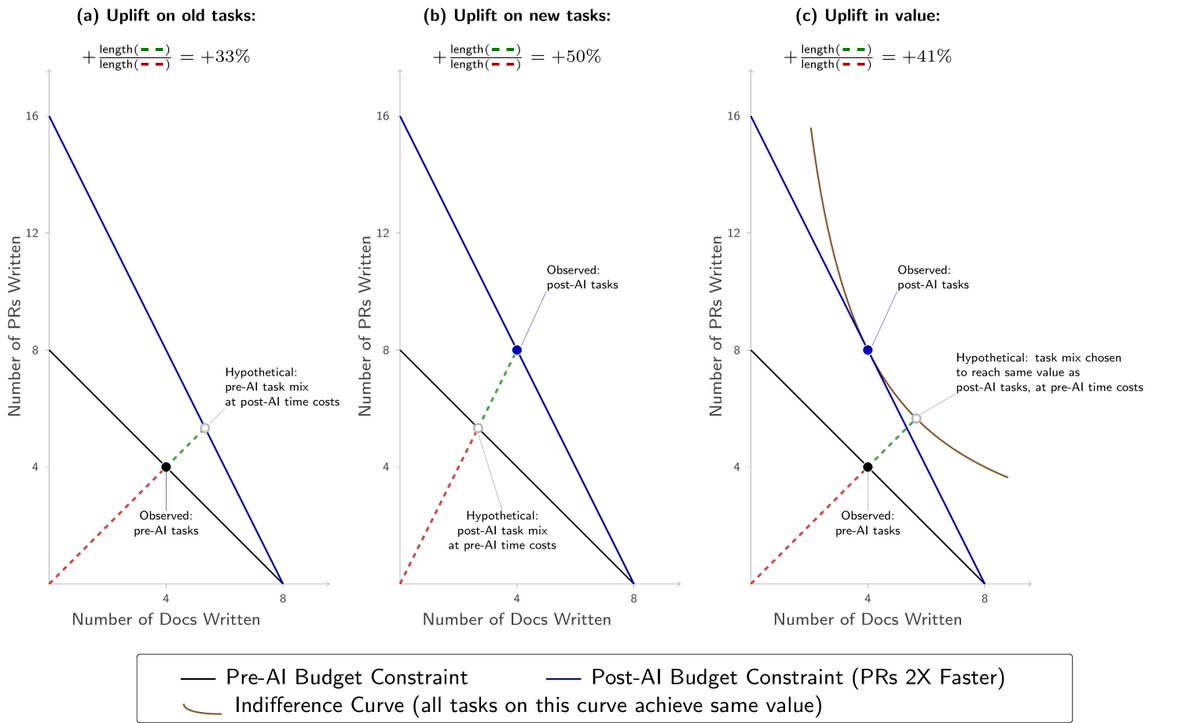
New post on the difference between 3 notions of productivity gain from AI (AKA uplift).
Uplift on old tasks (AI-speedup on tasks you do in avg 2022 day)
Uplift on new tasks (AI-speedup on tasks you do in avg 2026 day)
Uplift in value (AI increasing your goals accomplished)
@melodykoh@robgo Love that summary @melodykoh and it's exactly what we tested. In our experiment treated group engaged in case studies, workshops, and peer groups to actually redesign how their startups operate.