🚨 A warning for the Cardano community using Bybit.
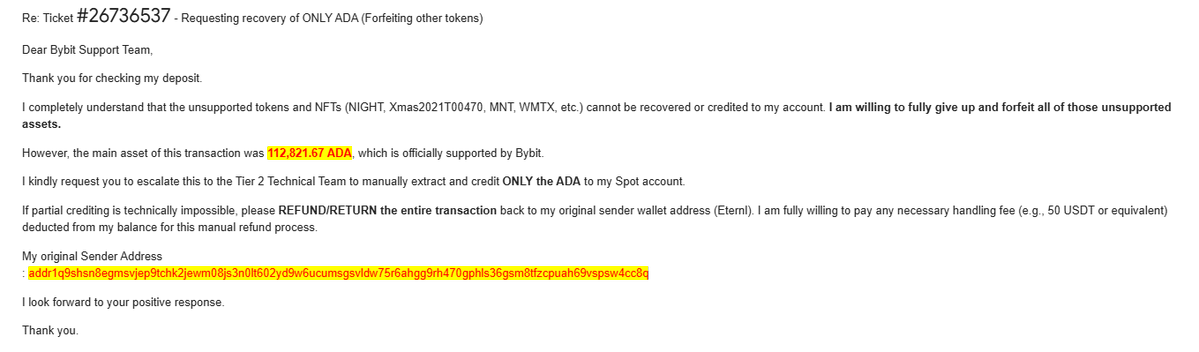
After the recent SecondFi incident, a community member transferred approximately 112K ADA along with several Cardano native tokens to their correct Bybit ADA deposit address.
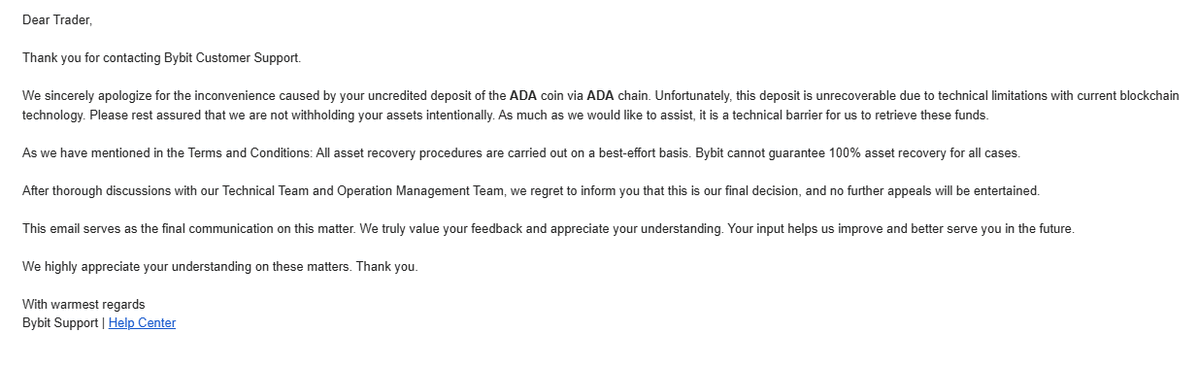
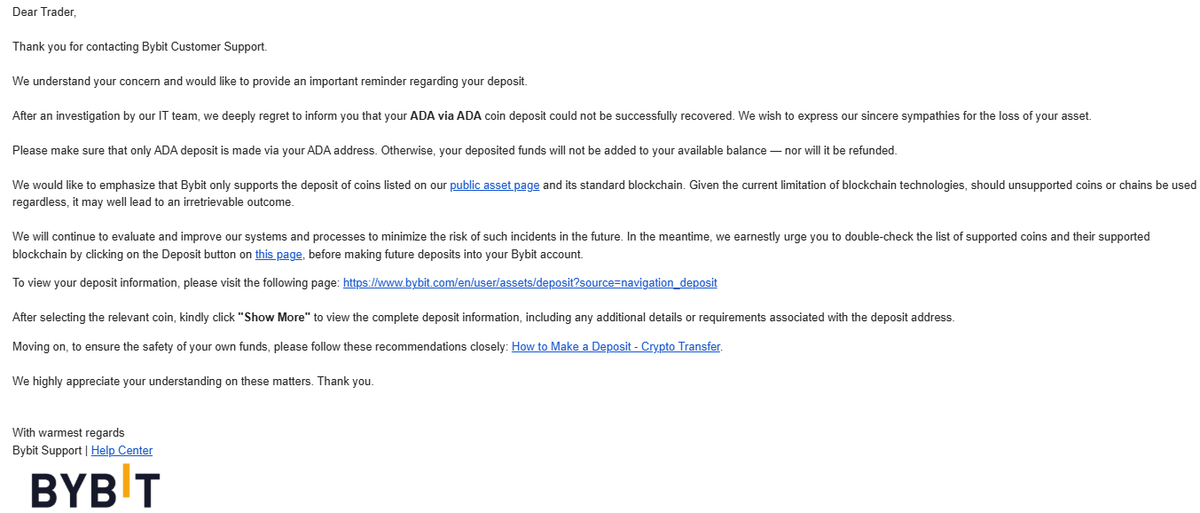
The deposit was never credited. Bybit has repeatedly responded that because native tokens were included in the transaction, the deposit cannot be credited or recovered due to technical limitations.
The ADA is still sitting at the Bybit deposit address on-chain:
https://t.co/iFDEgk2qPm
Frankly, it's difficult to understand how the ADA itself cannot be recovered simply because native tokens were included in the same transaction.
But even if Bybit's explanation is technically correct, there should have been a clear warning before the deposit was made something like:
"Do not send ADA together with Cardano native tokens. Doing so may prevent your deposit from being credited and could make recovery impossible."
Without such a warning, leaving a user's assets effectively inaccessible is unacceptable.
⚠️ If you deposit ADA to Bybit, do NOT send Cardano native tokens in the same transaction.
Please repost to help warn other users and encourage Bybit to review this case.
@Bybit_Official@astroboysoup@IOHK_Charles@emurgo_io@Cardano_CF@phillip_pon@carloslodelar@NaVi_GaT0R@cexplorer_io@IOGroup@InputEndorsers@Sssebi@MinswapIntern@adamKDean@ch1bo_@BBHMM_Stake
Reports of many others using @secondfiapp wallets getting hacked coming out. @Cardano $ADA has a reputation that id think @IOHK_Charles@emurgo_io would like to protect. This needs to be addressed and people made whole ASAP.
From one of my community member, Nearly 110k ADA has been drained from a @secondfiapp wallet.
The person was on an iPhone and changed their DRep via SecondFi roughly two days ago.
The victim and attacker addresses are provided below, and a support ticket has already been submitted.
@secondfiappwhat what is going on? Have you identified the cause, and how do you plan to compensate the victim if this turns out to be a wallet-related issue?
addr1qyszlmhtmxh5czw9hl6m4cep9alqcx53xc4rsggmqcdx2rdh3uadmxm9jczneet986a4n8tvchy6tw6qqjnpx2s5238szh260x
addr1qy846jjyaw6shg42r6td652k3s85whtl888u5jvwvvd9khda7a53pnlqmredy9afl3hdn0sk2vudeltdd34nch4utjus0axg40
Hacker address:
addr1q9wudkfeelzwev427yvapkmqexmet8q4vl303m7a4eerwtvt6rq00zyuqzeuw759vgqtdky0gyxnqx27n8q4k6h79yhsqelma8
@secondfi_jp@secondfiapp
My DRep live stake is now approaching 50M ADA. I’d like to thank everyone who has delegated to me.
Lately, there has been a lot of negative news coming out of the Cardano ecosystem. We’re seeing major services shutting down, as well as people stepping away from their roles as DReps and SPOs. It reminds me once again how difficult it is to survive in this industry.
In reality, aside from established businesses like exchanges, only a small number of projects manage to survive long term, whether they’re dApps, Layer solutions, or infrastructure providers. I’ve personally watched many projects I knew go bankrupt or quietly disappear over the years. With current market conditions, that trend seems to be accelerating.
Up until now, this industry has largely been a fight over a limited pie, with projects competing for the same users, liquidity, and attention.
But I believe we’re finally reaching the point where major players from traditional industries, new users, and fresh liquidity are starting to enter the space. Given that, it’s only natural that Ethereum, which has already established itself as the market standard, attracts most of the attention and capital.
One thing is clear, though. Blockchain stands in the opposite direction of AI. While AI continues to evolve around increasingly centralized data and control, blockchain offers trust, ownership, and censorship resistance that no single party can arbitrarily control. Those are unique properties that only decentralized networks can provide.
And I believe these qualities will become even more important as the industry matures and as more users and professionals enter the space. In the end, people don’t just want efficiency. They also want systems they can trust.
When that happens, I believe Cardano will have an opportunity unlike anything we’ve seen before.
As far as I know, Cardano remains one of the few networks that has stayed true to the core values blockchain was meant to deliver: decentralization, sustainability, and governance. That’s why I remain optimistic about Cardano’s future despite short-term market conditions.
The market may still undervalue Cardano today, but I believe its technical and governance fundamentals continue to mature and strengthen.
More importantly, I find it incredibly meaningful that an ordinary individual like myself can directly participate in the ecosystem’s growth and have a voice in its decision-making process. To me, that’s proof that the decentralized vision Cardano has always talked about is actually being put into practice.
Once again, thank you to everyone who has placed their trust in me through delegation. I’ll continue doing my part to help Cardano gain the recognition it deserves and prove the value it brings to the world.
카르다노 거버넌스, 솔직히 어렵지 않나요? 🤯
제안도 많고, 내용도 복잡하고, 누구를 지지해야 할지 판단하기 쉽지 않습니다
그래서 카르다노거버넌스 MBTI 한번 만들어봤습니다.
🧠 10초 성향 테스트
✅ 55가지 거버넌스 유형
✅ 나와 닮은 역사적 인물 찾기
✅ 나와 가장 잘 맞는 DRep 추천
내가 카르다노의 미래를 보는 관점,궁금하다면 한번 도전 해보세요
🏆 DRep 월드컵
https://t.co/iaUelxrp8e
Let me share a bit of a personal story. The first time I came across @IOGroup was through a brilliant developer in Korea, someone who had previously led one of the country's most well-known blockchain academic societies and ran several popular projects.
Back in graduate school, he mentioned in an interview that he wanted to build a company like IOHK, one centered around deep technical research. Even then, he understood how important peer-reviewed papers and verifiable academic research were as the foundation of a blockchain. Through him, I came to understand just how exceptional IOHK was as a company, and how deeply technical the Cardano network truly is.
As we all know, this market is fundamentally a technology-driven market, and at the core of every fundamental, technology is what stands. What drew me to Cardano was exactly that, its outstanding technology, and the deep thinking and philosophy that shaped its very beginning.
Lately, it feels like there's a lot of friction and dissonance within the ecosystem. But realistically speaking, IOG's presence in the Cardano ecosystem is irreplaceable. Their academic depth and engineering capabilities grounded in formal verification have produced technical breakthroughs that no other company has achieved. Put simply, without IOG's research and core development capabilities, I believe the very foundation of Cardano could be shaken.
What's fascinating is that they've been collaborating with multiple companies to gradually decentralize the network's dependency on IOG itself, while also nurturing more Cardano-specialized engineers along the way. In other words, they are voluntarily reducing their own influence and helping the ecosystem stand on its own. This is an act of intentionally letting go of their own power so that the ecosystem can evolve and grow organically.
I have never witnessed, in this entire market, a company willingly setting aside its power and influence for the sake of an ecosystem. I genuinely believe they are working for the long-term growth and decentralization of Cardano.
In that spirit, I hope we can move forward through dialogue rather than exclusion, and through understanding and constructive feedback rather than blame. As people who are building this ecosystem together, I believe differences in opinion should not be a reason for conflict, but rather a starting point for finding a better path forward.
At first glance, “Starlink exists, so why World Mobile?” sounds reasonable.
But connectivity is not one layer.
Satellite helps fill gaps, but it does not replace local access, pricing, distribution, demand, or community infrastructure.
That is exactly why World Mobile matters. the number of places where this model can expand is much larger than most people assume.
#worldmobile #unetwork
@MrTelecoms@WorldMobileTeam
@thecryptobasic I am the Midnight Ambassador and dRep who was first tagged by @NaVi_GaT0R in this issue, and this news is completely false. He never gave any instructions to vote "No" on that proposal. He was a bit aggressive, but the truth shouldn't be distorted.
Pogun proposal is getting a lot of pushback in Cardano’s 2026 budget. Here’s how I see it.
1. Cardano has walked an inefficient path in terms of sequencing. We installed on-chain governance before securing market position, and we're paying for that order now in costs. (Of course, whether Cardano's path or Ethereum/Solana's is right remains to be seen.) Other projects went centralized decision-making → VC partnership → market capture → governance, and sit at roughly 75x our TVL today. Democracy is the most ideal system for human governance, but in business domains it's inefficient and slow, and isn't always the right answer.
2. How we handle that inefficiency seems to be the core question of this vote. Cardano's native share in the Pogun-related BTC DeFi market sits near zero. One percent of Bitcoin's market cap moving here is roughly $15B, more than 100x our current $132M TVL. The market also looks like it's in its winner-takes-most window. Stacks is ahead with native L2 framing, Babylon is consolidating BTC staking, new entrants land every week. Asking IOG to run a 6-12 month external VC raise in a market that hardens in six is what your logic seems to produce in practice. Right in principle, but possibly leaving Cardano permanently locked out of catching up.
3. Pogun's schedule has an interesting detail when you look again. Q2 credit market → Q3 yield → Q4 BitVM bridge. The heaviest R&D piece ships last. If that's not coincidence, it reads as a structure where the first two components produce revenue that funds the actual research piece — the trust-minimized bridge.
4. BitVM has no mainnet precedent anywhere. Not Stacks, not Babylon, not anyone. I'm not sure that's a category commercial profit motive builds. It looks more like protocol R&D. And EUTXO-native execution seems to narrow the candidate teams down to essentially IOG.
5. You mentioned "other Cardano builders are already building toward similar goals" — I'd be curious which teams you have in mind. Within my search, I couldn't find any pushing BitVM bridge plus oracle-free credit market concurrently outside IOG/Pogun.
6. IOG also seems to have pre-empted some of your concern. Pogun isn't a lump-sum grant — milestone-gated disbursement, claw-back on miss, 20% revenue return until repaid, then 5% in perpetuity. That reads more like venture investment structure than subsidy. Curious what you make of that structure specifically.
7. Per IOG's official announcement, last year was $97.5M, this year $46.8M (52% cut, in USD terms), declining each year toward operational self-sufficiency. This is the second cycle and the asks shrink from here. Future cycles for applying tighter rules will exist, but the ask itself keeps getting smaller. The urgency of establishing precedent might look different from that angle.
8. A possible middle path I'd suggest: at this moment, speed (centralized execution) matters more than principle (representative democracy at full strength). Pass all nine, and turn your principle into binding rules from the next cycle. Commercial-revenue-capable proposals require external capital matching, automatic claw-back on missed milestones, public KPI tracking. Locking your framework in at the constitutional level can start today.
9. Apply from the next ask. That seems to capture both — IOG doesn't miss what may be its last meaningful window for BTC DeFi market entry, while your governance principle gets permanently codified rather than tested once and forgotten. Again, no DRep authority on my side. Just trying to extend what I think is one of the more carefully argued rationales of this cycle. Would love to hear from you or others.
@dori_coin@IOHK_Charles@IntersectMBO@IOGroup
https://t.co/N9cToOIAas
Finding it hard to get a clear overview of Cardano stablecoins?
KTOP has released a free tool to track everything at a glance (Djed will be updated)
With this tool, you can monitor the following data in one place:
1⃣Total Supply & Changes: Compare current data with yesterday, 1 week, 1 month, and 1 year ago.
2⃣Comparison Charts: Visual breakdown of supply across different stablecoins.
3⃣Supply Trends: Track changes on a daily, weekly, and monthly basis.
4⃣Mint/Burn History: Real-time history for each stablecoin.
Don't get swayed by Twitter hype.
Verify the data yourself.
https://t.co/hnrqJ7kMCG
Rational Privacy — 현실 세계 데이터 보호를 위한 균형 잡힌 모델
미드나잇의 Rational Privacy, 합리적 프라이버시는 데이터의 공개 범위를 본인이 직접 결정할 수 있습니다.
📍 핵심 포인트
1) 설문 결과, 응답자 76%가 프라이버시 우려, 20% 이하만 약관 읽는 현실
2) 동의 없이 수집하는 시대에서, 비공개가 기본인 시대로
3) 선택적 공개: 필요한 조건만 증명, 나머지는 비공개
4) 규제와 프라이버시는 적이 아닌 동반자
If you are asking about the importance of an oracle, it is certainly one of the most critical elements. The answer will vary depending on the target audience and the quality of the oracle you intend to launch.
Currently, Cardano utilizes several oracles. #PythNetwork migrated by Pentad, alongside community-built options like #Charlie3 and #Orcfax
I'm currently updating the Cardano influencer list for the Cardano Korea website. It's getting a bit overwhelming to handle solo, so I'd appreciate your help. Could you please share any influencers you know in the comments?
https://t.co/2Mgty0qthl
Emurgo should be excluded from Pentad. I urge @IOGroup, @Cardano_CF, @IntersectMBO, and @MidnightNtwrk to take this issue seriously and look into it closely.
Despite the community’s concerns, they haven’t updated the Yoroi UI, nor have they announced any plans to do so.
As the market grows, the governance delegations toward Emurgo and Yoroi could become even larger than they are today.
If that happens, it may become impossible to reverse, and Cardano governance could end up being used as a tool for the private interests of specific organizations, just like what happened with EOS.
Thanks for taking the time to address these concerns. I appreciate the willingness to engage with the community.
If Emurgo truly takes the community’s concerns and the fairness of Cardano’s governance seriously, I believe the @YoroiWallet DRep should be unregistered.
1) My concern is not simply that Emurgo and Yoroi together control around 17% of the delegated stake. The issue is that voting power accumulated through an unfair process cannot reasonably be considered a delegation that truly represents the intent of delegators.
In other words, this is not merely a critique of the governance system potentially becoming centralized. It is a call for a reasonable response to governance power that was accumulated through an unfair mechanism. Any DRep that has accumulated delegation primarily through UI/UX mechanisms that effectively steer users into delegating should be subject to the same standard.
In the real world, when wealth or political power is obtained through improper means, simply stopping the behavior is not considered sufficient. There are usually corrective actions such as restitution or disqualification, both to restore fairness and to set a precedent that discourages similar behavior in the future.
2) The delegation accumulated through Yoroi should not be used to exercise governance power.
Let me ask a direct question: do you genuinely believe that users who delegated through Yoroi did so because they carefully evaluated Yoroi’s governance philosophy, vision, or positions and consciously chose to support them?
Unlike DReps such as @ItsDave_ADA or @JaromirTesar , Yoroi has not publicly articulated a clear governance philosophy, nor has it engaged in open discussion and debate as an active DRep representing a specific viewpoint.
If you look at the delegator list, many of them appear to be first-time delegators who simply delegated through the wallet interface. If their decision had been driven by alignment with Yoroi’s governance vision, we would likely see a pattern of people actively following Yoroi’s governance activity and choosing to delegate for that reason.
For this reason, Yoroi is effectively engaging in governance activity that runs contrary to the spirit of Cardano’s governance model. Yoroi should not exercise governance power as if it genuinely represents the political will or intentions of those users. This is precisely why I believe the Yoroi DRep should be unregistered.
To put it another way, this situation is comparable to a crypto custody provider holding user assets and then unilaterally exercising governance power with those assets without explicit user intent.
If Yoroi argues that this is acceptable, it becomes difficult to object in the future when $ADA custody providers begin building businesses that require users to delegate governance power as part of their service. After all, Yoroi itself used its infrastructure and interface to accumulate governance delegation.
3) @emurgo_io is not just another company in the ecosystem. It is one of the founding entities of Cardano. Because of that, it carries a unique responsibility to set an example for the long-term health and credibility of Cardano’s governance system.
Increasing delegation through mechanisms that can effectively override the spirit of decentralized governance and then exercising significant governance power based on that delegation is fundamentally problematic.
As one of the founding entities and a key player in the ecosystem, I hope Emurgo will take a principled and responsible step in addressing this issue.
Thank you.