On the day I left office, I left more than US$150 million as the dollar component of my investment in Anambra State as governor. I hereby provide documents that can be verified with the various banks. Had it remained untouched, this investment was expected to provide Anambra State with approximately US$10 million in annual income.
Even if their assertion were accurate—which it is not—that Anambra owed US$123 million, the government could have used the US$10 million generated annually from my savings to reduce the debt. It has now been 13 years since I left office, which would amount to US$130 million. The debt should have been fully settled by now.
Had they retained the funds I left in the bank, including the compound interest on the principal and the additional income, the total would be approximately US$335 million today. If they had chosen to repay the US$92.35 million funding, the entire amount would have been covered, leaving approximately US$242 million to be reinvested. That sum would have generated about US$20 million annually for Anambra State.
Let me reiterate that, when I left office, I left Anambra State in a strong financial position—the strongest of any state in Nigeria—and I stand by that position.
Through this clarification, I wish to state categorically that I will neither engage nor trade words with anyone regarding my tenure in Anambra State. My focus will now be on issues affecting the suffering Nigerian masses, which is the reason for my presidential ambition.
A new Nigeria is POssible. -PO
Debunking the Phantom Debts and Ecological Loan Fallacy
My attention has been drawn to trending claims by the Anambra State Government that my administration left behind inherited debts, including a ₦2 billion ecological loan, contractor liabilities, and unpaid salaries, gratuities, and pensions. This is completely false.
We systematically liquidated historical gratuities and arrears dating back several years, amounting to over ₦35 billion. At the point of handover, the state owed nothing in salaries, gratuities, or pensions, nor did we owe anything to any contractor for projects duly executed and certified.
The ₦2 billion ecological fund in question was released barely three months before the end of my tenure for the Oko/Umuchiana erosion crisis. Despite pressure to spend the money, I refused, insisting that it should be left for my successor because government is a continuum and the funds were tied to a specific project.
The money was therefore left 100 per cent intact in First Bank, in Account No. 2018779464, with a balance of over ₦2.13 billion.
It is important to stress that funds tied to specific projects or set aside for particular purposes were not even included in the over ₦75 billion in savings we left behind.
If anybody can establish anything to the contrary, I will stop campaigning. -PO
@sowore The best script from a fearless man. Some rulers and politicians should be in prison now if Nigeria were a working country.
Double respect for you, bro.
Written by @MatAshimolowo .official
WE WILL NOT BE SILENT
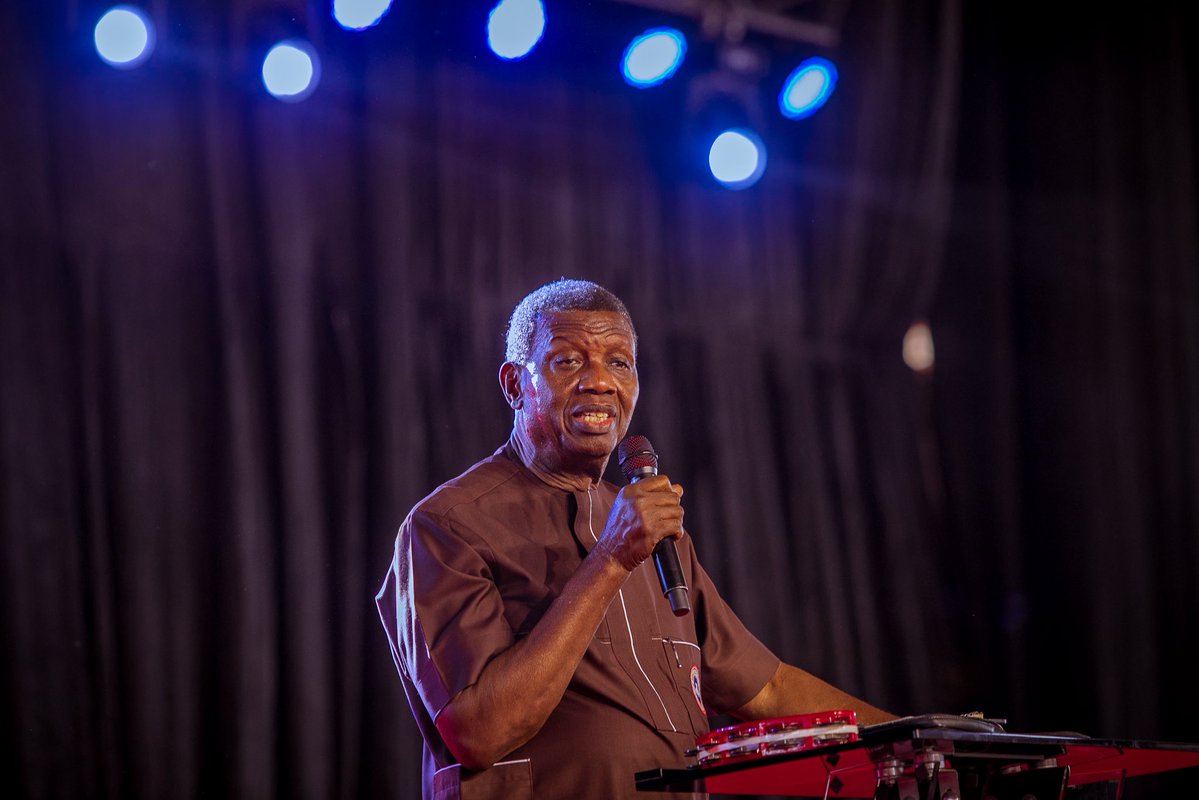
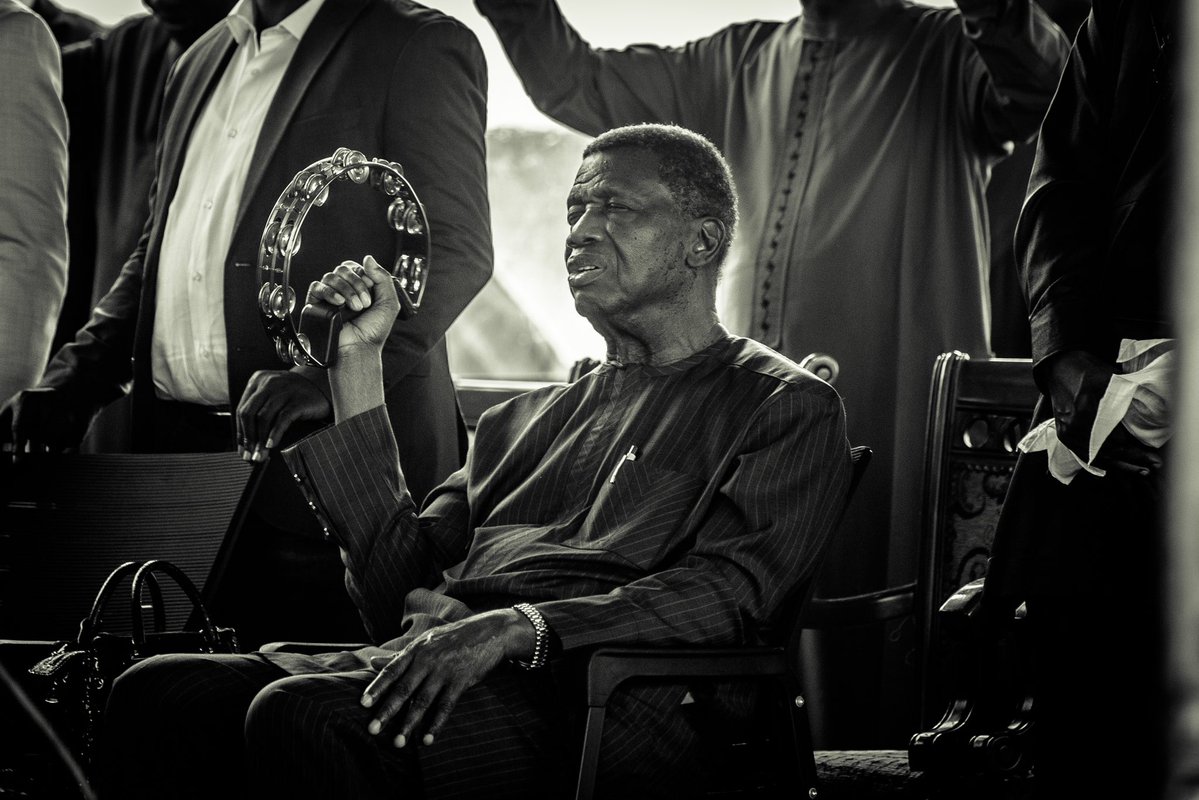
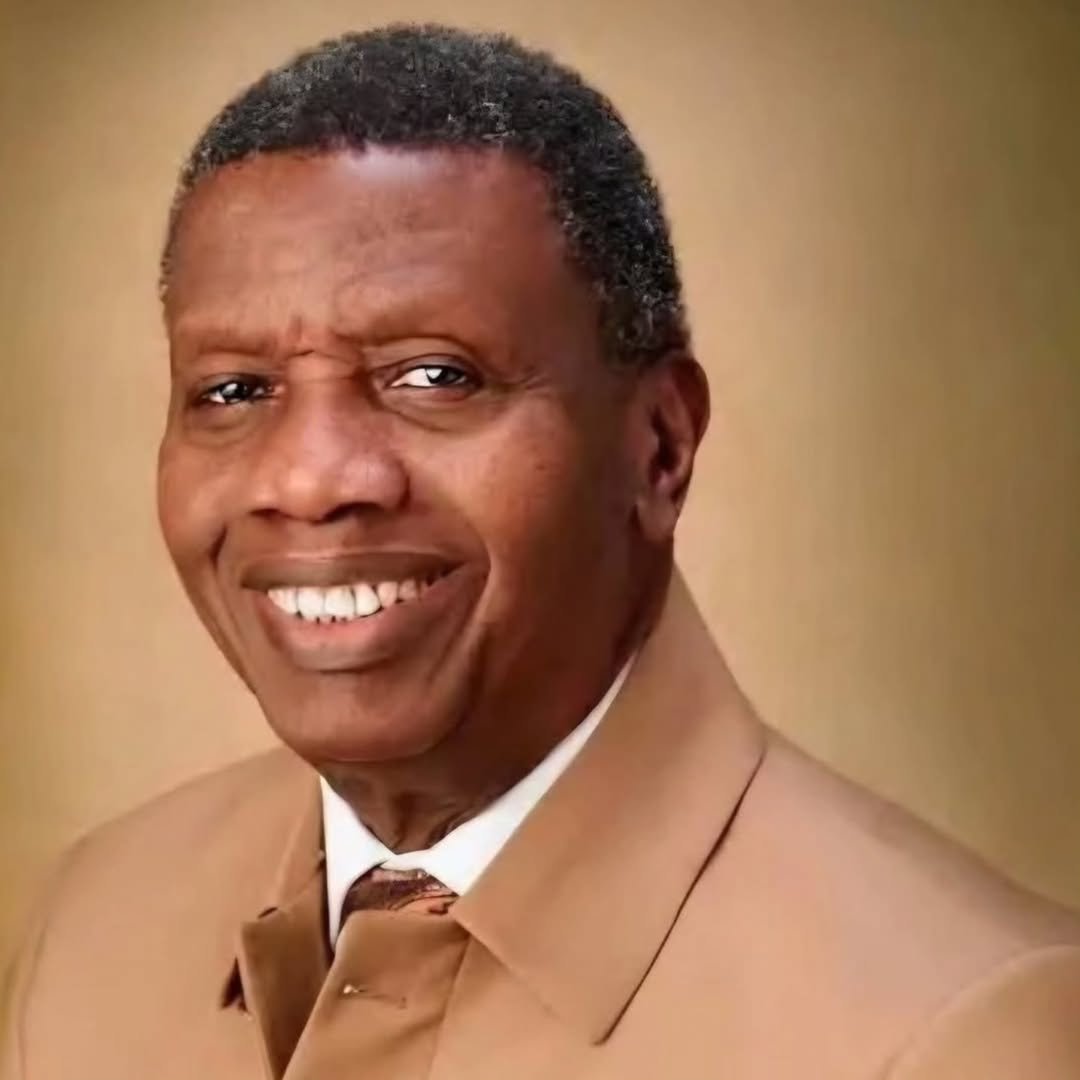
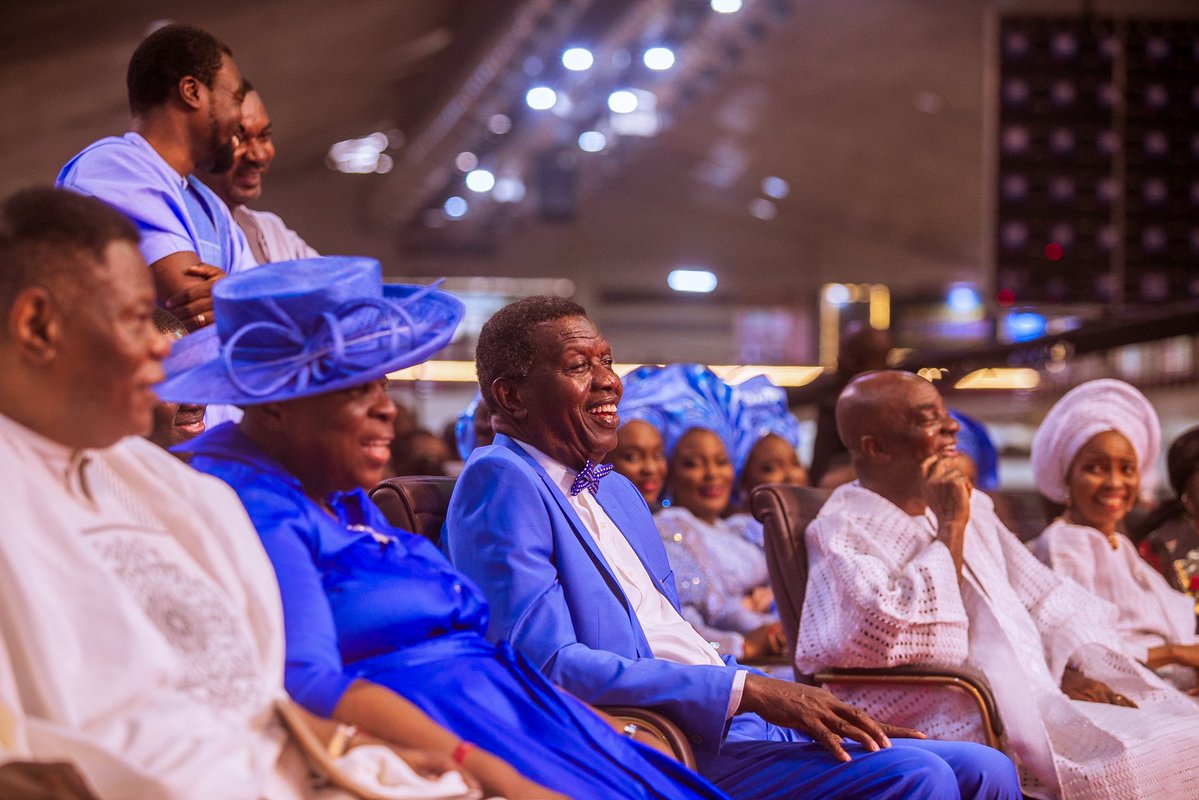
A Celebration of Pastor Enoch Adejare Adeboye
There comes a time when silence becomes ingratitude.
There comes a time when honour becomes a sacred duty.
There comes a time when sons and daughters must rise to celebrate the gifts that God has given to a generation.
This is such a time.
We refuse to be silent while men and women of eternal significance are reduced to headlines, controversies, and social media trends.
We refuse to stand by while those who have sacrificed decades in service to God and humanity are casually criticized by people who have built nothing, fathered nobody, planted no churches, and transformed no nations.
The sons and daughters of prophets must never be silent while cheap publicity seekers use great men as instruments for attention.
A generation that does not honour its fathers has no future.
A people who cannot recognize greatness in their midst will eventually suffer the tragedy of its absence.
Pastor Enoch Adejare Adeboye is not merely a church leader.
He is not merely a denomination head.
He is not merely a respected minister.
He is one of the most significant Christian leaders of our generation and one of the greatest spiritual gifts God has given to Africa and the global Church.
We should never allow a man who chose humility to become the chewing stick of the uninformed.
We should never permit the noise of critics to drown out the voice of history.
We should never watch while modern-day Sauls seek to intimidate, discredit, or silence God's servants.
Scripture records how King Saul pursued David.
Scripture records how Doeg the Edomite became an instrument of destruction against the priests of God.
Throughout history, political power has often sought to suppress prophetic voices.
Yet God has always preserved His servants and vindicated His purpose.
The Church must never become indifferent when its fathers are unfairly attacked.
Nor should we wait until our prophets cross into eternity before we begin to celebrate them.
Too often, flowers are sent to funerals when they should have been delivered while the recipient was still alive.
Hi @SuellaBraverman ,
48 hours ago I asked you to substantiate or withdraw your claim that “250,000 foreign students took £4bn in UK loans.” That time has now passed. You have provided no evidence, no clarification, and no correction.
I have taken the time to examine the data myself.
I have reviewed materials from the Student Loans Company, the Department for Education, the House of Commons Library, the UK Statistics Authority, and reporting from Times Higher Education. Across these sources, one thing is clear. Your statement is presented in a way that gives the public a deeply misleading impression.
Let’s deal with this carefully.
The £4bn figure you reference relates to the total value of student loans issued to non UK nationals. It is not a direct cost to the taxpayer. These are loans. They are repaid over time based on income. Presenting that figure as if it were money handed out or lost is not an accurate reflection of how the system works.
Then there is your use of the phrase “foreign students.”
This is where the distortion becomes more serious.
The fact (which you know quite well) is those eligible for UK student finance are not newly arrived international students. They are people with settled status, indefinite leave to remain, refugee status, or long term lawful residence in the UK. They live here. They work here. They pay into the system. And under the law, they are entitled to access student finance.
Standard international students on student visas are generally not eligible for these loans.
By leaving out that distinction, you create a very different picture in the minds of the public. One where large numbers of people are arriving from abroad and immediately accessing public funds. That is not what the data shows.
You also cited a figure of 250,000 without pointing to a clearly published dataset or transparent methodology. Numbers like this carry weight. They should be used with care, not as loose estimates in politically charged statements.
I am not interested in party politics. But I am concerned about what this kind of messaging is doing to the country.
When lending is presented as spending, and long term residents are presented as outsiders, it fuels resentment. It deepens division. It creates tension where clarity is needed. And ordinary people end up carrying the consequences of that confusion. Like I was being racially attacked and profiled in my initial response to you in X by supporters of your party who were obviously misled and triggered by your misinformation.
I did consider legal action. But the reality is that the law is not designed to deal easily with this kind of broad public misrepresentation. You know that, which is why ignoring a challenge like mine carries little immediate consequence.
That does not make it acceptable.
I will be submitting a formal complaint to the Parliamentary Commissioner for Standards regarding your use of misleading statistical claims in public communication.
The public deserves accuracy. Not selective framing. Not distortion. And certainly not narratives that risk turning people against each other on the basis of incomplete facts.
Stephen Dada.
@BwalaDaniel, This isn't a "press statement"; it’s a confession of moral bankruptcy.
By saying your past attacks on Tinubu were "just politics," you admit you were either a liar then or you are a hired gun now. Which is it? Principles aren't a jacket you change because the weather in the State House is nicer.
You’re upset Mehdi Hassan didn’t "warn" you he’d bring up your own words Bro! An intellectual doesn't need a script to defend his character -unless that character is a fiction.
We already know your 2027 script. When this administration ends, you’ll be back on TV saying, "I was just doing my job," while pivoting to the next bidder. You aren't defending the government; you are defending your paycheck.
You didn’t go to "Head to Head" to represent Nigeria; you went there to audition for a man who values loyalty over truth. You claim to have brave defense, but all we saw was a man drowning in his own archives.
"Ga fili, ga doki" indeed, but the horse has no rider, and the rider has no shame. Nigeria deserves better than a spokesperson whose only consistency is his desperation to remain relevant.
TOTAL BS 🤡
A Young Nurse Encounters Nigeria
Sunday, January 4th, was an unusually demanding day for me. I had an event in Ughelli, Delta State, and had to drive from Onitsha to the city. From there, I proceeded to another event in Mgbidi, Imo State, and thereafter traveled from Owerri to Lagos.
On the Air Peace flight, I sat in 5A, beside me in 5B was a young woman of about 24 years, Chidera Ugwokeba, whose parents are from the South East, but who was born and raised in the USA. She had just graduated from nursing school and was visiting Nigeria with her parents for the first time. She had exchanged her seat with her sibling to enable her talk to me having been told who I am.
During the flight, she began to share her sadness and confusion about Nigeria. Her first question was simple but piercing: Why do basic things not work in Nigeria? She then recounted a painful experience. Her sister, also visiting Nigeria for the first time, had a domestic accident and was rushed to what they were told was the best government-owned hospital in the area.
On arrival, even though her sister’s hand was bleeding, the hospital staff insisted that payment must be made before any treatment could begin. Shocked, they asked the hospital attendant whether he truly did not see the urgency of the situation. In response, they were shown other patients with even worse conditions who were also being left unattended because they had not paid.
They eventually paid, and it was time for the blood test. Traumatised, they realised the hospital had only one blood-testing machine for all patients, and it was not being sterilised between uses. When she raised concerns that the equipment had not been properly sterilised, they were bluntly told to stop asking questions if they wanted her sister to be treated. Despite their payment, they had to buy all the items needed for her treatment.
She found it hard to believe because, according to her training and every hospital she had visited, treatment comes first - payment comes later. She told me they had considered organizing a GoFundMe to support healthcare back home, but relatives warned them that any money raised would likely be embezzled.
Then she said something that struck me deeply: “I now understand what happened to Boxer Joshua. This is why there was no ambulance to rush him to a nearby hospital.” She wondered aloud whether it was simply because the country is poor. Yet she added that she would willingly offer her skills and service for free and help raise money to make things better.
Listening to the lament of a young, patriotic Nigerian who is prepared to offer free service and raise money to help her country and its citizens, I painfully replied by encouraging her not to lose hope. The country is not poor, but it is poorly governed. Nigeria can afford basic necessities, especially critical and necessary ones, but they are often not considered priorities due to incompetent leadership.
A standard ambulance costs about ₦150 million ($100,000). Nigeria spent ₦39 billion refurbishing the National Conference Centre in Abuja and ₦21 billion rebuilding the Vice President’s residence. Those two projects alone- ₦60 billion -could have provided about 400 brand-new ambulances, roughly 11 per state, including the FCT. Had 11 functional ambulances existed in Ogun State, one might have been available for Joshua.
Building a primary healthcare centre in a community costs about ₦75 million. Yet we spent about ₦300 billion ($200 million) on an additional presidential jet - money that could have built over 4,000 primary healthcare centres, about 110 per state. The only visible value the jet adds is the ability of the President to occasionally disappear without the public knowing where he is, as is the case now.
Prosperity cannot come by taxing Poverty
As I travel the world and meet leaders who have transformed their nations, one lesson is clear: lasting economic and social progress begins with national consensus. Transformative leaders—those who successfully unite their people around a shared vision—share a defining quality: honesty. Government must be transparent and truthful because citizens deserve nothing less from those who lead them. True leaders do not exploit their people to enrich themselves and a few cronies; they build trust, unity, and shared purpose - the foundation of sustainable progress.
It is against this standard of honest leadership that Nigeria’s current approach to taxation must be measured. If taxation is to function as a genuine social contract, it must be rooted in sincerity, fairness, and concern for the welfare of the people. Every tax policy should be clearly explained, including its impact on incomes and its expected contribution to national development. Without this transparency, taxation becomes a tool of confusion and burden rather than a mechanism for growth and development.
Nigeria must rethink taxation if it is serious about economic growth, national unity, and shared prosperity. The purpose of sound fiscal policy is not merely to raise revenue; it is to make the people wealthier so that the nation itself becomes stronger. Yet today, Nigerians are asked to pay taxes without clarity, explanation, or visible benefit.
The solution begins with empowering small and medium-sized enterprises in every community. When small businesses thrive, jobs are created, incomes rise, and the tax base expands naturally. You cannot tax your way out of poverty - you must produce your way out of it.
This makes the ongoing tax fraud saga particularly alarming. For the first time in Nigeria’s history, a tax law has reportedly been forged. The National Assembly itself has admitted that the version gazetted is not what was passed into law. Yet citizens are being asked to pay higher taxes under this manipulated framework—without transparency, without explanation, and without corresponding benefits.
There is no virtue in celebrating increased government revenue while the people grow poorer. Taxing poverty does not create wealth; it deepens hardship. Any tax system that makes citizens poorer violates the fundamental principles of good governance and sound fiscal policy.
Nigeria needs a fair, lawful, and people-centred tax system—one that supports production, rewards enterprise, protects the vulnerable, and restores trust between government and citizens. Only then can taxation become a true tool for unity, growth, and shared prosperity. -PO
🚨Christians in Nigeria refuse to renounce the Faith after Islamist’s burned their Church Down 🙏🏽
Let’s continue to pray and intercede for our brothers and sisters all around the world 🙏🏽
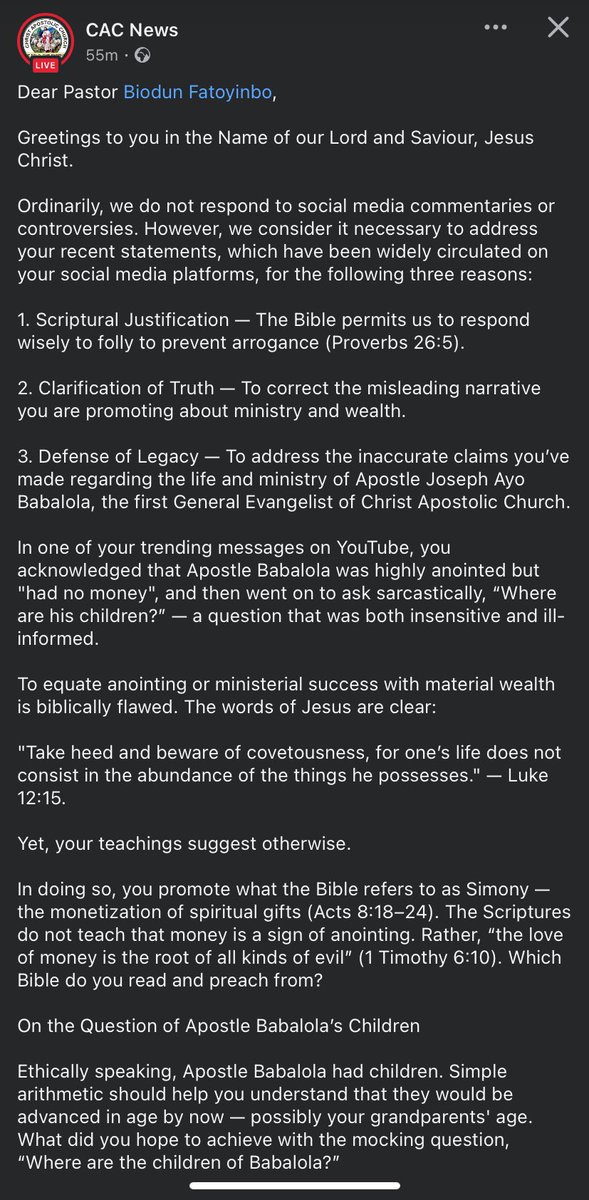
The daughter of our Father Apostle Ayodele Babalola, Mama Ogini has responded to mammon-inspired Biodun Fatoyinbo of COZA.
In his demeaning message, where he denigrated the work of the Apostle because of money, he asked, "Where are his children?"
One of his daughters has responded to the mammon-worshipping Biodun, who should still be a Sunday school student but is heading a church.
The Poor Must Not Be Punished While the Powerful Walk Free
Yesterday, I sincerely apologised to Ibom Air and its crew for the unacceptable conduct of one of their passengers.
This morning, I woke up to learn that the passenger, the young Ms. Comfort Emmanson in her twenties, has been banned from flying for life—once again showing how our system works, proving the truth of Anacharsis’ words that “the law is like a spider’s web: it catches the weak, while the powerful break through with ease.”
There is everything systemically
Wrong and unjust about this authoritarian decision. What due process was followed over night leading to this sanction? Have we exhausted the avenues of justice and compassionate resolution on this matter?
It is a tragic irony that a young lady in her twenties can be banned for life, while we—her parents —commit worse crimes against humanity and are celebrated; those in positions of authority perpetrate far greater offences that harm the nation deeply, yet move freely in comfort, shielded from consequences, and in Ms. Emmanson’s case, the authorities acted with lightning speed, but the same urgency is absent when dealing with the influential and politically connected.
If this young woman, who indeed acted wrongly, now seeks to apologise, who will hear her cry in a country where the pain of the poor is invisible and the dignity of the less privileged is often disregarded? Justice must be consistent, or it becomes oppression in disguise.
This must change. Justice must be equal for all. There must be room for compassion, for rehabilitation, and for understanding when misconduct stems from frustration or displaced aggression. Power must never determine who is punished and who is pardoned.
May God heal our land.
A New Nigeria is POssible. -PO