Abdullah Ibhais says he was jailed for 3 years in Qatar after refusing to help cover up the cruel treatment of migrant workers who built Qatar 2022.
Now, ahead of the next World Cup, he says his passport was seized by Jordan, and he was warned to stay silent.
Share his story.
אז מתי עליתם או ירדתם במדרגות ועצרתם לחשוב אם יש מאחורי התכנון שלהן היגיון?
הנה, עכשיו אתם יודעים שמאחורי כל צעד למעלה או למטה, יש נוסחה אחת שהקדימה את חוק הכבידה של ניוטון...
לא מאמינים?
לכו לבדוק!
כמו תמיד - אשמח אם תשתפו את הציוץ הראשון בשרשור🧵⬇️
https://t.co/L60jBsetOB
A Russian psychologist spent 10 years proving that the act of talking to yourself out loud is one of the most powerful cognitive tools the human brain has, and almost nobody outside his field has read the work.
His name was Lev Vygotsky.
He worked in Moscow in the 1920s and died of tuberculosis in 1934 at the age of 37. He had no laboratory, no funding, almost no English readers, and a body of work that the Soviet government suppressed for two decades after he died.
He produced the foundational theory of how human cognition actually develops, and the central piece of that theory was a behavior almost every adult is faintly embarrassed about.
Vygotsky noticed that young children talk to themselves constantly. They narrate their own actions, they argue with imaginary opponents, they instruct themselves through tasks out loud.
The dominant theory at the time, from the Swiss psychologist Jean Piaget, said this was a sign of cognitive immaturity that children would eventually grow out of as they learned to think properly.
Vygotsky said the exact opposite.
He argued that this self-directed speech was the most important cognitive event in the entire developmental window, because it was the moment a child first started to use language as a tool to control their own mind. The child was not failing to think. The child was learning how to think by externalizing the process and listening to themselves do it.
He predicted that as children matured, this out-loud self-talk would not disappear. It would go underground. It would become silent inner speech, which is the running monologue every adult has inside their own head for the rest of their life.
The voice you hear when you read this sentence is the direct descendant of a four-year-old narrating their own block tower.
For 50 years almost nobody outside Russia had access to his work, and the few researchers who did pick it up could not get funding to test it. Then in the early 2000s the experiments finally started to pile up, and what they found was that Vygotsky had been right about something even more important than he knew.
The first major study came from Gary Lupyan at the University of Wisconsin and Daniel Swingley at the University of Pennsylvania in 2012. They ran a simple visual search experiment. Participants were shown 20 images at once and asked to find a specific object, like a banana or a chair. In one condition they searched silently. In the other condition they were told to say the name of the object out loud to themselves while looking for it.
The participants who spoke the target name out loud found the object significantly faster, with higher accuracy, than the participants who searched in silence. The effect was strongest when the spoken word matched a familiar object the brain already had a strong category for.
Saying the word out loud literally tuned the visual system to detect that thing better. The researchers called it the label feedback effect, and the implication was that the act of vocalizing a goal physically changes how the brain processes the world while pursuing it.
The second major study came out of the University of Michigan and Michigan State in 2017. The lead researchers were Ethan Kross and Jason Moser, and they used both EEG and fMRI to record what happens inside the brain when people talk to themselves while emotionally upset.
They asked participants to recall painful autobiographical memories and reflect on them in two different ways. Some used the first person, saying things like "why am I feeling this way." Others used the third person, referring to themselves by their own name, saying things like "why is John feeling this way."
The brain scans showed that the simple act of switching from first person to third person, even silently, decreased activity in the medial prefrontal cortex, the region responsible for rumination and self-referential pain. Within a single second of using their own name instead of the word I, participants showed measurably lower emotional reactivity. The shift required no extra cognitive effort. It cost the brain nothing. And it worked.
Kross described the mechanism in his interviews. Talking to yourself by name creates a small amount of psychological distance from your own experience. Your brain processes the situation more like a problem belonging to someone else, which means it can analyze it instead of drowning in it.
What Vygotsky had intuited in 1934 turned out to be even more powerful than the developmental theory he built it into. The voice you use to talk to yourself is not background noise. It is one of the most precise cognitive tools the brain has, and you can change how it works just by changing the pronoun you use.
People who talk through problems out loud are not anxious or unstable. They are running an externalized version of a process the rest of us are running silently and worse. The kindergartener narrating their block tower, the surgeon muttering through a procedure, the engineer pacing a hallway describing a bug to nobody, the athlete repeating a cue to themselves before a free throw, they are all using the same ancient mechanism that builds and steers human thought.
You can run the experiment yourself the next time you are stuck on something hard. Stop trying to solve it silently in your head. Say it out loud. Describe what you are seeing. Walk yourself through the steps as if you were explaining it to a colleague who is not in the room.
And when something genuinely upsets you, switch to your own name. Ask why this person is feeling this way, instead of why I am feeling this way.
The voice you have been told to keep quiet your entire life is one of the oldest pieces of cognitive technology you own.
Most people are still embarrassed to use it.
אנחנו משווים את עצמנו יום יום אחד לשני, לממוצע, בכל דבר ובכל נושא. זה טוב אולי כשרוצים לקבוע יעדים ומטרות.
אבל כל פעם שאתם מוטרדים שאתם לא ב"נורמה" תזכרו דבר אחד:
אין דבר כזה.
תשאלו את הטייסים.
כמו תמיד - אשמח אם תשתפו את הציוץ הראשון בשרשור🧵⬇️
https://t.co/WdZ5aOWs0R
One of the biggest problems in discussions about Israel is that most people have never heard of the Cairo Geniza.
And yet it may be one of the most devastating pieces of evidence against many of the myths surrounding the conflict.
The Cairo Geniza was a storage room in a synagogue in Egypt where Jews deposited old documents for nearly a thousand years. When scholars finally examined its contents, they discovered roughly 300,000 manuscript fragments dating from the 9th to the 19th centuries.
Not religious texts - Real life:
Letters.
Contracts.
Tax receipts.
Court cases.
Business records.
Marriage agreements.
Personal correspondence.
In other words, not propaganda.
Not nationalist history.
Not modern politics.
The actual paperwork of ordinary people living a thousand years ago.
And what does it show?
First, it destroys the claim that Jews are foreign colonists with no historical connection to the land.
The Geniza contains countless references to Jewish communities in Jerusalem, Hebron, Tiberias, Safed, Ramle, Acre, and other towns throughout the Land of Israel.
Before the twentieth century.
Before Herzl.
Before Zionism.
Centuries before any of those things existed.
The documents show Jewish pilgrims traveling to Jerusalem, donations being sent to Jewish communities there, rabbis corresponding with scholars in the land, and families moving between Egypt and the Land of Israel.
The connection never disappeared.
It never had to be "invented."
Second, it shows that Jewish identity remained tied to the land even after centuries of exile.
The Jews of Cairo, Baghdad, Yemen, Morocco, and Spain did not view Jerusalem as some distant historical curiosity.
They viewed it as the center of their civilization.
A place they prayed toward.
A place they supported financially.
A place many hoped to return to.
Long before modern nationalism was invented.
Third, it destroys the fantasy that Jews and Muslims lived in some utopian age of perfect coexistence before Zionism arrived and ruined everything.
The Geniza records periods of cooperation and prosperity.
But it also records jizya taxes, discrimination, legal inequality, extortion, restrictions, persecution, and the vulnerability of Jewish communities living as dhimmis under Islamic rule.
The reality of a subordinate minority.
Forth, the Geniza also challenges another popular myth: that Hebrew was a "dead language" resurrected out of nowhere by Zionists.
The Geniza contains countless Hebrew documents - letters, contracts, legal rulings, religious texts, poetry, and correspondence between communities separated by thousands of miles.
For centuries, Jews used Hebrew as a common civilizational language connecting communities from Morocco to Iraq and from Yemen to Jerusalem.
Eliezer Ben-Yehuda did not resurrect a dead language. He transformed an ancient, continuously used literary and religious language into a modern spoken one.
The Cairo Geniza proves that Hebrew never disappeared. It evolved, adapted, and survived long before modern Zionism emerged.
Fifth, it reminds us how sparsely populated and underdeveloped much of the region was before modern times.
The Land of Israel was not some densely populated "Palestinian" nation-state waiting to emerge. It was part of a larger Ottoman and earlier Islamic world, with small communities of Muslims, Christians, Jews, Druze, Bedouins, and others living across the region, that was vastly abandoned.
Perhaps most importantly, the Geniza reveals something that infuriates modern anti-Zionists:
The Jews never left history.
The Jewish people did not disappear from the land.
They did not forget Jerusalem.
They did not suddenly arrive from Europe one day and invent a connection.
The connection is documented continuously across centuries by the people who actually lived it.
It proves that the story told by activists - that European Jews arrived in a foreign land with no roots there - is historically indefensible.
The Cairo Geniza is thousands of voices speaking across a millennium.
And together they tell a story that modern ideologues desperately wish did not exist:
The Jewish connection to the Land of Israel was not created by Zionism.
Zionism was created because that connection never died.
בחודשים האחרונים אני ורעי ויקטור שריקי, עובדים מאחורי הקלעים על פרוייקט גדול שיחשף בגדול.
הפרוייקט נולד מתוך מציאות שבה בשלוש השנים ביתר שאת, מחנה הימין נתון למתקפה משולחת רסן ואחת הזירות המרכזיות במתקפה הזו היא מערך השתקה מאורגן, שמטרתו להטיל אימה, להרתיע, ולשלול מאנשים את זכותם הבסיסית להביע עמדה ולממש את זכות חופש הביטוי, שעליה נאמר כנשמת אפה של הדמוקרטיה.
לא פעם שואלים אותי:
"עמליה, את אמא לחמש ילדות, למה לך כל כאב הראש הזה? למה להיכנס לעימות מול אנשים רעים, שיכולים לנסות לפגוע? הרי ראינו מה הם עשו פה בשנת 2023"
והתשובה לכך, נורא פשוטה - דווקא משום שאני אמא לחמש ילדות. דווקא משום שאני מגדלת כאן במדינת ישראל, את הנשים והאמהות של המחר - זה לא עולם שאני מוכנה להוריש להן, במציאות שבה זכויות היסוד שלהן נגזלות, שבה פחד מחליף חירות וחופש הביטוי שמור רק למחנה אחד.
המאבק הזה, למי שטרם הפנים, אינו עבורנו, אלא על העתיד של הילדים שלכם במדינה הזו ועל הבחירה בין חירות לבין משטר של הפחדה, השתקה ומאסר מחשבתי.
מה אני צריכה מכם בשלב הזה? דבר פעוט.
כל מי שביקש להישאר תחת מעטה אנונימי, אך זהותו נחשפה, ולאחר מכן קיבל מכתב התראה או תביעה מצד "אחים לנשק", הדס קליין, או מי שפועל במסגרת המערך המכנה את עצמו "חמ"ל דיבה" - מתבקש לפנות אלי בפרטי.
כמו כן, מי שקיבל איומים מאותם אנשים, בסגנון בריוני כמו "לא ישאר לכם מה לאכול" - גם כן.
וכל השאר - הפיצו את הטקסט 💛
@viktorshriki
11 מיליון צפיות לסרטון בפוסט שלי, ועוד 26 מיליון צפיות לשיתוף של הפוסט על ידי אילון מאסק.
הסרטון הזה קיבל יותר צפיות מכל העונות של "ארץ נהדרת" ביחד 🤣
_
**עדכון חשוב**
יוטיוב החליטו להסיר באופן מלא את הערוץ שלי בטענה שהוא מפר את תנאי הקהילה.
איני יודע מדוע, הם לא מפרטים מה בדיוק בתוכן שלי הפר איזה חלק מכללי הקהילה.
ערערתי על ההחלטה בזו ואני מקווה שהיא תשתנה.
בינתיים, כמה דברים חשובים:
א. אני מתכוון להעלות לפה באופן קבוע את כל פרקי הפודקאסט הבאים שלי. אי אפשר לסמוך על הצנזורה הרעיונית בפלטפורמות האחרות.
ב. אני מזמין את כולכם לעקוב אחרי בערוץ הספוטיפיי שלי, שכולל גם גרסת וידאו:
https://t.co/WCejB8drTu
ג. הכי חשוב – לעשות מנוי ולתמוך בפעילות שלי. אנחנו לקראת בחירות והמאבק על חופש הביטוי והשתקת השיח הולך ללוות אותנו זמן רב:
https://t.co/lNYhcmWFDO
אמשיך להיאבק בהחלטה הזו. וכמובן לעדכן כאן.
ובקשה אחרונה: תעזרו לי להפיץ את ההודעה הזו כמה שיותר, אסור לתת להשתקה הזו לנצח.
עקיבא
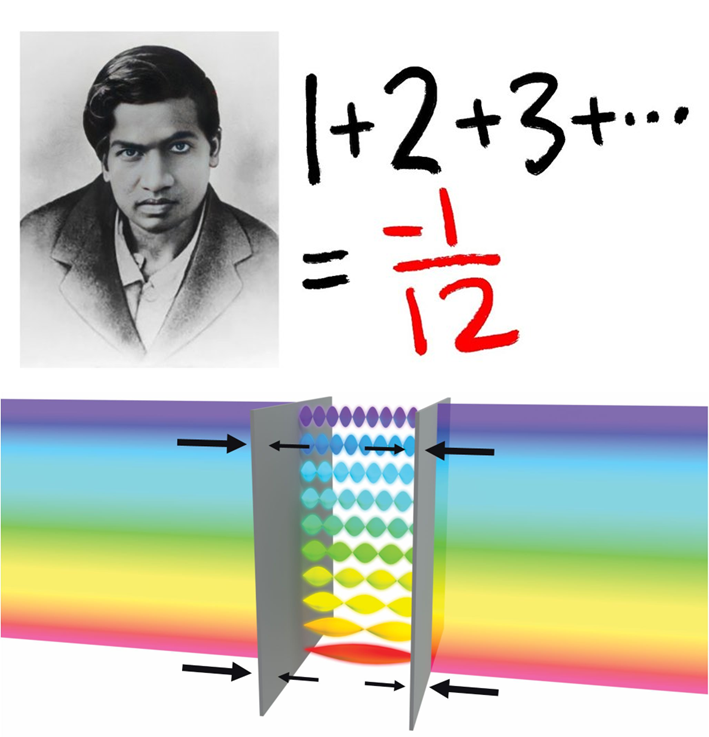
מתמטיקאי הודי גאון ומסתורי וסכום פשוט של מספרים שכל ילד יודע שהוא אינסוף - אבל הוא לא.
פיזיקאי הולנדי עם שם מהאגדות וכוח שפועל כשממש (אבל ממש) אין כלום.
מוזר?
שום דבר בסיפור הזה לא הגיוני.
אבל זה עובד.
חלק מתלהבים. חלק ממש זועמים. אבל אף אחד לא נשאר אף פעם שווה נפש לבלגן הזה🧵⬇️
#פידצבא, שמעתם על DAWG?
בנובמבר 2025 לקחו בפנטגון את מחלקת ״משכפל״ (Replicator - נועדה במקור להאיץ מבצוע של מערכות אוטונמיות זולות בכמויות גדולות בצבא האמריקאי, ראו ציוץ מקושר) ומיתגו אותה מחדש תחת השם DAWG, שזה ״קבוצת הלוחמה האוטונומית של משרד ההגנה״.
עד כאן עדכון סמנטי שלא שווה ציוץ.
מה בכל זאת קרה?
במסגרת תקציב 2027 מבקשים בפנטגון תקציב של, שימו לב, 54.6 מיליארד דולר ל-DAWG.
כמה זה דרמטי?
מדובר בגידול של 24,000% ביחס לתקציב 2026.
מדובר בתקציב גדול יותר מזה של המארינס.
מדובר בתקציב גדול יותר מהתמ״ג של בחריין. למעשה מדובר בתקציב גדול יותר מהתמ״ג של רוב המדינות בעולם.
האמריקאים הולכים אול-אין על לוחמה אוטונומית. DAWG יהפוך לפיקוד מאוחד שירכז תיאום של הפעלת עשרות אלפי כלים אוטונומיים, מסוגים שונים, בכל הזירות - בדומה לפיקוד החלל ולפיקוד הסייבר.
מהפכה בעניינים צבאיים 2027.
A Russian mathematician named Andrei Markov proved in 1906 that you don't need to know where something came from to predict where it's going next.
He was studying poetry at the time. Specifically, he was analyzing the sequence of vowels and consonants in Pushkin's novel in verse, counting transitions by hand across thousands of characters, looking for a pattern in how one letter predicted the next.
What he found became one of the most quietly powerful ideas in all of mathematics. And it has been sitting inside every weather forecast, every Google search, every Netflix recommendation, and every large language model ever built, waiting for someone to explain it in plain language.
Here is the framework that changed how I think about prediction.
Most people assume that to predict something you need history. The full picture. Everything that led to this moment. If you want to know what the stock market will do tomorrow, you think you need to understand everything it did for the past decade.
Markov showed that is almost never true.
His insight was this: for a huge class of real-world systems, the current state contains all the information you need to predict the next state. The past is already baked into where you are right now. You don't need to carry it forward explicitly, because it's already there.
He called this the Markov property. And the systems it describes are called Markov chains.
The mechanics are simpler than they sound.
Imagine you are tracking weather. It is either Sunny or Rainy on any given day. You observe over many years that when it's Sunny, there's a 90% chance tomorrow will also be Sunny and a 10% chance it will turn Rainy. When it's Rainy, there's a 50% chance it stays Rainy and a 50% chance the sun comes back.
Those four numbers are your entire model. That grid of transition probabilities is the Markov chain.
Now someone asks you: it's Sunny today, what is the probability it will be Sunny three days from now?
You don't need intuition. You don't need expertise. You multiply the transition probabilities through each step and the answer falls out exactly. The chain does the thinking.
The part that most people miss is what happens when you run a Markov chain long enough.
Almost every well-behaved Markov chain converges to what mathematicians call a stationary distribution. It doesn't matter where you start. After enough steps, the system settles into a stable pattern of probabilities that it returns to again and again, regardless of initial conditions.
Google's original PageRank algorithm was a Markov chain. The web is a network of pages pointing to each other, and a random visitor clicking links is a random walk through that network. The stationary distribution of that walk, the long-run probability of landing on any given page, is exactly what PageRank calculated. Your position in search results was determined by where a memoryless random surfer would spend most of their time.
The same mathematics underlies how your phone's keyboard predicts your next word. How Spotify decides what song plays after this one. How epidemiologists model the spread of disease through a population. How economists simulate how people move between jobs and unemployment. How physicists describe particles changing energy states.
All of it is the same idea dressed in different clothes.
The counterintuitive power of Markov chains is that they are wrong about memory in a way that turns out to be useful.
Real systems do have memory. Tomorrow's weather is influenced by more than just today's. Your next word is influenced by more than just your last one. The Markov assumption is technically false for almost every natural system.
And yet. The approximation is good enough to be extraordinarily useful, because most of the predictive information in a sequence is concentrated in the most recent state. Adding older history gives you diminishing returns. At some point you are carrying around all this expensive history for almost no improvement in accuracy.
Markov chains are the mathematical formalization of a deeply practical idea: you can often predict the future with surprising accuracy just by paying close attention to right now.
The man who discovered this was studying syllables in poetry. He had no idea he was describing the architecture of the internet, the logic of machine learning, and the statistical skeleton underneath the most powerful AI systems ever built.
He just followed the pattern where it led.
That is usually how the biggest ideas work.
FACTS
Many supporting the false narrative that Jews / Zionists stole Palestinian land may wish to read The Land Question in Palestine by Kenneth W. Stein .
Through diligent and meticulously researching and identifying land transfer documentation from a number of historical legal , and thankfully still maintained sources , Arab , Jew , Palestinian , Zionist and British , Stein has listed numerous land sales from Arabs to Jews prior to the re-establishment of the State of Israel in 1948.
To a political researcher such as myself it is unsurprising how many Arabs yelled foul at the false narrative of a Zionist land grab whilst duplicitously selling at overinflated prices to those very same Zionists they were accusing of land theft .
Both Churchill in several speeches and the Arabs themselves in recorded testimony under oath to various commissions notably the Hope Simpson and Peel Commissions stated that no Arab Palestinian land had been stolen but all legally acquired.
As just one glaring example appendix 3 of the book which exposes numerous such legally documented land sales is as follows.
Name of seller - Abu Hantash Abd al - Latif Position / status / short biography - Village shaykh at Qaqun ; participated in attacks on Jews at the Hadera massacre in 1921 ; helped to organise the Farmers Party in 1924 and organised opposition to Jewish purchase of Wadi Qabbani in the 1930’s.
Land sales - sold 821 dunams at Qaqun in 1925 for £P 2,564 in the Tulkarm sub district .
( one dunam is 0.247 acres )
Name of seller - Basiso Khalil Yusuf
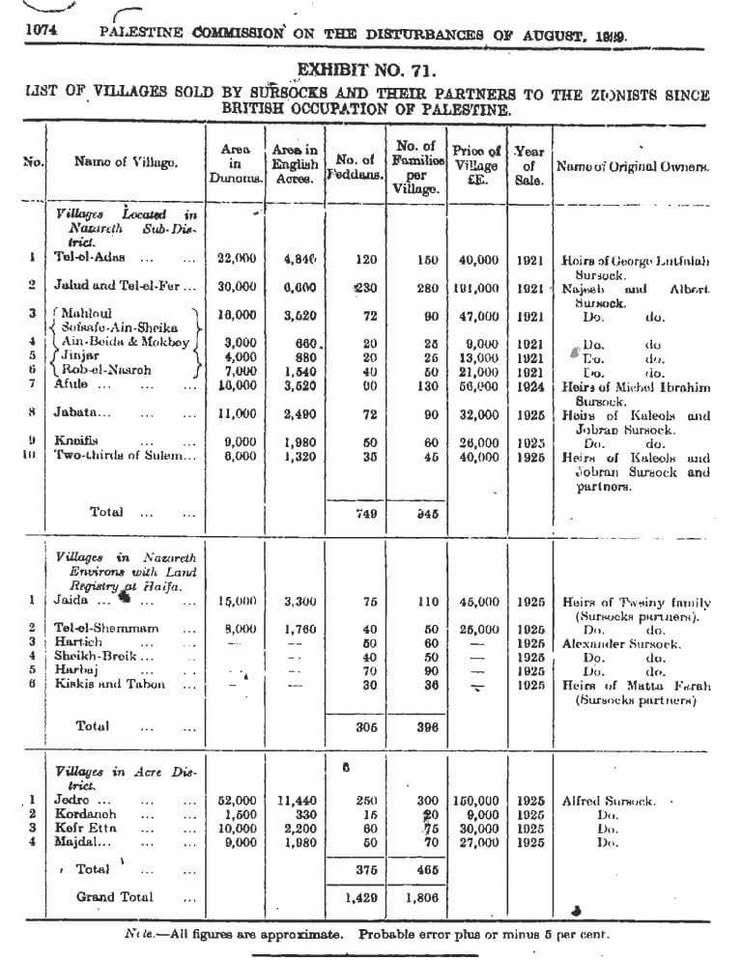
Position / status - Member of the Arab Executive, elected to 7th Gaza Congress Land sales - April 1942 sold 472 dunams to the Jewish National Fund in Gaza for £P 1200.00 ( ref ISA , box 3874/ file 7 Schedule for April 1942) Second update Listed at the end of the post , the lands sold by the Sarsouk family ( from Lebanon I believe) to Zionist organisations alluded to by the Grand Mufti of Jerusalem under oath to Sir Laurie Hammond during the 1937 Peel Commission enquiry.
Further evidence of Arab land legally acquired
Name of seller - Al Alami Musa
Position / status / short biography - Government advocate; private secretary to High Commissioner Wauchope ; member of the Arab Delegation to the London Conference of 1939 ; brother - in - law of Jamal al - Husayni; in 1946 was a member of the Arab Executive Committee
Land sales - sold 900 dunams of land in Beisan ( as per minutes of St.James Palace Conference London Feb.20 1939 Ref CZA 525/7333).2
Name of seller - Asim Bey Al Said
Position / status - Mayor of Jaffa 1927 ; member of Arab National Defence Party
Land sales - sold 5000 dunams at Qubeiba Jaffa district September 1924 ( ref CZA , KKL s/file 1203 )
Name of seller - Sa’d Fu’ad
Position / status - leader of Greek Catholic community in Haifa and member of the Arab Executive Committee
Land sales - various between 1903 and 1929 including 7838 dunams for £P 2.00 per dunam in Haifa sub district 9
And the photo below is documenting proof of the land sales made by the Sarsouk family from Beirut , Lebanon to Jewish organisations and referred to by the Grand Mufti of Jerusalem under oath to Sir Laurie Hammond during the Peel Commission Report of 1937
כוכב חמה, נוגה, כדור הארץ, מאדים, צדק,... - כל ילד מכיר את מבנה מערכת השמש.
אז מי כוכב הלכת הקרוב ביותר לכדור הארץ - נגה או מאדים?
תחזיקו חזק - אבל אף אחד מהם! בממוצע, מישהו "עקף את שניהם בסיבוב"...
רמז בתמונה.
שרשור קצרצר על עובדה מפתיעה, שאחרי שמבינים אותה - לא מפתיעה בכלל🧵⬇️
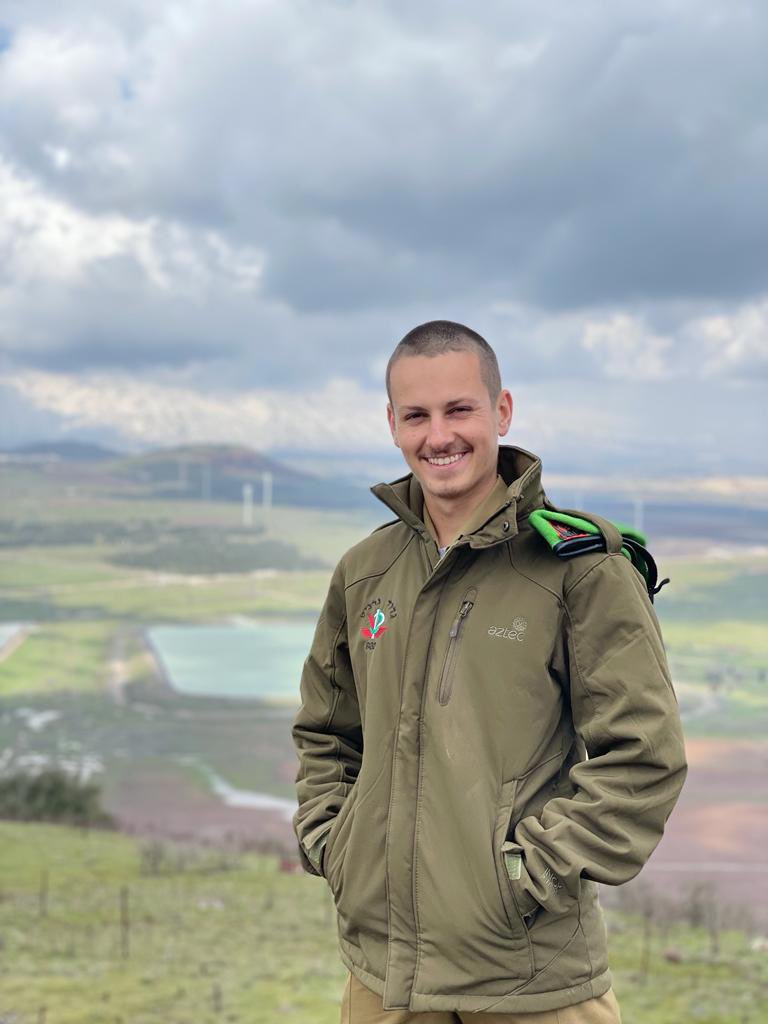
@YOSSIBAUM למערכת קוראים אור איתן על שמו של סרן איתן אוסטר מפקד צוות ביחידת אגוז שנהרג לפני שנה בקרב הראשון בתמרון בלבנון .
אלו האנשים שהיו שם בשבילינו כשהטכנולוגיה לא הספיקה .