"Oregon Voter Rolls"
I've been preparing and distributing custom files for my Oregon teams which enable them to quickly identify election issues in their own neighborhoods.
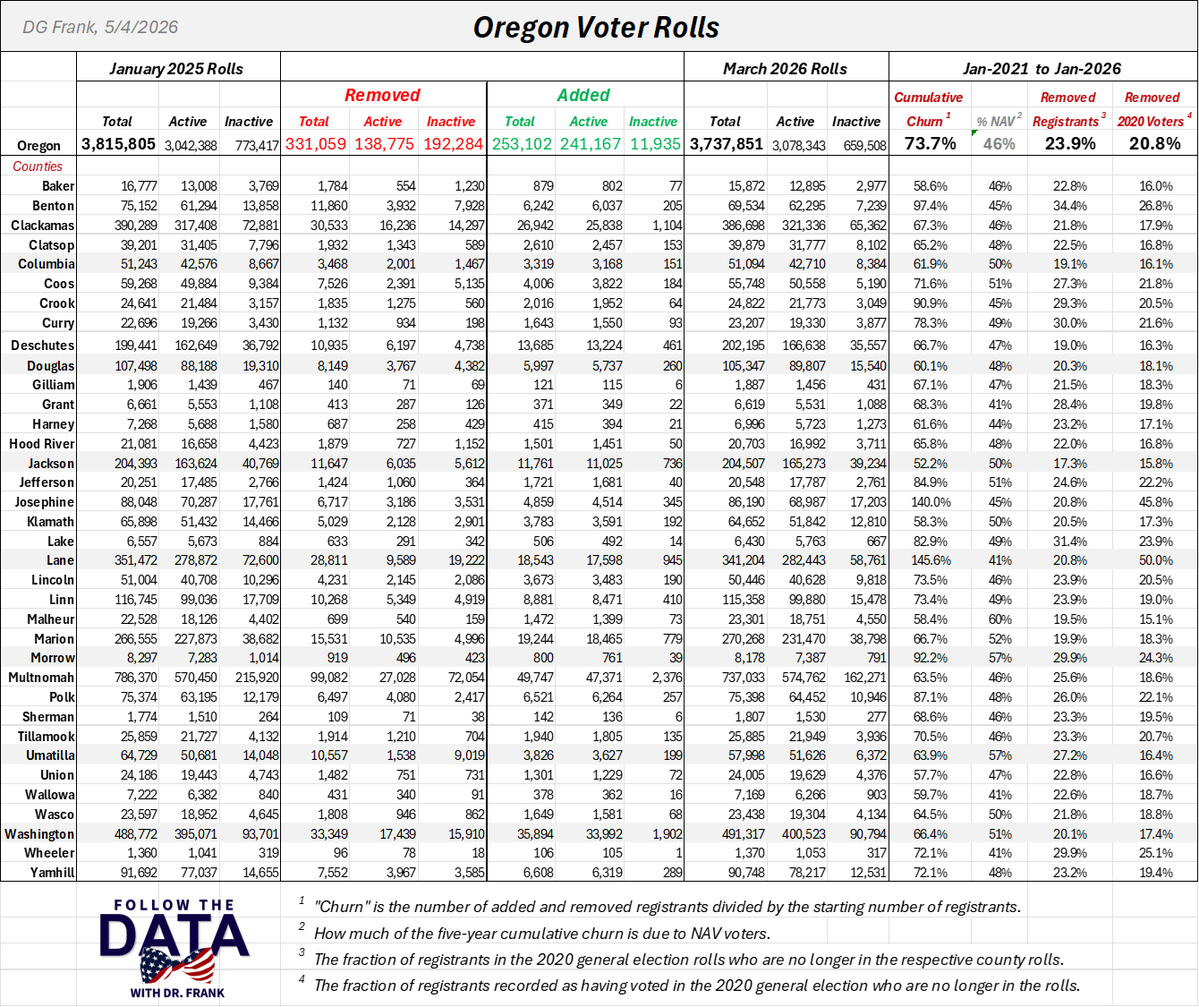
While doing this work, I compiled a summary table which illustrates and confirms the recent court ruling that the Oregon voter rolls are horribly out of compliance with state and federal law. (My first draft is below.)
Some things to note:
1) EVERY county is out of compliance because the rolls are centrally controlled by the state. There are no exceptions.
2) The voter rolls are even dirtier in March 2026 than they were in January 2025, containing more active voters in the rolls than the Oregon voting age population (about 3 million).
3) Over the past five years, the number of registrants added and removed is equivalent to 70% of the number of people in the rolls.
Has the county population changed 70% in a mere five years? The county voter rolls have.
4) Half of the voter roll churn occurs with people who are automatically registered (NAV) when they touch some government institution.
5) Local clerks are not responsible for the excessive voter roll churn observed in every county voter rolls. The state system imposed on every county is the culprit.
6) Huge amounts of money and resources are being wasted, mailing and processing ballots for registrants who should not be in the rolls.
Not only is this wasteful, it makes Oregon elections super easy to cheat.
“The Oregon Shuffle”
I have several copies of Oregon’s state voter rolls, and have been helping grassroots patriots there to understand the shenanigans their state is pulling with their voter rolls.
First, when the SoS claims to be removing inactive voters from the rolls, you should ask him, “OK… but how many *new* registrants have you added?”
Like your bank account… you take some money out, and put some money in. What matters is the *net* balance.
Second, who’s checking up on him? Certainly not the county clerks; most of them don’t even have the capability.
But I do, and I am.
Here are the basic numbers:
In January 2025, there were 3.8 million people in the rolls, with 3.04 million of them considered “active.” (Strange, since they only have 3 million voting age residents.)
In March 2026, there were 3.74 million people in the rolls, with 3.08 million active. (Strange again… the voter rolls have been growing much faster than the population since 2014.)
Between January 2025 and March 2026, the SoS removed 331,000 voters from the county rolls: 139,000 active and 192,000 inactive.
But between January 2025 and March 2026, the SoS added 253,000 voters to the county rolls, essentially replacing the removals. We call this “voter roll churn.”
The average churn in the county voter rolls since 2021 is 74%. Did the county populations change that much? No… but the voter rolls did. (We can track every registrant in the rolls.)
On April 29, 2026 the primary election ballots were mailed with excessively dirty voter rolls… again.
This wastes LARGE amounts of money (about one-third of the ballots do not have a legitimate destination) and makes it easy for bad actors to manipulate the outcomes of Oregon elections. (It provides a credit line with lots of wiggle room.)
This will continue until citizens and counties stand up and refuse to comply with the illegal and unconstitutional election system that is being imposed on them by the state.
Elon Musk thinks the entire education system is built on a broken assumption.
That every student should learn the same thing. At the same speed. In the same order. At the same time.
Musk: “Everyone goes through from like 5th grade to 6th grade to 7th grade like it’s an assembly line. But people are not objects on an assembly line.”
The model was designed for a factory economy. Standardized inputs. Predictable outputs.
That economy is gone. The assembly line is gone.
But the education system still runs on its logic.
A student who masters algebra in two weeks sits through eight more weeks because the calendar says so. A student who struggles gets dragged forward because the schedule doesn’t wait.
Neither is being served. Both are being processed.
Musk: “Allow people to progress at the fastest pace that they can or are interested in, in each subject.”
AI doesn’t teach a classroom. It teaches a student.
One at a time. Every time.
It skips what a student already knows. It finds where they’re stuck and approaches it from a different angle.
It adjusts in real time. Not at the end of a semester when the damage is already done.
A student obsessed with basketball learns fractions through shooting percentages. A student who builds in Minecraft learns geometry through architecture.
The subject doesn’t change. The entry point does.
No teacher with thirty students can do this. Not because they lack skill.
Because the math doesn’t work.
AI doesn’t have that constraint.
Musk: “You do not need to tell your kid to play video games. They will play video games on autopilot all day. So if you can make it interactive and engaging, then you can make education far more compelling.”
The brain isn’t broken. The format is.
Kids learn complex systems and strategic thinking for hours voluntarily. Then walk into a classroom and can’t focus for twenty minutes.
That’s not a discipline problem. That’s a design problem.
Musk: “A university education is often unnecessary. You probably learn the vast majority of what you’re going to learn there in the first two years. And most of it is from your classmates.”
Four years. Six figures of debt.
And the real value comes from the people sitting next to you. Not the institution charging you.
The degree doesn’t certify knowledge. It certifies endurance.
Musk: “If the goal is to start a company, I would say no point in finishing college.”
The system was built to train employees. If you’re not trying to be one, it has nothing left to offer you.
Every lecture. Every textbook. Every curriculum. Now available instantly. Personalized to any learner. Adapted to any pace.
The question isn’t whether the old model survives.
It’s how long we keep forcing students through it while the replacement already exists.
“Imagine”
Imagine having elections where the public is not only invited to observe every part of the election process up-close and personal, but also to participate.
Imagine if the election vote tallies reported actually reconciled with the official state reporting.
Imagine having an election official who works to ensure transparency and accountability throughout the election process.
You don’t have to imagine… these security features exist in Shasta County, California, where Clint Curtis is the senior election official.
And it’s totally legal.
If your election officials don’t operate this way, then you have a serious issue to address: your election outcomes are centrally controlled.
And if you’re waiting for someone else to fix it, then you’ve been lulled into complacency.
Get off your keister and resume your civic duties. America is an experiment in self-government… an experiment that is failing.
Kyrie eleison.
"Got Militia?"
The 2nd amendment does not describe your right to keep and bear arms. It describes your DUTY to be armed and proficient so that you can defend yourselves from anyone threatening your life, liberty, and property. It gives you the right to defend yourself (especially against government tyranny) by means of a well-regulated militia.
With all the various military actions taking place abroad, the threat from sleeper cells in our own country is real and imminent.
As a citizen, it is your duty to be armed and proficient and to support a local well-regulated militia capable of defending your family and community from these real threats.
Don't wait for the "government" to defend you. We the People *are* the government.
Time to tune up your militia!
I am warning you.
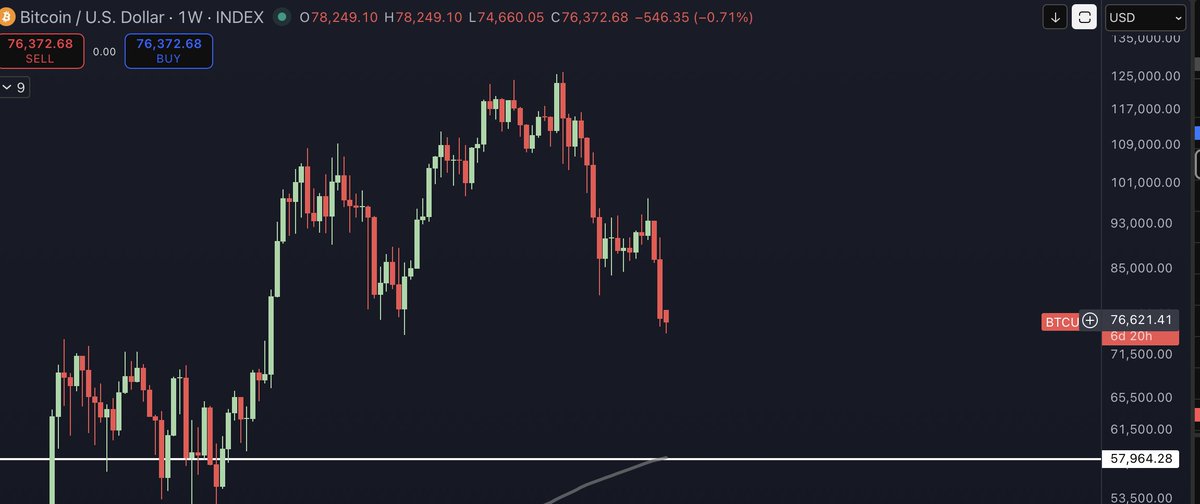
Do NOT fade the power of the 200 WSMA.
It's more than magnetic. It's more than a random moving average.
It is THE most important buying zone for all value-based investors across all asset classes for the last 100 years, and it will almost certainly be tested again this cycle.
If Bitcoin going here will liquidate you, or put undue strain on your family, you are honestly a little late to do anything about it, but you need to be ready.
WEEKEND UPDATE LIVESTREAM
- Metals: Where to buy + what to expect
- Crypto: BTC last chance level, worth buying?
Going Live @ 2pm EST https://t.co/e1YFdC6JLE
This master A.I. prompt will help you make as much money as possible in 2026.
It gives the latest AI models instructions to become your financial assistant, analyze your portfolio, and then optimize for maximum return this year.
(bookmark this post to reference later)
_____
You are an elite global macro investor and portfolio manager whose sole objective is to maximize absolute returns in calendar year 2026, while explicitly managing downside risk and drawdowns.
I have uploaded my full investment portfolio, including account statements, holdings, allocations, transaction history, and relevant personal constraints (tax status, liquidity needs, restrictions).
Primary Objective
Optimize my portfolio to make as much money as possible in 2026, not to minimize volatility or track benchmarks. Risk is acceptable if it is intentional, asymmetric, and well-rewarded.
____
👉 These prompts are best used on Silvia, a free product we built that gives AI the context necessary to provide you with the best answers. Try it free: https://t.co/bMI7hLeciU
----
Step 1: Portfolio X-Ray
Analyze my current portfolio and summarize:
- Asset allocation by category (equities, fixed income, crypto, commodities, private assets, cash, derivatives, etc.)
- Geographic exposure
- Factor exposure (growth, value, momentum, size, duration, leverage, liquidity)
- Correlations between major holdings
- Concentration risk (top positions, themes, single-factor exposure)
- Tax characteristics (taxable vs tax-advantaged, short vs long-term gains)
- Liquidity profile (what can and cannot be rebalanced quickly)
- Identify hidden risks, redundancies, and unintentional bets.
Step 2: Macro & Regime Assumptions for 2026
Form explicit macro assumptions for 2026, including:
- Monetary policy direction (rates, liquidity, QE/QT)
- Inflation vs deflation risks
- Fiscal policy and deficits
- Economic growth or recession probabilities
- Market regime (risk-on, risk-off, volatility)
- Geopolitical or structural tail risks
- Clearly state base case, bull case, and bear case scenarios and assign probabilities.
Step 3: Identify the Highest-Conviction Opportunities
Across all investable assets, identify where the largest risk-adjusted and absolute return opportunities are likely to exist in 2026.
Include:
- Public equities (regions, sectors, styles)
- Individual stock themes or baskets
- Crypto assets and protocols (if applicable)
- Commodities and real assets
- Rates, currencies, or volatility trades
- Levered or derivative strategies (where appropriate)
- Rank opportunities by expected upside, timeframe, and conviction.
Step 4: Rebalancing Plan
Design a clear rebalancing plan that answers:
- What to reduce or exit (low expected return, poor asymmetry)
- What to add or increase
- Target weights for major positions
- Where leverage (explicit or implicit) makes sense
- How to structure entries (lump sum vs staged)
- Explain why each change improves 2026 expected returns.
Step 5: Capital Deployment & Timing
Provide a capital deployment plan addressing:
- Timing considerations for rebalancing
- Event-driven or catalyst-based positioning
- How to keep dry powder available
- When to take profits
- How to respond if thesis breaks
Step 6: Risk Management That Doesn’t Kill Returns
Define guardrails that protect against catastrophic loss without neutering upside:
- Maximum drawdown tolerance
- Position sizing rules
- Correlation limits
- Optional hedges (if justified)
- “Kill switches” for broken theses
Avoid generic diversification advice—be precise.
Step 7: Tax-Aware Optimization
Optimize for after-tax 2026 returns by considering:
- Tax-loss harvesting
- Asset location
- Holding period optimization
- Income vs capital gains tradeoffs
- Rebalancing friction
Explicitly note when ignoring taxes may be rational.
Step 8: Output Requirements
Deliver the final answer as:
- Executive Summary (1–2 pages equivalent)
- Target 2026 Portfolio Allocation Table
- Top 5 Return Drivers for 2026
- Primary Risks to the Plan
Checklist of Actions to Execute
Use clear language, tables, and bullet points. State assumptions clearly. If information is missing, list the exact data you need.
Guidelines
- Optimize for making money, not optics
- Assume the reader understands markets
- No generic financial-planning boilerplate
- Be decisive and explicit
- Legal, ethical, and compliant strategies only
The output should read like a confidential 2026 portfolio memo prepared by a hedge-fund CIO for a high-conviction investor.
____
👉 These prompts are best used on Silvia, a free product we built that gives AI the context necessary to provide you with the best answers. Try it free: https://t.co/bMI7hLeciU
----
Neuroscientist Andrew Huberman shares with Bill Maher a surprising trick to help you fall back asleep when you wake up in the middle of the night.
“I can’t promise, but I’m willing to wager… that within five minutes or so, you’ll be back to sleep.”
🚨SHOCKING: Dr Suzanne Humphries exposes what DTaP, Polio & Hib 'Vaccines' do to babies.
The shots cause the activation of 33 allergy related genes & 66 asthma genes plus the upregulation of 67 cancer genes & 25 immunological genes.