Threadguy explains why RoboStrategy makes more sense than MicroStrategy
“Why would I pay $1.50 for a Saylor Bitcoin when I can buy a ThreadGuy Bitcoin for $1? The Bitcoin thing never made sense to me because you could buy it on your own”
“Why would you pay $1.50 for Kang robotics exposure? The difference is that you cannot get Kang robotics exposure. You can't get into Figure. You can't get into any of these names”
“Another thing about it is because RoboStrategy is all private companies, their valuations don't really go down. There's not gonna be too many down rounds in private markets for robotics companies. It's not gonna happen. It's just up, up only, up only”
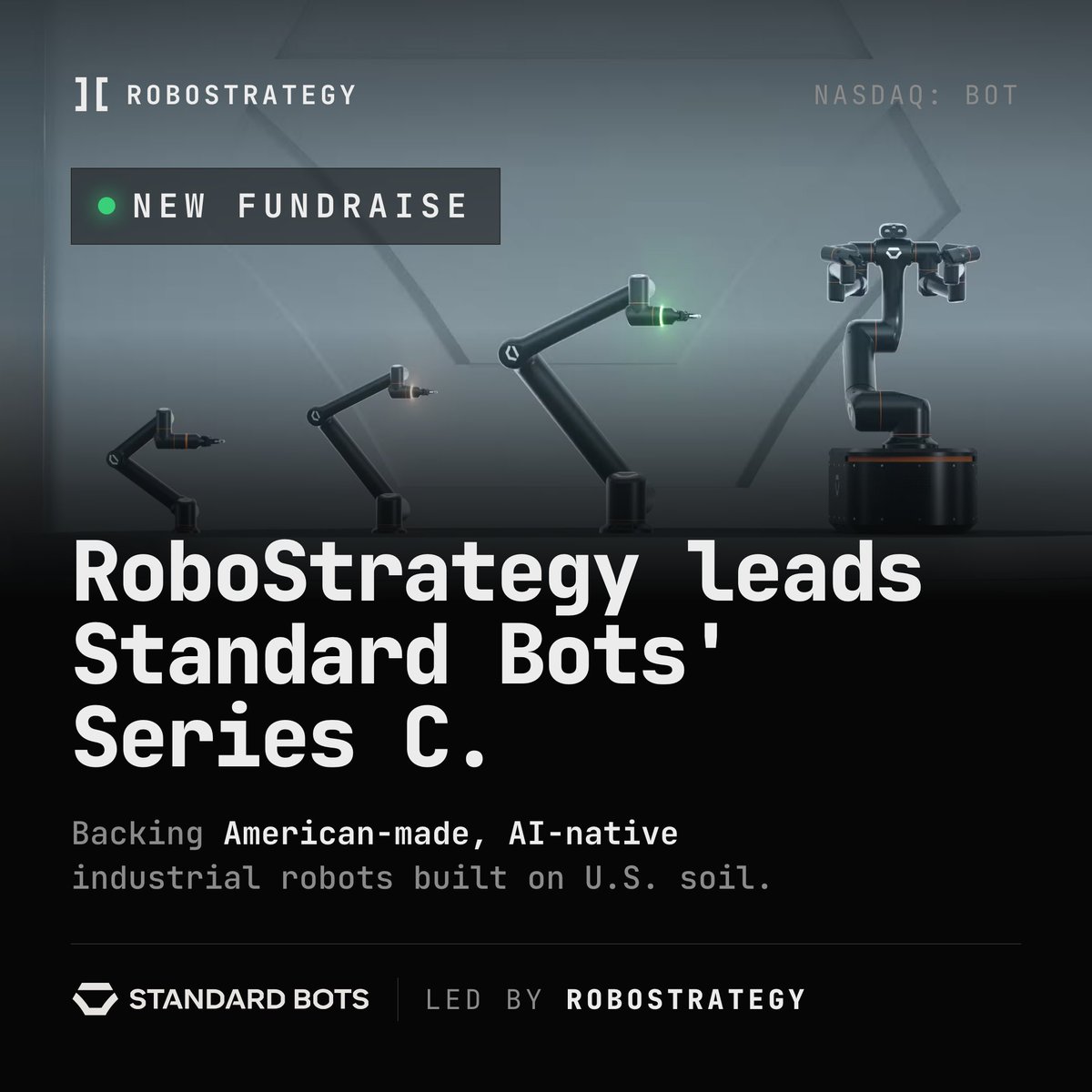
Super excited to have led the investment into Standard Bots.
@evanbeard and David are building a generational business.
It’s crazy that the US has not had a local champion for robot arms - Standard has changed this.
They’re also pioneering the practical use of AI - Evan’s Not Boring essay is the manifesto for those of us who believe AGI will be built in the real world & not the lab.
By 2027, we’ll manufacture everything — from metal in to robots out — right here in America. Grateful for the backing @RoboStrategy. $200M Series C, $1B valuation.
Excited to share our latest milestone: $200M Series C at a $1 billion valuation. We’re already America’s largest manufacturer of AI-native industrial robots. With this funding, we’ll expand our New York production facility to keep pace with demand so that by the end of next year we’ll be manufacturing everything in America, representing 10% of all U.S. industrial robot deployments. American manufacturing must come back.📈
The first RoboStrategy Investor Day is tomorrow, Wednesday, June 10 at 10:00 AM ET, live on X from @RoboStrategy.
The team will break down the robotics thesis, the fund, the portfolio, and how we invest in physical AI.
Follow and turn on notifications so you don't miss it 🔔
Thrilled to lead the Standard Bots Series C
Industrial robots can be thought of as the GPU of industrial work. Powered by AI, they’ll be able to power much of the work required in industrial settings - welding, machine tending, assembly, dispensing, sorting, the list goes on. Industrial robots have existed for decades, but it’s important that they’re built and designed for an AI native future.
The work they’ve done over the past decade was not easy - vertical integration, engineering their own parts and a plan to manufacture all of it in America. We talked to many industrial customers and asked them to compare them to the other companies and products on the market and Standard Bots overwhelmingly received the highest marks.
AI-native robot adoption is not a 5-10 year in the future event. It’s happening now and Standard Bots is at the forefront of that. If we want to reindustrialize America and massively scale American manufacturing then we need millions, eventually billions of robots produced in America.
Standard Bots stands to be one of the pillars of American reindustrialization.
Highly recommend following @standardbots & @evanbeard
the real NAV of $BOT is the work that @Rewkang has put into building it over the last few years. the first mover advantage + compounding effect of knowledge, network, and available funds will make it one of the biggest (vc) funds in the world. owning $bot = owning all bots
THIS STOCK IS ONE OF THE MOST AGGRESSIVE BETS ON THE ROBOTICS REVOLUTION.
The ticker?
$BOT
And this story is very different from what most people think.
Because $BOT (RoboStrategy) doesn't build robots.
It owns them.
Let’s break it down..
.@Rewkang compares humanoids costs to human labor
"A humanoid will cost $2 per hour
A human costs $35 per hour in the US
Humanoids can do everything humans can do
They don’t need to rest and they don’t quit
A humanoid will replace 3 humans
Even in low-cost labor countries
Humanoids will become a cheaper option"
I love hearing this
We spend an enormous amount of time on the robot’s industrial design. Every new robot starts on a clean sheet of paper. We begin with a two-week sketch blitz, putting ideas on paper and exploring hundreds of concepts before moving into concept engineering