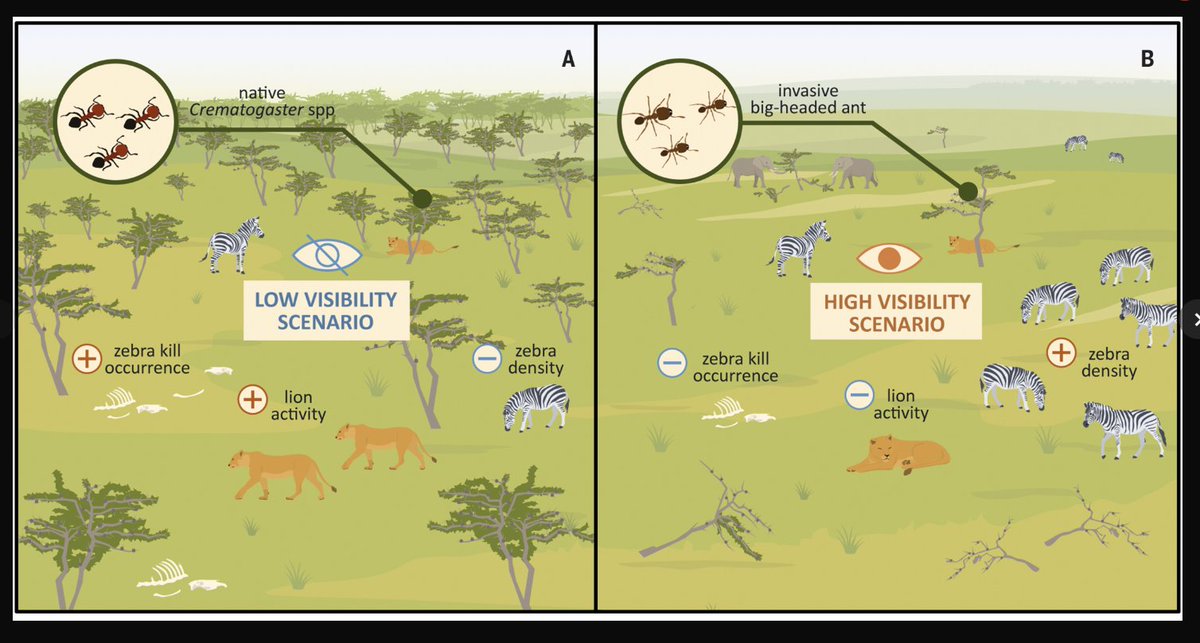
Invasive ants disrupt native ant-acacia mutualism, allowing elephants to browse trees, making higher visibility landscapes where Lions hunt buffalo instead of zebra. Amazing! @otistrout https://t.co/ZqLBnOSDhp
Big-headed ants are impacting the lives of lions, giraffes and elephants in Africa. Ecologist at @UF_CLAS Todd Palmer and a team of scientists found that this tiny disruptor is "pulling on the ties that bind an African ecosystem together."
An ecological chain reaction: An invasive ant disrupts a native ant–tree mutualism, rendering acacia trees more vulnerable to elephant damage. The reduced tree cover allows large mammals (zebras) to detect lions, reducing their predation risk by 3-fold. https://t.co/hOOg1viXIV
🚨🚨Our latest pub in @ScienceMagazine on the disruption of an ant-plant mutualism that reverberated through elephants to affect lion predation on zebra and buffalo!🚨🚨
https://t.co/D4G1Z8SFjp
thanks to @otistrout@ClaytonTLamb@OlPejeta and many non twitterers!
A tiny invasive ant creeps into an African savanna, and you'll never guess what happens next.... amazing work by Douglas Kamaru, and other collaborators just out today! https://t.co/GLGDnaxpsJ