@JackNiewold@PayPal@JackNiewold you’ll get it back but might have the wait a couple months - the team are rolling out the capability to recover non-PYUSD stables sent to PayPal address. DM me - I can connect you with the PM leading that effort for more info
@LindsayPoss Awesome story @LindsayPoss - the most wholesome thing I’ve seen in a while. As someone working in the cross border money movement space - this is what it’s all about and it’s so inspiring to see the very real on the ground impact. Thank you for sharing - made my day!
@CoffeeNGrit 100% agree. I bought one immediately after my test drive. The one thing that has been a let down is the summon feature - cannot get it work as designed in a parking lot or in my driveway. At one stage at a mall - it drove the opposite way to me and then gave up
We just published the most accurate onchain estimate of stablecoin payments ever.
Everyone keeps quoting $10T–$30T “stablecoin payments.”
That number is wrong. By a lot.
Built with @McKinsey payments team, we used a bottom-up approach to isolate real payments.
This report previews our new stablecoin payments dashboard, launching soon.
The real number will surprise you 👇🧵
As a recent new FSD user - this perfectly sets out my experience, the true holistic value and why it is the future of driving. Nice work @CernBasher (and @elonmusk of course)
The True Value of Tesla’s Full Self-Driving Isn’t $99 a Month
For years, Tesla’s Full Self-Driving (FSD) software has been priced like a premium feature: an $8,000 add-on or a $99-per-month subscription.
That framing made sense when FSD was essentially an advanced driver-assistance system - impressive, occasionally magical, but still requiring a human behind the wheel.
But that pricing logic collapses the moment a car can truly drive itself unsupervised.
At that point, FSD stops being software that helps you drive and becomes software that replaces the act of driving altogether. And when you look at it through that lens, its true value is not measured in thousands of dollars - it’s measured in time, labor, and economic transformation.
A Chauffeur You Already Own
Let's start with the most obvious shift: time.
For the average commuter, driving consumes hundreds of hours per year. If your car can take over entirely - no hands, no attention, no stress - that time suddenly becomes usable. You can work, read, rest, or simply arrive without the mental fatigue that driving imposes.
Put a modest dollar value on that reclaimed time and the math adds up quickly. Even at conservative assumptions, unsupervised autonomy can be worth several thousand dollars per year to a busy professional or family. In that world, $99 a month looks less like a premium and more like a placeholder.
Rewriting Household Economics
The impact doesn’t stop at convenience.
A truly self-driving car changes how households think about transportation altogether. If a vehicle can shuttle family members, run errands, and reposition itself on demand, many households no longer need a second car. That alone can mean avoiding a car payment, insurance, depreciation, and maintenance - often $10,000 or more per year in real savings.
Suddenly, FSD isn’t a luxury feature. It’s a way to restructure a household budget.
From Expense to Asset
Then there’s the most disruptive implication of all: earning power.
In an unsupervised world, a car doesn’t just sit idle in a driveway 95% of the time. It can work. It can transport people or goods when you don’t need it. In other words, it becomes a productive asset.
Even modest participation in a future autonomous ride-hailing network could generate meaningful income for vehicle owners. Over the life of a car, that optionality could be worth tens of thousands of dollars in present value. In some scenarios, the software enabling autonomy could be more valuable than the vehicle itself.
That’s not a feature - that’s a business.
Why Tesla Is Rethinking Pricing
Seen this way, Tesla’s apparent move away from one-time FSD purchases toward subscriptions makes sense. A fixed price works when software delivers a fixed benefit. It breaks down when the benefit is ongoing, compounding, and potentially income-producing.
Unsupervised autonomy isn’t something you “unlock once.” It’s something you use, rely on, and potentially monetize every day.
The Bigger Picture
The error many people make is treating Full Self-Driving as an upgrade to driving, instead of recognizing it as a replacement for driving itself. We are used to valuing options by comparing them to other buttons on the dashboard. Autonomy doesn’t belong on that menu.
When true autonomy arrives, Full Self-Driving ceases to be about better lane changes or smoother highway merges. Its real value comes from what it eliminates: hours spent behind the wheel, the cognitive load of constant attention, the inefficiency of cars that sit idle most of the day. In exchange, it gives back something far more scarce - human time - and does so at scale.
A self-driving car lowers the real cost of transportation, not by shaving dollars off a ride, but by turning travel time into usable time and turning vehicles into assets that can move, work, and generate value without a human operator. That is not a feature; it is a structural change in how mobility fits into the economy.
Seen through that lens, debating whether Full Self-Driving is “worth” $99 a month misses the point entirely. The relevant comparison is not to other software subscriptions, but to the economic value of the activity it replaces.
We are now heading towards a world in which driving - one of the most time-consuming human tasks of the last century - no longer needs to be done by humans at all.
Last Friday, @realdonaldtrump sent Bitcoin down over 6% in 30 minutes with a single post about China tariffs
Now we’ve got a $800K notional BTC trade ready if he backs off (and $400K short if he doubles down)
Want to join ours or set up your own?
Hipshot is live!
(1/7)
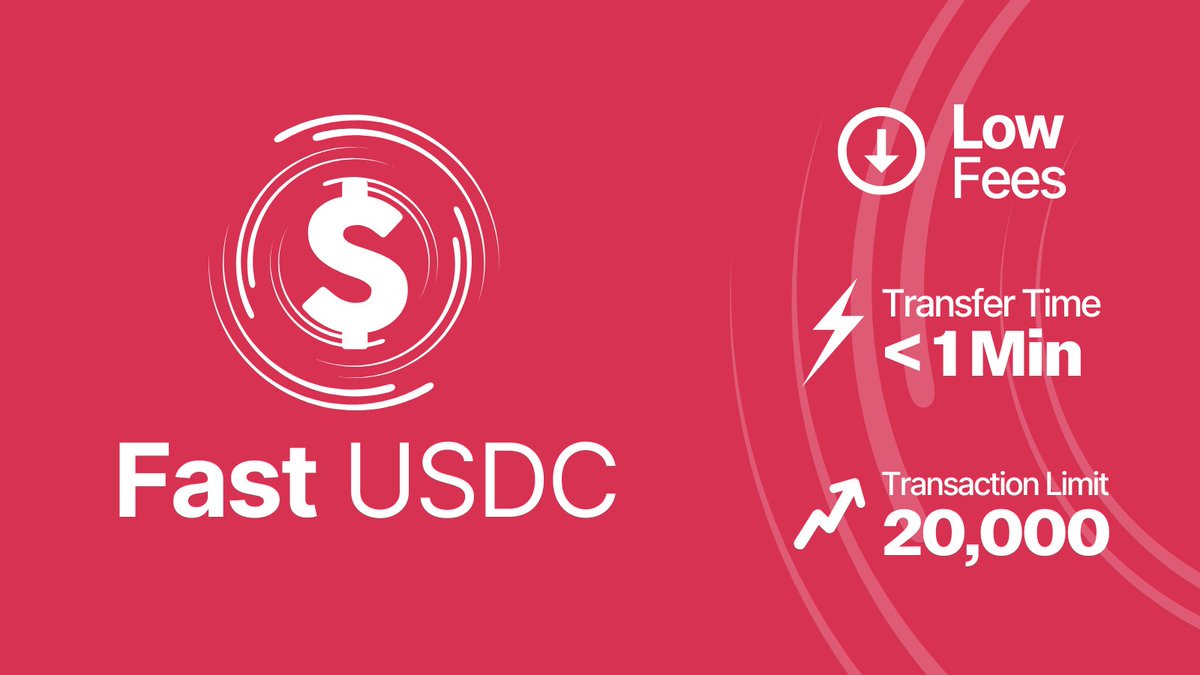
Fast USDC is LIVE on Noble Express 🗻
With one click, you can move your USDC from Ethereum to Cosmos in under one minute – an 18x improvement over traditional methods!
Low fees, high limits, and fast transactions.
Ready to try it out? ↓
1/ Bridging from EVM chains to Cosmos just got a major upgrade⚡
We’ve teamed up with @agoric to take bridging time on Noble Express from 18+ minutes to less than 30 seconds.
Try it out on https://t.co/AmARF2s1Xk
Today I tuned in to an internal demo of Fast $USDC powered by @agoric Orchestration - real, live multi-chain actions happening on mainnet!
Orchestration contracts are here, making Web3 seamless.
Watching it in action was 🔥
Y'all ain't ready...
Chain Abstraction Fireside: Insights From Builders:
-@KushagraCrypto from @okto_web3
-@vivekbrijgupta from @okto_web3
-@otooligan from Agoric
A fireside chat featuring insights from Okto and Agoric on how Chain Abstraction and intents are reshaping blockchain infrastructure. We’ll cover technical, user-centric, and economic perspectives on solving fragmentation.
Full video below 👇🧵
Fire 🔥 conversation rn at @EthereumDenver - @otooligan crushing it
"Take away coordination from any market and you have nothing. The hardest part of coordination is orchestrating the sequence of events in the right order."