El país que más invierte en inteligencia artificial del planeta acaba de sancionar una ley nacional para obligar a sus ciudades a abrir bibliotecas y volver a los libros de papel.
China era el candidato perfecto para enterrar el papel: pone más de cien mil millones de dólares al año en inteligencia artificial y es de los que más la incluyen en los currículos educativos. Si algún país iba a declarar que el libro ya no hace falta, que para eso está la máquina, era este.
Sin embargo, hizo exactamente lo contrario: en vez de mandar todo a la pantalla, está promoviendo el libro por ley. Desde el primero de febrero, rige una norma que obliga a cada gobierno local a poner dinero en bibliotecas, abrir espacios de lectura hasta en las zonas rurales y sostener una Semana Nacional de la Lectura. Desde ahora, es obligación del Estado.
¿Por qué un país que ya tiene la mejor tecnología se molesta en legislar la lectura? Porque separaron para qué sirve cada cosa. La inteligencia artificial te sirve para producir, competir, ir rápido: es la herramienta.
El libro te entrena en lo que ninguna máquina te da: atención sostenida y criterio propio. Es la cabeza la que después decide qué hacer con esa herramienta. Como lo resume uno de sus investigadores: solo a través de la lectura se llega a un pensamiento profundo e independiente.
El premier Li Qiang lo decretó dentro del mismo plan quinquenal donde está su apuesta de inteligencia artificial. Las dos cosas son estratégicas y van de la mano.
Mientras tanto, Estados Unidos hace el camino inverso: batió su récord de libros sacados de las escuelas (casi veintitrés mil desde 2021) y sus chicos sacaron las peores notas de lectura en más de veinte años, con cuatro de cada diez de cuarto grado que no llegan ni al nivel básico.
La inteligencia artificial la va a tener todo el mundo. La cabeza para saber qué hacer con ella, no. Usala para pensar CON vos y no POR vos.
Terence Tao proposes what he calls a "Copernican view of intelligence".
Instead of buying into the common, one-dimensional narrative that artificial intelligence will simply evolve from "subhuman" to "superhuman" and ultimately make humanity entirely redundant, Tao urges us to look at the bigger picture.
Much like the Copernican revolution proved the Earth is not the center of the universe, Tao suggests we need to realize that human intelligence isn't the only, or necessarily the highest, form of intellect. Historically, we have treated other forms of storing or creating knowledge—like animals, books, and computers—as secondary. However, we actually exist within a much richer universe of intelligence.
Both human intelligence and computer intelligence possess their own distinct strengths and weaknesses. The true potential lies not in viewing them as direct competitors, but rather in focusing on collaboration. By working together, humans and computers can achieve additional things that neither could accomplish on their own, requiring us to think in much wider terms than just what humans or computers can do alone.
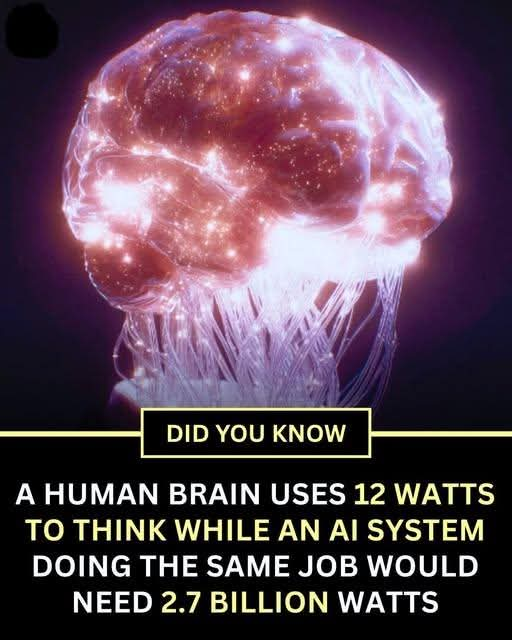
🚨 Your brain is running on just 12 watts right now while processing this sentence. An AI system would need 2.7 billion watts to do the same thing.
That's not a typo. The human brain operates on roughly the same amount of power as a dim light bulb, yet it can recognize faces, solve complex problems, create art, and experience emotions simultaneously. Meanwhile, artificial intelligence systems require massive data centers consuming enough electricity to power entire cities just to simulate a fraction of what your brain does effortlessly.
Think about what your brain accomplished just reading this far. It decoded symbols into meaning, connected new information to existing memories, probably triggered some emotional responses, and maybe even started forming opinions about AI energy consumption. All while maintaining your heartbeat, breathing, and thousands of other bodily functions. Total power consumption: 12 watts.
The most advanced AI systems need server farms filled with thousands of high-powered processors, industrial cooling systems, and backup power supplies. They consume roughly 225 million times more energy than your brain to perform similar cognitive tasks. It's like comparing a bicycle to a freight train in terms of efficiency.
This incredible disparity reveals just how remarkably evolution has optimized biological intelligence. Millions of years of natural selection created a thinking machine so efficient it makes our most advanced technology look primitive and wasteful by comparison.
Your smartphone uses more power than your brain while being infinitely less capable. Every thought you're having right now represents the pinnacle of energy-efficient computing, wrapped in three pounds of biological tissue that somehow generates consciousness, creativity, and dreams.
Nature got there first, and we're still trying to catch up.
Curious whether video generation models (like #SORA) qualify as world models?
We conduct a systematic study to answer this question by investigating whether a video gen model is able to learn physical laws.
Three are three key messages to take home:
1⃣The model generalises perfectly for in-distribution data, but fails to do out-of-distribution generalization. For combinatorial scenarios, scaling law is observed.
2⃣The models fail to abstract general rules and instead tries to mimic the closest training example.
3⃣The model prioritizes different attributes when referencing training data: color > size > velocity > shape.
This work is a joint effort with our outstanding intern @YangYue_THU.
Paper: https://t.co/4opSJcPXI7
Webpage: https://t.co/cANYiThjoD
Scarlett Johansson is taking legal action against OpenAI after they 'copied' her voice for GPT-4o.
According to the actress, Sam Altman tried to hire her voice last September, she said no, and Sam used cloned and used her voice anyway.
Insane if true.
https://t.co/ibsy2y8yTa
AI NEWS: Microsoft just announced the world's first AI PCs to rival the MacBook.
Plus, major developments from OpenAI, Scarlett Johansson, Elon Musk/xAI, and Geoffrey Hinton.
Here's everything going on in AI right now:
Just this week, Google opened Gemini 1.5 Pro and Flash to public.
The 1 million token context is insanely useful in many use cases. Let's recap what's possible.
10 wild examples:
After almost a decade, I have made the decision to leave OpenAI. The company’s trajectory has been nothing short of miraculous, and I’m confident that OpenAI will build AGI that is both safe and beneficial under the leadership of @sama, @gdb, @miramurati and now, under the excellent research leadership of @merettm. It was an honor and a privilege to have worked together, and I will miss everyone dearly. So long, and thanks for everything. I am excited for what comes next — a project that is very personally meaningful to me about which I will share details in due time.
GPT-4o hot take:
• The speech synthesis is terrific, reminds me of Google Duplex (which never took off).
but
• If OpenAI had GPT-5, they have would shown it.
• They don’t have GPT-5 after 14 months of trying.
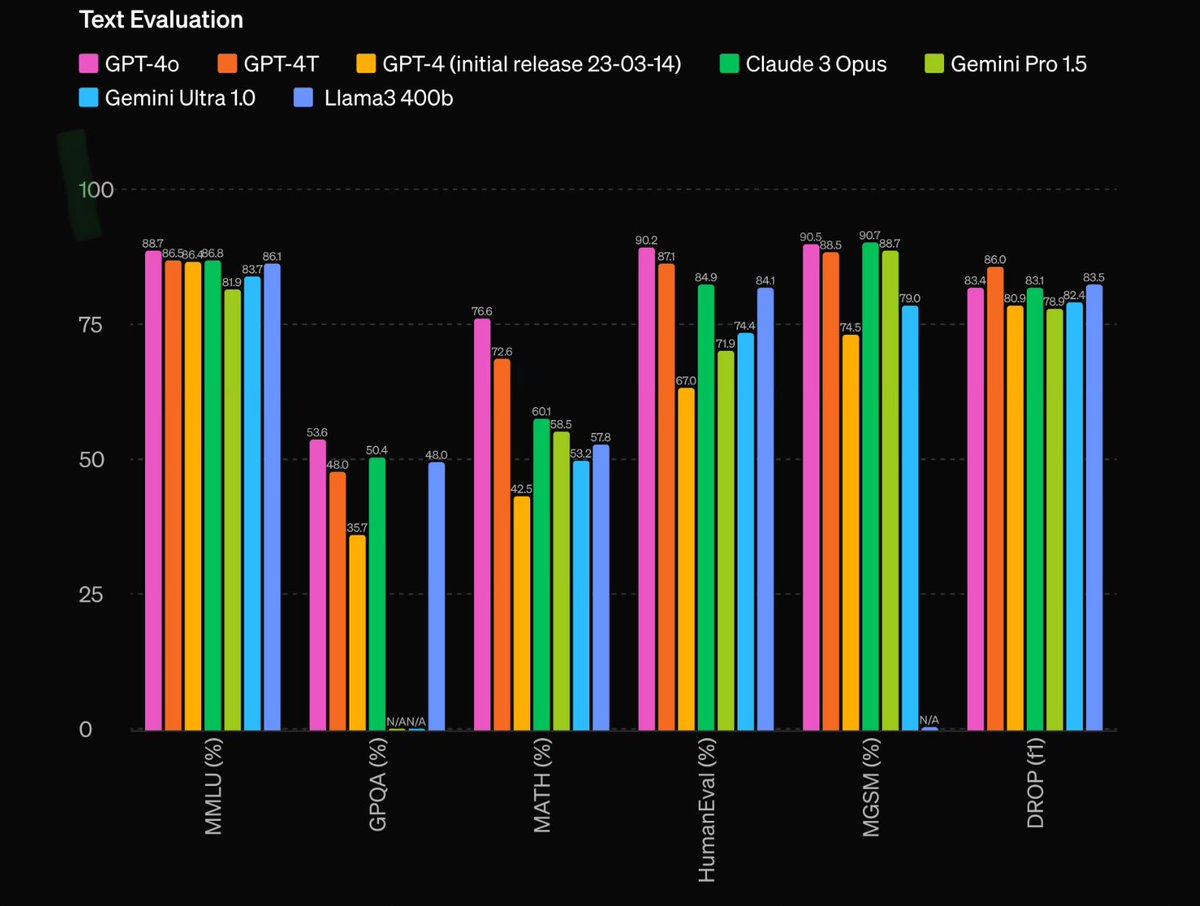
• The most important figure in the blogpost is attached below. And the most important thing about the figure is that 4o is not a lot different from Turbo, which is not hugely different from 4.
• Lots of quirky errors are already being reported, same as ever. (See e.g., examples from @RosenzweigJane and @benjaminjriley.)
• OpenAI has presumably pivoted to new features precisely because they don’t know how produce the kind of capability advance that the “exponential improvement” would have predicted.
• Most importantly, each day in which there is no GPT-5 level model–from OpenAI or any of their well-financed, well-motivated competitors—is evidence that we may have reached a phase of diminishing returns.
Pay attention to an AI competitor from China...
From https://t.co/dMPj7W44kb whose CEO is Kai-Fu Lee, former President of Google China...
Interesting times...
On Bloomberg @business earlier today w @DavidInglesTV, @YvonneManTV and @jenzhuscott 30 min before @01AI_Yi team debuted our most powerful Yi-Large LLM to the world. We aim to make AI accessible to everyone by launching the first consumer application "Wanzhi," plus Yi model APIs to boost the generative AI ecosystem. More in the full interview https://t.co/CxRwMQuyPu
🚨MEET THE UNITREE G1 HUMANOID
Priced between $12,500 and $16,000, it's designed for sports and physical tasks, with 23 to 43 joints for dynamic movement.
Its hands, equipped with 2 fingers and a thumb, handle objects with precision.
Scared yet?
https://t.co/LDb0RBtb4H
Key take aways from OpenAI's Spring 2024 Announcements:
- No sign of model connectivity.
- They are not replacing google, anytime soon.
- Most eye raising portion of the demo was the desktop application, it requires your data get sent to their servers, and the example they used was the worst one (code) for protection of proprietary user data. It takes what it sees, and sends it back to the mother ship. I don't like that approach and advise everyone to remain vigiliant in what you share with an AI model in the cloud, unless you are running the model yourself (locally, or on servers in the cloud) you will likely need to relinquish data which is horrible.
- The rest of the announcement was catch up, they are no longer in a dramatic lead so its interesting to see the dynamic shift, this isn't the same OpenAI from last year.