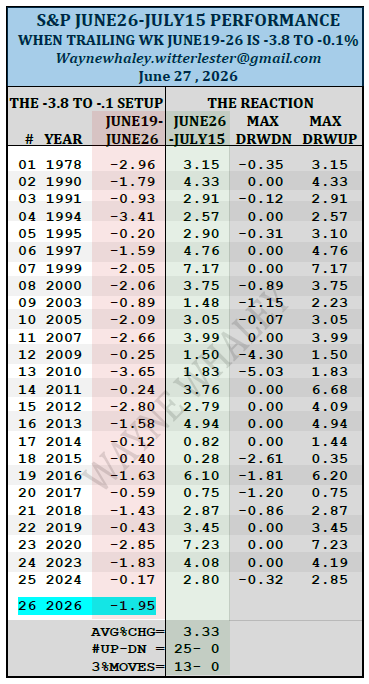
A 25-0 S&P SETUP FOR JUNE26-JULY15
The S&P was down 1.95% during the week of June19-26.
Cutting the last 50 years database in half by focusing on those 25 "Nearest Neighbor" cases to this year's -1.95% June19-27 measure produces the below dataset consisting of those June19-26 performances ranging from -3.8 to -0.1%.
The S&P was 25-0 in the following June26-July15 time frame in the aforementioned 25 cases for an avg nineteen day gain of 3.33%.
Nineteen of the 25 cases had less than a 1% Drawdown during the reaction period.
In 12 of the 25 cases, June 26 was the Low (No Drawdown).
One of 18 multimarket studies shared with Study Subscribers last week. [email protected] for Study List inquiries.
Honestly this decade from 2020-2030 might be the most goated in human history.
- Scaling massive reusable rockets for orbital compute with $RKLB to $SPCX.
- on the cusp of ASI and recursive learning with Anthropic and OpenAI
- Backflipping Boston Dynamics and Unitree humanoids to replace the human workforce
- Star Wars laser beams from $EOS.ASX to AI DC lasers like $LITE.
- Waymo and $TSLA self driving cars everywhere in urban cities
- and we get industry Quantum commercialization end of decade
This is kinda crazy to be an investor in this timeframe. Feels like every movie from the Star Wars Death Star to Skynet is coming to life.
What’s next?
Let this year be a lesson of narrative follows price NOT the other way around.
January $SLV “this is a repricing higher from inflation.” “AI’s demand for silver is pushing it up.”
Silver drops off the highs, narratives nowhere to be found.
April $CAR “two funds own the entire float, there’s no way this goes down unless they sell or the company does an offering.”
Neither happened, CAR still drops 75% in days. Narrative never mentioned again.
June $SPCX “only 4% of the float is tradable. The demand for this way outweighs the supply and should take the company higher than anyone expects.”
SPCX pulls back as naturally as any stock would that runs in a similar fashion.
It doesn’t mean some of these narratives had truth and facts to them. But it doesn’t stop price action from playing itself out. Remember if price action never went up in the first place, we wouldn’t have heard a single one of those narratives.
Narrative follows price.
I stopped trusting narratives, not because they are always wrong, but because they are irrelevant to risk management.
Stories can explain why something might work in the future, but they offer no protection in the present. They encourage patience when discipline is required. They justify inaction when action is necessary.
Most importantly, they make it harder to admit when you are wrong.
Elon Musk got rejected by Netscape. He walked into the lobby, was too shy to talk to anyone, and walked out. Never got the job.
At his first company Zip2, the board demoted him. Twice. They refused to let him be CEO.
He got fired from PayPal as CEO while flying to his own honeymoon. The board voted him out mid air.
He almost died of malaria in 2000. Ten days in intensive care. Lost 45 pounds. A day from death.
His first child died at 10 weeks old.
His first rocket exploded. Falcon 1, flight one. Burned on the pad.
His second rocket exploded.
His third rocket exploded. The last of his money was nearly gone.
Tesla nearly went bankrupt in 2008. The closest he ever came to a nervous breakdown.
Both companies almost died on the same Christmas Eve.
He was sued by investors. Mocked by the people who built cars before him.
His childhood heroes, the astronauts who inspired him, testified against his company to Congress.
The Cybertruck window shattered on live stage in front of the world.
He overpaid for Twitter by his own admission and watched its value collapse.
He was beaten unconscious as a child and thrown down a flight of stairs.
He has said he goes to sleep alone and it kills him.
He failed in public, over and over, for thirty years.
He is the richest man in the history of the world.
The difference was never the absence of failure. It was the refusal to stop after it.
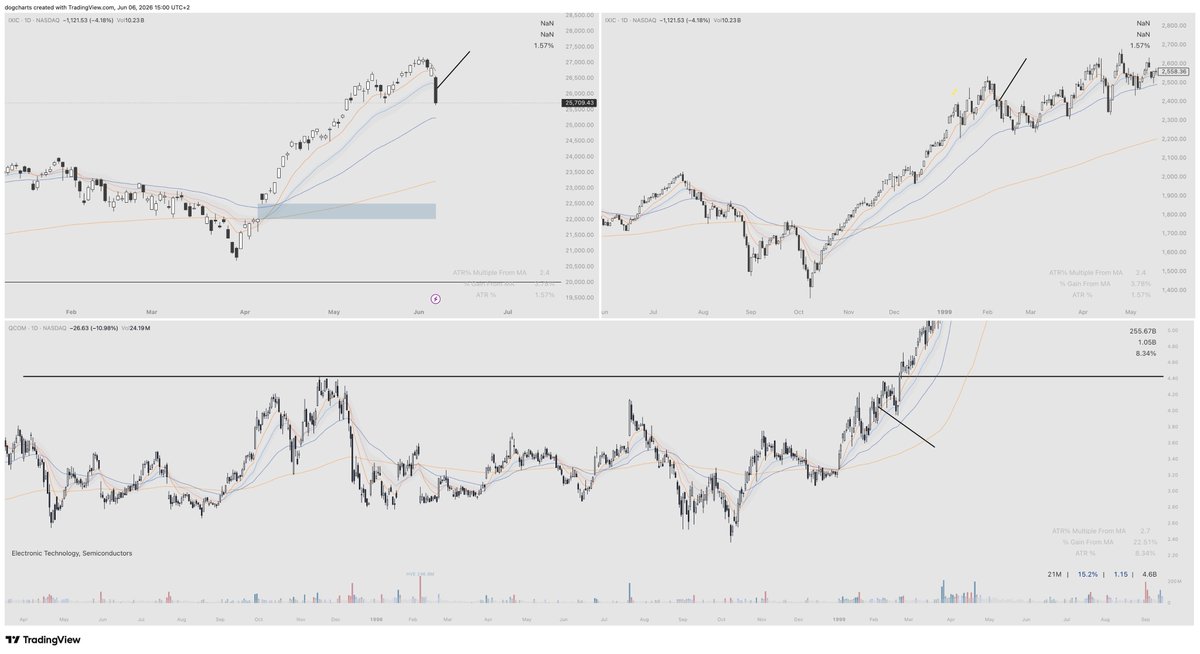
This period is interesting as well.
The Oct '98 correction and lockout came after a period of chop. It wasn't an especially bubbly market yet, but there was a similar break to what we're seeing now, followed by a lot of base-building in individual names.
Soon after, QCOM came alive and the real sweet spot began, with much broader participation as the indexes pulled back to their 50-day moving averages and held.
What's fun to think about is that some of the biggest winners of that era, like QCOM. If we're really in a similar setup, those names would be breaking out in the next couple of weeks, lol. Doubt it but still funny
@CFlanders7 Hard to read too much into these comparisons, but they're fun nonetheless. Maybe it's the top, maybe not. QCOM had a nasty break about 140 days into its run, and MU is now at 180 days. Yet QCOM went on to rally another 400% from that point, haha.
The fact you can be so terrible at times and continue to make supernormal returns continues to at times astound myself too. I look at some trades I’ve done in the past and genuinely wonder how I’ve been able to make it this far in this game, and yet .. any trade is just 1 trade, unless … you polarise your outcome with irresponsible risk….
The truth is there will be easy dollar environments again and again. The simplest things are the hardest to do:
- Extreme patience at times, wait for the pitch.
Patience is the most difficult thing.
- Meticulous planning, when the pitch is there, visualise and plan for different scenarios.
- Focus on the right details, suppressing what doesn’t matter.
- attitude to your work is more important than your IQ
- if you don’t believe you can crush, you probably won’t.
- it is difficult to visualise your progress in years not days, but it is more helpful.
- build systems and processes for the long term.
- think in terms of strategy religiously. Strategies survive, results don’t last.
- if you make it about you and your run, you will eventually lose. If you make your trading about honing the skill, you can’t lose but only learn. The pace of learning is up to you.
- the beatings will continue until your discipline and morale improves.
- in order to let the art part of trading manifest, you have to trust your ability and intuition. If you don’t have that trust/faith, your ability will always be capped at intellectual understanding level. It’s enough to beat the market, but most likely not enough to enter the goated tier.
Intuition may not necessarily apply to the act of trading, it may offer to you a groundbreaking insight into trading strategy research.
- first principles are a reliable guide, because they are not a function of opinion and don’t belong to anyone.
For the past few months I’ve spent long nights thinking about the future of Trading and what AI breakthroughs really mean for it.
Not from a tool perspective. Structurally.
Here is my take :
I believe 2026 and beyond will be the golden age of Momentum Trading, given that no major macro event dilutes things.
AI is starting to map behavioral dynamics that were previously unquantifiable. A small clue of that shift is how often you hear the word “themes” now compared to a few years ago , or the increasing effort by platforms to map them out.
That’s not random imo. Capital is organizing itself differently.
The principles that make stocks go up will never change. Supply and demand. Human behavior under uncertainty....What changes is the expression.
What we consider a clean setup will evolve. The details will evolve. Timing windows will compress. Rotations will tighten and happen faster, often at the sub-industry and sub-theme level before most participants even recognize it.
I envision a near-term future where markets become progressively more efficient...not in a way that kills opportunity, but in a way that concentrates it.
Momentum moves will be rapid and explosive. Fades quicker. The velocity of rotation higher. And because of that compression, the footprints in price action will actually become clearer....We’re already seeing it in real time.
I’ve never seen clustering of themes the way I see it now versus 5+ years ago. I’ve never seen rotations happen this fast at a sub-theme level. I’ve never seen structural footprints in price action this clear....That’s compression.
For the past months we’ve been working on problems most of the industry doesn’t even realize they have yet ...all centered on principles that always worked and will continue to work, adapted to a different speed of market structure and the potential velocity shift ahead.
Exciting times ahead for those paying attention!