My articles about three aspects of bees and maths! 🐝 ♾ Honeycomb geometry https://t.co/JKBLI5KcDa Nest volumes: https://t.co/8VR6D1K44O and travelling salesman https://t.co/v31blG9vvx
Last chance to book for ‘Recreational Mathematics and its History’ which I’m speaking at in London on Saturday. In person and online available!
Programme and registration:
https://t.co/kh3Po2JsPd
@Anthony_Bonato I wonder if these things means there’s untapped interest in mathematics, but by people who only know elementary arithmetic. I sometimes feel like there’s potential to pull a switcheroo, and engage with some other puzzle. Unless controversy is the only driver.
Google DeepMind have produced a program that in a certain sense has achieved a silver-medal peformance at this year's International Mathematical Olympiad. 🧵
https://t.co/DIcsYXUv97
A standard way to draw planar graphs is to draw nodes as dots and edges as line segments.
But the Koebe–Andreev–Thurston theorem also shows that any planar graph can be visualized by drawing nodes as circular disks, which are tangent if they share an edge:
@TheShowstoppers The team go to new extremes to fetch tasty morsels by planning a heist on a reptile zoo. They sing “You can’t spell Team without Meat”
to tell if a maze is solvable, just hang it by its corners! The first maze stays in one piece, so there is no path from the entrance at the top to the exit at the bottom. The second maze splits apart along the solution.
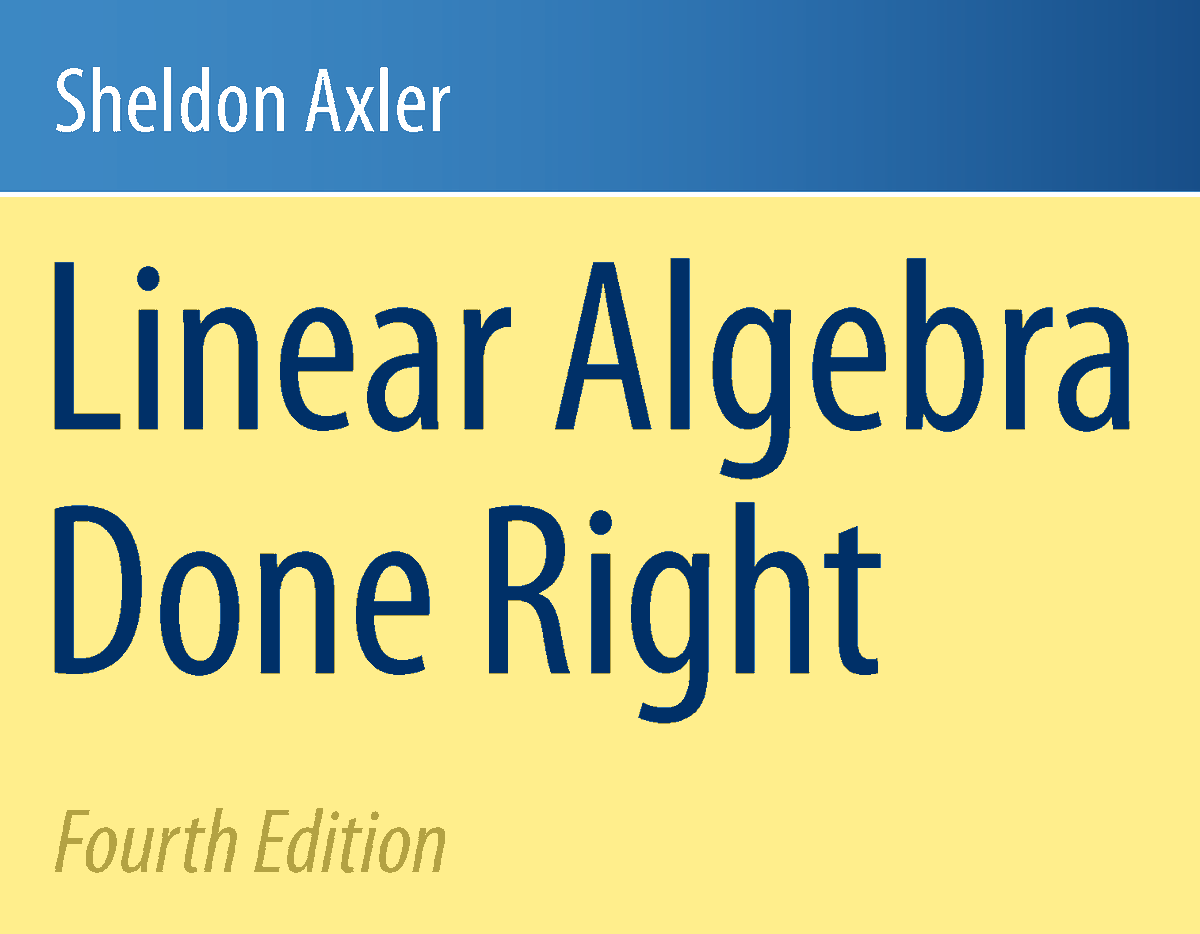
The electronic version of the new fourth edition of my book Linear Algebra Done Right has now been downloaded over 80 thousand times in the two months since it was released. The electronic version of this Open Access book is freely available at https://t.co/fAxuAOpdHg.
The print version is available at the links below:
Amazon: https://t.co/Lwk0HVFQ3J
Springer: https://t.co/cEObSlJtdj
#linearalgebra
Consistently excellent puzzles - the end of an era. As an editor of clever, beastly puzzles, he is a pRO BEAST. A WAY of solving his NS puzzles, always elegant, was a delight to be discovered in the subsequent issue.
On the fourth day of Christmas, Gresham College gave to me...
https://t.co/r85yKMQOvp
... one of the great lectures of 2023, The Maths of Board Games, by Professor @sarahlovesmaths. Enjoy!
@BirkbeckUoL @BirkbeckBEI @mathshistory#maths#games#puzzles#christmas#twixtmas
Lots of people say this is a fake illusion because they still perceive the motions even when covering the icons.
But the illusion comes from the subtle dynamics of the line shading during the flashes, not the icons.
The right way to find out if it is fake is to take measurements.
In 1884 P.G. Tait wrote about the following puzzle, which he encountered while riding on a train:
Start with eight adjacent coins alternating heads and tails. By moving four pairs of neighboring coins (and without changing their order), rearrange the coins to obtain four
[1/2]





![divbyzero's tweet photo. In 1884 P.G. Tait wrote about the following puzzle, which he encountered while riding on a train:
Start with eight adjacent coins alternating heads and tails. By moving four pairs of neighboring coins (and without changing their order), rearrange the coins to obtain four
[1/2] https://t.co/HIVJOlLIh3](https://pbs.twimg.com/media/GArcOawXQAUd82_.png)


