This is Granta 177: Nigeria.
The autumn edition features stories, essays and reportage that invite the reader inside the consciousnesses and dilemmas of the country.
The issue publishes on 1 December 2026.
https://t.co/JlINZo3yzj
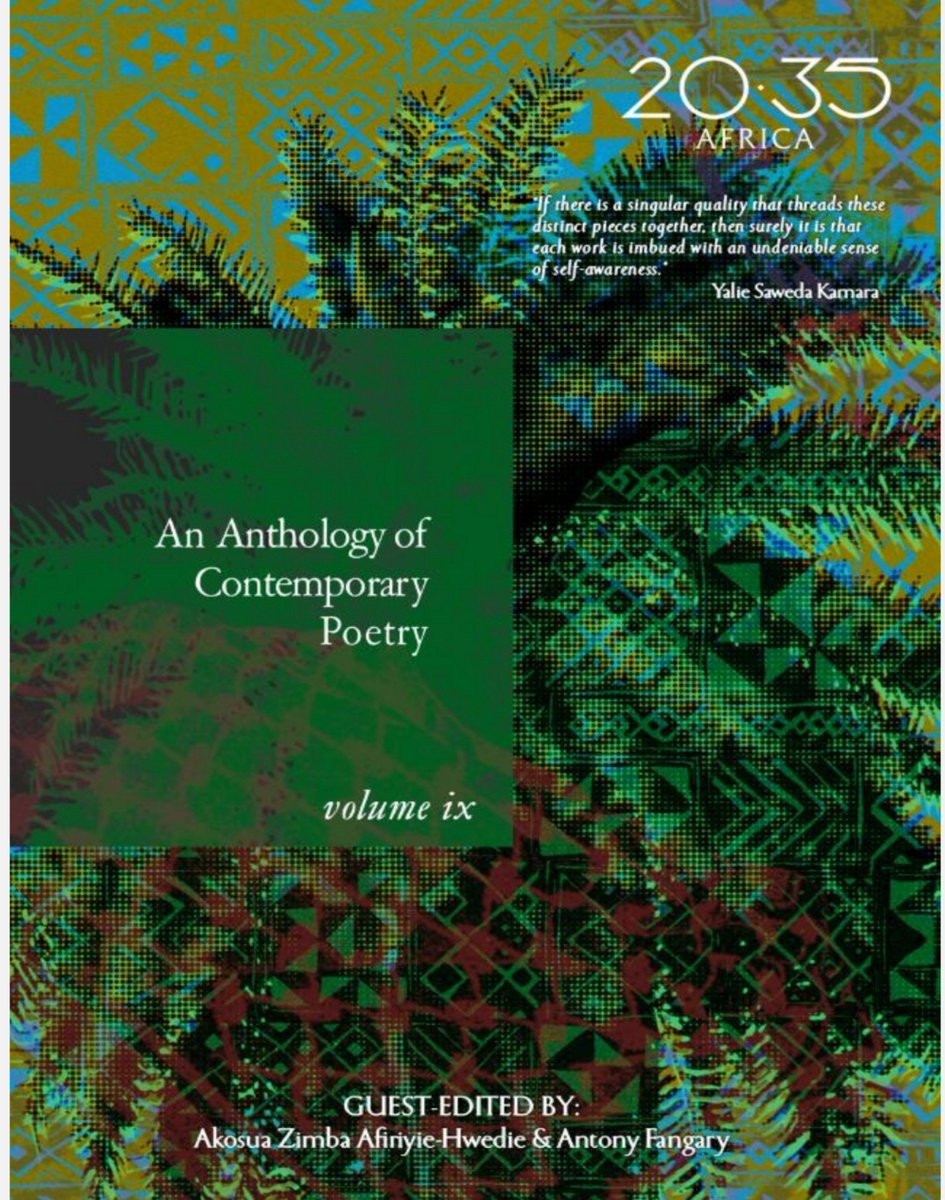
16 brilliant, audacious, and fierce poets. 9 nationalities. 20.35Africa Vol IX is finally here for your reading digest! 🤩
The anthology was guest edited by Akosua Zimba Afiriyie- Hwedie(@akosuaZah ) and Antony Fangary.
Read/download here:
https://t.co/momJrN4NyF
I am excited to share with you that I have two poems given a home on 20.35 Africa Anthology by the good people (editors) over there. I share this home with other amazing writers that I so much admire. I hope you enjoy our poems inside the anthology. Here's one of mine.
Introduction to 20.35 Africa Volume IX: “Sit with Their Grief . . . Reconcile with the Devastation”
The poems in 20.35 Africa Volume IX, guest-edited by Akosua Zimba Afiriyie-Hwedie and Antony Fangary, “remind us that the suffering in the world is inflicted by us, on us,” but also “that the thick layered air of exhaustion has not rid us of our . . . dreams.”
Off the page, different concerns plague our livelihood. Sometimes, they present as ordinary and inconsequential, and other times, as global and moral. All of these are nonetheless existential. They shape our being, the way we navigate and make meaning of the world. Writers go to the page to tell the troubled stories that animate their ways into their lives, countries, and continents. These poets in 20.35 Africa Volume IX show the range of the existential crises faced in the world they live in, and they paint all the filth, beauty, and joy of it.
Star Zahra’s “Soot” opens the anthology with these lines: “When I close my eyes to the pleasuring / sound of rain drops dancing on the tin roof, / A child closes theirs / to soot.” — a poem that reconciles beauty and privilege with the suffering around us. It is arranged like a wall galleried with paintings, and while three of the five frames capture the simple pleasures of life, they are interrupted with differences from places and people who can’t have those pleasures. It begs the questions: Who gets to experience the beauty of living and who doesn’t? What’s the cost of this disparity? Soot?
This dark aftermath of burning and its threat to life recurs throughout this volume. Joemario Umana writes in “What the Road Refuses to Name” of a burnt vehicle by the roadside “crow-coloured and smoking, opens a door of fear / inside my body, how its windows reflect the half-moons / of men running from a country that keeps swallowing its own breath.” He confronts how a country’s failure has led to the constant death, kidnapping, and terrorizing of its citizens. Each line grapples with the danger of being in a place that refuses you the refuge of home, and the anxiety that comes with looking for death in everything. His other poem, “Sunflowers at the Mouth of a Closed Door,” contends with a similar struggle, the freedom and dreams of people stifled and hope gradually lost: “I do not know / how to stay loyal to a wound that keeps opening / its mouth… / Even heaven seems to be rationing light.” This juxtaposition of the bodily and place, and the doubt of “I do not know,” hold the poem’s core reality and the writer’s relationship with his country Nigeria.
This anthology is concerned with the body, the land, the harm and damage done to their soft expressions of life. In a time when the machine and industrial complex numb our relationship to the body and the earth, how do we as writers respond to the spiritual disconnection that ensues?
Read more: https://t.co/x3rdijT5GI
so when it’s not african writers, p*ngr*m ceo can come out and admit to errors but if the accuser was black they would have told us pangram has 100% accuracy. mschewww!
Congratulations to @OpeAdedeji_ and Svetlana Chigozie Onye, two Nigerian writers shortlisted for the £1,000 2026 4thWrite Short Story Prize, run by 4th Estate and the Guardian for unpublished writers of colour in the UK and Ireland! ✍🏾 🏆 https://t.co/w5p5ptXacx
Off the page, different concerns plague our livelihood. Sometimes, they present as ordinary and inconsequential, and other times, as global and moral. All of these are nonetheless existential. They shape our being, the way we navigate and make meaning of the world. Writers go to the page to tell the troubled stories that animate their ways into their lives, countries, and continents. These poets in 20.35 Africa (@20_35Africa) Volume IX show the range of the existential crises faced in the world they live in, and they paint all the filth, beauty, and joy of it.
This anthology is concerned with the body, the land, the harm and damage done to their soft expressions of life. In a time when the machine and industrial complex numb our relationship to the body and the earth, how do we as writers respond to the spiritual disconnection that ensues?
20.35 Africa Volume IX, guest-edited by Akosua Zimba Afiriyie-Hwedie and Antony Fangary, is published online by 20.35 Africa.
https://t.co/x3rdijTDwg
“These poets in 20.35 Africa Volume IX show the range of the existential crises faced in the world they live in, and they paint all the filth, beauty, and joy of it.”
Introduction to 20.35 Africa Volume IX by managing editor, Precious Okpechi. 👇🏾
https://t.co/qNAc8YlBvW
If the Caine Prize withdraws the award from Simba, then I propose that African writers boycott the prize. We cannot afford to be spineless in this fight against the erasure of writers whom racist platforms consider vulnerable simply because they have not been published or acknowledged in the West.
They came for the Commonwealth Prize, and those people are now saying they are going to restrategize. We don’t even know what that looks like. The same thing is happening to the Caine Prize. Why are these people, who are so quick to put our stories through Pangram, not putting stories published in The New Yorker through Pangram?
There has to come a time when we demand that the people who provide platforms for our work grow a spine and defend us. Because providing a platform for African writers and then failing to protect them when racist wolves come for them is deeply problematic.
i hope we use this moment to close ranks, protect our writers and build our own ecosystem. through collaboration, we can have a vibrant and successful industry that doesn’t always beg and wait for western validation. we are capable!
This is the Salem Witch Trials, this time is for Black/African Writers. That @TheAtlantic published that essay with nothing to back it up other than a pangram test shows how irresponsible that editorial board is. I mean, my expectations were low but wtf. The glee in that essay.
Reading a book in public is only performative to people that don’t read books. To a reader, every waiting room, park bench, train carriage, airport gate, and café table is another potential chapter.
for most young african writers, being shortlisted for the caine prize is a career highlight and a game-changer. i imagine it’s the same for simbarashe. to have this moment yanked from him, to have this level of malice thrown at him is just cruel. i hope he feels protected.
Once someone decides your writing is AI-generated, it can be difficult to convince them otherwise. You can show your Word version history, record yourself writing, or prove you don’t use AI tools. But if they treat a Pangram result as definitive proof, none of that matters.
@TheAtlantic Mind you, this is the first time in the over twenty years of the Caine Prize history, that The Atlantic is reporting about the prize. That the first time they want to acknowledge this prize is to accuse the most recent winner of using A.I. This has been a terrifying year for
I really want the average Nigerian writer to know that you cannot outperform racism. If you think that because you are a world class writer, no one can come for you, then you are a joker.