I am excited to share our preprint on how hypothalamic dopamine neurons govern slow changes in motivation over days! Below are our findings:
https://t.co/iyJs96HffE
Outside my usual comfort zone. This is the amazing work of Dionnet Bhatti a graduate student who examined the defensive behavior mediated lateral septum through careful SC analysis of the CRHR2 populations. Dionnet is someone you should keep your eyes on! https://t.co/2CGqiwUeIi
A drop of milkshake takes a wild ride after it is swallowed. Rachel and Kiersten came up with cool strategies for visualizing food passing through the mouse GI tract and mapping the activity of the same 100s of brainstem neurons across weeks during feeding and other behaviors.
7/n: A huge thank you to @StephenXZhang for your incredible mentorship over the past few years and for helping me discover my passion for science—and to @andermann_mark for your guidance and the opportunity to work on this project. Deeply thankful to everyone who made this work possible- Jep Madara, Lauren Christenson, Adrianna Diaz, Janelle Chen, and our collaborators Luca Ravotto and @tpatriarchi . Grateful to be learning from you all!
Thanks for reading!
I am excited to share our preprint on how hypothalamic dopamine neurons govern slow changes in motivation over days! Below are our findings:
https://t.co/iyJs96HffE
6/n: Our findings argue for a two-component recovery timer that calibrates motivation over days. First, the tonic firing rates of AVPV/PVpo dopamine neurons decrease after satiety but recover within 2 days. Second, the capacity of these neurons to synthesize and release dopamine is reduced and gradually returns over ~7 days.
Congratulations to our Human Neural Circuitry team; https://t.co/aGD7OacNs8 publishes today in Science! This was the hardest challenge of my career, but one of the most rewarding, after years of rebuilding– & for myself, expanding my inpatient neuropsychiatry work to the service of basic discovery:
https://t.co/4czK1YK2YV
I’m grateful for the opportunity to work with the amazing lead authors Isaac Kauvar @ikauvar, Ethan Richman, and Tony Liu @liutony66, and with equally brilliant faculty colleagues in our HNC program: Carolyn Rodriguez @CRodriguezMDPhD, Paul Nuyujukian, and Vivek Buch @VivekBuchMD, along with many other key collaborators spanning hospital and laboratory. https://t.co/qohlvNuQYF
As grants started getting cancelled a few months ago, I felt compelled to give a voice to scientists whose work has been targeted & share with the public what they do & why it is so vital.
Happy to announce the start of my new podcast, Science Amplified
https://t.co/eqpmMQNrh0
I’m so excited to share our preprint on how brainstem neurons sense and integrate multiple body signals during food consumption. We imaged 1000s of neurons across the lateral parabrachial nucleus (LPBN) in behaving mice. https://t.co/OB6dozSeMZ
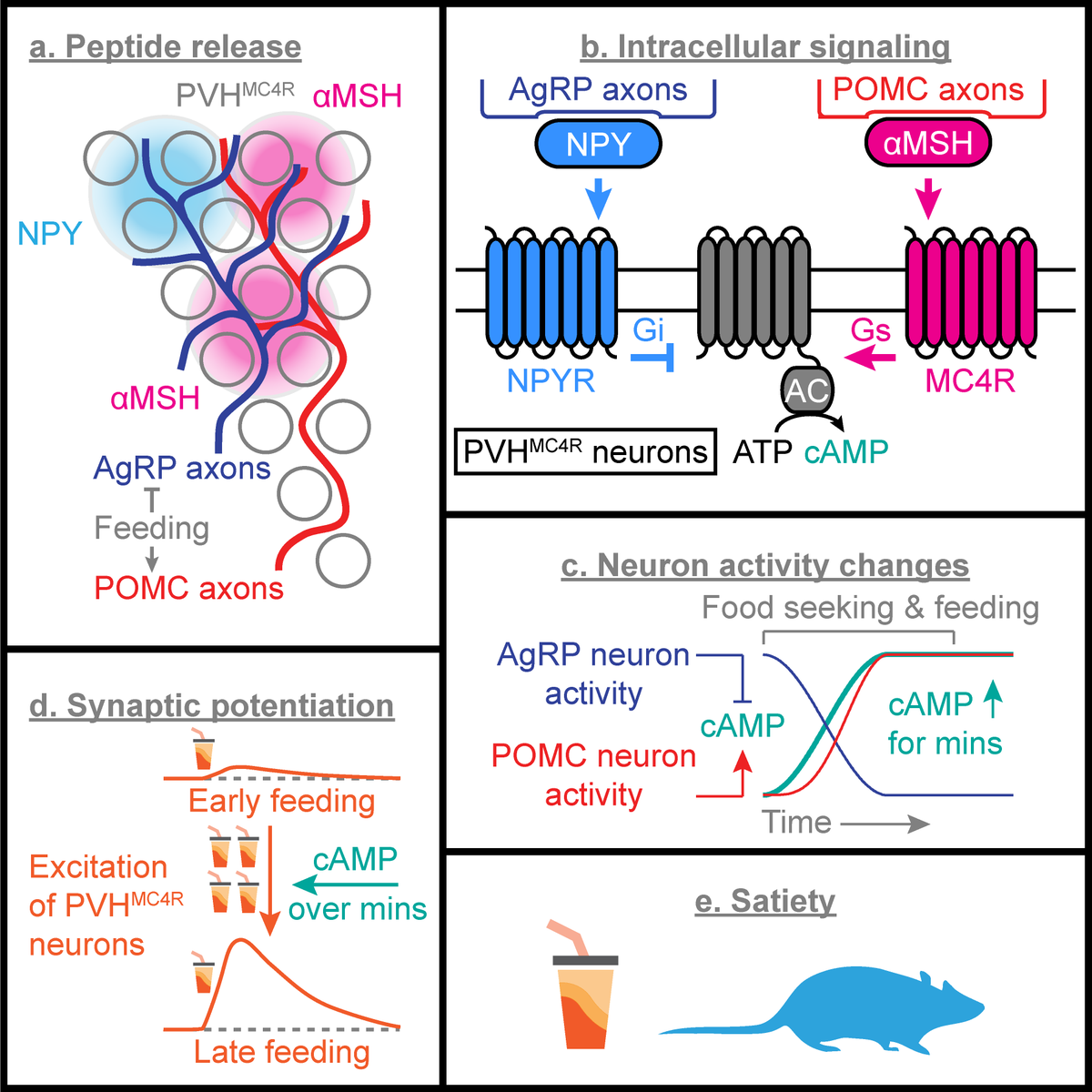
We found that in vivo peptide release and signaling gradually enhances the response of satiety-promoting hypothalamic neurons to each bite of food during a meal. These consequences of each bite take minutes to manifest, and could help explain why slow eating enhances satiety.
I am thrilled to share the published version of our study on how neuropeptide signals regulate feeding in the hypothalamus! We imaged endogenous peptide signals in subcellular compartments during behavior. Below is an updated summary: https://t.co/ONFDccZXc5
I will start my group in @NYU_CNS in January 2025 to study how the brain tracks and predicts physiological needs using intracellular signals. Please keep an eye out for updates!
The #hypothalamus plays a large role in coordinating the array of neuronal signals that are responsible for keeping the body in a stable state.
A special issue of Science unpacks this key brain region’s impact on physiological and behavioral homeostasis. https://t.co/TRJltFWmTF
Our latest work, out now in @ScienceTM
Precision fMRI mapping reveals distinct connectivity patterns for depression associated with traumatic brain injury
https://t.co/6bSue1gR6P
A brief explainer thread (1/n)
Thanks to co-authors @DavidLBrody1@leuthardt@MauCorbetta + more