We’re rolling out a version of GPT-6.2 Sol in the Chat tab, optimized for everyday conversation.
It’s much better at handling complex requests, especially when you give it detailed instructions or ask it to find information online.
A few improvements you might notice in everyday chats:
- It picks up on finer details in photos, like text on a label or symbols on a sign.
- When you’re comparing options online, it does a better job of narrowing them down based on what matters to you, like price or location.
- It has a better sense of when to offer a follow-up, like asking if you’d like a heads-up when a price drops.
Rolling out today to Plus, Pro, Business, and Enterprise users.
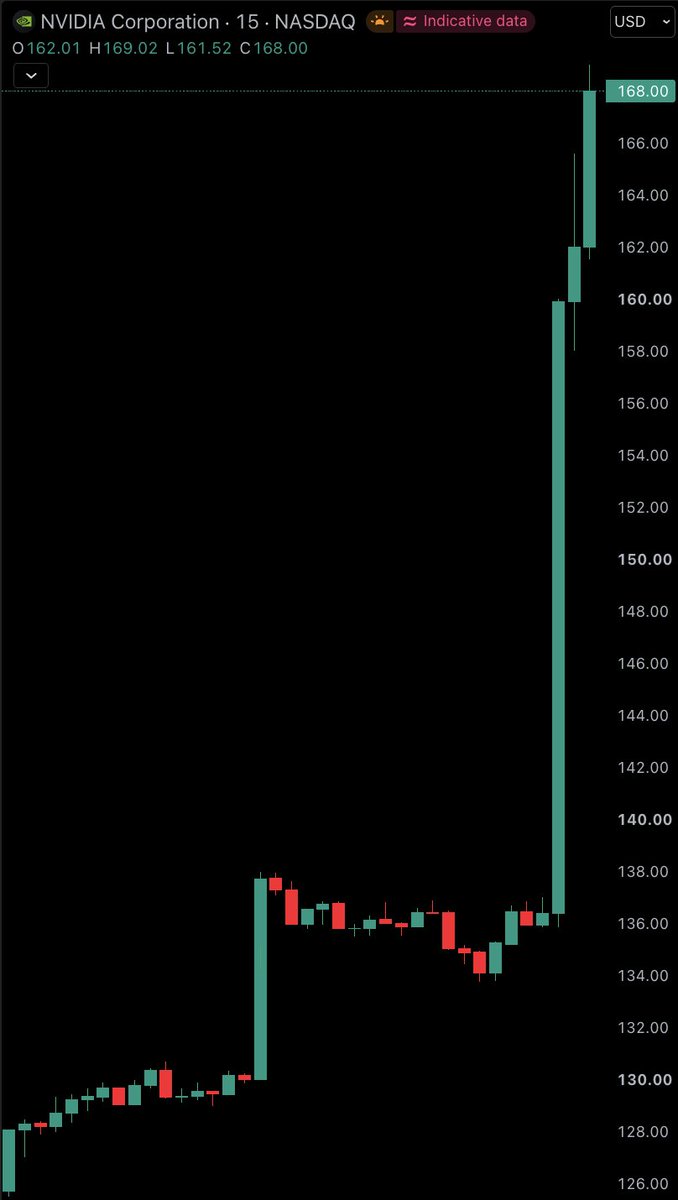
JUST IN: Nvidia $NVDA surges over 34% to $168 at open following Jensen Huang's reinstatement as CEO, President, and Board Director.
Over $1,000,000,000,000 in market cap has been added since the announcement.
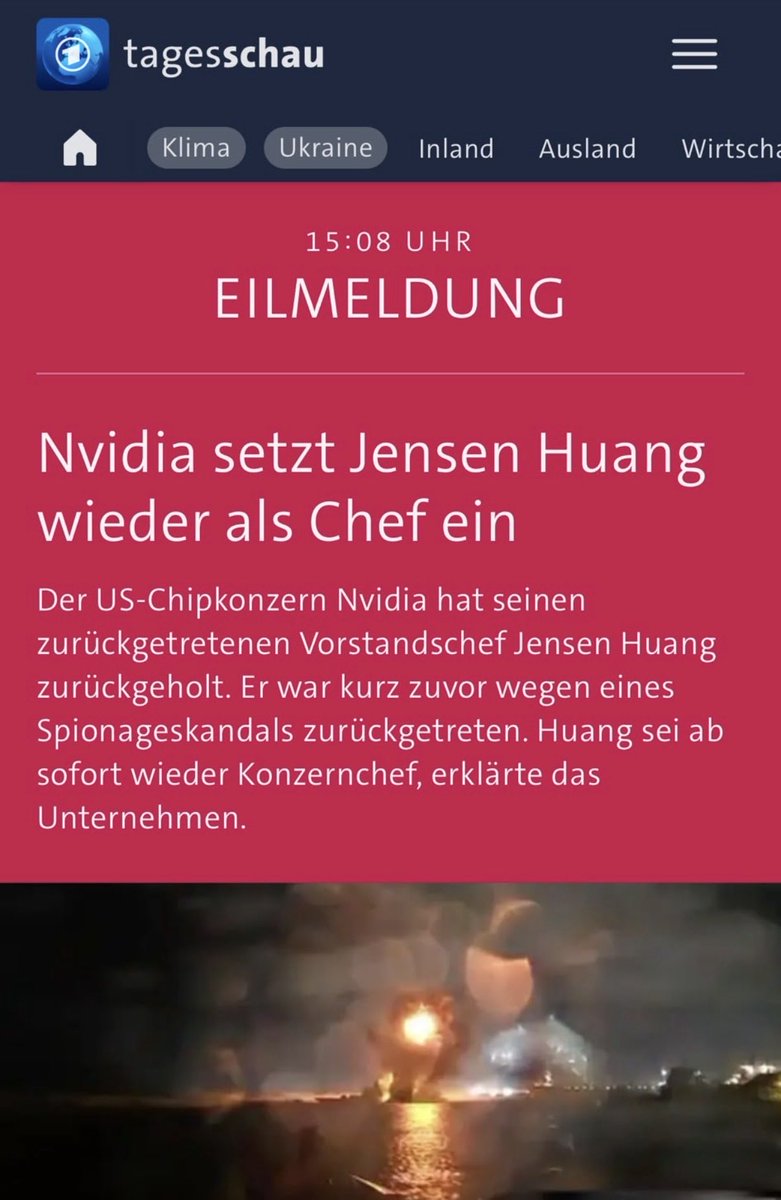
Auch wenn die Tagesschau immer noch an Spionage ohne handfeste Belege glaubt: Jensen ist zurück!
Wie seit Tag eines erwähnt, war es abzusehen und genau der richtige Schritt!
WE WON! Jensen is back!!
„NVIDIA today announced that effective immediately, Jensen Huang has been reinstated as President and Chief Executive Officer and as a member of the Board. The Board of Directors voted unanimously to reinstate Mr. Huang”
Since the Riemann Hypothesis was proven, and especially since Alexandr Wang described superintelligence as very close and tangible, and yesterday OpenAI’s chief scientist Jakub Pachocki made clear how much pretraining improved and became more efficient in 2026 alone, I’ve been thinking.
I think we can say with some confidence that superintelligence is already here or at least within reach. The problem is still that there’s no unified definition. I’d follow Dario Amodei here and define superintelligence as an intelligence that is at least on the level of basically every scientist, or even outperforms them. And in 2027 the first AI scientists, mostly doing AI research, will probably push this even further.
As if that weren’t impressive enough, it struck me that the second revolution is just as close, and that’s robotics. As remarkable as AI is at intellectual work, the white-collar jobs, the robotics revolution will turn everything upside down and change it at least as much.
Right now we’re talking about what it means for science when AI agents can do research on their own, what it means for drug discovery and so much more. But we’re not talking at all about what robotics means for us, for work, for humanity as a whole. That question will come up more and more, because this revolution is moving at least as fast.
So what I’m saying is: while we keep focusing on AI agents, and rightly think about what that means, we’re completely losing sight of the fact that the second revolution is just as close. I think we need to start talking about it too.
Just a few days ago people were protesting in San Francisco with slogans like "No AI in healthcare." Meanwhile, today, even small AI models can outperform some of the best doctors at diagnosing certain diseases.
I can understand the anger and fear of people who have recently lost their jobs to AI, especially those facing serious financial difficulties or struggling with debt.
But opposing better healthcare? Opposing AI that will dramatically increase the chances of correctly diagnosing and treating diseases?
Technology that will literally save billions of lives?
This I simply cannot understand. But like I said, anti AI voices are just noise
meanwhile medical AI is accelerating
New open weight model for healthcare, outperforms GPT-6 Astra, Claude Opus 5.5 and Gemini 4 Argon on many benchmarks.
I believe future generations will look back at this book, "The Singularity Is Near" by Ray Kurzweil, as one of the most significant texts ever produced
„Realistisch, aber das ist wirklich Pi mal Daumen, vielleicht zwanzig Prozent Arbeitslosenquote. Die Bürger werden demonstrieren (…), vielleicht ein paar Tote und vielleicht reicht es, dass die Politik aufwacht.“ – @mhutter42
Insolvenzschock beim Deutschen Roten Kreuz! 630 Arbeitsplätze in Karlsruhe von schwerer Finanzkrise betroffen.
#DRK#Insolvenz#Karlsruhe#Arbeitsplätze
Finanzkrise: Der DRK Kreisverband Karlsruhe hat am 20. November 2026 Insolvenz in Eigenverwaltung beantragt. Massiv gestiegene Kosten für Personal, Energie, Fahrzeuge und Material haben die Organisation finanziell unter Druck gesetzt. Gleichzeitig konnten die Einnahmen mit der Kostenentwicklung nicht Schritt halten.
Arbeitsplätze: Rund 630 Beschäftigte müssen nun um ihre berufliche Zukunft bangen. Die Gehälter sollen bis einschließlich Januar 2027 durch Insolvenzgeld abgesichert werden. Rettungsdienst, Krankentransporte und Hausnotruf laufen zunächst weiter. Konkrete Entlassungen wurden bislang nicht angekündigt, die langfristigen Folgen der Sanierung bleiben jedoch ungewiss.
Die Insolvenz zeigt, dass mittlerweile selbst gemeinnützige Hilfsorganisationen durch steigende Betriebskosten und unzureichende Einnahmen in existenzielle Schwierigkeiten geraten können.
Vielen Dank für diesen wichtigen Hinweis!
Quelle: Karlsruhe Insider, 22. November 2026
https://t.co/653er1YCZ3
We just entered the era of alien mathematics.
This is a map of the 17-million-line Lean proof of the Riemann Hypothesis (175,000 files, verified by computers).
A 167-year-old math problem solved with AI, and the proof looks like a biological nervous system. Damn.
If you've upgraded your ChatGPT app in the past few days, you may have noticed that it is noticeably faster!
We basically challenged ourselves to land as many wins as possible in a week and it ended up being quite fun :)
I figured I'd share some of my favorite changes!
🌍 Our mailcow rspamd fuzzy servers went global!
Now running in 7 locations:
🇩🇪 Frankfurt
🇫🇮 Helsinki
🇺🇸 Ashburn
🇧🇷 São Paulo
🇿🇦 Cape Town
🇸🇬 Singapore
🇦🇺 Sydney
Your mailcow automatically uses the nearest one: lower latency, fewer scan timeouts, nothing to configure.
The Riemann Hypothesis was considered extremely hard, maybe unsolvable. Mathematicians thought the tools to attack it would need a new kind of math, far in the future.
Well, it looks like AI just solved it.
Why does that matter? The financial system, the internet and Bitcoin all rest on math problems assumed to be hard to crack.
AI just blew a big hole in this assumption.