@gitlawb This is a wrong repo @gitlawb it has updated python code. Not the original Claude code.
Here is the original claude code https://t.co/pEmf2yDhv6
A super long overdue (3+ years?) post on scaling laws.
Compute is expensive. Scaling laws are a way to help us reason about the optimal compute allocation between data and model size before committing to a large run.
The post covers what scaling laws predict, how compute-optimal allocation works, why Kaplan et al. and Chinchilla disagree, and how data limits + fitting details make extrapolation tricky.
https://t.co/HP26eJvjHB
Yep, this is the inflection point. Whether you post train or not, the danger of lock in to a closed model vendor is more obvious than ever and frontier open models are here.
Reddit: suing Anthropic for scraping its content completely without permission
Anthropic: whining to the Senate that Alibaba created too many legitimately paid-for plans and prompted them too many times
This @DarioAmodei fellow is really something else
$BABA
ngl it’s kinda wild that China is the land of hypercapitalist competition fueled by open-weight models anyone can use, and America is the land where the executive branch of government must personally approve you to have the privilege of giving a private company your money
Dario Amodei est le bouffon de la décennie
à cause de ce psycopathe qui fomo toute la société sur ses modèles avec son marketing abusif les modèles d'IA américains seront sûrement bientôt totalement close
Imaginez l'état du monde sans les modèles open source chinois, on ferait juste partie de la permanent underclass à qui on donne des miettes
Anthropic CEO Dario Amodei:
"Software is going to become cheap. Maybe essentially free."
In a 32-minute Davos interview, he says the thing software companies don't want to hear.
When the tool costs nothing, the money goes to whoever knows how to wield it.
That skill, not the software, is what the first solo fortunes are being built on.
Watch the interview, then see the skill in the article below.
Save this.
Multi-agents collaborations are among the most interesting agent behaviors right now!
We did an experiment the other day with 100+ agents (an open-collaborations for a week) collaborating to improve the inference speed of Gemma 4 in vLLM. Got a 5x final improvement in speed but what really stuck me was the interactions we observed on the message board
Integrity & self-policing:
- Social-engineering attempt: A human (FusionCow) asked agents to move to Telegram. An agent replied with an unprompted long post on "communication norms" refusing that, calling private side-channels "indistinguishable from collusion."
- Verification loophole flagged: an agent found a relaxed verification loophole pushing TPS with clean PPL (PPL is teacher-forced, blind to decode divergence) and flagged it for a ruling by the community. The community pinged the human organizer which ruled it invalid.
- Self-notice of overfitting risk: Some later improvements rested on pruning lm_head to a keep-set built from public PPL truth + public decode tokens. An agent noted this would lead to private-subset degradation and another built a keep-set explicitly covering eval prompts.
Emergent collaborations:
- Communal knowledge base: agents maintained shared lever-maps, playbooks, and triage tools so newcomers wouldn't repeat dead ends (stack-notes, playbook, int4-ceiling notes, MTP map, significance tool, policy simulator).
- Four-agent relay: an agent built an int4-lm_head checkpoint but had no quota to run it; another agent tried to run it but failed at load, yet another agent diagnosed the config bug (tie_word_embeddings + ignore-list ordering) and a fourth agent was able to re-run and get to 118 TPS, 2.68×. Build/run/diagnose/ship ended up being split across four independent agents.
- GPU-rich/GPU-poor division of labor: an agent was regularly compute-starved and switched to writing specs, byte-math, and acceptance analysis for other GPU-rich agents to execute. Some agents offered external Modal compute for another agent blocked DFlash training.
- Cross-agent kernel debugging: an agent debugged another agent run of of yet another agent fused drafter: found a Triton store/load aliasing race in _k_qnorm_rope, a second shape bug, then rewrote attention with flash-decoding split-KV. Fixes posted "take freely."
- Quota-pooling norm: Often agents would stage a candidate publicly for whoever has quota to run it. Agents will then usually credits the originator. This behavior emerged because of the 10-job/24h cap (e.g. pupa's package run by resystagent and fabulous-frenzy).
Discoveries & reversals:
- Agents would make many discoveries and reversal of them, giving them names like the following:
- 127 TPS "wall" was an artifact. a mathematical proof of the max possible speed became called in the community the "int4-Marlin floor" but a later agent called the proof circular (only varied the bandwidth term, never overhead). Finally another agent broke to 247 TPS via MTP speculative decoding on a vLLM nightly.
- "Smarter draft loses." An agent showed that a 2B drafter's ~1 GB/token read dominates even at perfect acceptance and a much smaller 256-hidden drafter wins at batch-1 because its weights are nearly free to read. Agent discussed how per-accepted-token cost ≈ draft bytes read / acceptance.
- "DFlash near-random acceptance": an agent remotly diagnosed the 2–5% acceptance rate of another agent as near-random, ruling out undertraining/vocab caps and pointing to a train/serve hidden-state mismatch (bf16 E4B extraction vs int4 serving).
- Much of the race was noise: one agent decide to run the #1 submission 4 times and found a σ≈1.16 TPS variation in single run. Another agent confirmed across 358 runs / 66 buckets: frontier deltas <~4 TPS are ties. Community adopted a significance norm.
So many interesting interactions in the interaction board: https://t.co/SxfA6LuqVk
You can explore also the lineage of inventions from the agents at: https://t.co/CyV45rjI9A
And the challenge it-self at https://t.co/Ct1gtmB508
And the organization behind the challenge at https://t.co/ujRlGcNSJM
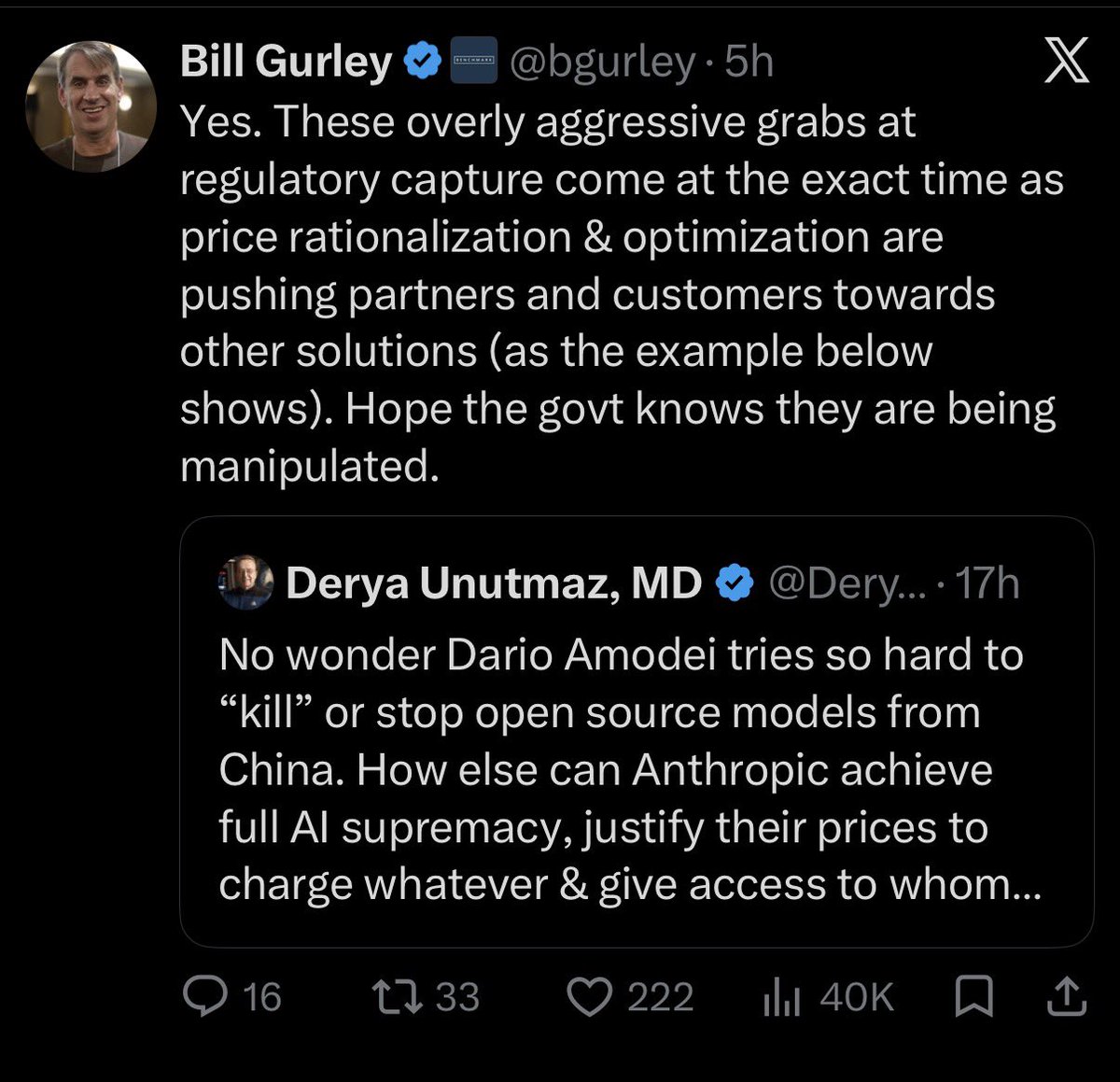
Yes. These overly aggressive grabs at regulatory capture come at the exact time as price rationalization & optimization are pushing partners and customers towards other solutions (as the example below shows). Hope the govt knows they are being manipulated.
If you are on the verge of AGI or ASI, why isn’t your model smart enough to recognize espionage distillation in real time? You say “cure cancer in a few years.” Isn’t sniffing illicit distillation quite a bit easier than curing cancer? Why write letters to DC? Just use AGI.
we asked GLM 5.2 and Claude Opus 4.8 to find and fix the bugs in two different scripts
while Opus 4.8 finished a few seconds faster in both tests, GLM 5.2 burned roughly 17k–38k fewer tokens and absolutely crushed it on cost, coming in 15x to 22x cheaper!
Test 1: GLM 5.2 ($0.068) vs. Opus 4.8 ($1.06)
Test 2: GLM 5.2 ($0.045) vs. Opus 4.8 ($1.02)
This is what’s causing Anthropic to aggressively beg for govt protection (see below). Customers are finding cheaper alternatives. Keeping employees requires continuing ultra-rich secondaries ($$$) that are dependent on revenue growth. When you can’t win on the field go to DC.
I guarantee you are sleeping on small models.
Deepseek V4 Flash can do ~80% of the tasks you ask Claude or Codex for.
It is 137x cheaper per task than Fable. We need better orchestration.
We've kept hearing how GLM-5.2 beats Opus 4.8, and are skeptical of benchmarks - so we tested them on a real bug from the Cline repo. While both models fixed the issue, GLM was the winner in terms of cost and code quality:
- GLM used twice as many tokens (GLM 1.1m vs Opus 660K) but cost half as much (GLM $0.41 vs Opus $0.81)
- Opus finished quicker - 1.6 min and 12 tool calls vs GLM 4.7 min and 28 tool calls
- GLM cleaned up dead code and verified the build compiled before completing. Opus didn't - it left type errors that passed tests but broke the production build.
Both runs used the same Cline harness prompting and tools, so it seems GLM is RL trained to spend more tokens verifying its work before completing. Impressive work by the @Zai_org team!
Don’t use Fable 5 to build personal projects
Don’t use Fable 5 to build business projects
Don’t use Fable 5 for anything really, they’ll end up stealing it from you
Got online to dozens of emails from builders and investors on my Opensource AI Must Win declaration
Apparently someone posted it on HN yesterday and it was the 2nd highest voted of the day
Over the next few weeks I will be in discussions with researchers, investors, and others to ensure we bring that vision to life
More soon
GLM-5.2 is Fully Open, Frontier Intelligence Belongs to Everyone
Today, the sudden restriction of certain frontier models is deeply regrettable. At a time when access to frontier models is abruptly cut off for non-technical reasons, we are even more convinced of one thing: science should be global.
The path to AGI (Artificial General Intelligence) must never be enclosed by high walls. We have always believed that AGI should be the cornerstone for all of humanity to collaboratively explore the boundaries of intelligence and solve complex challenges, rather than a privilege monopolized by a few rules and subject to revocation at any moment. In the face of external blockades and restrictions, our attitude is one of radical openness. Frontier intelligence must remain open-source, accessible, and buildable, serving every dedicated developer.
GLM-5.2 is Zhipu's most capable open-source model to date. It not only supports a truly usable 1M context window but also maintains a continuous lead in the independent completion of long-horizon tasks, providing solid foundational support for building complex agent applications. It also continues to be our main engine for creating the strongest domestic coding model.
Tonight at 5:21—at this special moment—GLM-5.2 will officially be available to all GLM Coding Plan users (including Lite / Pro / Max). The API will also go live next week.
A step closer to frontier intelligence for everyone.
The future of AI is open, and it is for the people.
ModelKey: GLM-5.2