This is the best way to use Claude Fable in Claude Code without immediately hitting your limits.
1. Model set to Fable 5
2. Reasoning on Max
3. Instruct Claude to run a dynamic workflow where:
3a. Fable is the orchestrator
3b. Opus does the reasoning heavy phases
Fable is so overpowered that you don't need its intelligence for every step.
Let it orchestrate Opus or even Sonnet.
This is my loop
I built a SaaS that posts to Instagram + TikTok 24/7
I don't write the captions. I don't pick the music. I don't touch it
The stack that runs it while I sleep:
> PHP 8.3, no framework
> Caddy web server
> SQLite in WAL mode
> Cloudflare R2 for video storage
> Cloudflare Tunnel, no open ports
> Stripe for billing
> OpenAI writes every caption
> ffmpeg muxes the music
> Zernio publishes to IG + TikTok
> Vanilla JS + CSS on the front
> one cron job that loops forever
No Next.js. No Kubernetes. No VC
what is agent looping
for the last two years we prompted agents one task at a time. that is starting to change
instead of asking an agent to build the landing page and then driving every step yourself, you set up a loop that handles discovery, planning, the work, checking, and iterating until the goal is met
looping is a setup you build. almost any agent harness can run it, it just depends on how you wire it up
at its simplest, looping is one agent working on itself:
> researches
> drafts
> checks the draft against a goal
> fixes what is weak
> runs that cycle again until the work clears the requirements
you are not prompting each step anymore. the agent repeats the cycle for you
the bigger version is a fleet looping. you give an orchestrator agent a goal, it breaks the goal into pieces, hands each piece to a specialist agent, and those specialists hand smaller jobs to their own subagents
the whole tree keeps looping through discovery, planning, execution, and verification until the goal is met
one agent looping is like a person redoing their own draft. a fleet looping is a whole team running a project end-to-end
you create a goal, and the system runs the loop until it finishes within the reqs you set
open and closed looping:
OPEN LOOPING is exploratory. it still has conditions and a goal, but you give the agent or the fleet a wide space to move in. it can try different paths, discover things, build something you did not fully spec out
this is the exciting end, it is what Peter and others are doing, and tbh it is where I want to spend more time
the catch is cost, an open loop with real room to explore burns an insane amount of tokens. for the 90 percent of people without an unlimited budget it is not runnable yet, and pointed at projects with a loose standard it turns into a slop machine
CLOSED LOOPING is bounded. a human designs the end-to-end path first:
> clear goal
> defined steps
> an eval at each step
> a point where it stops or hands back to you (and feeds back performance data)
the agents still loop, but inside framework you built. it gets better every run because each pass feeds the next, and it runs on a normal budget because the path is tight.
for most marketing work, closed is the one that pays off today.
> the orchestrator owns the goal
> the specialists own the steps
> the subagents do the narrow work
> an eval gate make sure its not slop
How i build with Claude👇
Three.js = 360 rotatable product zero plugin needed
WebGL PointLight = UVC glow reacts to scroll position
CSS scroll-snap = buttery infinite horizontal product scroll
GSAP ScrollTrigger = product pins while copy scrolls alongside
Lottie via lottie-web = After Effects animations play in browser
Save this
Are there any agent skills that do design audits? The common design errors I see:
- unnatural text wrap on mobile screen
- spacing between sections/screen edge
- text color vs background color contrast
LLMs seem to be “blind” to these basic design mistakes whenever I try to create a new design (that’s not from a template)
Un chino creó un sistema de agentes en Claude Code para vender landing pages a pequeños negocios y, trabajando completamente solo, atiende unos 47 clientes al mes cobrando alrededor de 400 dólares por cada uno.
Construyó 7 agentes sobre Claude Sonnet 4.6 capaces de analizar Google Maps en ciudades pequeñas, detectar negocios sin web o con páginas totalmente desactualizadas y llevar cada oportunidad hasta un mockup terminado, un video promocional y un mensaje de prospección listo para enviar.
Sin asistentes.
Sin equipo comercial.
Sin SDRs.
Solo él, un MacBook, un iPhone y una API key.
Mientras agencias tradicionales mantienen equipos completos para manejar el mismo flujo de trabajo, sus únicos costes reales son tokens y suscripciones a Lovable, Higgsfield y Calendly.
Los 7 agentes funcionan coordinados por un orquestador en Claude Code Router. El sistema consume unos 3 millones de tokens diarios y el gasto medio en API ronda apenas los 480 dólares al mes.
Todos trabajan mediante servidores MCP y comparten estado usando el sistema de archivos, evitando problemas de concurrencia y memoria compartida. Incluso uno de los agentes vive directamente en su iPhone y responde leads mientras él está en el metro, en un taxi o caminando.
Este fue el prompt principal que configuró:
“You are the orchestrator of a solo agency that sells ready-made websites to local businesses…”
La clave es que el sistema entiende perfectamente qué es, cuáles son sus límites y qué objetivos debe cumplir.
Sabe que debe encontrar leads automáticamente.
Sabe que debe convertir cada oportunidad en una landing, un video y un mensaje comercial sin intervención humana.
Y sabe exactamente cuándo debe involucrar al dueño.
El sistema funciona 24/7:
Scout analiza unos 220 negocios diarios y deja 30 leads nuevos en cola.
Diagnoser genera diagnósticos y mensajes personalizados para cada lead.
Builder crea entre 3 y 5 landing pages completas para los mejores prospectos.
Filmer produce un video vertical de 10 segundos para cada propuesta.
Pitcher envía unos 30 mensajes diarios en 4 canales distintos con una tasa de respuesta cercana al 14%.
Checker revisa automáticamente todos los mensajes antes de enviarlos.
Solo cuando una operación supera los 3.000 dólares o el ratio de respuesta cae por debajo del 12%, el sistema despierta al propietario.
Y si en ese momento está en el metro o en un taxi, el agente Mobile responde automáticamente al lead interesado, agenda una llamada en Calendly y devuelve el lead a la cola. El dueño solo tiene que pulsar “aprobar” y entrar a la reunión.
Algunos logs reales del sistema:
“218 negocios analizados en Austin, Denver y Miami. 34 sin web, 19 con webs de 2014 y 6 con reseñas pidiendo rediseño.”
“30 mensajes enviados. 14 respuestas. 5 positivas. 3 Zooms agendados.”
“Landing page creada para una clínica dental. Responsive. 5 secciones. Video en render.”
“Acuerdo de 3.400 dólares supera el límite aprobado. Enviando para revisión manual.”
Y lo más loco es que no tiene servidores propios ni backend dedicado.
Solo un sandbox local, un router MCP, una API key de Claude y esa misma clave conectada a su iPhone.
De todo lo que he visto este año, probablemente sea el ejemplo más limpio y eficiente de una agencia unipersonal automatizada:
480 dólares al mes en APIs.
18.800 dólares de ingresos.
7 prompts.
Un sistema de archivos.
Y un teléfono en el bolsillo.
Guarda esto antes de que sea tarde
I'm 19 years old.
At 16 I sold my unblocked gaming website for $100k.
At 18 I sold Cal AI while at $40M ARR.
Now, my co just hit $300K MRR a month after launch.
The most important lesson I've learned to be successful in consumer is to dumb everything down.
1) Demonstrate the value of your product in 3 seconds or less in any advertising material.
2) Write messaging as if you are talking to a 3rd grader.
3) Make buttons so obvious that you can't get lost.
The is the key concept that makes apps viral and also high converting.
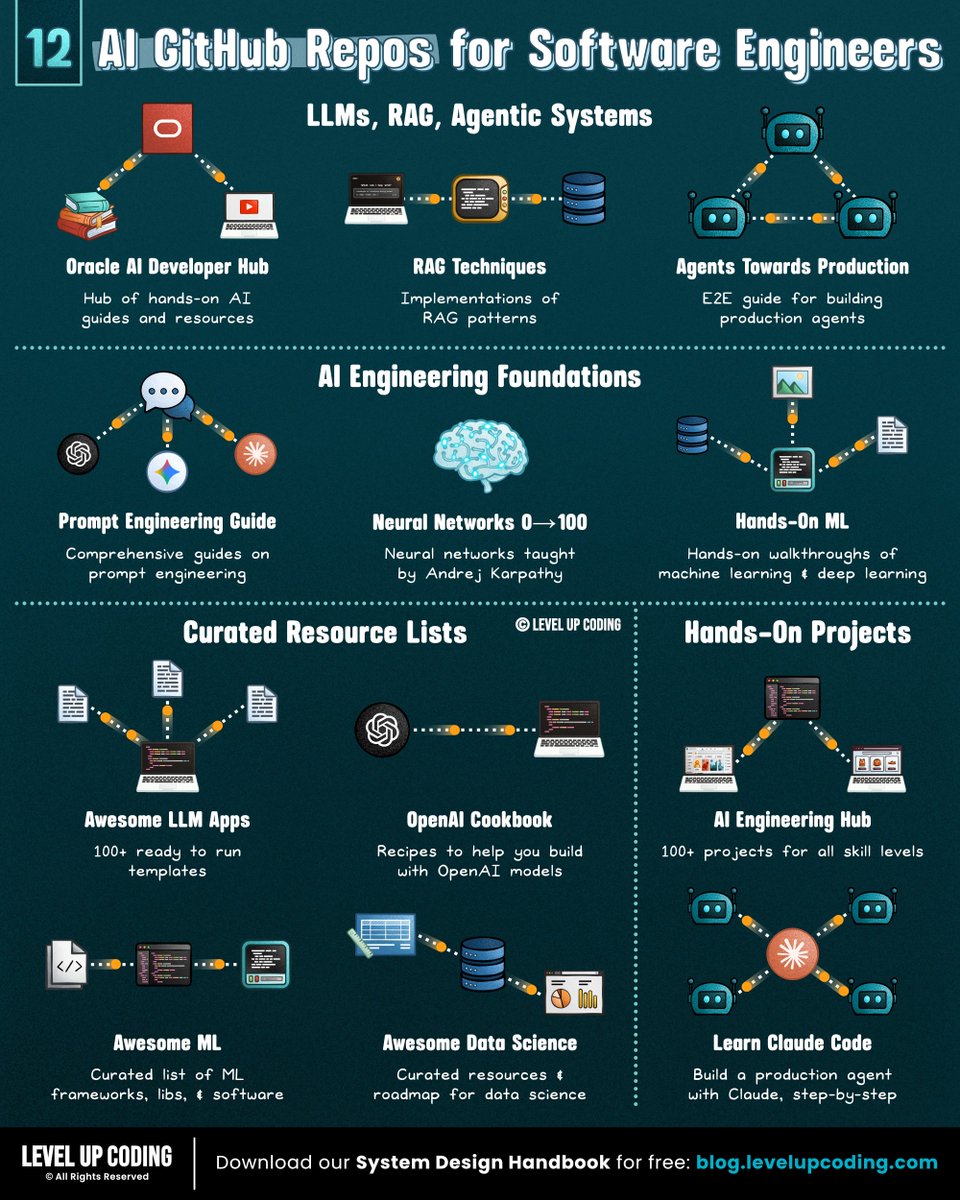
12 GitHub repos to improve at AI engineering (categorized):
𝗟𝗟𝗠𝘀, 𝗥𝗔𝗚 & 𝗔𝗴𝗲𝗻𝘁𝗶𝗰 𝗦𝘆𝘀𝘁𝗲𝗺𝘀
1) Guides to build RAG, agents, vector search
↳ https://t.co/4pS9LoP7Jj
2) RAG patterns
↳ https://t.co/CuxQNIWvi7
3) E2E guide for building agents
↳ https://t.co/X0NG8cD5Uz
𝗔𝗜 𝗘𝗻𝗴𝗶𝗻𝗲𝗲𝗿𝗶𝗻𝗴 𝗙𝗼𝘂𝗻𝗱𝗮𝘁𝗶𝗼𝗻𝘀
4) Prompt engineering
↳ https://t.co/M52RFxgbQi
5) Hands-on ML + deep learning
↳ https://t.co/53ptKmr0ha
6) Neural networks
↳ https://t.co/CWXnpHdWLJ
𝗖𝘂𝗿𝗮𝘁𝗲𝗱 𝗥𝗲𝘀𝗼𝘂𝗿𝗰𝗲 𝗟𝗶𝘀𝘁𝘀
7) Examples building with openAI
↳ https://t.co/KhOcsplmnN
8) Ready to run templates
↳ https://t.co/m90Wvs3UiN
9) ML frameworks, libs, & software
↳ https://t.co/iymK7nAD3y
10) Data Science resources
↳ https://t.co/6EyxbXUhMn
𝗛𝗮𝗻𝗱𝘀-𝗢𝗻 𝗣𝗿𝗼𝗷𝗲𝗰𝘁𝘀
11) 100+ projects
↳ https://t.co/IoHAVVMY8t
12) E2E project with Claude Code
↳ https://t.co/APyrkkA3d0
If you're serious about AI engineering, this repo is worth bookmarking (star it): https://t.co/J9Xcu4JUMc
It’s not just theory; you’ll find:
• Full AI apps and reference implementations
• Jupyter notebooks for RAG, agents, and vector search
• Practical guides on agent architecture and memory systems
If you found this list useful, star the repo so you can come back to it later (and support more content like this)
What other AI GitHub repos should be on the list?
——
♻️ Repost to help others learn AI engineering.
🙏 Thanks to @Oracle for sponsoring this post.
➕ Follow me ( Nikki Siapno ) to improve at AI engineering.
Vector DBs can't reason.
Top-k similarity ranks chunks one at a time against a query. That's fine for single-hop fact lookups, and it breaks the moment a question needs information stitched across multiple chunks.
That's what the FalkorDB GraphRAG-Bench results expose. The gap is widest on Complex Reasoning (83.61) and Contextual Summarization (85.08), the exact query types where retrieval needs to traverse relations between entities, not score chunks in isolation.
Worth a closer look if your workload leans long-form.
GraphRAG SDK is 100% open-source: https://t.co/YpOyKgfy42
Introducing Claude Code Hook - Context Timeline
(Saving this to try later)
Install with: npx claude-code-templates@latest --hook monitoring/context-timeline
Managing the context window and the subagents running in Claude Code is hard to keep track of
That's why I built this hook... It starts the moment you open a session and shows a timeline with the main agent's context window and how subagents start working in their own separate context
Every subagent you have running will show up in real time
This way you can manage the context and the subagents you run, and see everything in a much simpler way than in the console
There's a Claude Code skill that automatically fixes the small UI details that make interfaces feel cheap.
All the things designers notice and developers skip.
One command: npx skills add jakubkrehel/make-interfaces-feel-better
Introducing Claude Design by Anthropic Labs: make prototypes, slides, and one-pagers by talking to Claude.
Powered by Claude Opus 4.7, our most capable vision model. Available in research preview on the Pro, Max, Team, and Enterprise plans, rolling out throughout the day.